
Strategic Teamcenter Integration for Digitalization 2026
Is your industrial data thread a strategic asset or a tangled web of custom-coded “spaghetti” integrations? In 2026, many UAE enterprises realize that Teamcenter integration development is no longer just a technical task. It’s a fundamental architectural alignment that determines whether your AI initiatives will succeed or stall. You’ve likely experienced the frustration of data silos between engineering and production, where manual entry errors and high maintenance costs drain your resources.
We understand the complexity of navigating Siemens SOA and T4x frameworks. It’s a challenge to balance immediate connectivity needs with a long-term vision for a unified digital thread. This guide helps you master these intricacies to build a robust, scalable system. You’ll learn how to transition from brittle, custom code to a future-proof architecture that supports the latest AI BOM agents and automated workflows. We’ll explore the transition from CAD to ERP, ensuring your data flows seamlessly across the entire product lifecycle.
Key Takeaways
- Understand why a formal Digital Maturity Assessment is critical for aligning your integration strategy with a long-term 2026 digitalization roadmap.
- Master the technical frameworks of Siemens SOA and T4x to ensure your Teamcenter integration development remains scalable, manageable, and ready for AI implementation.
- Bridge the gap between engineering and production by synchronizing PLM with ERP and MES systems to create a reliable, real-time digital thread.
- Adopt a configuration-first mindset to minimize custom code, reducing technical debt and long-term maintenance costs for your industrial data architecture.
- Identify the benefits of collaborating with independent PLM consultants in the UAE to navigate the complexities of end-to-end system implementation and architecture.
Assessing Digital Maturity Before Teamcenter Integration Development
Many industrial organizations view Teamcenter integration development as a purely technical exercise. This narrow perspective often leads to brittle systems that fail to scale or adapt to changing market demands. Successful digitalization requires a deep understanding of Product Lifecycle Management (PLM) maturity before a single line of code is written. Without a clear strategic vision, integrations often become expensive bridges to nowhere. They might move data, but they don’t drive business value or operational efficiency.
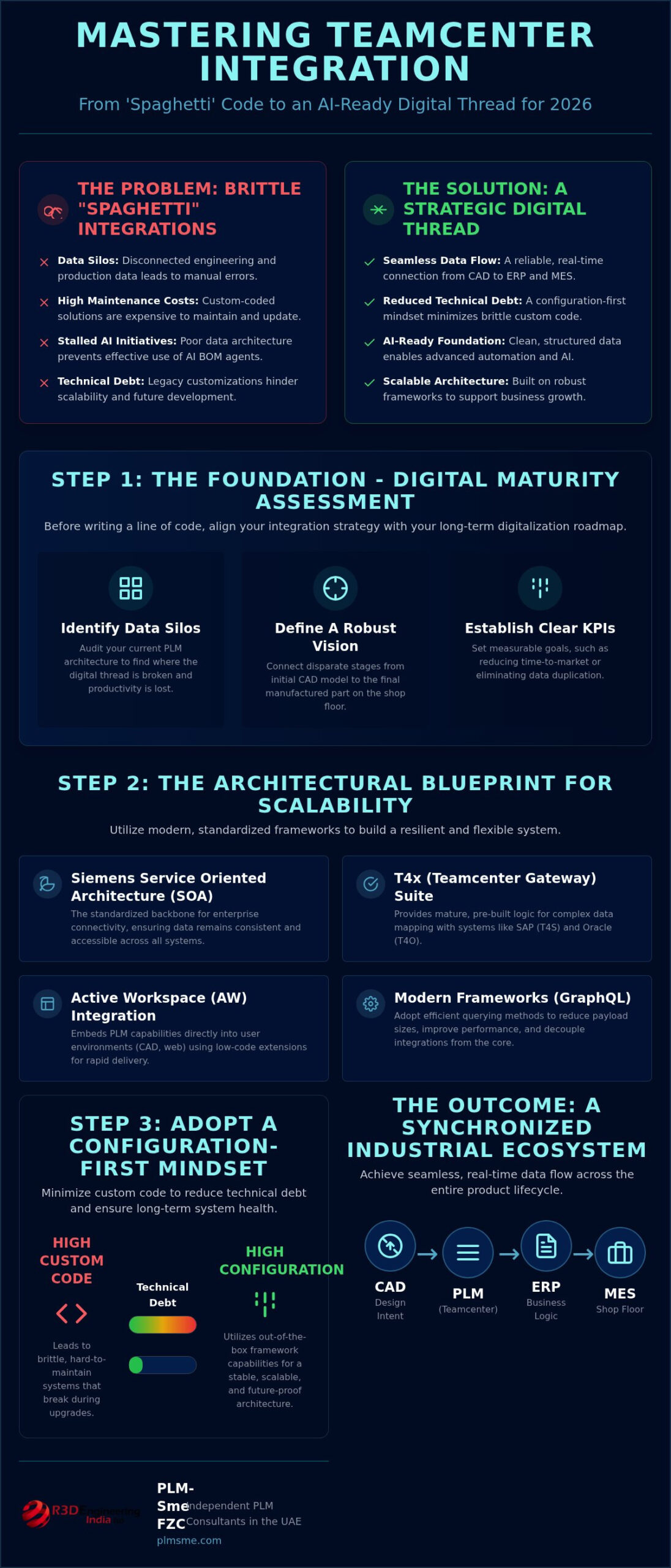
Identifying data silos is the critical first step in any meaningful Digital Maturity Assessment. These silos typically exist between engineering intent and downstream execution, creating friction in the production cycle. By defining a robust digital thread, you connect these disparate stages. This ensures that the design intent is maintained from the initial CAD model through to the final manufactured part on the shop floor. An independent consultant provides an objective audit of your current PLM architecture. They act as a thinking partner to identify where the digital thread is broken and where manual workarounds are draining your productivity.
Establishing the Digitalization Vision
Setting specific KPIs is essential for measuring the success of your integration efforts. These might include reducing time-to-market or significantly eliminating data duplication across departments. Your vision must align with the broader 2026 industrial AI roadmap. Modern tools, like the AI BOM agent found in Teamcenter 2606, require clean, structured data to function effectively. If your integration isn’t built on a foundation of high-quality data architecture, your AI initiatives will likely stall. For a deeper look at this process, see The Strategic Value of a Digital Maturity Report in Manufacturing.
Mapping the Current System Landscape
You can’t build a future-ready system on a foundation of unmanaged technical debt. Mapping the current landscape involves documenting legacy data flows between CAD, PDM, and ERP systems. It’s vital to evaluate the health of existing Teamcenter customizations to determine if they’re assets or liabilities. Often, custom-coded “spaghetti” integrations from years ago hinder new Teamcenter integration development. Identifying these bottlenecks early allows for a more streamlined, configuration-based approach. This reduces long-term maintenance costs and ensures your architecture can scale as your business grows.
Architecting Scalable Teamcenter Integration Frameworks
Scaling an industrial ecosystem requires more than just connecting two points. It demands a structured approach to Teamcenter integration development that prioritizes flexibility over rigid, custom code. Siemens Service Oriented Architecture (SOA) serves as the backbone for this connectivity, providing a standardized layer that ensures data remains consistent across the enterprise. In 2026, the T4x (Teamcenter Gateway) suite has evolved to offer even deeper maturity. Whether you’re utilizing T4EA for general enterprise applications, T4S for SAP, or T4O for Oracle, these frameworks provide the pre-built logic necessary to handle complex data mapping and synchronization.
Modern users expect data to be available where they work. Active Workspace (AW) integration facilitates this by embedding PLM capabilities directly into CAD environments or web browsers. By using low-code extensions, teams can now accelerate the delivery of these integrations. This approach allows for rapid customization without bloating the core system, making future maintenance far more manageable. Expert Teamcenter integration development utilizes these tools to maintain a clean core while delivering bespoke functionality.
The Role of System and Solution Architecture
Designing for high availability and low latency is a prerequisite for any global manufacturing operation. A well-architected system decouples integrations from the core PLM logic. This decoupling is essential; it ensures that when you upgrade your Teamcenter environment, your integrations don’t break. This strategic foresight is a cornerstone of The Role of PLM in System Architecture Consulting, where the focus is on building resilience into every connection point.
Framework Selection: SOA vs. GraphQL vs. Microservices
While the standard Teamcenter SOA remains the industry workhorse, 2026 marks a significant shift toward GraphQL for data querying. GraphQL allows developers to request only the specific data they need, which reduces payload sizes and improves performance. This efficiency is vital for maintaining an unbroken Digital Thread for Smart Manufacturing. Choosing between these frameworks depends on your specific use case. Our specialists can help you evaluate your framework through system architecture consulting to ensure long-term stability.
Synchronizing the Industrial Ecosystem: ERP, MES, and MOM
Connecting Teamcenter to the wider enterprise ecosystem is where strategic architecture meets operational reality. Effective Teamcenter integration development ensures that engineering data doesn’t just sit in a vault but actively informs manufacturing and supply chain decisions. By establishing interactive connections, organizations gain real-time visibility into product status, reducing the risk of costly production errors. This synchronization is the foundation of a resilient industrial data thread that supports both current operations and future AI-driven optimizations.
Teamcenter and ERP Synchronization
The bridge between PLM and ERP is often the most critical connection in the industrial landscape. A primary focus here is managing the transition from the Engineering Bill of Materials (eBOM) to the Manufacturing Bill of Materials (mBOM). This process ensures that part numbers, attributes, and release statuses remain synchronized across both systems. Automating Engineering Change Orders (ECO) from PLM to ERP eliminates manual data entry, which is a frequent source of errors. Beyond the shop floor, integrating customer feedback and requirements is equally vital. For a broader perspective on enterprise-wide connectivity, explore our guide on Unlocking Teamcenter CRM Integration Benefits.
Closing the Loop with MES and MOM
True digitalization requires closing the loop between design and the shop floor. Connecting Teamcenter to Manufacturing Execution Systems (MES) and Manufacturing Operations Management (MOM) allows for the direct delivery of work instructions and 3D visuals to the production line. This ensures that operators always work with the latest revisions, significantly reducing scrap and rework. In 2026, these connections are increasingly bidirectional, allowing for a more dynamic exchange of information.
This integration also enables the capture of “as-built” data, which is then fed back into the “as-designed” record within Teamcenter. This feedback loop is essential for maintaining a high-fidelity digital twin. When MOM systems are integrated, they support advanced capabilities like predictive maintenance and industrial automation. By analyzing real-time performance data against the original engineering specifications, companies can anticipate failures before they occur. This level of synchronization transforms Teamcenter integration development from a simple data exchange into a powerful engine for continuous improvement and operational excellence.
Development Best Practices for Future-Proof Integrations
Building a robust bridge between systems is only half the battle. Strategic Teamcenter integration development requires a rigorous focus on data quality as a development prerequisite. If the data entering the integration layer is inconsistent or poorly structured, the system merely propagates errors at scale. Successful projects implement validation and cleansing routines before data ever leaves the source. This ensures that downstream systems, such as ERP or MES, receive accurate information that they can process without manual intervention.
Robust error handling and logging are equally vital for cross-system transactions. In a complex industrial ecosystem, a single failed synchronization can disrupt entire production schedules. Developers must build integrations that provide clear, actionable logs and automated alerts. This transparency allows system administrators to identify and resolve issues before they escalate into operational downtime. Preparing your data architecture now for 2026 AI and machine learning applications is the final piece of a future-proof strategy.
Reducing Technical Debt in PLM Development
Hard-coding business logic directly into integration scripts is a common pitfall that creates significant technical debt. This practice makes the system rigid and difficult to maintain, often leading to “spaghetti” code that breaks during the next software update. We advocate for a “Configuration over Customization” mindset. By using standard Siemens integration tools and frameworks, you ensure your development remains supported by the vendor and easier to upgrade. To maintain this balance over time, many organizations utilize a PLM System Administration Retainer. This proactive approach includes regular health checks and architectural reviews to prevent technical debt from accumulating.
AI Readiness and Industrial Automation
Clean integration development is the primary enabler of a high-fidelity Digital Twin. For AI models to provide meaningful insights, they require structured, high-quality data from across the product lifecycle. If your PLM data isn’t correctly mapped and synchronized, your industrial AI initiatives will lack the necessary context to be effective. Structuring this data for ingestion by machine learning models allows for advanced predictive capabilities and more autonomous decision-making on the shop floor. These efforts align with the broader shift toward Industrial Automation Solutions in the GCC, where regional standards demand precision and scalability.
To ensure your architecture is ready for the next wave of digitalization, you can secure your roadmap with our expert Teamcenter Integration Development services.
Partnering for Success: Expert Implementation and Architecture
UAE manufacturers face unique challenges when scaling digital operations. While software vendors often focus on license volume, independent PLM consultants prioritize architectural integrity and long-term business alignment. Choosing an independent partner ensures an objective perspective on your technology stack, positioning your organization to make decisions based on technical merit rather than vendor bias. As a Siemens Digital Industries Alliance Partner, PLM-Sme FZC provides the technical depth of the Siemens ecosystem while maintaining the agility of a boutique specialist. This balance is crucial for complex Teamcenter integration development where one-size-fits-all solutions often fail to account for specific industrial nuances.
The PLM-Sme FZC approach begins with a comprehensive Digital Maturity Assessment. We don’t just execute code; we engage as thinking partners to align your integration project with a broader digitalization vision. This end-to-end implementation support covers everything from initial system architecture to ongoing managed support through our retainer services. By focusing on a structured roadmap, we help you avoid technical debt and ensure your system remains scalable as new AI capabilities emerge in 2026. Long-term success depends on this continuous oversight, ensuring your industrial data thread remains robust and reliable.
Tailored Solutions for Discrete Industry
UAE manufacturing standards require a high degree of precision and localized expertise. PLM-Sme FZC specializes in customizing Teamcenter environments for discrete industries, ensuring that your system architecture reflects the specific workflows of your production floor. Our role is to bridge the gap between global software capabilities and local operational requirements. Designing a robust system involves more than just connectivity; it requires a deep understanding of how data moves through the national industrial landscape. For more on this, see Building a Strategic Industrial Digitalisation Roadmap for UAE Manufacturing.
Next Steps: From Roadmap to Reality
Transforming your PLM environment from a static vault into a dynamic digital engine starts with a clear understanding of your current state. Initiating a Digital Maturity Assessment allows PLM-Sme FZC to audit your existing architecture and identify the data silos hindering your progress. This assessment forms the foundation of your integration project, providing a clear path from conceptual roadmap to concrete reality. We provide the expertise to navigate these complexities, ensuring your transition to a fully digitalized environment is seamless and cost-effective.
We invite you to contact our team for a detailed roadmap consultation. Whether you’re looking to synchronize ERP systems or prepare for AI-driven automation, our experts provide the strategic guidance needed for success. It’s time to move beyond fragmented systems and build a unified industrial data thread. Partner with PLM-Sme FZC for your Teamcenter Integration Development to secure your digital future in 2026.
Securing Your Industrial Digital Thread
Mastering the complexities of 2026’s industrial landscape requires moving beyond fragmented data silos. Successful digitalization depends on a foundation of high-quality data and a configuration-first approach to system architecture. By synchronizing PLM with ERP and shop-floor systems, you create a resilient environment that’s ready for the next wave of AI-driven automation. Strategic Teamcenter integration development is the catalyst that transforms static design data into a dynamic engine for operational excellence.
As a Siemens Digital Industries Alliance Partner, we bring specialized national UAE expertise to discrete industry digitalization. We act as a thinking partner, ensuring your technical framework supports both current needs and future scalability. Don’t let technical debt or legacy “spaghetti” code hinder your progress. It’s time to build a seamless, AI-ready thread that connects every stage of your product lifecycle. Our boutique consultancy is here to guide you through every step of this transformation.
Ready to align your systems with a future-proof roadmap? Consult with our Teamcenter integration experts today to start your Digital Maturity Assessment.
Frequently Asked Questions
What is the most effective framework for Teamcenter integration development?
The Siemens Service Oriented Architecture (SOA) remains the most robust framework for Teamcenter integration development. It provides a standardized layer for secure data exchange across enterprise systems. In 2026, we see a significant shift toward GraphQL for high-efficiency data querying. This approach allows developers to request specific data packets, reducing network load and improving system response times. Utilizing these standard frameworks ensures your architecture remains supported during future Siemens software updates.
How does Teamcenter ERP integration improve manufacturing efficiency?
Teamcenter ERP integration improves efficiency by automating the synchronization between the Engineering Bill of Materials (eBOM) and the Manufacturing Bill of Materials (mBOM). This automation eliminates manual data entry errors that often lead to scrap and rework on the production floor. Real-time visibility into part availability and release statuses allows procurement and production teams to plan more accurately. It creates a unified source of truth that shortens change management cycles across the organization.
What is the difference between T4S, T4O, and T4EA in Siemens Teamcenter?
These tools are part of the Teamcenter Gateway (T4x) suite, each designed for specific enterprise connections. T4S is the specialized gateway for SAP integration, while T4O is tailored for Oracle E-Business Suite. T4EA (Enterprise Applications) provides a flexible, generic framework for connecting Teamcenter to other systems like Microsoft Dynamics or proprietary databases. Selecting the correct gateway depends on your existing IT landscape and the depth of data mapping required for your 2026 digitalization goals.
Can Teamcenter be integrated with non-Siemens MES or CRM systems?
Yes, Teamcenter integrates effectively with non-Siemens MES or CRM systems using the T4EA framework or custom web services. Modern industrial ecosystems often rely on a mix of vendors, so maintaining a neutral integration layer is essential. By leveraging the Siemens SOA, developers can build interactive connections to platforms like Salesforce or specialized shop-floor execution systems. This flexibility ensures your digital thread remains unbroken, regardless of the specific software providers in your production environment.
How much does a typical Teamcenter integration project cost for a manufacturer?
Integration project costs vary significantly based on the complexity of the data mapping and the number of connected systems. Industry data from 2026 suggests that small to medium-sized implementations can range from $10,000 to $50,000. Larger enterprise projects involving multiple global sites often exceed $100,000. These figures typically cover development and deployment but don’t include ongoing maintenance or licensing. We recommend a detailed maturity audit to establish a precise budget tailored to your specific architectural needs.
Why is a Digital Maturity Assessment necessary before starting integration development?
A Digital Maturity Assessment is necessary because it identifies existing data silos and technical debt that could derail your project. It’s risky to build complex integrations on a foundation of unmanaged or poor-quality data. This assessment ensures that your Teamcenter integration development aligns with a broader strategic vision and a 2026 AI roadmap. By auditing your current PLM architecture first, you avoid expensive rework and ensure your systems are ready for end-to-end implementation.
How do we ensure our Teamcenter integrations are ready for industrial AI?
Ensuring AI readiness requires a rigorous focus on data quality and structured architectural mapping. Clean, validated data is the primary fuel for industrial AI models and the creation of high-fidelity Digital Twins. Your integration framework must support bidirectional data flows that capture “as-built” information from the shop floor. By adopting a configuration-first mindset and avoiding hard-coded logic, you create a scalable environment where machine learning agents can easily ingest and analyze product lifecycle data.
What are the benefits of using an independent PLM consultant for integration development?
Independent PLM consultants provide objective, vendor-neutral advice that prioritizes your long-term business vision over software sales. They act as a “thinking partner,” offering boutique expertise tailored to the specific industrial standards of the UAE. Unlike large vendors, an independent specialist provides agile, end-to-end implementation support and dedicated system administration. This collaborative approach ensures your architecture is designed for your unique discrete manufacturing challenges, leading to more sustainable and cost-effective digital transformation outcomes.