
Specialized Siemens PLM Support Services in the UAE
The right Siemens PLM support partner is defined by its fit with your engineering and delivery needs, not simply by a partner label. A specialized Siemens PLM support partner in the UAE can help with consultancy, training, hands-on problem-solving and deployment for Siemens Xcelerator solutions. Siemens has 1,700 partners worldwide, so the practical task is to identify the expertise that matches your industry, products and implementation scope.
It is important to distinguish software selection from the work required to make a PLM environment effective. Buying decisions, implementation planning and ongoing support each involve different requirements, from solution architecture and data processes to integration with enterprise systems. A partner’s specialization and delivery capabilities help determine which support your organization needs.
This article explains how to assess partner expertise for CAD, CAM, CAE, PDM and PLM in the UAE, and what to consider when planning implementation and ongoing support. It also explains how Siemens partner roles differ and how a structured assessment and roadmap can connect PLM decisions with your wider digitalisation objectives.
Key Takeaways
- Separate software purchasing from implementation and ongoing support to define the scope your Siemens PLM project needs.
- Match partner expertise to your industry, technology domain and deployment requirements, rather than relying on a general partner label.
- Consider how CAD, CAM, CAE, PDM and PLM processes connect when shaping an engineering systems strategy.
- Use a maturity assessment and roadmap to clarify priorities before moving into end-to-end PLM implementation.
Buying, implementing, and supporting Siemens solutions
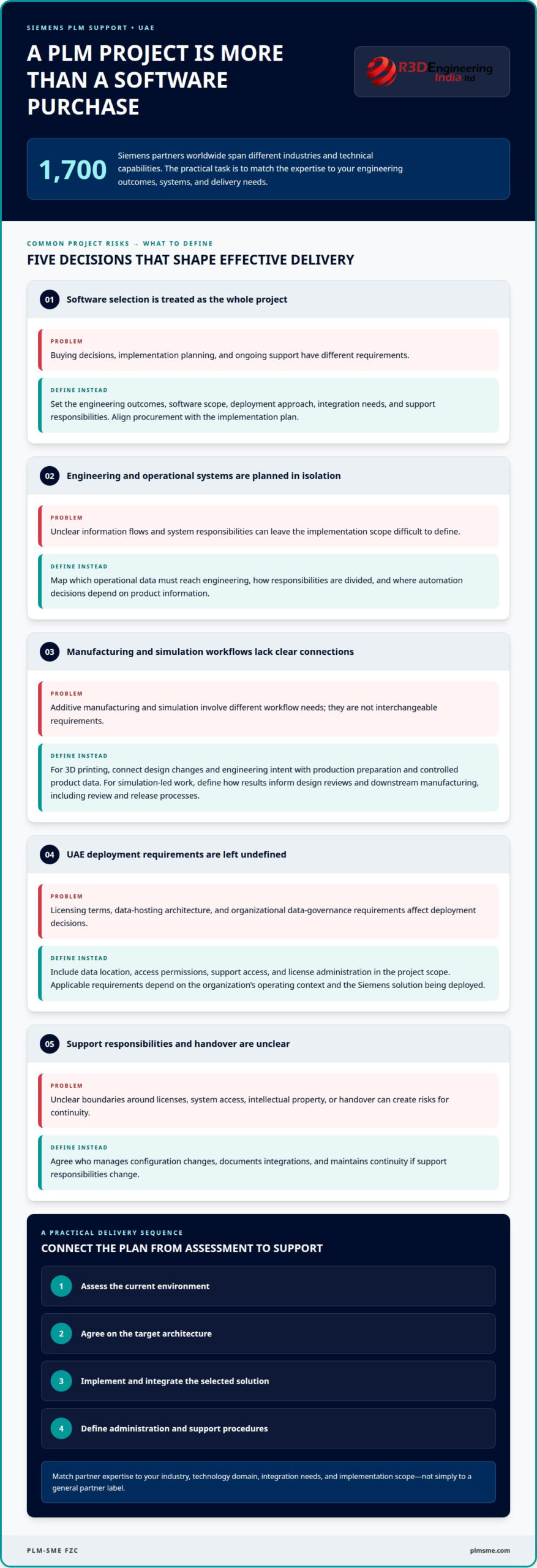
Siemens has 1,700 partners worldwide, spanning different industries and technical capabilities. A Siemens partner can provide consultancy, training, hands-on problem-solving, and deployment for Siemens Xcelerator solutions. Treat buying, implementation, and ongoing support as connected but distinct workstreams. First define the engineering outcomes, required software scope, deployment approach, integration needs, and support responsibilities. Then align procurement decisions with the implementation plan, rather than treating software selection as the entire project.
Siemens electrification and automation solutions may sit alongside engineering and manufacturing systems in a broader digitalisation programme. Define the connection points: which operational data must reach engineering, how system responsibilities are divided, and where automation decisions depend on product information. For example, a manufacturer planning an automation initiative can map relevant information flows before selecting the architecture. This clarifies the implementation scope and supports practical innovation.
Manufacturing solutions and 3D printing introduce their own workflow considerations, including how design changes, production preparation, and controlled product data relate. Engineering simulation adds another decision layer: teams need to define how simulation results inform design reviews and downstream manufacturing. These are not interchangeable requirements. A project involving additive manufacturing, for example, needs a clear connection between engineering intent and production data, while simulation-led work needs defined review and release processes.
For UAE projects, licensing terms, the data-hosting architecture and organizational data-governance requirements shape deployment decisions. Define data location, access permissions, support access and responsibility for license administration in the project scope. Applicable requirements depend on the organization’s operating context and the Siemens solution being deployed.
Independent support can create risks if responsibilities for licenses, system access, intellectual property or handover are unclear. Define these boundaries in the engagement, including who manages configuration changes, documents integrations and maintains continuity if support responsibilities change.
A specialized Siemens PLM support partner in the UAE should connect these decisions to practical delivery. Set the sequence: assess the current environment, agree on the target architecture, implement and integrate the selected solution, then define administration and support procedures. This gives procurement, engineering, IT and manufacturing teams shared milestones without assuming one Siemens product or partner capability covers every need.
Finding a Siemens partner by industry, product, domain, location, or technology
Start by defining the work your UAE team needs, then match it to partner expertise. Siemens Expert Partners specialize in particular solutions or industries, earning this status through examinations, skills validation and successful business outcomes. Siemens Service partners provide value-added services for digital transformation, cloud migration and solution implementation. These categories distinguish technical specialization from implementation and transformation support.
Siemens Digital Industries Software partner services can include consultancy, training, hands-on problem-solving and deployment for Siemens Xcelerator solutions. For PLM support, define the system scope, engineering processes, integrations and post-implementation responsibilities. Then match each requirement to relevant industry and technology expertise. For example, a manufacturer connecting product data with ERP or MES needs appropriate integration and architecture experience, not just broad digital transformation language.
There is no single typical Siemens PLM support or maintenance cost in the UAE. The price depends on the scope, system complexity, integration work, support responsibilities, and engagement model, and is provided after a quote request.
When planning digital transformation, AI or industrial IoT, identify the operational outcome first. A strategic assessment can connect data, automation and engineering priorities without treating AI as a standalone purchase. Siemens infrastructure and industry solutions also require a clear view of how operational technology, information flows and enterprise systems interact. Industry-specific engineering needs should shape the solution architecture and implementation plan.
Which Siemens Digital Industries Software partners specialize in UAE PLM support? Siemens Expert Partners focus on specific solutions or industries; Service partners deliver implementation and transformation services. These categories clarify relevant capabilities, but they do not identify a particular UAE firm. A partner category alone also does not establish that a company is an authorized reseller. Reseller authorization and support services are distinct roles.
Engagement works best when the company defines its business outcomes, existing systems, integration requirements, and support scope. A structured digital maturity assessment can help translate those needs into priorities for architecture, implementation, and industrial digitalisation.
For PLM, look for an Expert Partner with relevant solution or industry expertise, and a Service partner when you need implementation or transformation support.
A partner category alone does not establish a UAE company’s official reseller authorization or support-provider status; these are distinct roles.
Specialized partner expertise and services
Specialist capability matters because PLM/PDM, CAD/CAM and consulting address different parts of an engineering environment. PLM governs product information and lifecycle processes; PDM focuses on managing product data. CAD supports design, while CAM connects engineering models with manufacturing activity. Choose services that fit the actual workflow, such as managing design revisions through approval and release.
Engineering services and project support turn software scope into practical delivery. Typical work can include solution architecture, configuration, integration planning, migration, testing and implementation coordination. For example, a project connecting engineering data with ERP needs clear ownership of data mapping, interface decisions and change control. Support should also define system administration and future configuration changes.
Siemens Expert Partners specialize in particular solutions or industries, earning Expert status through examinations, skills validation and successful business outcomes. Siemens Service partners provide value-added services for digital transformation, cloud migration and solution implementation. These distinctions describe partner roles, but do not establish that one category covers every PLM, CAD/CAM or project-support requirement.
Compare UAE partners by considering the relevance of their Siemens expertise, project experience, industry fit and customer feedback together. An examination-based designation indicates validated skills; comparable project examples show how those skills apply to a specific engineering environment. Customer reviews add context about delivery, but should be considered alongside the project scope and services described. No single credential or review captures a provider’s full delivery capability.
For a practical comparison, map the project’s required work to evidence in four areas:
- Technical scope: PLM/PDM processes, CAD/CAM workflows, integrations, and system architecture.
- Industry fit: Engineering methods and manufacturing context relevant to the project.
- Project delivery: Responsibilities across planning, implementation, testing, and handover.
- Ongoing support: Administration, issue resolution, and ownership of system changes.
This structured approach distinguishes global product specialization from hands-on project support and clarifies which expertise aligns with the required outcome.
CAD, CAM, CAE, PDM and PLM software
These disciplines create connected engineering workflows, but solve different information problems. CAD captures design intent; CAM supports manufacturing preparation; CAE supports engineering analysis. PDM organizes product data, while PLM connects product information and processes across lifecycle stages. A UAE implementation should define how these environments exchange released models, revisions, approvals and downstream production information.
Siemens product coverage may include Teamcenter, NX and Opcenter, depending on the partner’s service scope and project requirements. A product name alone does not show whether support covers configuration, integration, implementation or ongoing administration. Map each required task to the relevant system and workflow before assigning project responsibilities.
For example, a design change created in an engineering environment may need a controlled review before manufacturing teams use the updated information. The architecture should identify where the approved revision is stored, which system distributes it and how related records remain traceable. If engineering data must connect with ERP, CRM, MES or MOM, define each interface and who owns the exchanged data.
CAE workflows also need clear governance. Define how analysis inputs, results and design decisions relate to the managed product record. For CAM, establish how released design information reaches manufacturing preparation without confusing working files with approved data. These process decisions help shape integration requirements, permissions, migration scope and testing scenarios.
- CAD: Identify design outputs, revision controls, and downstream consumers.
- CAM: Define how manufacturing preparation uses approved engineering data.
- CAE: Establish how analysis evidence links to design decisions.
- PDM and PLM: Set ownership for product records, lifecycle states, and approvals.
A connected solution needs architecture and implementation decisions that reflect actual engineering processes, not just software labels. Plan your Teamcenter integration and PLM implementation around the data flows and responsibilities your engineering teams depend on.
PLM-Sme FZC: End‑to‑End PLM Implementation Support
PLM-Sme FZC supports organizations planning or improving Siemens Teamcenter environments through end-to-end PLM implementation. This is relevant when engineering data, business systems and lifecycle processes need a coordinated architecture and delivery plan.
For teams still defining priorities, digital maturity assessments and reports can clarify current capabilities and gaps. Digitalisation Vision & Roadmap Consulting helps translate those findings into transformation priorities. Where needs extend beyond PLM, industrial automation and AI solutions can connect digitalisation planning with operational objectives.
Implementation support can take a project from requirements and system architecture through deployment and integration. The right starting point depends on whether you need a defined implementation, a clearer roadmap or an assessment of digital maturity. Contact PLM-Sme FZC to discuss your Siemens PLM requirements.
Turn PLM priorities into a practical next step
Choosing a specialized Siemens PLM support partner in the UAE means deciding how engineering information will support your organization’s direction. Connect immediate implementation needs with longer-term priorities so architecture and delivery decisions serve a clear purpose.
PLM-Sme FZC can help establish that direction through digital maturity assessments and reports, followed by Digitalisation Vision & Roadmap Consulting. For organizations exploring operational improvement, industrial automation and AI solutions can also form part of their digitalisation priorities. These services frame the work around your current environment and intended outcomes, rather than treating technology choices as isolated decisions.
Bring your engineering and business priorities into the discussion, including the processes or system connections that need attention. That gives the conversation a concrete starting point for planning the next stage of PLM work. Contact PLM-Sme FZC to discuss your requirements and consider a clear path forward.
Frequently Asked Questions
What Siemens PLM implementation, migration, customization, and technical support services are available in the UAE?
UAE businesses can access end-to-end Siemens Teamcenter implementation, data migration and translation projects, custom integrations, and ongoing system administration and maintenance. Support can also connect PLM with ERP, CRM, MES and MOM systems. For example, a manufacturer moving from a legacy data environment can scope migration alongside integration development, then define the system’s administration needs after deployment.
What response times, service-level agreements, and support hours do UAE Siemens PLM providers offer?
Response times, service hours and service-level agreements depend on the support arrangement and its defined scope. For Teamcenter administration, specify incident priorities, response and resolution targets, escalation contacts, planned maintenance responsibilities and coverage hours. Distinguish urgent system interruptions from routine configuration requests so the agreement explains how each is handled and assigns clear responsibilities to the support team and your internal system owners.