
PLM System Health Check: Optimizing Performance and Scalability in 2026
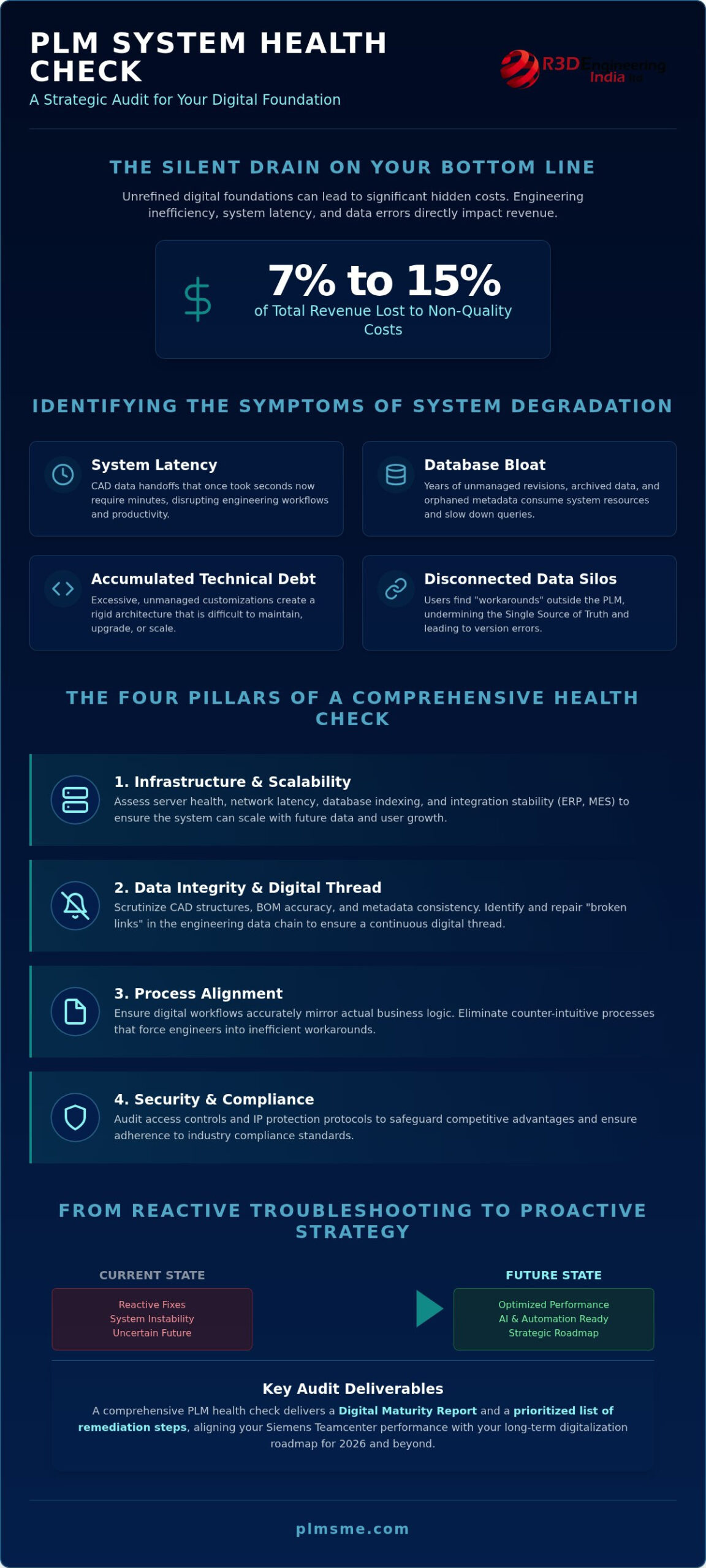
Manufacturing leaders often overlook a silent drain on their bottom line; research shows that businesses without a refined digital foundation can incur non-quality costs ranging from 7% to 15% of their total revenue. If your engineering teams are struggling with system latency or slow CAD data handoffs, your current infrastructure is likely reaching its breaking point. Conducting a comprehensive PLM system health check is no longer a routine maintenance task but a strategic necessity to identify the technical debt accumulated from years of unmanaged customizations.
You’ve likely invested significant resources into your digital ecosystem, yet the uncertainty of whether your architecture can support advanced automation or generative AI remains a persistent concern. This article outlines how a structured audit provides a clear report on system bottlenecks and a prioritized list of remediation steps. You’ll discover how to transition from reactive troubleshooting to a proactive strategy that aligns your Siemens Teamcenter performance with your long-term digitalization roadmap, ensuring your operations are scalable for the demands of 2026 and beyond.
Key Takeaways
- Recognize how database bloat and unmanaged customizations create a “slow creep” of latency that impacts engineering productivity.
- Identify how a comprehensive PLM system health check serves as the foundation for your Digital Maturity Report and long-term AI roadmap.
- Evaluate the advantages of independent, vendor-neutral expert audits in uncovering structural flaws that internal maintenance might miss.
- Implement a structured diagnostic methodology that moves beyond reactive troubleshooting to a state of optimized system performance.
- Leverage a managed administration retainer to ensure ongoing stability and prevent the re-accumulation of technical debt in your Siemens Teamcenter environment.
Identifying the Symptoms of PLM System Degradation
System degradation in a Product Lifecycle Management environment rarely manifests as a sudden, catastrophic failure. Instead, it presents as a “slow creep” of diminishing performance that gradually erodes engineering efficiency. You might notice that CAD data handoffs which once took seconds now require several minutes, or that simple metadata queries return results with visible latency. This database bloat is often the byproduct of years of unmanaged revisions and archived data that hasn’t been properly indexed or purged.
Accumulated technical debt represents one of the highest hidden costs for UAE manufacturers operating legacy systems. When a system is burdened by years of unmanaged customizations, it loses the agility required to respond to market shifts. Disconnected data silos eventually emerge as users find “workarounds” outside the PLM, directly undermining your Single Source of Truth. This fragmentation leads to version errors and rework, which can account for significant non-quality costs, often ranging between 7% and 15% of total revenue. A comprehensive PLM system health check is the only way to quantify these inefficiencies before they impact your scheduled time-to-market.
Analyzing the Root Causes of Performance Bottlenecks
Performance issues often stem from a fundamental misalignment between the software’s original intent and its current implementation. Over-reliance on excessive custom scripting rather than utilizing out-of-the-box (OOTB) functionality is a primary culprit. While custom code solves immediate functional gaps, it creates a rigid architecture that is difficult to maintain or upgrade. In many Siemens Teamcenter environments, we find that remnants of inefficient data migrations and orphaned metadata continue to consume system resources, despite serving no active business purpose. Furthermore, if your underlying infrastructure hasn’t evolved to meet modern hardware requirements, the software’s advanced features will remain throttled by legacy server constraints.
Connecting System Health to Digital Maturity
A stable and high-performing PLM system is the non-negotiable prerequisite for any industrial digitalization roadmap. You cannot successfully integrate advanced automation or generative AI if your foundational data layer is inconsistent or slow. AI-driven design tools require clean, structured, and rapidly accessible data to provide meaningful insights. By conducting a PLM system health check, you aren’t just fixing bugs; you’re performing a strategic audit of your digital foundation. This assessment serves as a critical component of a broader Digital Maturity Report, allowing leadership to determine if the current architecture can support the complex integrations required for the factory of the future.
Defining the Four Pillars of a Comprehensive PLM Health Check
A professional PLM system health check moves beyond surface-level troubleshooting to conduct a deep-tissue diagnostic of the four areas that sustain industrial operations. These pillars ensure your digital ecosystem remains a strategic asset rather than a technical liability. By evaluating Infrastructure, Data Integrity, Process Alignment, and Security, you establish a baseline for both current stability and future innovation.
Infrastructure audits focus on server health and network latency, which are critical for UAE manufacturers moving toward hybrid or cloud-native environments. Data integrity involves scrutinizing CAD structures and ensuring Bill of Materials (BOM) accuracy, as metadata consistency is the glue that holds these records together. Process alignment ensures digital workflows mirror actual business logic, preventing engineers from being forced into counter-intuitive paths. Finally, security and compliance reviews safeguard competitive advantages by auditing access controls and IP protection protocols.
Assessing Technical Infrastructure and Scalability
System performance often hinges on database indexing and volume server efficiency. During a diagnostic, we test the stability of integrations with ERP, MES, and MOM systems to ensure data flows without friction across the enterprise. Scalability is not just about current users; it involves determining the capacity for future data growth and user expansion. If your architecture is brittle, scaling will lead to systemic instability. Organizations seeking to quantify these findings often start with a digital maturity assessment to justify necessary architectural investments.
Auditing Data Quality and Digital Thread Continuity
A fractured digital thread often begins with “broken links” in the engineering data chain. We check for compliance with industry standards and internal naming conventions to ensure long-term data retrievability. This stage also includes verifying the health of Teamcenter CRM integrations. Ensuring that customer requirements and engineering specifications remain synchronized prevents the costly rework associated with misaligned data. Maintaining this continuity is essential for providing a reliable foundation for downstream manufacturing and service operations.
Evaluating Independent Expert Audits vs. Internal Maintenance
Internal IT teams are essential for maintaining daily uptime, yet they often suffer from a “blind spot” when evaluating long-term architectural health. Because internal staff are responsible for the current configurations, they may overlook the gradual accumulation of technical debt or view inefficient workarounds as standard operating procedures. An independent PLM system health check provides a necessary layer of objectivity, identifying structural flaws that those closest to the system might miss. This external perspective is vital for UAE manufacturers who need to ensure their digital foundation is robust enough to support national industrial goals.
Vendor-neutrality is another significant advantage of engaging specialized consultants. While software vendors may suggest additional licenses or modules to solve performance issues, an independent auditor focuses on optimizing your existing environment. This objective approach ensures that remediation steps prioritize high-impact fixes over expensive software acquisitions. By leveraging cross-industry benchmarking, consultants can compare your system’s performance against global best practices, providing a clear cost-benefit analysis. While an audit requires an upfront investment, the long-term savings in maintenance and the reduction of non-quality costs far outweigh the initial fee.
Leveraging Specialized Siemens Teamcenter Expertise
Generic IT audits frequently fail because they lack the depth to analyze complex PLM data models and CAD integrations. Specialized Siemens Teamcenter consulting is required to perform deep technical dives into the system’s core configuration. These experts advocate for an “OOTB first” philosophy, which emphasizes using out-of-the-box functionality to replace aging, custom-coded scripts. This shift simplifies the system architecture, making future upgrades more predictable and significantly reducing the risk of system instability during version transitions.
Reducing Risk Through Objective System Architecture Consulting
Strategic PLM system architecture consulting serves as a safeguard against future technical debt. By gaining an unbiased view of your system’s readiness for AI and advanced automation, you can avoid investing in technologies that your current infrastructure cannot support. A professional PLM system health check results in a structured roadmap for remediation, focusing on stabilizing the environment before layer-on new complexities. This methodical approach ensures that every architectural change aligns with your broader digitalization goals, providing a stable platform for continuous industrial innovation.
Executing the PLM Health Check: A Step-by-Step Methodology
Executing a professional PLM system health check requires a structured approach that balances technical telemetry with human experience. It isn’t enough to simply run a diagnostic script; you must understand how the system facilitates or hinders daily engineering tasks. Our methodology follows four distinct phases designed to uncover both obvious performance bottlenecks and hidden architectural weaknesses.
- Step 1: Stakeholder Interviews. We engage with users across engineering, procurement, and manufacturing to identify functional pain points that automated tools might miss.
- Step 2: Automated System Diagnostics. This phase involves a rigorous analysis of performance logs, database query speeds, and network latency to establish a technical baseline.
- Step 3: Deep-Dive Configuration Review. We scrutinize the underlying data models and workflows to identify where custom scripting has introduced unnecessary complexity or technical debt.
- Step 4: Reporting and Roadmap Development. The final deliverable is a comprehensive report that translates technical findings into a prioritized plan for system optimization.
Gathering Functional and Technical Requirements
Success depends on identifying the widening gaps between “as-designed” and “as-used” processes. When a system is slow or counter-intuitive, engineers naturally develop workarounds, often moving critical data into unmanaged spreadsheets or local drives. Documenting these frustrations is vital for understanding the true cost of system degradation. The discovery phase acts as the essential foundation of any successful audit, ensuring that technical findings are grounded in operational reality. By mapping these deviations, we can pinpoint exactly where the software’s configuration no longer serves the business logic.
Developing the Remediation and Optimization Roadmap
Once the data is collected, findings are categorized by severity into Critical, High, and Medium risk tiers. This allows leadership to visualize which issues require immediate intervention and which can be addressed in later phases. We perform a detailed effort versus impact analysis for each suggested correction, ensuring that your budget is allocated to the most transformative changes. Aligning these technical fixes with your broader industrial automation goals ensures that your PLM remains a capable engine for future growth. To begin your journey toward a more resilient architecture, consider booking a professional Digitalisation Vision & Roadmap Consulting session.
Driving Continuous Value with Managed PLM Administration
A PLM system health check acts as a catalyst for a fundamental shift in how digital assets are managed. While the audit identifies specific bottlenecks, transitioning from reactive firefighting to proactive management prevents these issues from re-emerging. By utilizing a PLM Administration Retainer, you ensure the technical debt uncovered during the audit is systematically cleared and prevented from re-accumulating. This oversight allows internal IT teams to focus on core manufacturing operations while external experts maintain the complex architecture of your environment.
Staying current with Siemens Teamcenter updates and security patches is critical for maintaining a resilient system. Many UAE manufacturers struggle with update cycles because the testing and deployment effort strains limited internal resources. Managed administration removes this burden, providing a structured path for incremental improvements. This ensures the system remains agile and capable of scaling as your data volume and user base grow.
Implementing the Post-Audit Maintenance Strategy
A successful strategy relies on establishing clear KPIs for system health and user adoption. Monitoring these metrics ensures that the remediations from the PLM system health check deliver measurable results. Ongoing support also stabilizes integrations with ERP and MES systems, preventing synchronization errors that could otherwise halt production. By leveraging specialized support, you reduce the total cost of ownership by avoiding emergency downtime and the efficiency losses of a degraded system.
Preparing for the Next Phase of Industrial Digitalization
A stabilized PLM environment serves as the launchpad for advanced AI and machine learning applications. These tools require a clean, high-performing data foundation to provide accurate predictive insights. Continuous roadmap refinement ensures your digital strategy remains aligned with evolving operational realities. As you move toward more sophisticated automation, your architecture must be ready to support increased complexity. Contact PLM-Sme FZC for a comprehensive system health check today to secure your digital foundation and prepare for the future of manufacturing.
Securing Your Digital Foundation for the Future of Manufacturing
Optimizing your digital ecosystem is a continuous journey rather than a one-time project. As UAE manufacturers prepare for the complexities of 2026, ensuring that your core architecture remains lean and responsive is vital. A professional PLM system health check serves as the definitive first step in this process, transforming technical debt into a prioritized roadmap for growth. By leveraging independent expertise, you gain an objective view of your system’s readiness for advanced automation and generative AI.
As a Siemens Digital Industries Alliance Partner, PLM-Sme FZC provides specialized Teamcenter architecture knowledge that internal IT teams may lack. Our expert Digital Maturity Assessment Reports offer the clarity needed to align your technical capabilities with high-level business goals. Transitioning from reactive maintenance to proactive administration secures your data integrity and ensures your infrastructure can scale alongside your ambitions. We invite you to Book Your Independent PLM System Health Check to stabilize your operations and unlock new levels of engineering efficiency. Building a resilient digital thread today ensures your competitive advantage tomorrow.
Frequently Asked Questions
What is a PLM system health check?
A PLM system health check is a comprehensive diagnostic audit of the technical and functional state of your software environment. It evaluates infrastructure, data integrity, and process alignment to identify hidden technical debt. For UAE manufacturers, it ensures the system remains a reliable single source of truth rather than an operational bottleneck. This assessment acts as the essential first step toward building a resilient and scalable industrial digitalization roadmap.
How often should a manufacturer perform a PLM audit?
Most industrial organizations should conduct a health check every 12 to 18 months or before initiating major system upgrades. If your business undergoes significant scaling or integrates new ERP and MES layers, an audit is essential to verify architectural stability. Regular reviews prevent the slow creep of database bloat and ensure that unmanaged customizations don’t compromise your long-term digital maturity goals or AI readiness.
Does a health check require system downtime?
Professional health checks are designed to be non-intrusive and typically don’t require production downtime. Analysts use automated diagnostic tools to gather performance logs and telemetry data in the background while your team continues their daily operations. While stakeholder interviews and configuration reviews require time from your subject matter experts, the actual system remains live. This allows for a realistic assessment of performance under standard load conditions.
What are the common signs that my Siemens Teamcenter system needs an audit?
Visible latency during CAD data handoffs and frequent database timeout errors are primary indicators of system degradation. You might also notice that users are creating workarounds in spreadsheets because the official workflows feel rigid or slow. If your technical debt from legacy customizations makes it difficult to apply standard Siemens patches, it’s time for a PLM system health check to stabilize the environment and restore efficiency.
How long does a professional PLM health check typically take?
The duration depends on the complexity of your environment, but a standard audit generally spans one to three weeks. This timeframe includes the initial discovery phase, automated diagnostics, and the deep-dive configuration review. Specialized consultants focus on delivering actionable insights quickly. This ensures that you receive a prioritized list of remediation steps without a prolonged engagement that distracts from your core manufacturing and engineering operations.
What is the difference between a technical audit and a digital maturity assessment?
A technical audit focuses on the current performance, stability, and integrity of the software and infrastructure. In contrast, a digital maturity assessment evaluates your organization’s overall capability to leverage technology for strategic goals. While a PLM system health check fixes existing bottlenecks, the maturity assessment provides a high-level vision and roadmap for future investments in AI and industrial automation across the entire enterprise.
Can a health check help reduce our PLM maintenance costs?
Identifying and removing inefficient custom code and orphaned metadata significantly reduces the total cost of ownership. By returning to out-of-the-box functionality where possible, you simplify future upgrades and lower the labor hours required for system administration. A healthy system also reduces non-quality costs associated with version errors and rework. These efficiencies can save a manufacturer between 7% and 15% of their total revenue.
What deliverables should I expect from a PLM system health check report?
You should receive a comprehensive report featuring a detailed analysis of system bottlenecks and a prioritized remediation roadmap. This document categorizes findings by risk level and estimates the effort required for each fix. Key deliverables include infrastructure performance scores, data integrity evaluations, and specific recommendations for architectural alignment. This report serves as a technical foundation for your broader digitalization strategy and future AI integration plans.