
PLM Integration Best Practices: Building a Resilient Digital Thread in 2026
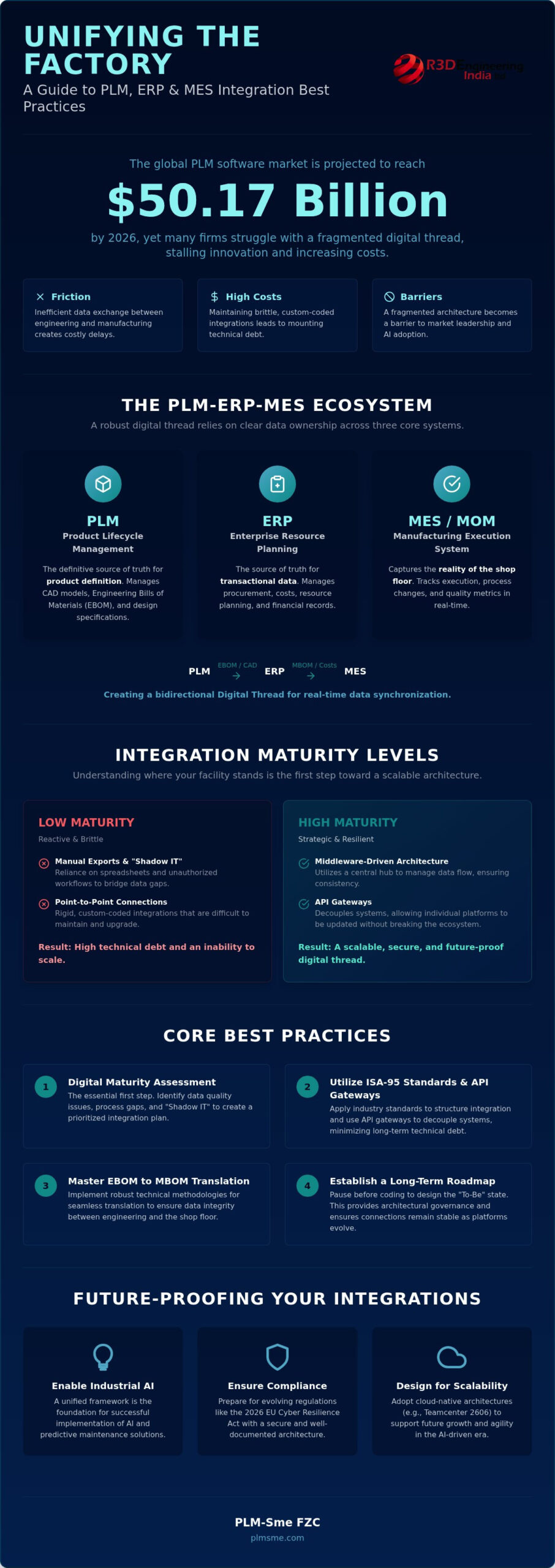
By the end of 2026, the global PLM software market has reached 50.17 billion dollars, yet many firms still struggle to adhere to PLM integration best practices. You likely recognize the friction caused by inefficient data exchange between engineering and manufacturing or the mounting costs of maintaining brittle, custom-coded integrations. It’s frustrating to watch innovation stall because your technical architecture can’t keep pace with your strategic vision. We understand that a fragmented digital thread isn’t just an IT issue; it’s a barrier to market leadership.
This article provides the strategic and technical frameworks you need to unify PLM, ERP, and MES systems for industrial digitalization success. We’ll examine the shift toward cloud-native architectures like Teamcenter 2606, explore compliance with the 2026 EU Cyber Resilience Act reporting requirements, and outline a roadmap for automated data flow. By the end, you’ll have a clear path to reducing time-to-market through a scalable system architecture designed for the AI-driven era.
Key Takeaways
- Understand why a comprehensive digital maturity assessment is the essential prerequisite for building a resilient and cost-effective digital thread.
- Learn how to apply PLM integration best practices by utilizing ISA-95 standards and API gateways to decouple systems and minimize long-term technical debt.
- Master the technical methodologies required for seamless EBOM to MBOM translation to ensure data integrity between engineering and the shop floor.
- Discover how a unified architectural framework enables the successful implementation of industrial AI and predictive maintenance solutions in 2026.
- Identify the strategic value of a long-term administration roadmap in maintaining the health and scalability of your integrated enterprise ecosystem.
Defining the Strategic Role of PLM Integration in Industrial Digitalization
Industrial digitalization isn’t just about installing software; it’s about weaving a resilient digital thread across the enterprise. This thread ensures that data created during the Product Lifecycle Management (PLM) phase flows seamlessly into production and procurement. Without this connectivity, manufacturers face fragmented silos where engineering intent gets lost in translation on the shop floor. Implementing PLM integration best practices allows organizations to move beyond manual file sharing toward real-time data synchronization. This shift directly impacts the bottom line by reducing engineering change cycle times and lowering scrap rates through improved data accuracy.
Breaking Down the PLM-ERP-MES Ecosystem
A robust digital thread relies on clear data ownership across three core systems. PLM serves as the definitive source of truth for product definition, including CAD models and Engineering Bills of Materials (EBOM). ERP functions as the source of truth for transactional data, managing procurement, costs, and resource planning. Finally, the Manufacturing Execution System (MES) or MOM captures the reality of the shop floor, tracking execution and quality metrics in real time. When these systems aren’t integrated, data duplication leads to costly errors. Effective PLM integration best practices establish a bidirectional flow where engineering updates automatically trigger resource adjustments in ERP and process changes in MES.
Identifying Integration Maturity Levels
Organizations typically progress through several stages of integration maturity. Initial stages often rely on manual exports or basic point-to-point connections, which create high maintenance overhead and technical debt. Mature industrial environments utilize middleware-driven architectures or API gateways to decouple systems, ensuring that an update to one platform doesn’t break the entire ecosystem. Understanding where your facility stands is a critical first step. Before committing to a technical framework, many leaders benefit from a structured The Strategic Value of a Digital Maturity Report in Manufacturing to identify gaps and prioritize investment. This assessment ensures that the chosen architecture supports long-term scalability rather than just a quick fix for current bottlenecks.
Establishing a Roadmap: The Prerequisite for Seamless Integration
Many manufacturers rush into integration development as a reaction to immediate data silos. This approach often results in brittle, point-to-point connections that are difficult to maintain and even harder to upgrade. One of the most critical PLM integration best practices is pausing to establish a comprehensive roadmap. This prevents the accumulation of technical debt and ensures that your PLM to ERP integration architecture supports long-term agility rather than just a temporary fix. Without a strategy, you risk automating inefficient processes, which only accelerates the production of errors across your digital thread.
Technical debt in integration occurs when developers choose the easiest path to connect two systems without considering how those systems will evolve. In 2026, with rapid updates to platforms like Teamcenter 2606 or SAP S/4HANA 2608, a rigid integration becomes a liability. A roadmap provides the architectural governance needed to ensure that as individual software versions change, the connections between them remain stable and secure.
Conducting a Digital Maturity Assessment
Evaluating current data quality and process standardization is the foundation of any integration project. A maturity assessment exposes “Shadow IT” solutions where departments use unauthorized spreadsheets to bridge gaps between PLM and ERP. These undocumented workflows often hide critical business logic that must be accounted for in the new architecture. By identifying these gaps, we create a prioritized list of integration touchpoints based on risk and value. This level of clarity is vital when aligning with a broader industrial digitalization roadmap UAE, ensuring your infrastructure meets national standards for industrial excellence.
Designing the Digitalization Vision
Success requires defining a clear “To-Be” state before selecting middleware or writing code. We map the flow of a Part Number from its initial engineering concept through to the customer record. This mapping identifies exactly where data needs to be mastered and where it should be referenced. Setting quantifiable KPIs, such as a 99.9% data synchronization success rate or a significant reduction in manual data entry, provides a benchmark for success. A phased implementation plan ensures that high-value connections, such as EBOM to MBOM synchronization, are prioritized to deliver immediate operational benefits. If you’re looking for an objective partner to guide this process, our Digitalisation Vision & Roadmap Consulting helps bridge the gap between high-level strategy and technical execution.
Core Best Practices for PLM, ERP, and MES Architectural Alignment
Aligning PLM, ERP, and MES requires a common language to prevent data silos. Adopting the ISA-95 standard for industrial system connectivity ensures that data exchange between the business level and the shop floor follows a structured, repeatable model. This is one of the foundational PLM integration best practices because it prevents custom-coded logic from becoming obsolete as software versions evolve. When systems speak the same language, the risk of data corruption during synchronization drops significantly, allowing for a more resilient digital thread.
Direct point-to-point connections often create a “spaghetti” architecture that is impossible to scale. Instead, we recommend decoupling systems through an Enterprise Service Bus (ESB) or an API Gateway. This architectural layer acts as a translator, allowing for bidirectional data flow where shop floor feedback from the MES informs engineering adjustments in the PLM. To ensure these connections remain flexible, many firms prioritize PLM system architecture consulting. This objective oversight prevents vendor lock-in and ensures the architecture serves your specific business goals rather than the limitations of a single software provider.
Bidirectional flow isn’t just about sending data; it’s about closing the loop between design and execution. When a shop floor operator identifies a manufacturability issue in the MES, that data should ideally trigger a notification or a problem report within the PLM environment. This real-time visibility prevents the same errors from recurring in future production runs. It transforms the integration from a simple data pipeline into a strategic asset for continuous improvement.
Master Data Management (MDM) Strategies
Defining clear data ownership is critical for maintaining integrity across the enterprise. While a Part Number might be initiated in the PLM, costs and lead times are typically mastered in the ERP. Implementing “Golden Record” principles ensures there’s no ambiguity about which system holds the truth for specific attributes. During CAD-to-BOM transformations, the integration must handle the transition from engineering intent to procurement reality without manual intervention. Mastering the Engineering Change Order (ECO) process is equally vital; the integration must ensure that an ECO approved in PLM automatically updates the ERP production BOM and procurement schedules to eliminate lag.
Middleware and Connectivity Options
Choosing the right toolset involves balancing implementation speed with long-term control. Siemens-native tools like T4S (Teamcenter Gateway for SAP) offer deep, pre-built connectivity for standard industrial workflows, reducing initial development time. However, complex environments often require custom API development to handle unique business logic or legacy system requirements. Ensuring this scalability is vital for future industrial automation solutions GCC, where regional manufacturing demands high levels of interoperability and local support for advanced AI-driven processes.
Overcoming Common Integration Hurdles: Data Integrity and Performance
Data migration is often the Achilles’ heel of integration projects. Attempting to synchronize legacy records without a rigorous cleaning phase inevitably spreads inaccuracies throughout the new digital thread. Adhering to PLM integration best practices requires a “clean as you go” approach, where data is validated against modern standards before it ever enters the integration pipeline. This is particularly vital when managing the transition from an Engineering Bill of Materials (EBOM) to a Manufacturing Bill of Materials (MBOM). The translation logic must account for shop-floor specifics, such as phantom assemblies or regional procurement variations, without manual intervention that invites human error.
High-volume global environments frequently encounter latency issues that can disrupt real-time synchronization. If an engineer in one region releases a change, the delay in updating the ERP for a manufacturing site in another region can lead to the production of obsolete parts. Robust error handling and automated notification protocols are essential to manage these gaps. The system shouldn’t just fail; it should provide actionable logs that allow administrators to resolve synchronization conflicts before they impact the production schedule.
Data Governance and Quality Control
Successful integration depends on establishing clear ownership for every data field at the point of entry. If the ERP and PLM both allow users to modify a part description, you’ll eventually face conflicting records. Automating data validation checks within the integration layer helps catch these discrepancies before they propagate. In 2026, Data Integrity in PLM-ERP links is defined as the verifiable accuracy, completeness, and regulatory traceability of product data across its entire lifecycle, ensuring compliance with standards like the EU Cyber Resilience Act. This level of governance ensures that your data remains a reliable asset for both human decision-makers and AI-driven analytics.
Performance Optimization for Global Teams
Global manufacturing requires a technical architecture that supports high-speed access regardless of location. Using data caching and asynchronous processing reduces the immediate load on core systems, allowing the user interface to remain responsive while heavy data transfers happen in the background. Optimizing Teamcenter Active Workspace for mobile and remote access is a priority in 2026, as shop floor managers and field engineers increasingly rely on handheld devices to view integrated data. To maintain the long-term health of these complex connections, many organizations opt for a PLM System Administration Retainer to proactively manage performance and security updates. This proactive oversight ensures that as your data volume grows, your integration performance doesn’t degrade.
Future-Proofing Integrations with AI and Long-Term Administration
In 2026, the value of a resilient digital thread extends beyond immediate operational efficiency. It serves as the essential foundation for artificial intelligence. Without a clean, integrated data set, AI models produce unreliable results that can lead to costly manufacturing errors. Following PLM integration best practices ensures that your data architecture is structured enough to feed machine learning algorithms with high-fidelity information. This transition moves your organization from reactive troubleshooting toward a state of proactive optimization, where the system anticipates needs before they become bottlenecks.
Integrated data enables advanced predictive maintenance and demand forecasting by correlating engineering intent with real-world performance. When your PLM system shares historical part data with the ERP’s procurement logs and the MES’s machine health sensors, AI can identify patterns that human analysts might miss. This level of insight allows for more accurate resource allocation and a significant reduction in unplanned downtime. Transitioning to this proactive model requires a shift in how we view integration; it’s no longer a static bridge but an evolving asset that requires consistent roadmap evolution.
Enabling Industrial AI through Unified Data
Unified data from PLM and MES systems is the primary fuel for high-fidelity Digital Twin simulations. When these systems are synchronized, manufacturers can simulate production runs with extreme accuracy, identifying potential failures before the first part is even machined. This connectivity also supports AI-driven generative design, where the system suggests optimized part geometries based on real-world manufacturing constraints captured in the MES. Protecting intellectual property remains a priority during this process. A well-architected integration includes robust security layers and access controls to ensure that AI models don’t expose sensitive engineering data to unauthorized entities or external threats.
The Value of Managed PLM Services
Integration health isn’t a “set and forget” achievement. It requires ongoing maintenance to handle frequent software updates and shifting business requirements. A dedicated PLM System Administration Retainer is often more cost-effective than the operational loss caused by unexpected system downtime or broken synchronization. These services provide the technical oversight needed for the continuous improvement of specialized connections, such as the Teamcenter CRM integration. By keeping sales and engineering data aligned, you ensure that customer requirements are accurately reflected in the final product definition.
Adhering to PLM integration best practices involves aligning every technical update with your long-term 2026 digitalization vision. This ensures that your technical infrastructure evolves alongside your strategic goals rather than becoming a legacy burden. Managed services allow your internal teams to focus on innovation while experts handle the complexities of system solution architecture and end-to-end implementation support. This collaborative approach ensures that your digital thread remains resilient, scalable, and ready for the next wave of industrial transformation.
Advancing Your Industrial Digitalization Strategy
Building a resilient digital thread requires more than just connecting software; it demands a strategic alignment of people, processes, and technical architecture. By prioritizing PLM integration best practices, you’ve established a foundation that supports real-time data flow and AI-driven optimization. This approach minimizes technical debt and ensures your enterprise remains agile in a rapidly evolving industrial landscape. You’ve seen that successful integration is a byproduct of strategic design and digital maturity rather than simple software connectivity. As your systems evolve toward the 2026 standards of Teamcenter and SAP S/4HANA, maintaining this architectural health becomes your core competitive advantage.
As an independent Siemens Digital Industries Partner with national UAE industrial expertise, we specialize in Teamcenter Architecture and end-to-end implementation. We function as your technical thinking partner to ensure your roadmap delivers measurable ROI. We invite you to Request a Digital Maturity Assessment for your UAE operations to identify immediate gaps and prioritize your next integration milestones. Our team is ready to help you bridge the gap between high-level vision and grounded, practical execution. Let’s build a digital infrastructure that’s not only functional but truly future-proof.
Frequently Asked Questions
What is the most common mistake in PLM-ERP integration?
The most common mistake is focusing on technical connectivity before establishing process alignment. Many firms automate inefficient workflows, which only accelerates the production of errors across the enterprise. Successful projects prioritize mapping the Engineering Bill of Materials to the Manufacturing Bill of Materials before writing any code. Without this foundational work, you risk creating brittle connections that require expensive, frequent maintenance as your business requirements evolve in the future.
How long does a typical Siemens Teamcenter integration project take?
A typical Siemens Teamcenter integration project generally spans four to nine months, depending on the complexity of the data model. This timeline includes the initial digital maturity assessment, architecture design, and a phased rollout of the digital thread. Utilizing current 2026 standards, such as Teamcenter 2606, allows for more streamlined connectivity. However, the duration is heavily influenced by the quality of legacy data and the number of touchpoints between ERP and MES systems.
Should we use a vendor-specific connector or build a custom API?
Choosing between a vendor-specific connector and a custom API depends on your long-term flexibility goals. Siemens-native tools like T4S offer rapid deployment for standard SAP workflows, but they may limit your ability to handle unique business logic. Custom APIs provide greater control and help avoid vendor lock-in, though they require more intensive initial development. We recommend a hybrid approach that utilizes standard connectors for common tasks while reserving custom development for proprietary competitive advantages.
How does digital maturity affect the cost of PLM integration?
Digital maturity is a primary driver of total project costs. Low maturity often necessitates extensive data cleaning and process standardization before integration can begin, which increases the initial investment. Conversely, firms with a high maturity level benefit from structured data and documented workflows, leading to faster implementation and lower long-term maintenance fees. Starting with a detailed digital maturity report helps quantify these variables and provides a realistic budget for your digitalization roadmap.
Can PLM be integrated with legacy MES systems?
PLM can be integrated with legacy MES systems through middleware layers or API wrappers. This connectivity is essential for maintaining a resilient digital thread, as it allows engineering intent to reach the shop floor even on older equipment. While legacy systems may lack modern web services, specialized integration development can bridge these gaps. This ensures that real-time production feedback continues to inform design improvements, regardless of the age of your manufacturing execution hardware.
What is the role of an independent PLM consultant in integration projects?
An independent PLM consultant functions as a neutral “thinking partner” who prioritizes your strategic vision over specific software sales. Their role involves designing a scalable system architecture and providing objective advice on PLM integration best practices. By remaining vendor-independent, they help you avoid expensive licensing pitfalls and ensure that your technical framework supports a diverse ecosystem of ERP, CRM, and MES platforms without creating unnecessary technical debt.
How do we ensure data security across integrated industrial systems?
Ensuring data security requires a multi-layered approach involving encryption, robust access controls, and adherence to international standards. In 2026, manufacturers must also consider compliance with the EU Cyber Resilience Act, which mandates specific vulnerability reporting and incident management protocols. We implement secure API gateways and structured data governance to protect your intellectual property as it moves between engineering and manufacturing environments, preventing unauthorized access during high-volume data synchronization.
What are the benefits of integrating PLM with CRM for manufacturing?
Integrating PLM with CRM systems allows customer requirements to flow directly into the engineering environment. This synergy enables sales teams to provide more accurate quotes based on real-time engineering capacity and product configurations. It also creates a closed-loop feedback system where field performance data informs future design iterations. By connecting these systems, manufacturers can reduce the time-to-market for bespoke solutions and improve overall customer satisfaction through more precise product definition.