
Navigating PLM System Integration Challenges in Industrial Digitalization
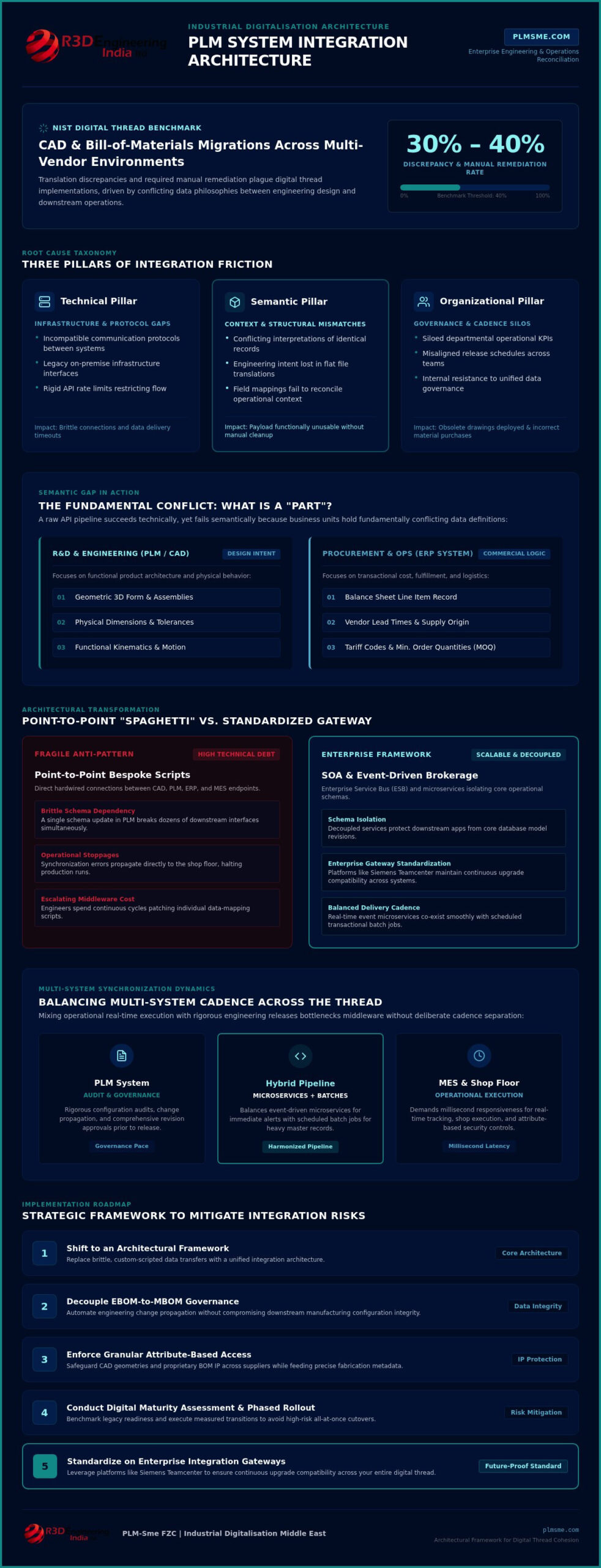
According to NIST digital thread benchmarks, 30% to 40% of CAD and bill-of-materials migrations across multi-vendor industrial environments suffer from translation discrepancies or require manual remediation. If connecting your design data to enterprise resource planning (ERP) and manufacturing execution systems (MES) feels like an endless cycle of brittle custom scripts and synchronization errors, you aren’t alone. Most PLM system integration challenges don’t stem from faulty APIs; they occur because engineering and operations operate under fundamentally conflicting data philosophies.
Bridging this divide requires treating integration as an architectural reconciliation rather than a mere data-mapping task. In this article, we examine the structural, semantic, and organizational hurdles that compromise cross-system connectivity and drive up middleware maintenance costs. You will discover practical strategies to replace point-to-point scripts with standardized gateways, decouple your engineering and manufacturing BOMs, and establish a scalable roadmap that secures a dependable digital thread from initial design to the shop floor.
Key Takeaways
- Overcome persistent PLM system integration challenges by shifting from brittle, custom-scripted data transfers to a unified architectural framework.
- Eliminate multi-system latency across ERP, MES, and MOM environments by balancing event-driven microservices with scheduled batch operations.
- Establish a decoupled EBOM-to-MBOM governance model to automate engineering change propagation without sacrificing configuration integrity.
- Use a digital maturity assessment to benchmark legacy readiness and execute a phased rollout that avoids high-risk cutovers.
- Standardize on enterprise integration frameworks like Siemens Teamcenter to ensure continuous upgrade compatibility across your entire digital thread.
Understanding the Core PLM System Integration Challenges
True operational synergy requires more than pushing flat files between software endpoints. In industrial environments, product lifecycle management serves as the single source of truth for design intent, yet engineering data routinely remains trapped inside CAD and CAM environments. This isolation creates a stubborn silo effect. When design teams release revisions without programmatic links to downstream business systems, production teams make parts using obsolete drawings, procurement purchases incorrect materials, and project timelines drift.
Achieving a functional digital thread demands resolving integration breakdowns across three distinct pillars:
- Technical: Incompatible communication protocols, legacy on-premise infrastructure, and rigid API rate limits.
- Semantic: Fundamental discrepancies in how different business units interpret and structure identical product records.
- Organizational: Siloed departmental KPIs, misaligned release cadences, and resistance to unified data governance.
Without addressing each pillar, enterprises face persistent PLM system integration challenges that no software upgrade can resolve on its own.
Technical vs. Semantic Integration Gaps
Technical connectivity simply means opening a reliable pipeline between two databases. Semantic interoperability, however, ensures the receiving application understands the context of the incoming payload. For an R&D engineer, a “part” represents geometric form, physical tolerances, and functional kinematics. For a procurement specialist inside an ERP system, that exact same part is a balance sheet line item governed by vendor lead times, tariff codes, and minimum order quantities. Establishing raw REST or SOAP connections does not solve this mismatch. When field mappings fail to reconcile these operational contexts, the incoming data becomes functionally unusable, requiring manual cleanup by planners.
The Cost of “Spaghetti” Architecture
Point-to-point connections work when an enterprise only needs to link two static databases. Industrial enterprises, however, operate complex ecosystems spanning CAD, PLM, ERP, MES, and field telemetry. Writing bespoke point-to-point scripts across these nodes creates an unmaintainable “spaghetti” architecture. Every custom script builds technical debt. A single schema change or version update in your core PLM environment can break dozens of downstream integrations simultaneously, halting shop-floor operations.
Resolving these PLM system integration challenges requires abandoning custom middleware. Forward-thinking manufacturers transition toward service-oriented architectures (SOA) and modular microservices. By decoupling functional services and relying on standardized enterprise service buses or event-driven brokerages, organizations isolate core systems from downstream schema changes, ensuring reliable data distribution across the entire product lifecycle.
Identifying Architectural Bottlenecks in Multi-System Environments
An industrial enterprise relies on the synchronized movement of data across PLM, ERP, MES, and MOM platforms. Yet managing these touchpoints introduces acute architectural friction. Production environments demand millisecond responsiveness for shop-floor tracking, while engineering changes require comprehensive configuration audits before release. Mixing transactional batch jobs with real-time operational streams often bottlenecks middleware pipelines. As documented in NIST research on PLM information architecture, establishing robust data cohesion across distributed systems requires structured traceability and process-aware schemas rather than treating ERP as an all-encompassing master database.
Security and IP protection complicate this pipeline. Sharing CAD geometries and proprietary bill-of-materials (BOM) data across extended supplier and operational networks exposes critical corporate assets. Architectures must enforce granular, attribute-based access controls to protect design data while providing downstream applications with the precise fabrication metadata they require for automated execution.
Legacy System Friction and Middleware Limitations
Modern platforms like Siemens Teamcenter rely on modern APIs and semantic data models, but they frequently must interface with decades-old on-premise ERP modules. While an Enterprise Service Bus (ESB) can broker these interactions, generic enterprise middleware often stumbles over deep CAD metadata, variant configurations, and complex assembly structures. Overcoming these PLM system integration challenges means recognizing when standardized connectors (such as Siemens T4EA or Teamcenter Integration for SAP S/4HANA) suffice, and when tailored integration development is mandatory to support specialized plant routings.
Data Governance and Ownership Conflict
Friction often boils down to operational disputes over data authority. Engineering controls product geometry, tolerances, and design revisions, while manufacturing operations dictate resource routing, machine capacities, and supplier substitutions. Without rigorous Master Data Management (MDM), updates in one platform inevitably overwrite critical attributes in another.
Data governance within a 2026 digital thread is the unified policy framework that guarantees traceability, contextual integrity, and role-based access across engineering, operations, and enterprise systems without duplicating authoritative data.
Resolving these governance disputes requires an objective system and solution architecture that formalizes asset ownership across the lifecycle before writing a single line of integration code.
Reconciling Engineering Data with Enterprise Business Logic
Engineering departments design products based on functional geometry, mechanical tolerances, and spatial hierarchies. Enterprise systems, however, schedule resources around financial cost centers, procurement lead times, and inventory locations. This fundamental divide is why standard CAD plugins and API calls repeatedly fail to create a working digital thread. Overcoming these PLM system integration challenges requires an architectural bridge between engineering structure and enterprise business logic.
Engineering Change Orders (ECOs) demonstrate this friction. When an R&D team issues a design modification, the integration layer must calculate its operational blast radius. Does the revision scrap work-in-progress inventory? Does it render on-order raw materials obsolete? If your integration pipeline treats an ECO as a simple file replacement rather than an orchestrated operational event, plant managers face scrap costs, unfulfilled customer orders, and compliance gaps.
The BOM Transformation Challenge
The core of this operational friction lies in the divide between the Engineering Bill of Materials (EBOM) and the Manufacturing Bill of Materials (MBOM). An EBOM represents functional assemblies, such as a motor mounted directly to a chassis bracket. The manufacturing plant cannot assemble the product in that exact sequence; it requires consumables like adhesives, grease, and packaging materials that never appear in a 3D CAD model. Forcing a single, rigid BOM across both PLM and ERP satisfies neither group. Best practice relies on dual-BOM decoupled governance. By automating the EBOM-to-MBOM translation inside the PLM environment, enterprises maintain functional design intent while populating the ERP with plant-specific routing and procurement parameters.
Closing the Feedback Loop with MES
Digitalization cannot stop at passing engineering intent downward to ERP; it must capture real-world execution data from the plant floor. Bridging this gap requires synchronizing the MBOM with Manufacturing Execution Systems (MES) to record the precise “as-built” record against the original “as-designed” configuration.
- Non-Conformance Traceability: Flagging machining deviations directly against CAD features to identify design tolerance issues.
- Closed-Loop Quality: Feeding operational telemetry and assembly exceptions back into PLM engineering workbenches to refine future product revisions.
- Configuration Verification: Using Teamcenter MES integration to validate that serialized components match customer options before sign-off.
Resolving these PLM system integration challenges ensures that shop-floor realities continuously guide engineering decisions, closing the loop on continuous product improvement.
Executing a Strategic Framework to Mitigate Integration Risks
High-stakes manufacturing environments cannot afford high-risk integration cutovers. Attempting a single “Big Bang” cutover across CAD, PLM, and ERP platforms usually triggers operational paralysis when unmapped exceptions emerge under live production conditions. A structured risk-mitigation framework begins with rigorous data cleansing long before any pipeline goes live. Migrating dirty data, duplicate part records, and orphaned revisions will only distribute flawed inputs across downstream systems faster. Establishing standardized RESTful APIs and certified data schemas ensures clean, predictable payloads flow continuously between engineering and operational nodes.
Successful deployments prioritize phased rollouts. By running targeted pilot programs on specific product lines, teams isolate friction points, validate data transformations, and refine synchronization rules without putting active assembly lines at risk. This phased progression turns abstract system blueprints into proven, repeatable integration patterns.
Building the Integration Roadmap
A dependable integration roadmap ties technical milestones directly to quantifiable operational outcomes. Rather than focusing solely on server uptime, organizations measure impact through concrete business metrics:
- ECO Cycle Compression: Slashing engineering change notification transit times from weeks to hours.
- BOM Reconciliation Speed: Automating discrepancy detection between design revisions and plant procurement schedules.
- Downstream Re-entry Reduction: Eliminating manual keying of part attributes into ERP purchase requisitions.
Conducting an AI readiness check during the roadmap phase ensures that underlying engineering schemas and BOM metadata possess the semantic structure required for autonomous change analysis and predictive sourcing algorithms. Aligning these internal milestones with the broader industrial digitalization roadmap UAE guarantees your technical architecture supports long-term operational resilience and national competitive standards.
Testing and Validation Protocols
Digital Twins provide an ideal sandbox to validate integration logic prior to shop-floor rollout. Engineering teams can simulate complex change propagation scenarios inside a virtual production environment, confirming that parameter updates trigger the correct routing updates in ERP and MES. API pipelines must undergo rigorous stress testing under synthetic peak-load conditions, verifying that high-frequency shop-floor telemetry does not saturate engineering databases. Finally, cross-functional User Acceptance Testing (UAT) guarantees that both design engineers and line supervisors validate the workflow before live deployment.
Navigating these complex technical variables requires an objective assessment of your baseline systems. Request a comprehensive digital maturity assessment to identify architectural bottlenecks and establish an actionable integration blueprint.
Designing a Future-Proof Integration Architecture with Siemens Teamcenter
Operating as an open, highly extensible collaboration platform, Siemens Teamcenter serves as an ideal foundation for discrete manufacturing enterprises. Modern deployments must handle sophisticated data models, from mechanical CAD assemblies to embedded software requirements. Meeting these demands requires an enterprise backbone capable of orchestrating multi-CAD environments while communicating cleanly with operational software. Rather than applying rigid off-the-shelf configurations that force organizations to change their core business processes, Teamcenter Integration Development allows companies to tailor data mappings, lifecycle triggers, and cross-platform workflows to their precise manufacturing operations.
Working alongside an independent Siemens Digital Industries Alliance Partner ensures that your architecture remains neutral and objective. Independent advisors focus on long-term operational resilience, helping industrial organizations navigate vendor-specific hurdles, avoid proprietary lock-in, and select integration patterns that support broader national industrial digitalization strategies in the UAE.
Advanced Teamcenter Integration Capabilities
Siemens provides proven COTS middleware tools to eliminate brittle point-to-point connections. Utilizing standard gateways like Teamcenter Gateway for Enterprise Applications (T4EA) and Teamcenter Integration for SAP S/4HANA (S4S) isolates business mapping logic from the core platform schema. This modular abstraction ensures that when Teamcenter updates to new continuous release versions, external interfaces remain stable. Beyond core shop-floor connectivity, capturing upstream market demands and configuring tailored engineering variants becomes seamless when exploring Teamcenter CRM integration benefits. Modern cloud-hybrid deployments leverage these connectors alongside autonomous AI agent layers to detect BOM discrepancies and flag supplier part lead-time risks before components hit the production line.
Sustaining Performance with Managed Administration
Long-term architectural health depends on minimizing technical debt across evolving digital pipelines. Adopting a structured PLM system architecture consulting methodology guarantees that your data models, event handlers, and web-tier microservices adapt gracefully as business rules shift. Retaining dedicated PLM system administration provides ongoing schema governance, routine performance tuning, and patch management. This continuous operational support resolves emerging PLM system integration challenges before they interrupt engineering deliverables or stall production lines.
Ready to unify your digital thread? Contact PLM-Sme for a Digital Maturity Assessment.
Transforming Integration Friction into Operational Agility
Industrial digitalization succeeds when engineering intent translates cleanly into physical production. Resolving persistent PLM system integration challenges isn’t accomplished with ad-hoc scripts or forced, monolithic data models; it requires an architectural reconciliation of how CAD, ERP, and MES platforms interpret product lifecycles. By decoupling your EBOM and MBOM structures, establishing standard middleware gateways, and validating data flows through phased pilot testing, you protect data integrity while eliminating costly shop-floor scrap.
Achieving a reliable digital thread requires technical depth and objective architectural oversight. As an independent Siemens Digital Industries Alliance Partner with extensive expertise in UAE industrial digitalization roadmaps, PLM-Sme delivers vendor-neutral guidance to modernize your enterprise ecosystem. Our specialized Teamcenter Integration Development team works to bridge the gap between design engineering and plant execution, ensuring your infrastructure adapts seamlessly to future AI and industrial automation layers.
Take the definitive first step toward connected manufacturing today: Request a Digital Maturity Assessment to identify your integration bottlenecks and establish a dependable path toward operational agility.
Frequently Asked Questions
What are the most common PLM system integration challenges in 2026?
The most frequent bottlenecks involve semantic mismatches between engineering configurations and operational records, rigid API rate limits, and unmaintained custom middleware. Modern enterprises also struggle with synchronizing high-frequency shop-floor telemetry back into revision-controlled PLM environments. When companies neglect structured data governance, these PLM system integration challenges lead to widespread data duplication, manual workarounds, and costly scrap on active production lines.
How do I choose between a custom integration and an out-of-the-box PLM-ERP connector?
Choose certified commercial off-the-shelf connectors when connecting standard data models between leading enterprise platforms like Siemens Teamcenter and SAP S/4HANA. Standard gateways isolate core business logic and guarantee upgrade stability. Conversely, opt for tailored Teamcenter Integration Development when your plant relies on deeply customized routing schemas, legacy ERP modules, or proprietary shop-floor equipment that standard connectors cannot parse without significant operational compromise.
Why is data governance critical for successful PLM integration?
Data governance establishes authoritative ownership for every product attribute across its entire lifecycle. Without clear rules defining whether engineering or manufacturing controls specific metadata, automated sync pipelines overwrite critical values like lead times or physical tolerances. Enforcing strict Master Data Management policies prevents synchronization conflicts and guarantees cross-functional teams trust the records flowing across their digital thread.
Can Siemens Teamcenter integrate with legacy ERP systems like SAP or Oracle?
Yes, Siemens Teamcenter integrates with legacy systems using specialized integration frameworks like Teamcenter Gateway for Enterprise Applications (T4EA) and Teamcenter Gateway for SAP (T4S). These enterprise gateways bridge modern RESTful web services with older RFC protocols, flat file exchanges, or database triggers. This architecture lets organizations modernize engineering operations without demanding a risky, simultaneous overhaul of their legacy transactional ERP infrastructure.
What is the role of middleware in industrial digitalization?
Middleware serves as the translation layer and traffic controller between disparate industrial software systems. Rather than allowing brittle point-to-point scripts, robust middleware decouples platforms by normalizing data payloads, managing event triggers, and enforcing business transformation logic. This layer ensures that schema updates within PLM don’t break manufacturing execution operations or interrupt downstream supply chain planning.
How does PLM integration support an AI roadmap in manufacturing?
Artificial intelligence algorithms require clean, structured, and contextualized operational training data to generate actionable insights. Integrating PLM with shop-floor execution feeds engineering context directly into machine learning models, enabling predictive maintenance, automated tolerance optimization, and dynamic supplier risk management. A unified data architecture turns scattered manufacturing data into high-value assets for autonomous enterprise intelligence.
How long does a typical PLM-ERP-MES integration project take?
A standard enterprise integration typically spans several months, depending entirely on system complexity, data cleanliness, and process customization. Phased deployments that begin with an initial discovery audit and targeted pilot line achieve measurable milestones much faster than risky monolithic cutovers. Establishing clear data governance early remains the best way to prevent unexpected delivery delays during development.
What are the benefits of hiring an independent PLM consultant for integration?
An independent consultant provides objective, vendor-neutral architectural guidance focused entirely on your operational goals. Rather than pushing pre-packaged software licenses or generic configurations, an independent advisor evaluates multi-vendor friction points objectively. Partnering with a specialized advisory firm ensures your Teamcenter deployment integrates cleanly with legacy assets while supporting national industrial digitalization frameworks across the UAE.