
Maximizing Industrial Value: PLM CRM Integration Benefits for Discrete Manufacturing
Discrete manufacturers often lose significant market share not through poor engineering, but because their sales and product teams are effectively speaking different languages. You’ve likely felt the friction when sales promises a custom feature that engineering cannot deliver, or when engineering teams spend months perfecting a product that no longer aligns with actual customer needs. It’s a costly, inefficient cycle driven by fragmented data and manual entry errors that drain your team’s productivity.
Understanding the PLM CRM integration benefits is the first step toward transforming your organization from a reactive production house into a proactive innovation engine. By bridging the gap between Teamcenter and your customer data, you create a unified source of truth that powers faster decision-making. This article provides a strategic framework for implementation and demonstrates how connectivity builds the essential foundation for AI-driven industrial digitalization in 2026. We’ll explore the clear ROI of system connectivity, how to align real-world feedback with development, and the architectural steps required to eliminate technical debt while accelerating your time-to-market.
Key Takeaways
- Resolve the persistent misalignment between sales and engineering by establishing a unified data environment that eliminates communication gaps and manual entry errors.
- Realize tangible PLM CRM integration benefits such as reduced development cycles and improved product reliability through the use of real-world field data.
- Build a robust foundation for industrial AI and predictive analytics by securing high-quality, integrated data across the entire product lifecycle.
- Follow a methodical framework for system architecture that prioritizes digital maturity assessments to prevent long-term technical debt.
- Leverage independent expertise to develop a vendor-neutral digitalization roadmap tailored to the complex requirements of discrete manufacturing.
Bridging the Gap Between Engineering and Market Demand
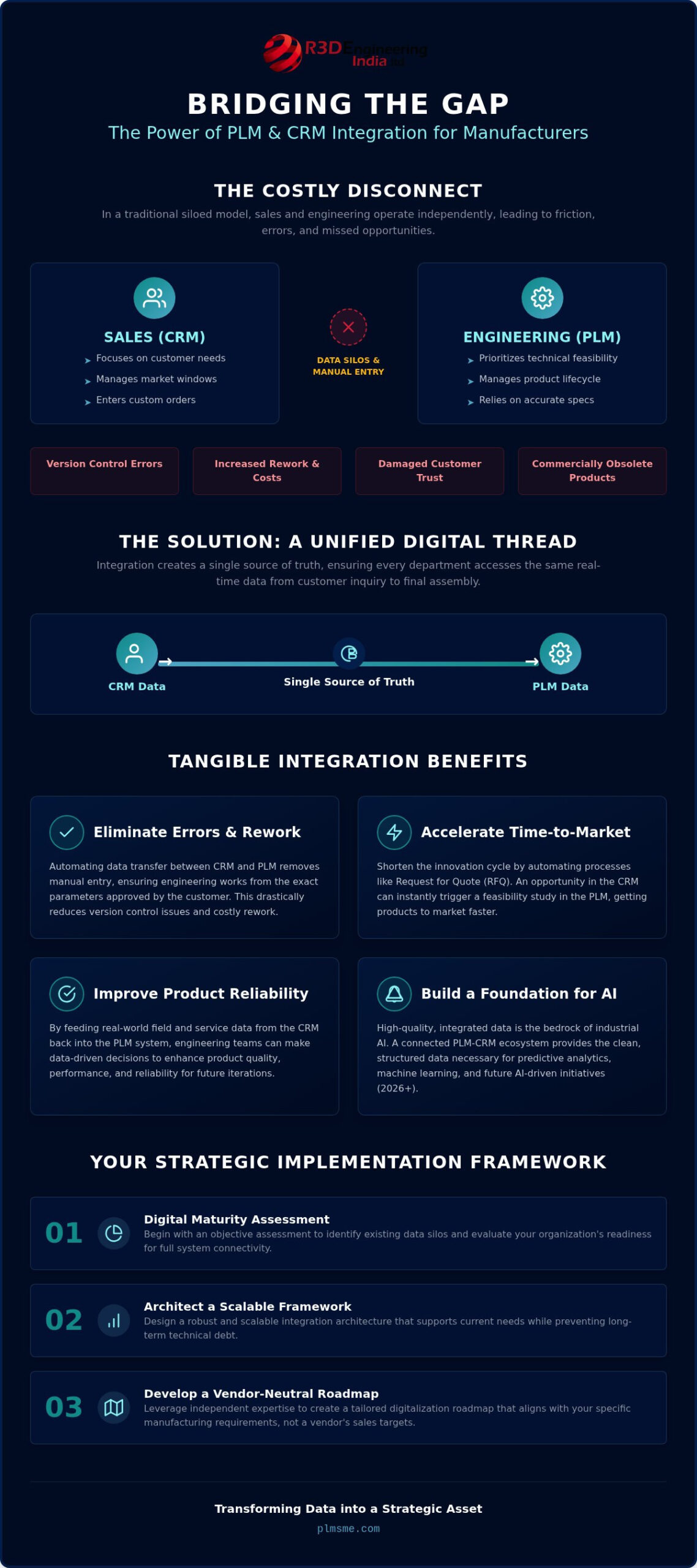
Discrete manufacturing thrives on technical precision, yet many organizations operate with a fundamental disconnect between the shop floor and the storefront. In a traditional siloed model, sales teams and engineering departments often speak different languages. Sales focuses on customer requirements and market windows, while engineering prioritizes technical feasibility and Product Lifecycle Management (PLM). When these systems don’t communicate, the business relies on tribal knowledge and manual updates, leading to expensive inefficiencies that hinder growth.
Identifying the hidden costs of disconnected systems is essential for long-term viability. These costs manifest as excess inventory, redundant prototyping, and product recalls caused by outdated specifications. Shifting from a product-first mindset to a customer-centric engineering approach requires a clear view of your current capabilities. This is where a digital maturity report manufacturing becomes invaluable. It highlights exactly where data silos exist and provides an objective assessment of your readiness for full system connectivity.
The Crisis of Misaligned Product Data
Manual data transfers are the primary catalyst for version control errors. When a sales representative enters a custom order into a CRM and an engineer manually replicates that data into the PLM system, the risk of human-induced friction increases exponentially. One of the most significant PLM CRM integration benefits is the elimination of this redundant entry, ensuring that engineering works from the exact parameters the customer approved.
Misalignment also impacts lead times. If sales promises a feature that engineering hasn’t vetted for manufacturing feasibility, the resulting delay damages customer trust. The lost opportunity cost of slow feedback loops is often higher than the direct cost of rework. By the time market feedback reaches the design team through manual reports, the market demand may have already shifted, leaving you with a product that’s technically sound but commercially obsolete.
Creating a Unified Digital Thread
A unified digital thread ensures that every department, from procurement to customer service, accesses the same single source of truth. This thread begins at the initial customer inquiry in the CRM and persists through final assembly and field service within the PLM environment. This level of transparency is no longer optional for companies aiming to remain competitive in a high-speed industrial environment.
Establishing this connectivity is a core component of a strategic industrial digitalization roadmap UAE. By integrating these systems, manufacturers ensure that product development is directly informed by real-world demand. This alignment maximizes the PLM CRM integration benefits, turning technical data into a strategic asset that drives revenue rather than just recording costs.
Realizing Operational PLM CRM Integration Benefits
Operational efficiency in discrete manufacturing relies on the seamless flow of technical data into commercial workflows. When your systems are connected, the transition from a customer inquiry to a production-ready design becomes a streamlined event rather than a series of manual handoffs. One of the core PLM CRM integration benefits is the ability to maintain a live connection between market demand and engineering capacity, ensuring that what’s promised to the client can actually be built profitably.
By synchronizing these platforms, manufacturers eliminate the friction that typically slows down the innovation cycle. This integration allows for real-time visibility into product configurations and availability, which is essential for maintaining a competitive edge. Organizations that prioritize this connectivity often see a marked improvement in their ability to respond to custom requests without bloating their engineering overhead.
Shortening the Innovation Cycle
Manufacturers can significantly reduce their time-to-market by automating the Request for Quote (RFQ) process through system triggers. Instead of sales teams emailing spreadsheets to engineering, an opportunity update in the CRM can automatically initiate a technical feasibility study within the PLM environment. This reduces engineering rework by providing designers with direct access to customer specifications during the initial concept phase.
Leading manufacturers are extending their product lifecycle management (PLM) software to include these customer-facing touchpoints, enabling a closed-loop development cycle. In this model, field service data captured in the CRM informs immediate engineering changes in the PLM. This ensures the next product iteration addresses real-world performance issues before they become widespread. If you’re unsure how your current systems stack up, a digital maturity assessment can provide the necessary clarity to begin this transition.
Financial and Compliance Transparency
Margin creep remains a persistent threat when sales teams use outdated engineering costs to generate quotes. Integration ensures that CRM pricing reflects real-time Bill of Materials (BOM) costs from the PLM system, protecting your bottom line. This transparency is equally critical for regulatory oversight. Integrated systems simplify the tracking of customer-specific requirements, such as ITAR or EAR compliance, by linking jurisdictional data in the CRM directly to technical assets in the PLM.
This automation reduces the administrative burden of audits and ensures that sensitive technical data is only accessible to authorized parties based on verified customer profiles. In 2026, the ROI of industrial data transparency is defined by the total elimination of non-value-added data reconciliation hours and the reduction of production scrap through the alignment of design intent with actual field performance.
Evaluating Strategic Integration for AI Readiness
Industrial AI is often marketed as a standalone solution, but its effectiveness is entirely dependent on the quality of the underlying data architecture. In the discrete manufacturing sector, the primary hurdle to AI adoption isn’t the algorithm; it’s the fragmentation of data between commercial and technical departments. Realizing the full scope of PLM CRM integration benefits means moving beyond simple data synchronization to create a high-fidelity dataset that machine learning models can actually use to drive value.
As generative AI competencies are projected to be embedded in 50% of PLM solutions by 2026, the cost of maintaining data silos continues to rise. Without a live connection between customer feedback and product design, AI remains a localized tool rather than an enterprise-wide asset. Strategic integration ensures that your AI initiatives are built on a foundation of reality rather than fragmented assumptions.
Building the Data Foundation for Industrial AI
Siloed data renders most AI manufacturing initiatives useless because the models lack the context required for complex decision-making. When product specifications are trapped in a PLM and customer behavior is isolated in a CRM, the AI cannot identify the correlation between design choices and market success. A strategic approach that enables developers to manage product lifecycles must include a unified data backbone that feeds clean, structured information into the digital thread.
Transitioning from descriptive analytics to predictive product development requires mapping data flows that account for the unique complexities of discrete manufacturing. This includes multi-level Bill of Materials (BOM) structures and intricate custom configurations. By ensuring that these data points are accessible to machine learning algorithms, manufacturers can begin to automate the identification of design flaws and supply chain vulnerabilities before they impact production.
AI-Driven Customer Insights
Once systems are integrated, AI can begin to prioritize PLM engineering backlogs automatically based on CRM opportunity data. This predictive sales capability allows manufacturers to forecast market trends by analyzing which engineering features are driving the highest conversion rates. AI-driven tools can also scan customer service logs to identify recurring field issues, signaling the need for an immediate engineering change order in the PLM system.
Preparing for this level of autonomous industrial digitalization requires a clear vision. Integrating these systems shouldn’t be an afterthought; it’s a core component of a comprehensive industrial digitalization roadmap. This strategic foresight ensures that your organization can turn customer preferences into generative design inputs, effectively accelerating the cycle from initial inquiry to a market-ready, engineered solution.
Architecting a Scalable Integration Framework
Successful enterprise integration is not simply a matter of installing a software plugin. It’s a structural transformation that requires a methodical approach to data governance and system logic. To capture the full PLM CRM integration benefits, discrete manufacturers must move beyond basic data synchronization and adopt a strategic framework that prioritizes long-term scalability over immediate, short-term fixes.
The following five steps provide a roadmap for a resilient integration deployment:
- Step 1: Conduct a comprehensive digital maturity assessment to identify existing data bottlenecks and evaluate the readiness of your current IT infrastructure.
- Step 2: Define the solution architecture and data mapping protocols to ensure semantic consistency between engineering and sales platforms.
- Step 3: Select the appropriate middleware or native connector, such as the Teamcenter Gateway, to facilitate robust, real-time communication.
- Step 4: Execute a pilot integration focusing on a single high-value workflow, such as the transition from a customer request to an engineering feasibility study.
- Step 5: Establish ongoing PLM system administration for performance monitoring, ensuring the integration evolves alongside your business needs.
The Role of System Architecture Consulting
Many organizations fall into the trap of “point-to-point” integrations. While these may solve immediate needs, they often fail in complex industrial environments because they create rigid dependencies that break during software updates. Designing for scalability ensures your architecture remains resilient as your product portfolio grows. Professional Siemens Teamcenter consulting during the design phase is critical to avoid technical debt and ensure that the integration supports the long-term vision of the digital thread. This specialized oversight helps align technical capabilities with commercial objectives from the outset.
Integration Best Practices for 2026
In 2026, the industry has shifted away from legacy batch processing in favor of API-led connectivity. This approach allows for real-time data exchange, which is essential for maintaining a live single source of truth. For manufacturers operating within the UAE national framework, data security and sovereignty must be prioritized within the integration design to comply with local regulations. Independent, vendor-neutral advice ensures that your technology stack remains flexible and prevents the restrictive vendor lock-in that often accompanies proprietary, one-size-fits-all solutions.
To ensure your integration is built on a foundation of technical excellence, you can request a professional system architecture review to evaluate your current roadmap.
Advancing Your Digital Transformation with Independent Expertise
While the technical PLM CRM integration benefits are clear, the execution phase often determines the long-term ROI. Many manufacturers rely solely on software vendors for implementation, but this often leads to a “one-size-fits-all” configuration that doesn’t account for unique operational nuances. An independent consultant provides a neutral perspective, ensuring the system architecture is designed for your specific business goals rather than the vendor’s feature list. This objectivity is essential for building a resilient digital thread that survives software version updates and evolving market demands.
Tailoring integration roadmaps to the unique needs of the discrete industry requires more than just technical proficiency; it demands a deep understanding of engineering workflows and commercial sales cycles. Beyond the initial implementation, the necessity of a PLM system administration retainer becomes apparent. These retainers provide the ongoing oversight required to monitor system performance, manage data integrity, and update protocols as your organization scales. Starting this journey begins with a focused Teamcenter CRM integration assessment to identify low-hanging fruit and high-impact workflows.
Selecting a Strategic Digitalization Partner
Evaluating PLM-CRM integration consultants in the UAE requires a focus on end-to-end implementation support rather than simple software installation. You should look for partners who function as thinking partners, engaging deeply with your long-term vision. The value of independent expertise lies in the ability to offer vendor-neutral roadmaps that prevent restrictive lock-in. Leveraging boutique expertise allows for a more agile response to bespoke industrial challenges, ensuring that the final solution architecture aligns perfectly with your existing technology stack and internal processes.
One of the core PLM CRM integration benefits realized through expert guidance is the ability to maintain a clean data environment from day one. A strategic partner doesn’t just connect systems; they optimize the data flow to ensure that technical insights from engineering are usable by commercial teams without manual intervention. This collaborative approach builds a foundation of trust and transparency across the entire organization.
Your Next Steps Toward Industrial Excellence
Initiating your first digital maturity report provides the baseline for all future digitalization efforts. This report serves as an objective audit of your current capabilities, highlighting exactly where data silos are draining resources. From there, you can set concrete milestones for a 12-month digitalization roadmap. This roadmap should move methodically from initial system architecture design to pilot execution and, finally, to enterprise-wide automation. By following a structured progression, you ensure that each phase of the transformation delivers measurable value and prepares your team for the next level of industrial maturity.
To begin defining your path toward a connected enterprise, you can Contact PLM-Sme for a Strategic Digital Maturity Assessment to gain an objective view of your current digitalization status.
Securing Your Industrial Competitive Advantage
Integrating Product Lifecycle Management with Customer Relationship Management is no longer a luxury for discrete manufacturers; it’s a strategic necessity. By establishing a unified digital thread, you eliminate the friction between market demand and technical execution. The PLM CRM integration benefits extend far beyond simple data entry, providing the high-fidelity data foundation required for autonomous industrial AI and predictive product development. This connectivity ensures that every product iteration is directly informed by real-world customer feedback rather than fragmented assumptions.
As a Siemens Digital Industries Alliance Partner, PLM-Sme specializes in Siemens Teamcenter and industrial AI implementation. We provide independent, vendor-neutral consulting that prioritizes your long-term vision over software license sales. Our methodology focuses on building scalable system architectures that prevent technical debt while accelerating your time-to-market. We function as a seasoned thinking partner to help you navigate the complexities of digitalization in 2026 with confidence and technical precision.
Ready to evaluate your current infrastructure? Request a Strategic Digital Maturity Assessment from PLM-Sme to begin your journey toward a fully connected, customer-centric innovation engine.
Frequently Asked Questions
What are the primary PLM CRM integration benefits for small to medium manufacturers?
Small to medium manufacturers gain immediate agility by eliminating redundant data entry and improving communication between sales and engineering. The PLM CRM integration benefits include faster response times to custom RFQs and reduced production errors caused by outdated customer specifications. This allows SMEs to compete with larger enterprises by maintaining a leaner, more responsive product development cycle that prioritizes customer value over administrative overhead.
How long does a typical PLM-CRM integration project take in the discrete industry?
A typical integration project ranges from three to six months, depending on the current digital maturity of the organization. The timeline includes phases for system architecture design, data mapping, and pilot testing of high-value workflows. Complex environments with legacy data may require additional time for cleansing. Establishing a clear 12-month roadmap ensures that the initial deployment provides immediate value while setting the stage for broader enterprise-wide connectivity.
Do I need to upgrade my Siemens Teamcenter version before integrating with a CRM?
Not necessarily, but your version of Siemens Teamcenter must support modern API-led connectivity or the specific middleware connector you intend to use. Older versions might lack the performance or security protocols required for real-time CRM data exchange. A digital maturity assessment will identify if an upgrade is a prerequisite or if your current environment can support the desired integration architecture without immediate software updates.
Can PLM-CRM integration help reduce my product development costs?
Yes, integration directly reduces costs by minimizing engineering rework and preventing the production of features that lack market demand. By aligning engineering directly with CRM data, companies avoid the “margin creep” associated with manual data transfers and outdated pricing. These PLM CRM integration benefits ensure that resources are focused on high-value innovations that have already been vetted by customer service and sales teams.
What is the difference between ERP-PLM and CRM-PLM integration?
ERP-PLM integration primarily manages the transition from engineering to manufacturing, focusing on the Bill of Materials (BOM), procurement, and logistics. In contrast, CRM-PLM integration bridges the gap between customer demand and product design. While ERP ensures the product can be built efficiently, CRM integration ensures the product is designed according to what the customer actually needs and is willing to purchase.
Is a digital maturity assessment necessary before starting an integration project?
A digital maturity assessment is a critical first step for any integration project. It provides an objective audit of your existing system architecture and identifies potential data silos that could derail the project. This report ensures that your integration strategy is built on a realistic foundation, allowing you to prioritize workflows that offer the highest ROI while avoiding the accumulation of technical debt during the implementation phase.
How does PLM-CRM integration support my company’s AI roadmap?
Integration provides the high-fidelity, structured data required for industrial AI initiatives. Machine learning models need access to both technical engineering data and commercial customer feedback to generate predictive insights. By connecting these systems, you create a unified digital thread that serves as the training ground for AI tools, enabling capabilities like automated design generation and predictive market trend forecasting within your digitalization roadmap.
What are the most common challenges when connecting engineering and sales systems?
The most significant challenges involve semantic data mapping and managing version control across different departments. Engineering and sales teams often use different terminology for the same product attributes, which can lead to confusion without robust solution architecture. Other hurdles include maintaining data security within the UAE national framework and ensuring that the integration remains scalable during future software updates, which is why vendor-neutral consulting is often recommended.