
Manufacturing AI Transformation Strategy: From Use Cases to Scalable Execution
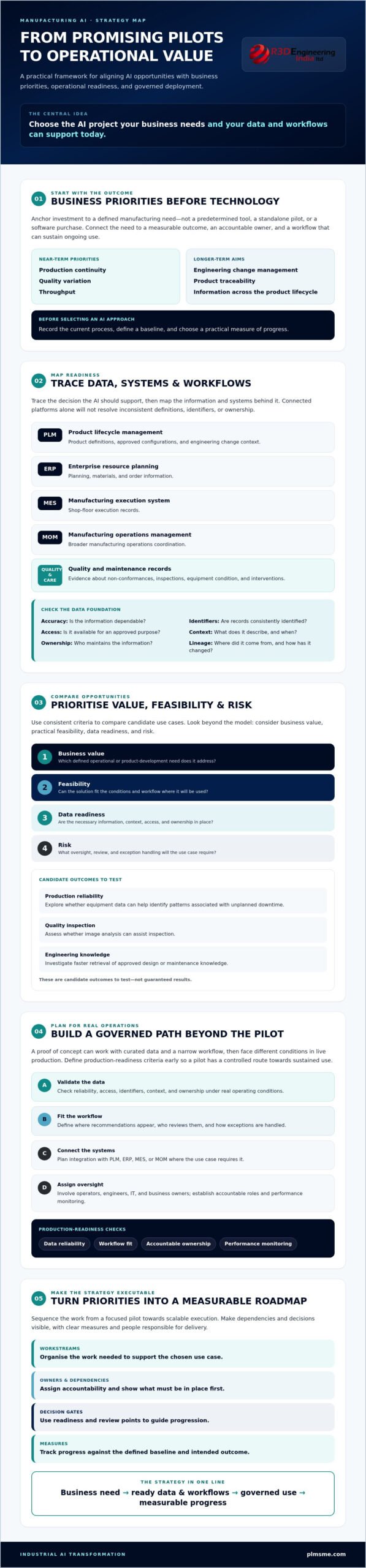
What if the best first AI project for your factory isn’t the most impressive one, but the one your data and workflows can support today? A manufacturing AI transformation strategy connects business priorities with operational readiness. Without that link, promising pilots can remain isolated, while fragmented production and product data makes reliable deployment harder.
Choosing which use cases merit investment means looking beyond the model. Teams need clear success measures, dependable data flows, suitable architecture, and defined governance. Planning for these foundations early can help bridge the gap between a successful proof of concept and sustained operational use.
This article explains how to prioritise AI opportunities against business value and readiness, assess the data and systems they depend on, and plan for the people and oversight needed to support adoption. It also explores how connected platforms such as PLM, ERP, MES, and MOM can contribute to a governed industrial data foundation, then shows how to phase implementation from a focused pilot towards scalable execution.
Key Takeaways
- Anchor AI investment to measurable manufacturing outcomes, rather than treating standalone pilots or software purchases as a strategy.
- Map data ownership, quality, and flow across engineering, production, quality, and maintenance before selecting solutions.
- Use consistent criteria to compare use cases by business value, feasibility, data readiness, and risk.
- Plan the path from pilot to production with clear integration steps, monitoring, review, and accountable roles.
- Turn the manufacturing AI transformation strategy into sequenced workstreams with owners, dependencies, decision gates, and measures.
Why Manufacturing AI Transformation Strategy Must Start with Business Priorities
A manufacturing AI transformation strategy is a prioritised plan connecting AI capabilities to business outcomes, operational workflows, and the systems needed to support them. Start with the problems the manufacturer needs to solve, not a predetermined technology or a desire to “use AI.” This distinction matters in an Industry 4.0 programme, where connected systems and data can support decisions across the product lifecycle.
An isolated proof of concept tests whether an approach might work in specific conditions. An automation project may improve a defined task, and a software purchase may add functionality. None of these alone sets enterprise priorities, addresses integration, assigns ownership, or defines how results will be measured and sustained.
Strategic AI adoption connects a defined business need to measurable outcomes, accountable owners, and workflows that can support ongoing use.
What should manufacturing AI transformation achieve?
Begin with operational and product-development objectives. A plant focused on production reliability might explore whether equipment data can help identify patterns associated with unplanned downtime. A quality team could assess whether image analysis can assist inspection, while engineering might investigate faster retrieval of approved design or maintenance knowledge. These are candidate outcomes to test, not guaranteed results.
Separate immediate operational needs from longer-term goals. Near-term priorities may include production continuity, quality variation, or throughput. Longer-term aims can involve engineering change management, product traceability, and better use of information across the product lifecycle. For each priority, record the current process, define a baseline, and choose a practical measure of progress before selecting an AI approach. This keeps investment decisions grounded in the work teams need to improve.
Why do manufacturing AI pilots struggle to scale?
A demonstration can perform well with a curated dataset and a narrow workflow, then encounter different conditions in live production. Equipment records may use inconsistent identifiers; engineering documents, quality findings, and maintenance histories may sit in separate systems. If data access, context, and ownership aren’t clear, the model’s output may be difficult to trust or reproduce.
Production deployment also requires more than technical validation. Teams need to know where AI recommendations appear in existing workflows, who reviews them, and how exceptions are handled. Integration with enterprise platforms such as PLM, ERP, MES, or MOM may be necessary, depending on the use case. Operators, engineers, IT, and business owners should help shape the process so it reflects operational realities.
Scale is therefore a strategy question as much as a model question. Define production-readiness criteria early, including data reliability, workflow fit, accountable ownership, and a method for monitoring performance. A pilot can then become a controlled step towards broader value, rather than an isolated success with no clear route into everyday operations.
Build the Manufacturing AI Foundation Across Data, Systems, and Workflows
A dependable AI application needs more than a large volume of information. Data must be accurate, consistently identified, accessible for an approved purpose, and accompanied by context: what a record describes, when it was created, and which process or product it relates to. Ownership clarifies who maintains that information, while lineage shows where it came from and how it has changed. Without these foundations, an AI output may be difficult to validate or use appropriately.
Manufacturing AI is only as dependable as the contextualised, governed data behind its outputs. A manufacturing AI transformation strategy should map information and workflows before choosing an application. Connecting platforms alone won’t resolve inconsistent definitions, identifiers, or ownership.
Which manufacturing systems and data sources matter?
Start by tracing a relevant decision through the systems that support it. PLM can provide product definitions, approved configurations, and engineering change context. ERP can contribute planning, materials, and order information. MES records shop-floor execution, while MOM can connect and coordinate broader manufacturing operations. Quality and maintenance records add evidence about non-conformances, inspections, equipment condition, and interventions.
For example, investigating a recurring defect may require linking a production record to the relevant product revision, process conditions, inspection result, and corrective action. Identify each authoritative source, the identifiers used to connect records, and the interfaces through which information moves. PLM, ERP, MES, and MOM each have defined roles; no single platform automatically harmonises their data or integrations.
How should leaders assess AI readiness?
Assess readiness against the needs of a specific use case, not as an abstract technology score. Review data quality and context, integration paths, infrastructure capacity, cybersecurity controls, staff skills, and ownership of the business process. Then distinguish blockers from improvements that can happen in parallel. Missing product identifiers may prevent a particular model from being tested reliably, while training teams or documenting interfaces can progress alongside remediation.
- Data: Are records complete, current, and consistently identified?
- Integration: Can required information move between source systems and the AI workflow?
- Governance and security: Are access, responsibility, and review processes defined?
- People and process: Who will interpret outputs, handle exceptions, and maintain the workflow?
A digital maturity assessment can help reveal these dependencies and shape practical next steps. For a deeper discussion, see this digital maturity report in manufacturing. The World Economic Forum’s guide to scaling AI in industrial operations also examines the shift from pilots towards deployment. Use these resources to check whether your architecture, data, and workflows can support the use cases under consideration.
Prioritise Manufacturing AI Use Cases by Value, Feasibility, and Risk
Once you understand the data and workflow foundations, compare candidate use cases using the same criteria. A practical shortlist weighs business value, feasibility, data readiness, integration effort, ownership, and risk. The table is a starting point for discussion, not a set of universal scores. A use case that is feasible in one plant may be unsuitable in another because its processes, records, or operating constraints differ.
| Candidate use case | Potential value | Feasibility and data readiness to assess | Key risks to review |
|---|---|---|---|
| Predictive maintenance | Support equipment reliability and maintenance planning | Equipment history, condition signals, and links to maintenance actions | Signal quality, integration with work orders, and safe human review |
| Visual quality inspection | Assist inspection consistency and defect identification | Representative inspection evidence and agreed defect definitions | Missed or misclassified defects, escalation rules, and operator trust |
| Engineering knowledge retrieval | Help teams find relevant product and engineering information | Controlled documents, product structures, revision status, and change records | Access controls, outdated answers, and clear source traceability |
Which AI use cases fit different manufacturing challenges?
Match each candidate to the decision it should support. Maintenance models need a meaningful relationship between equipment history, condition data, and the maintenance workflow. Quality applications depend on inspection evidence, consistent defect definitions, and a process for escalating uncertain results. Engineering knowledge retrieval must respect product structures, document controls, and engineering changes, so users can distinguish current information from superseded records.
System boundaries matter. Before selecting a tool, map which applications hold the relevant information and how it can be used in the intended workflow. PLM system architecture consulting can help clarify how product information and connected systems fit within an overall architecture.
How can teams compare value with implementation risk?
Score each use case against agreed criteria, then record the evidence and assumptions behind each rating. Include strategic alignment and potential operational impact alongside data availability, integration effort, and a named accountable owner. Review cybersecurity, explainability, safety implications, and human oversight wherever the application could influence consequential production or quality decisions.
Set a baseline before a pilot begins. Choose measures tied to the problem, such as downtime patterns, inspection outcomes, or the time needed to locate approved engineering information. Specify how those measures will be collected and reviewed, without assuming a result in advance. This gives the manufacturing AI transformation strategy a defensible basis for sequencing work and deciding whether a candidate is ready to advance.
Move from AI Pilots to Governed Manufacturing Deployment
A pilot becomes valuable when it tests not only whether a model can perform, but whether the whole operating process can support its use. Build a controlled progression from baseline to review, assigning an owner at each stage. This keeps technical performance, production needs, and accountability connected as an application moves towards deployment.
What should a manufacturing AI pilot prove?
Before testing, document the baseline, scope, data requirements, success measures, and decision owner. Test against representative operating conditions, including normal variation and relevant exceptions, rather than relying only on curated or historical datasets. Agree in advance what evidence would justify stopping, revising, or scaling the pilot. Operations and engineering should validate the results alongside IT and data specialists, while the business owner decides whether the use case remains worthwhile.
What changes when a pilot enters production?
Production use introduces live interfaces, workflow dependencies, and ongoing responsibilities. Plan how AI outputs reach the people or systems that need them, and what happens when inputs are missing or a result is uncertain. Define who reviews recommendations, approves model or data changes, handles incidents, and gathers user feedback. Training and process adoption belong in the deployment plan, not as follow-up tasks.
A practical sequence assigns clear responsibilities at every step:
- Define the baseline: The business owner and operations team establish the current process and measures.
- Validate data: Data and engineering roles check sources, quality, access, and operating context.
- Run the pilot: Operations tests the agreed use case; IT supports the environment and integration.
- Integrate: IT and engineering connect the application to approved systems and workflows, with operations confirming the fit.
- Monitor and review: Named business, operations, and technical owners review performance, exceptions, user feedback, and whether the original measures still apply.
Build governance into this sequence. Set review points for model performance and data changes, define change-control responsibilities, and establish fallback procedures so staff know how to continue the process if the AI service is unavailable or its output is unsuitable. The right fallback depends on the use case and its operational risk; document and test it before deployment.
To connect deployment planning with a practical manufacturing AI transformation strategy, discuss AI roadmap consulting with PLM-Sme FZC.
Turn the Manufacturing AI Strategy into a Measurable Roadmap
A roadmap turns selected use cases into coordinated work, with dependencies, owners, decision gates, and measures. It should show not only which AI initiatives come first, but what must be in place for each one to proceed. A use case that depends on inconsistent records, for example, may need a data-quality workstream before integration or model development can begin.
Sequence activities according to assessed readiness, rather than forcing every manufacturer into the same timeline. Some organisations may be ready to test a focused application while improving data governance in parallel. Others may need to clarify system architecture, process ownership, or workforce capabilities first. Digital maturity findings can help distinguish immediate blockers from longer-term capability improvements.
What belongs in an actionable AI roadmap?
For each initiative, document the business need, enabling capabilities, dependencies, accountable owner, decision gates, and review points. Define measures before committing to scale. Business measures might track a relevant operational outcome, while technical measures assess data quality, integration performance, or how often outputs require human correction. Set a baseline and specify who will review the evidence and decide what happens next.
- Use case: State the intended outcome and the workflow it supports.
- Enablers: Record required data, architecture, governance, skills, and integration work.
- Ownership: Name business and technical leads responsible for delivery and ongoing review.
- Decision gates: Define what evidence is needed to proceed, revise, pause, or stop.
- Measures: Track operational value alongside system and data readiness.
Review the roadmap as operating conditions, organisational priorities, and data readiness change. Connected-system planning can involve dependencies across product lifecycle and operational platforms. An industrial digitalisation roadmap should make those dependencies visible, showing which capabilities need to be established before each use case can move forward.
When should manufacturers involve a specialist adviser?
An independent assessment can help when priorities compete, maturity is unclear, or system dependencies make sequencing difficult. If product lifecycle information is central to a use case, PLM architecture and Teamcenter integration may be relevant parts of the wider plan. The aim is to understand how systems and data fit together, not to assume that one platform resolves every integration need.
A practical manufacturing AI transformation strategy should remain adaptable while keeping decisions traceable to business needs and readiness. To discuss digital maturity assessment or roadmap requirements, contact PLM-Sme FZC.
Build Your Next Steps Around Readiness and Results
A manufacturing AI transformation strategy is strongest when it starts with business priorities, accounts for the data and systems behind each use case, and sets clear measures before implementation. Prioritise opportunities by value, feasibility, and risk, then move from pilot to production through defined ownership, governance, and review.
The roadmap should reflect your organisation’s actual maturity, dependencies, and operating needs, not a fixed timeline. A digital maturity assessment can help identify capability gaps and clarify which steps are ready to advance. Where product lifecycle information is central, PLM architecture, Teamcenter integration, and administration may also form part of the wider plan.
PLM-Sme FZC provides digital maturity assessment and roadmap consulting, alongside Teamcenter architecture, implementation, integration, and administration. It is a Siemens Digital Industries Alliance Partner. Discuss your manufacturing AI roadmap with PLM-Sme to explore priorities and practical next steps for your organisation.
With a clear sequence and accountable owners, manufacturers can move forward with greater confidence, learning from each step while keeping deployment grounded in operational value.
Frequently Asked Questions
What is a manufacturing AI transformation strategy?
A manufacturing AI transformation strategy is a structured plan for applying AI to business and operational priorities. It identifies which use cases to pursue, what data and systems they depend on, and how to govern and implement them. Unlike a list of tools or isolated experiments, it connects technology decisions to defined outcomes, accountable owners, readiness assessments, and a path from testing into operational use. Teams can review and adjust the plan as needs change.
How do manufacturers choose their first AI use case?
Start with a specific operational or engineering problem, then define what evidence would show progress. Compare candidate use cases by strategic value, data availability, integration effort, risk, and ownership. For example, a maintenance application may depend on usable equipment history and condition signals, while a quality use case needs consistent inspection evidence. Choose a testable scope, set a baseline, and agree success, revision, and stop criteria before the pilot begins.
Is manufacturing AI ready to use with existing factory data?
It can be, but readiness depends on the use case and the data behind it. Check whether relevant records are accurate, consistently identified, accessible, and connected to the right operational context. Also assess system connectivity and who owns the process and information. If gaps emerge, make data remediation or integration explicit workstreams in the plan. Don’t assume existing factory data is immediately suitable just because it can be accessed.
How can manufacturers scale an AI pilot into production?
Scale only after testing the pilot against agreed measures in conditions that reflect real operations. Before deployment, plan system interfaces, workflow changes, user training, monitoring, and human review. Assign owners for model updates, data changes, incidents, and feedback, and document what users should do if an output is unavailable or unsuitable. Clear criteria to scale, revise, or stop help teams treat production adoption as an operational change, not just a technical release.
What role does PLM play in a manufacturing AI strategy?
PLM can provide product definitions, engineering changes, and lifecycle context that may support selected AI applications. For instance, an engineering knowledge tool may need to distinguish current documents from superseded revisions. PLM isn’t a substitute for every operational data source: ERP, MES, and MOM may hold different planning or production information. Map authoritative sources, identifiers, and integration needs for the use case rather than assuming one platform contains everything required.
How should manufacturers measure AI transformation progress?
Define a baseline and measures for each initiative before implementation. Choose indicators that match the intended outcome, such as a relevant operational, quality, engineering, reliability, or adoption measure. Track enabling progress too, including data readiness, integration, governance, and user uptake. The manufacturing AI transformation strategy should specify who reviews the evidence and when. Compare results with the agreed objectives, then use the findings to adjust the use case or roadmap.