
Industrial Digitalization Maturity Audit UAE: The 2026 Strategic Guide
A digital maturity report that sits on a shelf is a wasted investment in the UAE’s rapidly evolving industrial sector. Most manufacturers recognize that conducting a comprehensive industrial digitalization maturity audit UAE is the first step toward resolving fragmented data issues across legacy systems. You’re likely feeling the pressure to align with MoIAT national goals while questioning if your current infrastructure can actually support advanced automation or AI. It’s a common challenge where the desire for progress meets the reality of technical debt.
This guide demonstrates how a structured audit transforms these uncertainties into a strategic vision for 2026. You’ll discover a methodical approach to evaluating your current state and building a vendor-neutral roadmap centered on robust Product Lifecycle Management (PLM) principles. We’ll outline the exact steps to move from a static maturity report to a functional, AI-ready operation that delivers measurable results through improved system architecture and seamless integration. By focusing on objective assessments and Siemens-aligned frameworks, you can ensure your digitalization journey is both strategically sound and technically viable.
Key Takeaways
- Learn how a technical industrial digitalization maturity audit UAE identifies critical data gaps and prepares your facility for advanced automation.
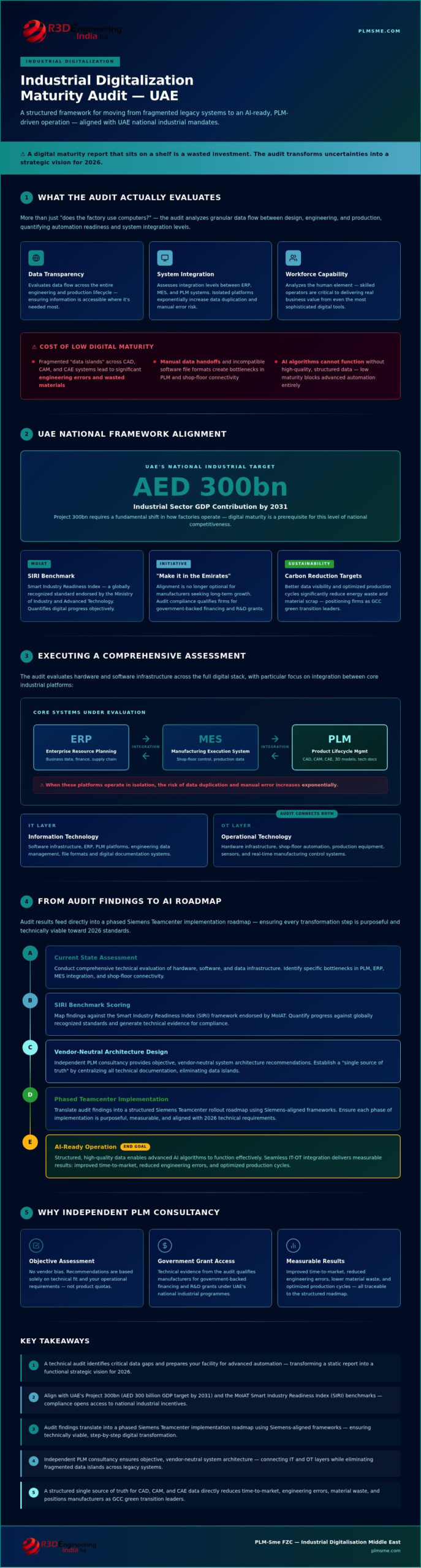
- Align your digital transformation strategy with the UAE’s Project 300bn and the MoIAT Smart Industry Readiness Index (SIRI) benchmarks.
- Master a structured approach to evaluating hardware and software infrastructure to ensure your operations are ready for 2026 standards.
- See how to translate audit findings into a phased Siemens Teamcenter implementation roadmap that facilitates successful AI integration.
- Explore the benefits of independent PLM consultancy for achieving an objective, vendor-neutral system architecture that connects IT and OT.
Defining the Industrial Digitalization Maturity Audit
An industrial digitalization maturity audit UAE represents a comprehensive technical evaluation specifically designed for the modern manufacturing facility. It doesn’t merely look at whether a factory uses computers; it analyzes the granular data flow between design, engineering, and the production floor. By quantifying automation readiness and system integration levels, the audit uncovers hidden inefficiencies that hamper long-term growth. These assessments identify specific bottlenecks in Product Lifecycle Management (PLM) and shop-floor connectivity, such as manual data handoffs or incompatible software file formats. This structured audit is the foundational step for any AI roadmap, ensuring that advanced algorithms have high-quality, structured data to process.
The Core Components of Industrial Maturity
Measuring maturity involves a multi-dimensional approach to a factory’s technical ecosystem. We begin by evaluating data transparency across the entire engineering and production lifecycle to ensure that information is accessible where it’s needed most. A significant portion of the audit focuses on assessing the integration level between ERP, MES, and PLM systems. When these platforms operate in isolation, the risk of data duplication and manual error increases exponentially. Additionally, we analyze the workforce’s capability to manage advanced digital tools. This human element is critical to a successful digital transformation, as even the most sophisticated software requires skilled operators to deliver real business value.
Why Maturity Matters for Discrete Manufacturing
In the discrete manufacturing sector, the complexity of managing CAD, CAM, and CAE data makes digital maturity a necessity rather than an option. Modern industrial environments rely on intricate 3D models and simulation data that must remain consistent across various departments. Without a high maturity score, manufacturers often struggle with fragmented “data islands” that lead to significant engineering errors and wasted materials. Implementing a single source of truth through a robust PLM system architecture resolves these issues by centralizing all technical documentation. This organized structure directly impacts time-to-market for new products. By streamlining the flow from design to delivery, UAE-based manufacturers can respond faster to market demands while maintaining the highest quality standards. Ultimately, the results of an industrial digitalization maturity audit UAE provide the clarity needed to transition from legacy systems to a future-proof, AI-ready architecture.
Navigating National Standards and the MoIAT Framework
Aligning operations with the UAE’s Project 300bn and the “Make it in the Emirates” initiative is no longer optional for manufacturers seeking long-term growth. An industrial digitalization maturity audit UAE serves as the critical bridge between private operational goals and national industrial mandates. By adopting the Smart Industry Readiness Index (SIRI) as a benchmark, companies can quantify their progress against a globally recognized standard endorsed by the Ministry of Industry and Advanced Technology (MoIAT). This alignment isn’t just about compliance; it’s a strategic move to secure national industrial incentives and support. Many firms find that an industrial digitalization maturity audit UAE provides the necessary technical evidence to qualify for government-backed financing and R&D grants.
Digitalization also plays a pivotal role in meeting the nation’s sustainability and carbon reduction targets. Through better data visibility and optimized production cycles, manufacturers can significantly reduce energy waste and material scrap. Audit compliance provides the documentation necessary to prove these efficiencies to regulatory bodies, positioning your firm as a leader in the green industrial transition. These technical improvements ensure that your facility remains viable as environmental regulations tighten across the GCC region.
Project 300bn and the Digital Transformation Push
The UAE’s ambitious goal to increase the industrial sector’s GDP contribution to AED 300 billion by 2031 requires a fundamental shift in how factories operate. Digital maturity is a prerequisite for this level of national competitiveness. Implementing a structured industrial digitalization roadmap UAE allows businesses to meet these government standards while preparing for the 2026 technical requirements. This roadmap ensures that every step of the transformation is purposeful and aligned with the country’s broader economic vision, turning high-level strategy into shop-floor reality.
The Impact of the National ICV Program
The National In-Country Value (ICV) program rewards companies that demonstrate high levels of local investment and operational efficiency. Digitalization directly improves ICV scores by localizing technical expertise and building more resilient supply chains through real-time data sharing. When your digital maturity is high, you’re better equipped to participate in major national initiatives and secure government contracts. To begin this alignment, many leaders start with specialized digital maturity assessments and reports to identify where their current infrastructure falls short of national benchmarks. This objective evaluation ensures that your investment in technology translates into tangible advantages within the local market.
Executing a Comprehensive Digital Maturity Assessment
Executing a successful industrial digitalization maturity audit UAE requires a structured, multi-phase approach that moves beyond high-level strategy into technical reality. The process begins with stakeholder engagement to define clear objectives, ensuring that IT, engineering, and production teams are aligned on the desired outcomes. Once goals are set, we conduct an on-site technical evaluation of existing hardware and software infrastructure to document the current state of the facility. This isn’t a superficial checklist; it’s a deep dive into the actual tools your team uses every day.
Mapping data flows follows the physical inspection, tracing information from the initial design phase through to manufacturing execution. We look for friction points where data is manually re-entered or lost between systems. A rigorous gap analysis follows, comparing these findings against industry-leading digital benchmarks to see where your facility stands. The final step is the delivery of a comprehensive digital maturity report manufacturing executives use to justify investment and prioritize technical upgrades. This report provides the objective evidence needed to secure internal buy-in for the next stage of your transformation.
Evaluating System Architecture and Connectivity
A core focus of the audit is reviewing the interoperability of Siemens Teamcenter with legacy systems. We identify “data silos” where information is trapped within specific departments, preventing real-time decision-making across the organization. By assessing the scalability of current PLM system architecture consulting models, we determine if your digital foundation can support future growth. It’s not enough to have the right tools; they must be connected in a way that allows for a seamless, bidirectional flow of technical data. This ensures that engineering changes are reflected on the shop floor without delay.
Benchmarking AI and Automation Readiness
Transitioning to AI-driven operations depends entirely on the quality of your underlying data. During the industrial digitalization maturity audit UAE, we determine if existing data sets are clean and structured enough for AI implementation. We also evaluate shop floor connectivity through Manufacturing Operations Management (MOM) and Manufacturing Execution Systems (MES) integration. This analysis reveals whether your facility is ready for advanced technologies like predictive maintenance and digital twins. Without this granular level of detail, AI initiatives often fail because the “digital thread” connecting design to the shop floor is broken. We provide the technical clarity required to bridge that gap.
Translating Audit Findings into a Scalable AI Roadmap
Once the industrial digitalization maturity audit UAE identifies specific technical gaps, the focus shifts toward strategic prioritization. We rank investments based on their potential to resolve immediate production bottlenecks while building the necessary data architecture for future AI applications. This phased approach prevents the common trap of attempting an “all-at-once” implementation, which frequently leads to system rejection or budget overruns. By developing a clear timeline for Siemens Teamcenter deployment, manufacturers ensure each module delivers measurable value before moving to the next level of technical complexity.
Success depends on setting granular KPIs for every stage of the digital transformation journey. These metrics might include reductions in engineering change order (ECO) cycle times or significant improvements in first-pass yield rates. Integrating industrial automation solutions GCC into your long-term vision ensures that your physical shop floor evolves in tandem with your digital systems. This synchronization is vital for achieving the “AI-ready” status required by 2026 standards. To begin building your specific timeline, consider our Digitalization Vision & Roadmap Consulting services to ensure technical alignment from day one.
Phase 1: Foundation and Data Consolidation
The initial phase focuses on stabilizing engineering data through core PLM modules. We establish rigorous data migration protocols to move technical assets from legacy CAD systems into a centralized, secure environment. This stage isn’t just about software; it involves training key personnel to operate within a new, structured digital ecosystem. By creating a single source of truth early on, you eliminate the risk of propagating “dirty data” into advanced automation layers. It’s the essential groundwork that makes predictive modeling possible in later stages.
Phase 2: Integration and Optimization
With a stable foundation, we expand Siemens Teamcenter consulting to bridge the gap between engineering and business systems. This involves creating seamless connectivity with ERP and CRM platforms to ensure information flows freely across the enterprise. Deploying Teamcenter CRM integration benefits provides end-to-end visibility, allowing sales and production teams to work from the same live data set. Finally, we launch pilot AI projects, such as demand forecasting or automated quality control, to prove the roadmap’s effectiveness in a controlled, high-impact environment.
Leveraging Independent PLM Consultancy for Objective Transformation
Selecting the right partner to interpret your industrial digitalization maturity audit UAE results determines whether your roadmap succeeds or stalls. Vendor-independent advice remains a critical advantage during this selection phase. While software giants often prioritize their own licensing targets, an independent consultant focuses solely on the technical viability of your system architecture. This objectivity ensures that the tools you implement actually solve your fragmented data issues rather than adding another layer of complexity. Specialized consultants from a boutique firm like PLM-Sme FZC bridge the essential gap between Information Technology (IT) and Operational Technology (OT). They understand that while IT prioritizes data security, OT requires uninterrupted shop floor performance. Balancing these competing needs is vital for maintaining a functional digital thread across your organization.
Why a Boutique Consultancy Outperforms Large Vendors
Boutique consultancies often outperform large global vendors because they provide bespoke solutions tailored to specific discrete industry workflows. Instead of applying a generic template, senior architects engage deeply with your facility’s unique engineering challenges. This hands-on approach allows for agile implementation strategies that minimize production downtime during the transition. You’re not dealing with a rotating cast of junior account managers; you have direct access to Siemens Teamcenter experts who’ve navigated the UAE’s specific regulatory and industrial landscape since 2017. This localized expertise ensures your digitalization efforts align perfectly with national goals like Project 300bn without the overhead of a one-size-fits-all provider.
Securing Long-Term Success with Retainer Support
Securing long-term success requires moving beyond the initial industrial digitalization maturity audit UAE into a phase of continuous improvement. A one-off report identifies gaps, but ongoing PLM system administration maintains the maturity levels achieved during implementation. Retainer-based support allows for constant optimization of your digital environment based on real-time operational data. As emerging AI technologies become available in 2026 and beyond, having a dedicated partner ensures your roadmap evolves to incorporate these advancements seamlessly. This proactive maintenance prevents system degradation and ensures your investment continues to deliver high efficiency and improved time-to-market for your products.
Securing Your Industrial Future for 2026
Building an AI-ready factory requires more than high-level ambition; it demands a technically sound foundation. By conducting a structured industrial digitalization maturity audit UAE, you transform fragmented data into a cohesive, scalable system architecture. This process ensures your operations don’t just meet current MoIAT standards but are positioned to lead the sector through 2026 and beyond. Integrating Siemens-backed PLM solutions with a clear, phased roadmap allows you to bridge the gap between legacy systems and advanced automation.
As a Siemens Digital Industries Alliance Partner with specialized discrete industry expertise since 2017, PLM-Sme provides the independent guidance necessary for objective transformation. We offer end-to-end implementation and dedicated retainer support. It’s the most reliable way to ensure your digital environment remains optimized as technologies evolve. Request your comprehensive Digital Maturity Audit from PLM-Sme today and take the first step toward a future-proof manufacturing operation. Your facility’s long-term success starts with a clear technical vision.
Frequently Asked Questions
What is the typical duration of an industrial digitalization maturity audit?
The duration of a technical audit typically ranges from two to four weeks depending on the complexity of the manufacturing facility. This period includes the initial stakeholder engagement, on-site technical evaluations, and the subsequent data flow mapping. Smaller operations might conclude sooner, while large discrete industry plants require more time to assess the full integration of ERP and PLM systems. The final delivery is a comprehensive report that outlines your current standing and future roadmap.
How much does a digital maturity assessment cost for a UAE manufacturer?
Professional service fees for a digital maturity assessment vary based on the specific scope of the project and the technical depth required. Factors such as the number of departments included, the complexity of existing legacy systems, and the level of integration with Siemens Teamcenter influence the final investment. We provide tailored proposals that reflect the unique requirements of each manufacturer, ensuring the assessment delivers a clear, actionable vision for your digitalization journey without using one-size-fits-all pricing.
Is a digitalization audit mandatory for government industrial incentives?
While not always a legal requirement for all businesses, an industrial digitalization maturity audit UAE is often a prerequisite for accessing national industrial incentives. Programs like Project 300bn and the Smart Industry Readiness Index (SIRI) use these assessments to verify eligibility for government-backed financing and technical support. Demonstrating a high level of digital maturity through a structured audit helps manufacturers align with national goals and secure competitive advantages in the local market through MoIAT initiatives.
What is the difference between a digital maturity audit and an IT audit?
An IT audit primarily focuses on hardware maintenance, cybersecurity, and general software compliance across the organization. In contrast, a digitalization maturity audit examines the technical flow of data between engineering and production. It specifically analyzes the integration of Product Lifecycle Management (PLM) with shop floor operations. This evaluation determines how effectively your systems support complex manufacturing processes and whether your current architecture is capable of handling advanced automation or AI applications in a production environment.
Can a maturity audit be performed remotely or is a site visit required?
A comprehensive audit usually requires on-site technical evaluations to accurately assess hardware infrastructure and shop floor connectivity. While some initial stakeholder meetings and data reviews can occur remotely, physically inspecting the integration between MES and production equipment is essential. This ensures that the resulting digital maturity report reflects the actual state of your facility. A site visit allows consultants to identify “data silos” and manual friction points that remote assessments might overlook during the evaluation.
How often should a manufacturing firm undergo a digitalization audit?
Manufacturing firms should consider undergoing a digitalization audit every 18 to 24 months to ensure their technical roadmap remains current. This frequency allows you to adjust your strategy based on emerging technologies and real-time operational data. If your facility undergoes a major system implementation, such as a new Siemens Teamcenter module or an ERP upgrade, an interim audit is recommended. Regular assessments help maintain high maturity levels and prevent technical debt from accumulating as your operations expand.
What information is required from the manufacturer before the audit begins?
Before the audit begins, manufacturers should provide a list of current software platforms, including ERP, MES, and CAD/CAM tools. Documentation regarding existing process maps, data flow diagrams, and a list of key stakeholders from both IT and engineering departments is also necessary. Having this information ready allows the consultancy team to move quickly into the technical evaluation phase. Clear visibility into your technical assets ensures the audit provides a more accurate and useful gap analysis for your transformation.
How does the audit specifically address AI readiness?
The audit specifically addresses AI readiness by evaluating the cleanliness and structure of your current datasets. AI algorithms require high-quality, centralized data to deliver accurate demand forecasting or predictive maintenance results. We analyze your PLM system architecture to determine if the “digital thread” is strong enough to support machine learning models. By identifying gaps in data transparency and system integration, the audit provides a clear path toward building a scalable, AI-ready manufacturing environment that meets 2026 standards.