
Industrial Digital Transformation Audits for Discrete Manufacturing
Digital transformation should start with evidence, not a technology purchase. An industrial digital transformation audit for discrete manufacturing establishes a current-state baseline across management digitalization and technology readiness, then uses a 0-3 maturity scale to show where capabilities stand. The result is a clearer basis for choosing the first practical step.
Manufacturers are increasingly looking to automation, AI, and connected systems to improve operations. But without a clear picture of processes, data, and existing systems, it is hard to know which investment should come first. An industrial digital transformation audit for discrete manufacturing helps turn broad ambitions into priorities grounded in the operation’s actual needs.
This article explains what to examine, how to score maturity using operational evidence, and how to translate findings into a phased starting point. It also covers how to assess core manufacturing systems and integrations, and when specialist assessment and roadmap support can help shape next steps.
Key Takeaways
- Map current processes, data flows, and business priorities to identify where digital change can address operational constraints.
- Assess management practices alongside technology readiness, then connect improvement targets to measurable business outcomes.
- Use documented evidence to distinguish established capabilities from gaps and build a credible maturity score.
- Review how production technologies and enterprise systems work together before prioritizing pilots or roadmap initiatives.
Consulting support and current-state audits
For a smart factory in the UAE, map the federal and emirate-level requirements that apply to its sector, data, and facility role. Document the cybersecurity standards and controls required by regulators, customers, and internal policy. Applicability depends on the operation, not simply on whether it uses connected equipment.
A current-state audit tests how work actually moves across production, engineering, maintenance, and business systems. For example, compare a machine’s downtime record with its maintenance ticket and production schedule. Differences reveal whether teams can rely on shared data or must manually reconcile separate records.
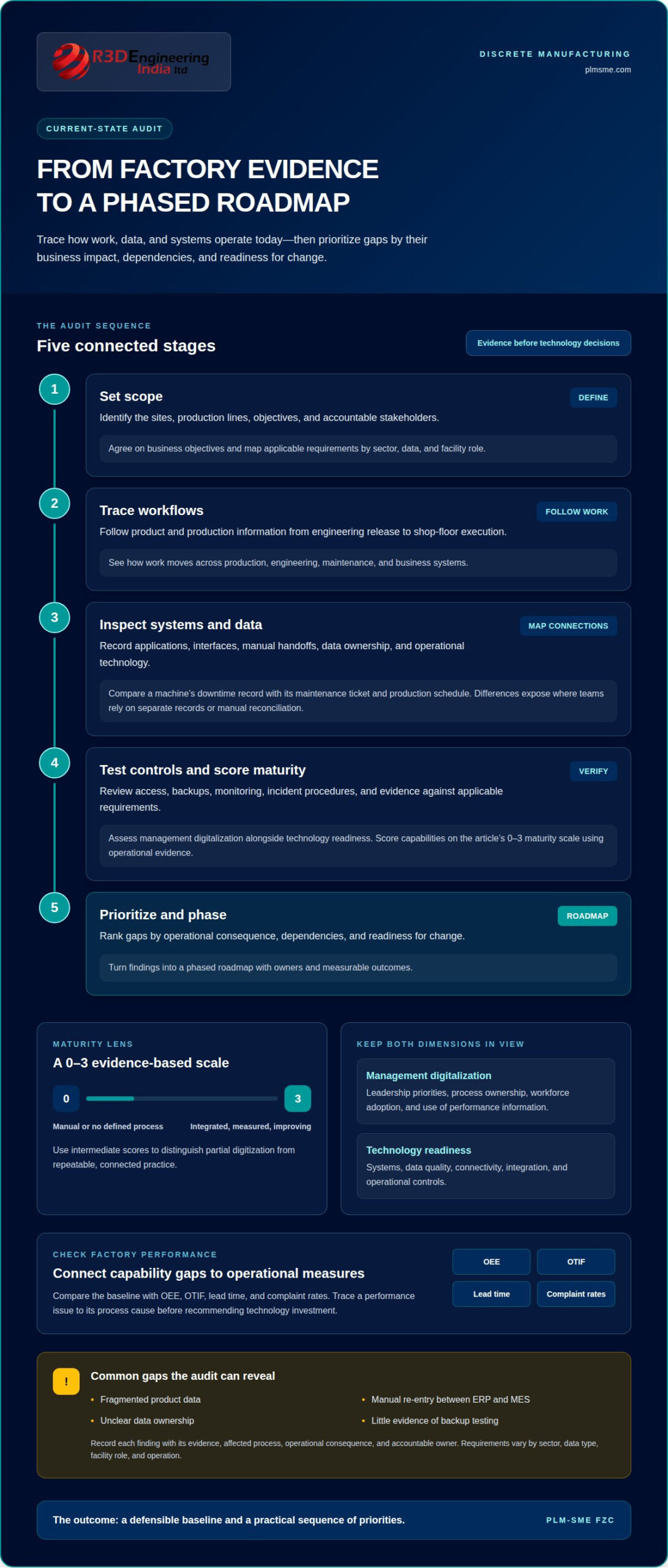
Which are the key stages of a factory digital transformation audit? Agree on business objectives, then map processes, applications, data flows, and operational technology. Inspect evidence, score maturity, prioritize gaps by business impact, and turn the findings into a phased roadmap with owners and measurable outcomes.
Keep the assessment tied to factory performance. Review OEE, OTIF, lead time, and complaint rates alongside process evidence. A production delay may stem from equipment availability, engineering-change handling, or late material information. Tracing the cause helps prevent a technology purchase from masking the underlying issue.
- Set scope: identify sites, production lines, objectives, and accountable stakeholders.
- Trace workflows: follow product and production information from engineering release to shop-floor execution.
- Inspect systems: record applications, interfaces, manual handoffs, and data ownership.
- Test controls: review access, backups, monitoring, and incident procedures against applicable requirements.
- Prioritize: rank gaps by operational consequence, dependencies, and readiness for change.
What common risks and gaps appear in audits? Typical findings include fragmented product data, manual re-entry between ERP and MES, unclear data ownership, and little evidence of backup testing. These gaps can lead to inconsistent work instructions, delayed decisions, and avoidable production disruption.
Separate immediate control weaknesses from longer-term capability gaps. An untested backup, for example, needs a different response from an ERP-to-MES integration constraint. Record each finding with its evidence, affected process, operational consequence, and accountable owner. This makes prioritization transparent and roadmap decisions easier to justify.
Applicable requirements vary by sector, data type, facility role, and operation, and may include federal and emirate-level requirements. Document the cybersecurity standards and controls required by regulators, customers, and internal policy. Connected equipment alone does not determine which requirements apply.
Digital maturity assessment
Digital maturity models measure different things. Some focus on technology deployment; others assess management practices and technology readiness together. For discrete manufacturers, the broader view links digital tools to production decisions, engineering workflows, and measurable operating outcomes.
Assess both dimensions. Management digitalization covers leadership priorities, process ownership, workforce adoption, and how teams use performance information. Technology readiness examines systems, data quality, connectivity, integration, and operational controls. A factory may have connected equipment but unreliable production data or unclear ownership of engineering changes. Technology presence alone can overstate maturity.
Use business objectives to make the assessment relevant. For each function, identify a production or customer outcome, its current measure, and the digital capability that could influence it. One global discrete manufacturer’s digitalization analysis used three-year targets and translated performance KPIs into financial impact. This approach links maturity findings to business decisions instead of treating a higher score as the goal.
Compare the baseline with operational measures such as OEE, OTIF, lead time, and complaint rates. If OTIF performance is weak, for example, trace whether planning information, production visibility, or engineering changes contribute. The assessment should distinguish a process constraint from a technology gap before recommending investment.
- Management: review ownership, decision rights, change adoption, and KPI use.
- Technology: assess data reliability, system connectivity, access controls, and maintainability.
- Business alignment: connect each gap to an operational measure and priority.
- Readiness: establish reliable data and foundational capabilities before relying on advanced technologies such as AI and robotics.
Compare manufacturing sites or functions using consistent definitions, then record where local processes require different targets. A design team and a production line may need distinct capability measures, even when both support the same product-delivery objective. This keeps comparisons useful without mistaking process variation for poor performance.
For a practical baseline, use a digital maturity assessment framework that relates capability findings to factory goals and evidence. The resulting priorities can guide which gaps deserve attention first.
Digital maturity scoring and evidence sources
A 0-3 scale can translate maturity findings into a consistent view across factory functions. At level 0, work remains manual or lacks a defined process; level 3 represents integrated, measured, and improving capability. Use the intermediate scores to distinguish partial digitization from repeatable, connected practice, and define those criteria before assessment begins.
Score each capability against observable evidence, not confidence or intent. A team may report that production data is integrated, for example, while system logs show manual transfers between applications. Record the score, evidence, process owner, and operational impact together. This keeps comparisons across engineering, production, and maintenance grounded in a consistent method.
What data, documents, and stakeholder interviews are needed for a manufacturing audit? Gather screenshots, system logs, backup-test results, BI reports, documented procedures, and ERP or PIM samples. Interview operators, planners, engineering, maintenance, quality, and IT/OT stakeholders to compare documented workflows with daily practice.
- Screenshots: capture dashboards, workflow states, and access settings relevant to the assessed capability.
- Logs: examine interface activity, system errors, and records showing whether data moves automatically.
- Backup tests: review results as evidence that recovery procedures have been exercised.
- BI reports: compare reported measures with the underlying operational records.
- Procedures and samples: compare written instructions with ERP or PIM records and actual work.
Triangulate evidence before assigning a score. If a procedure describes an automated approval, compare it with workflow screenshots, event logs, and employee accounts. Agreement across these sources supports a stronger finding; conflicting evidence signals a process gap that needs clarification.
Keep the scoring record actionable. For every capability, note the evidence reviewed, the reason for its score, the affected process, and the next improvement step. A low score due to missing integration requires a different response from one caused by unreliable source data. This distinction helps teams sequence work and measure whether later changes improve maturity.
What technologies and systems should a discrete manufacturing audit assess?
Assess the full path from product definition to production reporting. The European Commission identifies advanced manufacturing and robotics, artificial intelligence, big data and cloud, photonics, digital security, blockchain, and the Internet of Things as underpinning technologies. In a factory audit, prioritize capabilities that directly support production needs.
At the equipment level, examine whether IoT devices collect usable data from machinery, equipment, and production lines. Check how AI uses manufacturing data for demand forecasting or machine-failure prediction. A factory digital twin can model floor layouts and simulate production conditions, helping teams investigate potential bottlenecks before changing schedules or processes.
Review network and automation readiness alongside use cases. Private 5G can provide dedicated infrastructure for large-scale manufacturing operations. Robotics and collaborative robots may support repetitive or hazardous tasks, while energy and material data can help identify waste. The audit should connect each technology to a defined operational decision, not treat installation as the outcome.
- Production systems: assess machine connectivity, automation, sensor data, and how operators access instructions.
- Business applications: map ERP, CRM, and WMS data flows to production planning and customer commitments.
- Engineering information: trace product definitions and approved changes into manufacturing processes.
- Integration: review APIs, ESBs, or webhooks, and identify manual imports or unmonitored interface errors.
Follow a sample order from customer demand through planning, engineering, production, and delivery. At each handoff, identify which system owns the record, how updates move, and where duplicate entry occurs. This reveals whether centralized data collection and production automation support operational decisions or leave teams reconciling disconnected records.
Assess cybersecurity and resilience across connected systems. Review access policies, multi-factor authentication, security training, phishing tests, tested backups, monitoring, and alerting. These controls help teams understand how access is managed and how system issues are detected and recovered from.
To connect technology choices with operational requirements, plan an industrial automation and AI assessment around specific production use cases and system dependencies.
PLM-Sme FZC: Digital maturity assessments and reports
PLM-Sme FZC provides digital maturity assessments and reports to help discrete manufacturers turn audit findings into priorities. This support is useful when teams need an evidence-based view of current capabilities, clearer transformation objectives, or a practical basis for sequencing initiatives.
The assessment can inform Digitalisation Vision & Roadmap Consulting, connecting identified gaps with business goals and implementation priorities. Where findings point to automation or AI opportunities, industrial automation and AI solutions can address relevant use cases. System and Solution Architecture can shape how applications and data flows support the target state.
This support is most useful when audit results need to guide action rather than remain a scorecard. PLM-Sme FZC can align assessment findings, roadmap decisions, and architecture considerations with the manufacturer’s needs. Contact PLM-Sme FZC to discuss a digital maturity assessment.
Turn audit findings into a focused next step
An industrial digital transformation audit for discrete manufacturing is most valuable when its findings shape decisions, not just document the current state. Choose a priority that addresses a real operational constraint, assign ownership, and define how progress will be evaluated. This discipline keeps transformation work connected to factory needs as systems and processes evolve.
When you need help moving from assessment to action, PLM-Sme FZC offers digital maturity assessments and reports, Digitalisation Vision & Roadmap Consulting, and industrial automation and AI solutions. These services can help manufacturers clarify priorities, develop a practical direction, and explore relevant use cases without treating technology adoption as an end in itself.
Bring your audit questions and transformation priorities into a focused discussion. Contact PLM-Sme FZC to discuss your audit and consider a clear, evidence-led next step for your operation.
Frequently Asked Questions
Digital Transformation / How to Start?
Start with a business outcome that matters to the factory, such as reducing delays between engineering release and production. Identify the process owner, the decision causing friction, and the information needed to improve it. Map the current workflow, then select a contained use case to test. This gives leaders a practical starting point without committing to broad technology changes before understanding the operational need.
What is an industrial digital transformation audit for discrete manufacturing?
It is a structured review of how digital capabilities support the design and production of distinct products. An audit can trace a customer order through product configuration, engineering approval, production, and delivery, for example. This can reveal where information changes meaning or arrives too late for a decision. The aim is to connect digital capability gaps to specific manufacturing needs, rather than assess technology in isolation.
Which KPIs measure digital maturity and audit outcomes in discrete manufacturing?
Use measures that show whether digital processes are reliable and useful, such as master-data completeness, engineering-change workflow cycle time, and the proportion of forecast exceptions resolved with current information. Define each KPI’s calculation, system of record, owner, and review cadence before comparing performance. A shorter workflow time matters only if approvals remain controlled and teams use the released engineering data.
How should manufacturers prioritize audit findings and build a digital transformation roadmap?
Rank findings by operational impact, prerequisite dependencies, implementation readiness, and the people or systems needed to address them. A data-quality issue may need attention before an AI use case can produce dependable results. Group related work into decision-ready initiatives, assign accountable owners, and define a measurable outcome for each. Revisit priorities as evidence changes, so the roadmap reflects factory constraints rather than a fixed technology wish list.