
Industrial Automation and PLM Alignment Consulting: A Practical Guide
How can manufacturers make industrial automation and PLM work as one coordinated transformation rather than two separate initiatives? The challenge is rarely a lack of technology. Engineering and shop-floor teams may work from disconnected information, while unclear ownership leaves overlapping projects competing for investment. Industrial automation and PLM alignment consulting helps connect lifecycle objectives to operational priorities, so local improvements support wider business goals.
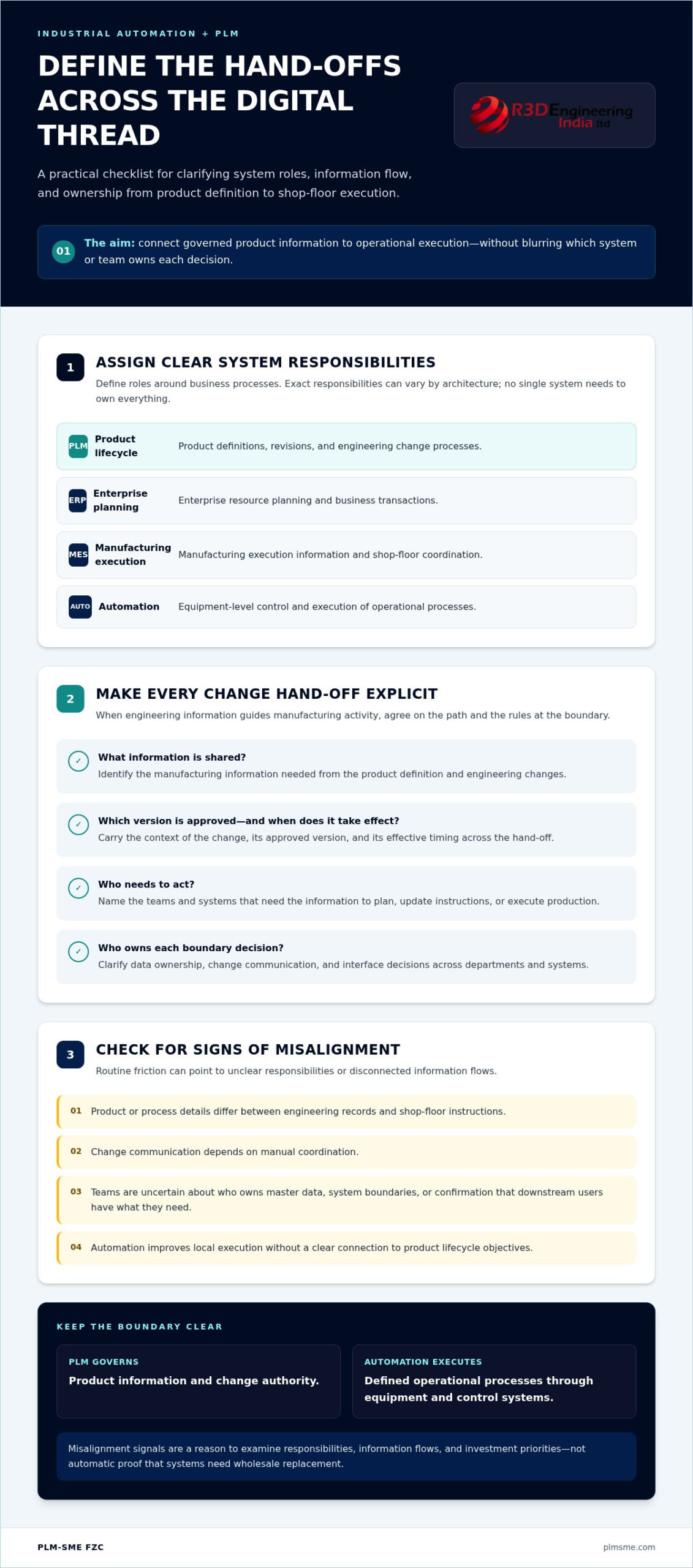
PLM typically governs product and engineering information, while automation executes production processes. The difficult work is defining where those responsibilities meet, how data should move between systems, and who owns decisions at each boundary. Without that clarity, a technically successful deployment can still leave lifecycle goals unmet.
This guide explains how to establish clear boundaries across PLM, automation, and connected enterprise systems, then sequence priorities, architecture, and implementation. It also shows how consulting can bridge strategy and delivery, from maturity assessment and roadmap development to Teamcenter integration and ongoing system administration. The aim is a practical plan that gives engineering and operations a shared direction.
Key Takeaways
- Define clear responsibilities for PLM, ERP, MES, and automation so teams know where information is managed and how it moves between systems.
- Trace the digital thread from product definition and engineering changes to the manufacturing information needed for production.
- Coordinate projects around shared objectives, ownership, dependencies, and governance without assuming every system or initiative must be replaced or combined.
- Use a readiness sequence to clarify outcomes, map systems and ownership, assess gaps, prioritise work, and build a practical roadmap.
- See how industrial automation and PLM alignment consulting can connect assessment and architecture with implementation and ongoing system administration.
Why industrial automation and PLM alignment matters to manufacturers
Manufacturers often invest in product lifecycle management (PLM) and industrial automation to meet different operational needs. PLM governs product information, including definitions, revisions, and engineering change decisions. Automation supports production execution through equipment, control systems, and operational processes. These domains have distinct responsibilities, but their decisions meet wherever engineering information guides manufacturing activity.
Alignment means coordinating business objectives, information ownership, and system responsibilities across product and production contexts. It doesn’t mean forcing every team onto one platform. It means deciding which information is authoritative, how approved changes reach the people and systems that need them, and who is accountable when a process crosses departmental or technical boundaries.
Without that coordination, engineering and operations can work from different assumptions. For example, a released design revision may not be reflected in work instructions or manufacturing plans at the same time. Depending on the process and systems involved, this gap can lead to rework, confusion, or delays in communicating a change. An industrial automation solutions overview can help frame automation priorities within a wider transformation discussion.
Where product lifecycle decisions meet automated operations
Consider a discrete manufacturer assembling a product with several configurable components. PLM holds the approved product definition and manages engineering changes. When a revision is released, relevant manufacturing information may need to inform planning, work instructions, or production-system configuration. Automation then executes the defined process on the shop floor. It doesn’t decide whether the product design is approved.
This distinction matters. Lifecycle governance controls product information and change authority, while machine-level control manages operational execution. The hand-off needs a defined path, with clear rules for what information is shared, when it is shared, and which system or role owns each step. For a foundational explanation of Industrial Automation, see the linked overview.
Signals that automation and PLM priorities are misaligned
Misalignment often appears in routine work before it becomes a major programme issue. Teams may find inconsistent product or process information across engineering and operations, or discover that change communication depends on manual coordination. Another warning sign is uncertainty about who owns master data, defines system boundaries, or confirms that downstream users have the information they need to act.
PLM-automation alignment means connecting governed product information to operational execution through clear ownership, agreed system boundaries, and dependable change hand-offs.
- Product or process details differ between engineering records and shop-floor instructions.
- Teams disagree about who owns data, change communication, or interface decisions.
- Automation initiatives improve local execution without a clear connection to product lifecycle objectives.
These signals don’t automatically mean that systems need wholesale replacement. They show where responsibilities, information flows, and investment priorities need closer examination. Industrial automation and PLM alignment consulting can help manufacturers clarify those intersections before deciding what to change, integrate, or govern differently.
How PLM and industrial automation connect across the digital thread
A digital thread links product definition and engineering decisions with the manufacturing information needed to plan and execute production. It isn’t simply a stream of data between applications. Each hand-off needs context: what changed, which version is approved, when the change takes effect, and which teams or systems need to act on it.
That context matters because PLM, enterprise resource planning (ERP), manufacturing execution systems (MES), and automation have different responsibilities. Treating them as interchangeable can blur ownership and leave teams unsure which record or process governs a decision. The goal is to connect their roles while preserving clear boundaries.
Assigning clear roles to PLM, ERP, MES, and automation
PLM manages product-related lifecycle information and processes, including product definitions and engineering changes. ERP supports enterprise planning and transactions, such as coordinating resources and business operations. MES supports the management of manufacturing activities, while automation executes operational tasks through equipment and control systems. Exact responsibilities vary by architecture, so define them around business processes rather than assuming one system should own everything.
- PLM: Product definitions, revisions, and engineering change processes.
- ERP: Enterprise resource planning and business transactions.
- MES: Manufacturing execution information and shop-floor coordination.
- Automation: Equipment-level control and execution of operational processes.
These roles can intersect without collapsing into one another. A product definition may originate in PLM, inform planning in ERP, be applied through manufacturing processes coordinated by MES, and ultimately guide automated equipment. Make the information passed across each boundary intentional. The NIST publication on PLM integration provides a relevant reference for manufacturing information integration.
Maintaining product and change information across system boundaries
Suppose engineering approves a component revision. The digital thread should help responsible teams determine which product version is valid, when the revision applies, and whether planning or production information needs updating. ERP may need revised planning inputs, while MES or automation may require relevant operational instructions or parameters. The right exchange depends on the change, not on a rule that every update must flow to every system.
Agree on versioning, change ownership, and timing before defining interfaces. Specify who releases the authoritative product information, who evaluates its manufacturing impact, and how teams distinguish an approved revision from one still under review. These decisions help prevent an interface from passing information without communicating its status or intended use.
System connectivity moves data; operational alignment ensures the right people and processes use the right, approved information at the right time. Industrial automation and PLM alignment consulting can turn this principle into architecture and governance decisions. For support connecting PLM strategy with integration and delivery, explore PLM consulting and integration support.
Choosing an alignment approach: separate projects or a coordinated programme?
Not every manufacturer needs to manage PLM and automation as one large programme. The right structure depends on how closely initiatives share business objectives, data, architecture, delivery dependencies, and decision-makers. Separate workstreams can remain effective when their scope is bounded. A coordinated programme is more useful when choices in one project shape the requirements or timing of another.
Alignment doesn’t mean replacing every existing system or merging all projects under one delivery team. It means making cross-project dependencies visible and agreeing who can make decisions about them. This addresses a common concern that alignment adds bureaucracy. A practical model sets decision rights and interface expectations where work intersects, while allowing independent teams to deliver within their scope.
| Approach | Benefits | Trade-offs | Suitable conditions |
|---|---|---|---|
| Separate workstreams | Clear local scope and direct accountability; teams can progress independently. | Shared dependencies may surface late, requiring teams to resolve competing assumptions. | Objectives are distinct, interfaces are limited, and projects don’t rely heavily on shared product or process information. |
| Coordinated programme | Shared priorities make dependencies, sequencing, and cross-functional ownership visible. | Requires agreed governance and time for decisions across participating teams. | Initiatives share data, change processes, operational outcomes, or architecture decisions. |
When separate projects can remain appropriate
Separate workstreams may suit a bounded automation upgrade with no material dependency on product lifecycle information, or a PLM improvement with no planned change to production execution. Keep them separate when objectives and delivery decisions are genuinely independent. Still agree on shared terminology, system boundaries, and a route for escalating changes that could affect another project.
These lightweight controls help teams spot new dependencies without imposing programme-level governance on every decision. Revisit the structure if scope shifts, shared information becomes critical, or an architecture choice starts constraining another initiative.
When a coordinated alignment programme is more suitable
A coordinated programme makes sense when PLM and automation projects depend on the same product data, engineering changes, operational outcomes, or architecture decisions. A shared view of priorities can clarify which decisions must come first, who owns cross-functional issues, and how project plans fit together. Individual workstreams can still keep their own delivery plans and specialist teams.
Industrial automation and PLM alignment consulting can establish proportionate governance by mapping dependencies and clarifying decision rights before implementation. The objective isn’t more meetings. It’s a clear path for resolving decisions that cross project boundaries without slowing work that doesn’t.
For a tailored discussion of programme scope and ownership, Discuss an aligned PLM and automation approach.
Assessing readiness and sequencing industrial automation-PLM alignment
A practical alignment plan starts with evidence, not a preferred platform or predetermined project list. Before committing to implementation, establish what the business needs to achieve, how work and information flow today, and what constraints will affect delivery. A digital maturity report can help structure this assessment and show where priorities, capabilities, and gaps need closer examination.
Assess readiness across four areas. Business readiness covers sponsorship, objectives, and the teams expected to adopt changed processes. Information governance covers data quality, ownership, version control, and change authority. Architecture readiness considers system boundaries, interfaces, and dependencies. Delivery capacity accounts for available expertise, competing initiatives, and the organisation’s ability to implement and sustain change.
Assessing objectives, processes, information, and architecture
Start by capturing the business outcomes each PLM and automation initiative is expected to support. Map current workflows and hand-offs, identify which systems support each activity, and record who owns decisions and information. Then compare the documented current state with the intended future state. Treat a gap as a finding only when it is supported by process reviews, system evidence, or stakeholder input, rather than assumptions about the organisation.
- Clarify outcomes: Describe the business or operational objectives in terms decision-makers can evaluate.
- Map the current state: Record relevant processes, information hand-offs, system responsibilities, and known dependencies.
- Assess readiness: Review business ownership, information governance, architecture constraints, and delivery capacity separately.
- Identify and prioritise gaps: Connect each finding to an outcome, dependency, or risk that needs attention.
- Build the roadmap: Sequence governance, architecture, and implementation work with clear decision owners.
Choose measurable indicators that reflect the initiative’s own objectives. For example, a team aiming to improve engineering-change communication might track whether affected functions acknowledge approved changes through the agreed process. A project focused on information quality could monitor defined completeness or revision-control measures. Set a baseline and agree how each indicator will be measured. Don’t assume a particular gain in advance.
Prioritising changes into a realistic roadmap
Rank initiatives by business value, dependencies, readiness, and delivery complexity. Foundational decisions, such as defining information ownership or agreeing architecture boundaries, may need to come before implementation. Other work can progress independently. Sequence work by balancing an initiative’s value with the organisation’s readiness to deliver and sustain it. A roadmap should make those trade-offs visible, not simply arrange projects by ambition.
A strategic industrial digitalisation roadmap can translate assessment findings into staged priorities. Industrial automation and PLM alignment consulting connects that strategy with system architecture and delivery planning. Discuss a readiness assessment and roadmap to establish a practical sequence for your organisation.
How industrial automation and PLM alignment consulting moves from strategy to delivery
A useful engagement connects business priorities to decisions teams can implement and sustain. Industrial automation and PLM alignment consulting can bring assessment findings, a target vision, system architecture, delivery activities, and ongoing administration into one coherent path. The work should stay grounded in the organisation’s objectives and existing environment, rather than assuming one platform or implementation pattern suits every manufacturer.
Connecting consulting, architecture, and implementation support
A digital maturity assessment establishes a fact-based view of current capabilities, constraints, and gaps. Roadmap consulting turns that view into priorities, clarifying what the organisation intends to address and how work can be staged. This bridges strategic goals and delivery decisions, giving business and technical stakeholders a shared reference for scope and direction.
System and solution architecture translates priorities into defined responsibilities across PLM, automation, and connected enterprise systems. It sets out key interfaces, information flows, and dependencies before implementation begins. End-to-end PLM implementation support and integration development can then address the agreed delivery scope. Specific activities depend on the target architecture and project requirements.
A consulting-led path may include:
- Assessing current digital maturity and documenting relevant findings.
- Defining the target vision, objectives, and roadmap priorities.
- Establishing architecture decisions, system boundaries, and integration requirements.
- Supporting PLM implementation and relevant integration development.
- Providing ongoing PLM system administration as part of continued operations.
Teamcenter expertise can be valuable when it forms part of the organisation’s PLM environment. PLM-Sme FZC is an independent consultancy and Siemens Digital Industries Alliance Partner, with Teamcenter integration development among its capabilities. This expertise supports a broader alignment discussion. It doesn’t mean every automation and PLM initiative needs to adopt the same product.
Sustaining alignment through administration and continuous improvement
Alignment needs attention after implementation as business priorities and operating processes evolve. Ongoing PLM system administration supports continued system performance, while reviews of business needs can inform future architecture choices and roadmap updates. This helps teams assess whether existing responsibilities and information flows still support how the organisation works, instead of treating the original design as fixed.
PLM-Sme FZC connects strategic assessment with architecture and delivery, keeping recommendations tied to the organisation’s context. This creates a structured basis for deciding what to implement, how to integrate it, and what needs continued attention. The approach can draw on PLM implementation support, Teamcenter integration development, and administration where they fit the agreed priorities.
To discuss your industrial automation and PLM priorities, start a conversation with PLM-Sme FZC.
Turn alignment priorities into your next decision
The next step doesn’t have to be a large transformation programme. Choose one cross-functional priority where product lifecycle decisions and operational execution meet, then agree who owns the decision, what information must be reliable, and how progress will be assessed. This gives engineering and operations a practical starting point while keeping future choices connected to wider lifecycle objectives.
With industrial automation and PLM alignment consulting, the value lies in making strategy actionable: aligning the right stakeholders, defining a realistic direction, and connecting architecture choices to delivery needs. An independent consulting perspective can help teams assess options without treating a particular platform or implementation path as the default.
PLM-Sme brings its experience as an independent consultancy and Siemens Digital Industries Alliance Partner to support organisations from assessment and roadmap planning through architecture, implementation support, integration development, and ongoing administration. Identify the priority that matters most to your teams and the decisions needed to move it forward.
Discuss your industrial automation and PLM alignment priorities. A clear first step can create momentum for a more connected transformation.
Frequently Asked Questions
What is the difference between industrial automation and PLM?
Industrial automation executes or coordinates production activities, while product lifecycle management (PLM) manages product-related information and processes throughout a product’s lifecycle. For example, automation may control a machine’s operating sequence, while PLM manages the approved product definition and its revisions. They have different responsibilities, but product and process decisions can connect them. Clear boundaries help teams understand which system governs each decision and where information needs to be shared.
Does PLM control machines on the production line?
No. PLM isn’t generally the system that directly controls production-line machines. Equipment control belongs to industrial automation and control systems. Depending on the organisation’s architecture, PLM can provide governed product information that informs manufacturing planning or instructions. For instance, an approved product configuration may shape a production setup, but the automation system executes its own control logic. Define the hand-off between product information and equipment execution without confusing their roles.
Can PLM and automation systems be aligned without replacing existing systems?
Yes. Alignment can build on existing systems when their capabilities, interfaces, and ownership support the intended processes. A manufacturer might retain its current PLM and automation environment while clarifying how approved engineering information reaches downstream planning or operations. The work may involve adjusting responsibilities, data exchange, or governance rather than replacing platforms. First establish the required business outcomes and constraints, then assess whether the existing architecture can support them.
How does PLM alignment support engineering change management?
PLM alignment can give engineering changes a clearer route from proposal and approval to downstream assessment and action. A change process should identify the affected product information, approval status, responsible decision-makers, and operational teams that may need to respond. For example, a revised component might require an engineering review and a separate assessment of manufacturing implications. Defining these steps helps teams distinguish approved changes from work still under review.
What information should flow between PLM and manufacturing operations?
Exchange only information needed for a defined manufacturing process, with its context and status intact. Depending on the use case, this may include released product structures, part or document revisions, approved change notices, and manufacturing definitions or instructions. An interface should preserve identifiers and version status so recipients can interpret what they receive. Before sharing a data set, specify its owner, intended use, and the event or approval that makes it ready for downstream use.
When should a manufacturer seek industrial automation and PLM alignment consulting?
Consider industrial automation and PLM alignment consulting when a planned change crosses engineering and operations, or when teams can’t agree which information or process is authoritative. A new production line, recurring confusion around engineering revisions, or an integration initiative with unclear ownership can all justify an assessment. The goal is to clarify the decision or dependency before it becomes embedded in delivery plans. A maturity assessment can help establish priorities based on the organisation’s actual context.
Can Siemens Teamcenter support an industrial automation and PLM alignment strategy?
Yes. Siemens Teamcenter can form the PLM part of an alignment strategy when it fits the organisation’s product lifecycle processes and architecture. Its role is to manage PLM information and workflows, while automation systems remain responsible for operational execution. Integration and governance decisions determine how relevant information is exchanged. PLM-Sme FZC is a Siemens Digital Industries Alliance Partner with Teamcenter integration development expertise, but an alignment strategy should follow business requirements rather than assume every project needs Teamcenter.