
How to Build a High-Impact Smart Factory Digitalization Roadmap: A Consulting Guide
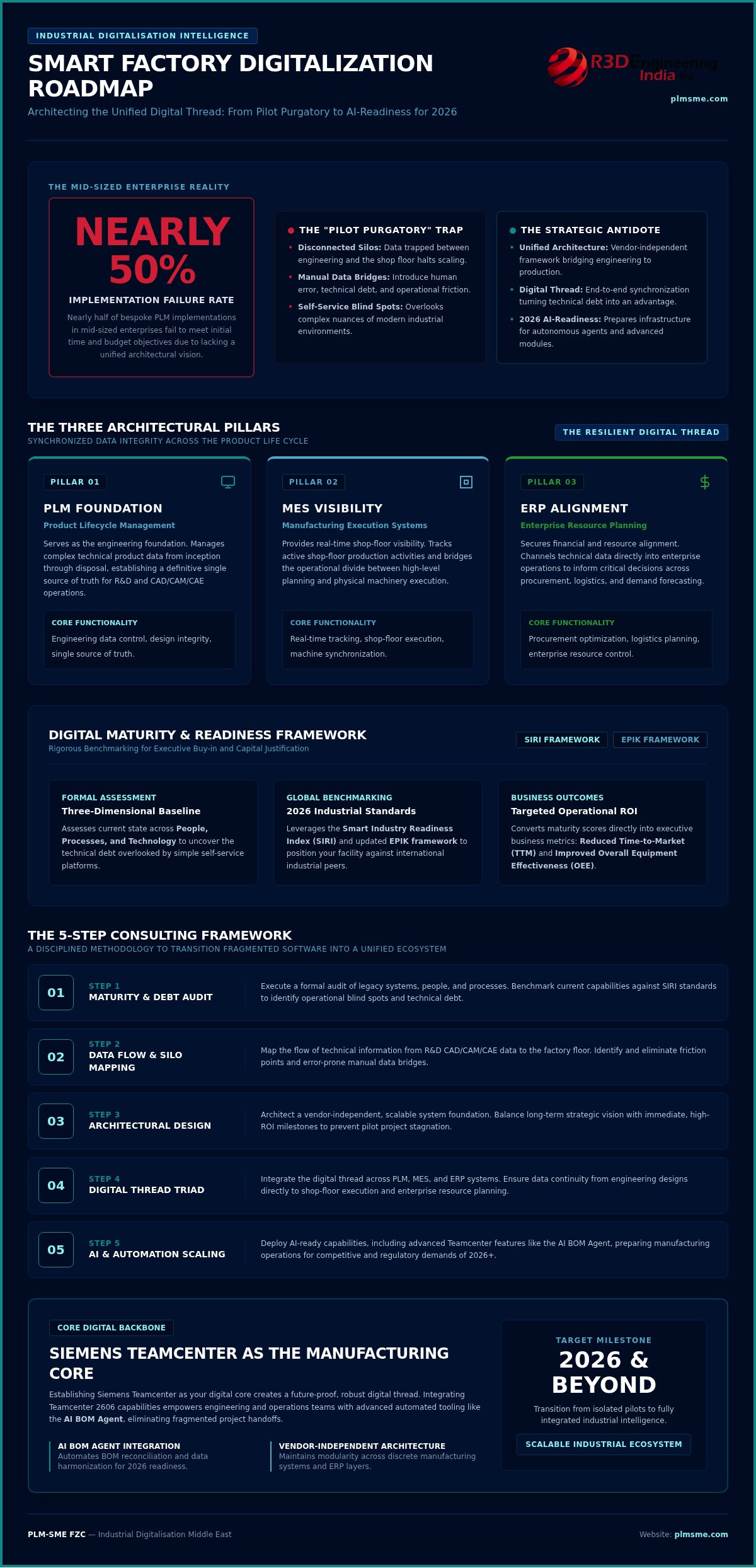
Nearly 50% of bespoke PLM implementations in mid-sized enterprises fail to meet their initial time and budget objectives. It’s a sobering statistic that highlights the danger of launching digital initiatives without a unified architectural vision. Most manufacturers find themselves trapped in pilot purgatory, where disconnected data silos between engineering and the shop floor stall progress. Engaging in professional smart factory digitalization roadmap consulting isn’t just about selecting software; it’s about architecting a vendor-independent framework that transforms these fragmented projects into a cohesive, scalable system.
You’ve likely felt the pressure of managing complex integrations while lacking the internal expertise to map out a multi-year AI and automation strategy. This guide provides a clear, actionable methodology to move your operations toward AI-readiness for 2026 and beyond. We’ll examine how to leverage the latest Siemens Teamcenter 2606 capabilities, such as the AI BOM Agent, and utilize the SIRI framework to benchmark your progress. By the end of this article, you’ll understand how to build a seamless digital thread between PLM, MES, and ERP that turns technical debt into a competitive advantage.
Key Takeaways
- Learn how a structured strategy serves as the ultimate antidote to pilot purgatory, aligning your high-level business goals with clear technical milestones.
- Discover how professional smart factory digitalization roadmap consulting utilizes formal maturity assessments to secure executive buy-in and bridge the gap between engineering and the shop floor.
- Explore the principles of designing a scalable system architecture that eliminates data silos and ensures your operations are fully prepared for future AI modules.
- Master a disciplined, five-step consulting framework designed to transition your enterprise from fragmented software adoption to a unified ecosystem.
- Understand why establishing Siemens Teamcenter as the digital core of your manufacturing process creates a reliable, future-proof digital thread.
Defining the Smart Factory Digitalization Roadmap
A smart factory digitalization roadmap is a strategic document that aligns high-level business goals with technical milestones to achieve Industry 4.0 maturity. It serves as a comprehensive guide for manufacturers to transition from manual, disconnected processes to a fully integrated, data-driven environment. Many organizations find themselves stuck in “pilot purgatory,” where isolated digital projects fail to scale because they lack a unified architectural vision. Professional smart factory digitalization roadmap consulting acts as the antidote to this fragmented approach, providing the objective, vendor-independent perspective required to build a stable foundation. A smart factory digitalization roadmap is a multi-year architecture designed to integrate AI and automation into a cohesive industrial ecosystem.
The Core Pillars of Industrial Digitalization
Building a resilient digital thread requires a deep understanding of the foundations of smart manufacturing. This transformation rests on three essential pillars that must be synchronized to ensure data integrity across the product life cycle:
- Product Lifecycle Management (PLM): This serves as the engineering foundation. By implementing a robust PLM system architecture consulting framework, companies can manage complex product data from inception through disposal, ensuring a single source of truth for all engineering activities.
- Manufacturing Execution Systems (MES): These systems provide the necessary shop-floor visibility. They track real-time production activities and bridge the gap between high-level planning and physical execution.
- Enterprise Resource Planning (ERP): Integration with ERP ensures financial and resource alignment. It allows the technical data from the factory floor to inform broader business decisions regarding procurement, logistics, and demand forecasting.
Why Consulting Beats Self-Service Planning
Attempting to map out a 3 to 5 year digitalization strategy internally often leads to significant “blind spots.” Internal teams are frequently biased by existing legacy systems or lack exposure to broader industry benchmarks. Expert consultants bring specialized knowledge from various discrete manufacturing sectors, utilizing frameworks like the Smart Industry Readiness Index (SIRI) to provide objective assessments. This external perspective is vital for identifying technical debt in your current system architecture that might hinder future AI adoption.
Effective consulting balances long-term strategic vision with immediate, high-ROI wins. It’s about more than just software selection; it involves a “thinking partner” who understands how Siemens Teamcenter consulting can optimize specific workflows. This collaborative approach ensures that every digital investment contributes to a scalable, AI-ready architecture that is prepared for the regulatory and competitive demands of 2026.
Conducting a Digital Maturity Assessment
Before architecting a solution, you must define the baseline. A successful smart factory digitalization roadmap consulting engagement begins with a cold, hard look at current capabilities across people, processes, and technology. Many manufacturers rely on self-service platforms for this phase, but these tools often overlook the technical nuances of complex environments like Siemens Teamcenter. A thorough assessment identifies the specific gap between your current state and the desired future state, ensuring the roadmap isn’t just a wish list, but a viable engineering plan that accounts for technical debt.
The cornerstone of this phase is a formal digital maturity report manufacturing leaders can use to secure executive buy-in. It translates technical deficiencies into business risks and opportunities. By benchmarking against national industrial standards for 2026, such as the Smart Industry Readiness Index (SIRI) and the updated EPIK framework, you gain an objective view of where your facility stands compared to global peers. This report links maturity scores directly to tangible outcomes like Reduced Time-to-Market (TTM) and improved Overall Equipment Effectiveness (OEE).
Analyzing Data Readiness and Silos
You can’t build a digital thread if the data is trapped in disconnected pockets. Consultants map the flow of technical information from R&D through to the shop floor, often discovering manual “data bridges” that introduce human error and operational friction. Assessing the health of legacy CAD, CAM, and CAE data is critical for long-term scalability. We evaluate these flows against the NIST smart manufacturing reference architecture to ensure that your data collection frameworks are standardized and interoperable across the entire digital thread. Identifying these silos early prevents costly integration failures during the implementation phase.
Establishing the Digital Vision
True transformation requires moving beyond “digitizing” (merely converting paper records to digital files) toward “digitalization,” which involves fundamental process transformation. This vision must define clear KPIs for both 3-year and 5-year horizons, ensuring every step aligns with national AI and automation goals. Whether your goal is agentic BOM management or autonomous quality loops, the vision serves as your North Star. It helps prioritize investments that support a Unified Namespace (UNS) architecture rather than rigid point-to-point integrations. If you’re ready to define your baseline, a digital maturity assessment is the most logical starting point for your journey.
Constructing the Technical Architecture for 2026
Building a future-proof technical foundation requires moving beyond simple software procurement toward comprehensive PLM system architecture consulting. In 2026, your architecture must accommodate the massive data volumes generated by high-frequency IoT sensors while maintaining a closed-loop Digital Twin. This virtual representation of physical production allows for real-time simulation and predictive maintenance, effectively linking virtual design with physical execution. We advocate for a vendor-neutral approach when selecting integration layers to prevent proprietary lock-in. A resilient architecture often follows the World Economic Forum’s Lighthouse Operating System, which provides a framework for scaling digitalization across the entire global value chain.
Integrating PLM with ERP, CRM, and MES
Industrial digitalization relies on the “Golden Triangle” of software: PLM for engineering, MES for execution, and ERP for resource management. True operational efficiency comes from interactive connections that eliminate duplicate data entry and manual errors. For instance, leveraging Teamcenter CRM integration benefits ensures that specific customer requirements flow directly into the engineering phase. This creates a customer-centric manufacturing model where shop-floor agility meets real-time market demand. By synchronizing these systems, you ensure that the “as-designed” configuration in PLM matches the “as-built” record in MES.
Planning for Industrial AI and Automation
Artificial Intelligence is only as effective as the data feeding it. High-impact smart factory digitalization roadmap consulting must prioritize clean, structured PLM data as the primary fuel for machine learning models. As we move through 2026, the focus has shifted from simple predictive tools to agentic AI. Tools like the Siemens Teamcenter AI BOM Agent now perform complex change-impact analyses and systems engineering rule checks autonomously. When evaluating industrial automation solutions GCC, manufacturers must consider regional compatibility and local data residency requirements. Preparing for this level of automation means architecting a system that supports decentralized shop-floor decision-making without compromising central data governance.
Constructing the Roadmap: A 5-Step Consulting Framework
Successful transformation isn’t a byproduct of software installation; it’s the result of a disciplined consulting sequence. Generic models often fail because they lack the technical validation required at each transition point. High-impact smart factory digitalization roadmap consulting follows a rigorous five-step framework to ensure every technical decision supports a specific business outcome. This methodical approach prevents the “pilot purgatory” that affects nearly half of all industrial digital initiatives.
Step 1 focuses on Stakeholder Alignment and Business Case Development to ensure the executive team understands the financial and operational stakes. Step 2 moves into a Comprehensive Digital Maturity Assessment and Gap Analysis, identifying the technical debt that could stall progress. Step 3 involves Solution Architecture Design and Vendor Selection, where we provide independent, vendor-neutral advice to avoid proprietary traps. Step 4 transitions into Phased Implementation Planning, establishing “Quick Win” milestones to maintain organizational momentum. Finally, Step 5 implements a Governance and Continuous Improvement Framework to ensure the system evolves alongside your business needs.
Prioritizing Use Cases by ROI
To avoid the common “everything at once” trap, we utilize a Value vs. Complexity matrix. This allows manufacturers to select pilot projects that deliver high impact with manageable technical risk. We often prioritize foundational areas like Bill of Materials (BOM) accuracy and engineering change management. These initial wins provide the data integrity needed for more advanced AI modules later in the roadmap. By focusing on high-ROI wins, you build the internal credibility necessary for large-scale transformations.
Building the Implementation Retainer Model
A roadmap is a living document, not a static file. As technology evolves through 2026, maintaining system health requires ongoing expertise. A PLM administration retainer ensures your architecture remains agile and updated with the latest releases, such as Teamcenter 2606. This model provides the steady, reliable support needed to manage complex digital processes without the overhead of a full-time internal team. It’s a cost-effective way to ensure your digitalization vision doesn’t degrade over time. If you’re ready to move beyond fragmented pilots, you can start your roadmap consulting journey here.
Executing with Siemens Teamcenter and PLM-Sme
Execution is the phase where strategic planning meets technical reality. While a roadmap provides the vision, the successful deployment of a smart factory relies on a platform capable of handling the rigors of discrete manufacturing. Siemens Teamcenter consulting remains the gold standard in this regard, offering the scalability and security required to manage a global digital thread. Choosing an independent partner for this journey ensures that your implementation isn’t biased by software sales quotas. Instead, you receive objective guidance focused on how the system architecture supports your specific production requirements. Siemens-backed architectures provide the long-term reliability and interoperability necessary to sustain industrial operations for decades.
Regional context is equally vital for success. The industrial digitalization roadmap UAE strategies are specifically designed to align with national growth objectives and local data residency regulations. By tailoring these roadmaps to the unique economic landscape, manufacturers can leverage smart factory digitalization roadmap consulting to gain a competitive edge in the regional market. This localized expertise ensures that your digital transformation supports broader industrial goals while addressing specific supply chain challenges unique to the country.
End-to-End Implementation Support
Moving from a legacy environment to a modern PLM system requires meticulous attention to detail. We provide comprehensive support that begins with complex data migration, ensuring that historical engineering knowledge isn’t lost during the transition. Our team develops specialized Teamcenter integrations for ERP and MOM (Manufacturing Operations Management), creating a seamless flow of information from design to delivery. This includes extending the digital thread into CAD, CAM, and CAE environments to ensure that every engineer works from the same synchronized data set. Ongoing solution design ensures that as your production volume grows, your system architecture scales accordingly without performance degradation.
Securing Your Digital Future
A resilient foundation is mandatory for any facility planning to integrate AI and robotics by 2026. By establishing a robust digital core today, you prepare your shop floor for the next generation of autonomous decision-making and agentic PLM workflows. Vendor-independent support within the Siemens ecosystem is critical; it allows you to prioritize your own operational health over specific software modules. Our role as a “thinking partner” is to ensure your technology stack remains agile enough to adopt emerging innovations without requiring a total system overhaul. It’s time to move beyond fragmented pilots and build a scalable architecture. Book your Digital Maturity Assessment with PLM-Sme FZC to define your path toward a high-impact smart factory.
Architecting Your Industrial Future
Building a high-impact smart factory is a complex journey that demands more than just incremental technology upgrades. It requires a strategic alignment of people, processes, and technical architecture. By following a structured 5-step framework, manufacturers can move past the limitations of fragmented pilot projects and establish a scalable digital thread. Professional smart factory digitalization roadmap consulting ensures that your investment in Siemens Teamcenter is optimized for long-term growth and AI-readiness for 2026 and beyond.
As a Siemens Digital Industries Alliance Partner, PLM-Sme FZC brings specialized expertise in Siemens Teamcenter implementation and complex industrial system architecture. We act as your independent thinking partner, providing the objective guidance needed to navigate a rapidly evolving technological landscape. Transitioning from manual silos to an integrated, data-driven environment is a significant undertaking, but it’s the essential path for maintaining competitive relevance. Establish your digital vision with a professional roadmap from PLM-Sme and begin building a more resilient, automated manufacturing future today.
Frequently Asked Questions
What is the first step in a smart factory digitalization roadmap?
The first step is conducting a thorough Digital Maturity Assessment to establish an objective baseline of your current operations. This process evaluates your existing people, processes, and technology to identify technical debt and data silos. By starting with a formal report, you gain the necessary clarity to align stakeholder expectations and define a realistic vision. It ensures that subsequent investments in smart factory digitalization roadmap consulting are targeted toward high-ROI areas rather than speculative pilots.
How long does it take to develop a comprehensive digitalization roadmap?
Developing a comprehensive roadmap typically takes several weeks of intensive discovery and analysis, depending on the complexity of your industrial environment. The timeline involves deep-dive interviews, system audits, and architectural reviews to ensure every technical milestone is achievable. While a preliminary vision can be established quickly, a detailed execution plan requires time to validate integration points and business case models. This methodical pace ensures the final strategy is both stable and actionable for long-term transformation.
Why is PLM considered the foundation of a smart factory?
PLM serves as the foundation because it acts as the single source of truth for all product data throughout its lifecycle. Without a robust PLM system like Siemens Teamcenter, data becomes fragmented across engineering and production, leading to costly errors and delays. It provides the digital thread necessary for advanced automation and AI. By centralizing “as-designed” data, PLM ensures that your manufacturing execution systems (MES) and ERP layers operate on accurate, synchronized technical information.
Can we build a roadmap if we already have an ERP system?
You absolutely can and should build a roadmap if you already have an ERP system. In fact, ERP is a critical component of the industrial software “Golden Triangle,” alongside PLM and MES. The roadmap focuses on creating seamless, interactive connections between these systems to eliminate manual data bridges. Professional smart factory digitalization roadmap consulting helps you integrate your existing ERP with a robust PLM architecture, ensuring that financial resource planning is always informed by real-time engineering and production data.
What is the difference between an independent consultant and a software vendor?
The primary difference lies in objectivity and long-term strategic alignment. A software vendor is inherently motivated by license sales and proprietary ecosystem growth. In contrast, an independent consultant like PLM-Sme FZC serves as a neutral “thinking partner.” We focus on vendor-independent system architecture and solution design that prioritizes your specific operational health. This approach ensures you select the best integration layers for your business rather than being locked into a single vendor’s restricted roadmap.
How does AI fit into a manufacturing digitalization roadmap in 2026?
In 2026, AI has evolved from simple predictive tools into autonomous agents capable of managing complex engineering workflows. Within a digitalization roadmap, AI fits as an optimization layer that relies on clean, structured data from your PLM system. It enables agentic Bill of Materials (BOM) management and autonomous shop-floor decision-making. Preparing for this requires architecting a Unified Namespace (UNS) today, ensuring your technical foundation can handle the high data volumes required for advanced machine learning models.
What are the common reasons digitalization roadmaps fail?
Digitalization roadmaps frequently fail when organizations fall into “pilot purgatory,” launching disconnected projects that never scale. Failure also stems from ignoring technical debt in legacy systems or failing to secure executive buy-in through a formal maturity report. When data silos between engineering and production remain unaddressed, the resulting lack of interoperability stalls progress. Success requires a disciplined framework that balances high-level strategic vision with grounded, practical execution and ongoing governance to maintain system health.
How much does smart factory consulting typically cost for a mid-sized firm?
Consulting fees for smart factory initiatives are determined by the specific scope of the project, the current maturity level of the facility, and the complexity of the desired architecture. Factors such as the number of integrated systems, the volume of legacy data to be migrated, and the depth of AI-readiness required all influence the investment. Rather than looking for a flat industry average, manufacturers should focus on the ROI generated by avoiding failed implementations and achieving a faster time-to-market through expert guidance.