
How to Assess Digital Manufacturing Technology Roadmap Needs
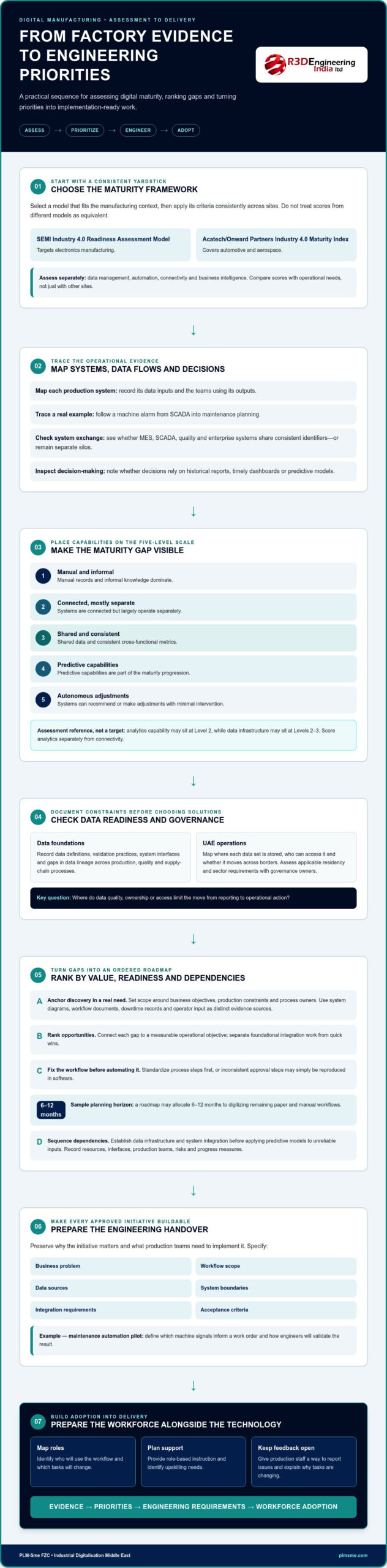
A technology roadmap should start with evidence of where the factory stands, not a list of tools to buy. A digital manufacturing technology roadmap assessment rates data management, automation, connectivity and business intelligence, then maps gaps to practical priorities. A useful maturity scale runs from Level 1, where manual records and informal knowledge dominate, to Level 5, where systems can recommend or make adjustments with minimal intervention.
It’s easy to assume that adding advanced analytics or automation will accelerate transformation. But if production systems remain disconnected or operational data is inconsistent, those investments may not address the underlying constraints. A digital manufacturing technology roadmap assessment helps distinguish foundational needs from capabilities that are ready to scale.
This guide explains how to assess digital maturity, translate findings into a manufacturing technology roadmap, and move priorities from discovery to engineering. It also covers how to sequence initiatives around business objectives, system integration and workforce adoption, so the roadmap guides decisions rather than sitting unused as a strategy document.
Key Takeaways
- Map how production data moves between systems to pinpoint integration gaps and capability constraints.
- Rank roadmap initiatives by business value, dependencies and readiness, then sequence foundational work before advanced applications.
- Turn discovery findings into engineering-ready priorities with clear objectives, architecture decisions and ownership.
- Use a structured maturity assessment to align transformation plans with your manufacturing context and operational goals.
How can manufacturers assess their current digital maturity?
Assess maturity by scoring systems, data flows, analytics and governance against a consistent framework. Then compare the scores with operational needs and document the gaps that should shape investment priorities.
-
Select Maturity Models and Assessment Frameworks
Choose a model that matches your manufacturing context, then apply its criteria consistently across sites. A five-level maturity scale can distinguish manual practices, connected systems, integrated data, predictive capabilities and autonomous adjustments. The SEMI Industry 4.0 Readiness Assessment Model targets electronics manufacturing, while the Acatech/Onward Partners Industry 4.0 Maturity Index covers automotive and aerospace. Avoid comparing scores from different models as if their levels were equivalent.
-
Assess Manufacturing Systems and Data Flows
Map each production system, its data inputs and the teams using its outputs. Trace a practical example, such as a machine alarm moving from SCADA into maintenance planning. Check whether MES, SCADA, quality and enterprise systems exchange consistent identifiers or operate as separate silos. In a five-level model, Level 2 describes connected but largely separate systems; Level 3 describes shared data and consistent cross-functional metrics.
- Score analytics and decision-making separately from connectivity. A typical assessment places analytics capability at Level 2, while data infrastructure often sits at Levels 2-3. Record which decisions rely on historical reports, timely dashboards or predictive models. Then identify where data quality, ownership or access limits the move from reporting to operational action.
- Inspect data management and infrastructure readiness across production, quality and supply-chain processes. Document data definitions, validation practices, system interfaces and gaps in data lineage. For UAE operations, map where each data set is stored, who can access it and whether it moves across borders. Assess applicable residency and sector requirements with the organization’s governance owners, rather than assuming one hosting pattern fits every enterprise.
- Turn the findings into ranked priorities. Separate foundational integration work from quick wins, and connect each gap to a measurable operational objective. This makes maturity findings useful for decisions, not just comparisons between leaders and other sites.
Discovery-to-roadmap workflow and engineering handover
Move from discovery to delivery through sequenced decisions, clear ownership and engineering-ready requirements. The handover should preserve why each initiative matters and what production teams need to implement it.
- Set the discovery scope around business objectives, production constraints and process owners. Gather system diagrams, workflow documents, downtime records and operator input as distinct sources of evidence. For a recurring quality issue, trace the workflow from inspection through corrective action. This ties the proposed change to a real operational need.
- Rank process digitization opportunities by impact, readiness and dependencies. Standardize the workflow before automating it: inconsistent approval steps can simply reproduce inconsistency in software. A sample roadmap allocates 6-12 months to digitizing remaining paper and manual workflows, giving teams a defined planning horizon.
- Sequence initiatives to make dependencies visible. Establish data infrastructure and system integration before applying predictive models to unreliable inputs. Identify the resources, system interfaces and production teams needed at each stage. Record decisions, risks and progress measures so leaders can adjust the sequence when operating conditions change.
- Prepare an engineering handover for every approved initiative. Specify the business problem, workflow scope, data sources, system boundaries, integration requirements and acceptance criteria. For a maintenance automation pilot, define which machine signals inform a work order and how engineers will validate the result. This gives technical teams actionable requirements instead of a high-level aspiration.
- Plan workforce training and change management alongside technical delivery. Map which roles will use a new workflow, what tasks will change and where upskilling is needed. Provide role-based instruction and a way for production staff to report issues. Transparent communication helps teams understand why automation changes a task, rather than treating adoption as a final launch activity.
For a tailored route from discovery priorities to implementation planning, explore Digitalisation Vision & Roadmap Consulting as a potential next step.
What Is a Manufacturing Digital Transformation Roadmap?
A roadmap turns capability gaps into sequenced initiatives, measurable objectives and engineering decisions. A digital manufacturing technology roadmap assessment anchors that plan in operational evidence.
-
Assess Capabilities and Plan the Transformation
Set target outcomes, then map the capabilities and dependencies needed to reach them. A maturity assessment should inform measurable KPIs, such as throughput, quality, downtime, operating margins or revenue. According to Gartner, improved operating margins were a critical technology-investment outcome for 67% of surveyed CIOs, while higher revenue was cited by 46%. Use relevant measures, not an oversized dashboard.
-
Weigh Benefits, Challenges, and Success Factors
Identify the operational benefit each initiative should deliver, then document barriers such as weak data quality, integration dependencies or limited workforce readiness. McKinsey & Company research puts the success rate of large transformation programs at roughly 30%. Reduce avoidable risk by assigning accountable owners, defining progress measures and planning employee training alongside technology deployment. Track compliance outcomes where relevant to the business.
-
Adapt the Roadmap to Company Size and Industry
Tailor the scope to site complexity, production model and existing capabilities. A single-site operation may prioritize a contained workflow, while a multi-site enterprise needs shared architecture and phased deployment. Industry needs also differ: electronics, automotive and aerospace have distinct processes and assessment frameworks. Avoid copying another company’s roadmap; choose initiatives that fit your products, constraints and operating priorities.
-
Set Assessment Costs and Transformation Timelines
Plan assessment timing around scope, site access and the number of capabilities reviewed; a focused assessment can take weeks. Assessment cost depends on scope, site complexity and required analysis, with pricing provided after a quote request. For multi-site transformation, the execution cycle may span 18-24 months; its first 90 days produce an assessment, target architecture and pilot-site selection. Months 10-18 can scale work to the next two or three sites.
Digital manufacturing roadmap development
Turn assessment findings into a sequenced portfolio, linking each initiative to operational value, feasibility and risk. Prioritize work that addresses factory challenges and supports measurable improvement.
- Evaluate proposed initiatives against business value, implementation feasibility, dependencies and operational risk. Prioritize improvements tied to production bottlenecks, quality losses or avoidable downtime. Check whether the necessary data, system integration and workforce readiness are in place. If a predictive use case depends on unreliable production data, schedule foundational work first rather than treating the model as an immediate solution.
- Define measurable objectives across production, quality and supply chain, alongside technology and workforce-development investments. For example, connect a production objective to a quality measure and an accountable process owner. This keeps digital maturity work aligned with operating priorities instead of creating a disconnected technology wish list.
- Compare two to three candidate roadmaps and make the trade-offs explicit. One option may prioritize system integration, while another targets a contained pilot for faster operational learning. Show which initiatives depend on shared data, architecture or training. Decision-makers can then select a sequence based on value and readiness, not technology visibility alone.
- Use phased timing as a planning structure, not a universal promise. A sample roadmap assigns 0-6 months to data infrastructure and system integration, then 4-9 months to a pilot rollout and OT-IT data pipeline. It places predictive models on clean data in 12-18 months, followed by broader predictive capability and workforce adoption in 18-24 months.
- Review the roadmap at stage gates. Confirm that every initiative has an owner, a target measure, dependencies and a decision to proceed, adjust or pause. For a factory pilot, compare actual production and quality results with the defined baseline before scaling. This makes prioritization a controlled path from assessment to operational improvement.
To translate ranked priorities into an implementation-ready plan, develop your digital manufacturing roadmap.
PLM-Sme FZC: Digital maturity assessments and reports
PLM-Sme FZC helps manufacturers turn digital maturity findings into a practical transformation direction. Its digital maturity assessments and reports clarify capability gaps, system dependencies and opportunities to prioritize. This is a useful next step when internal teams have identified issues but need a structured view of what to address first.
Digitalisation Vision & Roadmap Consulting connects priorities to a sequenced plan. When implementation planning needs technical definition, System and Solution Architecture can shape how systems and data fit together. Industrial automation and AI solutions can support initiatives where automation or advanced analytics align with operational needs.
Keep the Roadmap Responsive to Change
A roadmap should guide decisions without becoming fixed as production conditions evolve. Treat the digital manufacturing technology roadmap assessment as a baseline for reviewing changes in operational priorities, system dependencies and engineering capacity. When a proposed initiative shifts, record the reason, affected processes and decision owner. This keeps adjustments traceable and helps teams distinguish deliberate reprioritization from stalled execution.
Use each implementation decision to improve the next. Capture lessons from pilots, including integration constraints and user feedback, then apply them when shaping subsequent work. A roadmap grounded in practical experience supports more disciplined investment choices and clearer coordination between business and engineering teams.
When you’re ready to turn your priorities into a considered next step, contact PLM-Sme FZC to discuss your roadmap. A clear starting point can help your team move forward with purpose and build momentum for lasting improvement.
Frequently Asked Questions
How long does it typically take to advance through digital maturity levels?
The time needed to advance depends on the starting point, system dependencies, data quality and workforce readiness. A focused assessment can usually be completed in a matter of weeks, but that measures current capabilities, not the time required to change them. Set progress checkpoints around completed improvements, such as establishing consistent production records or connecting a priority workflow, then reassess annually.
What Signals Digital Maturity in an Enterprise?
Digital maturity is reflected in repeatable decisions supported by reliable, accessible operational data. For example, production and quality teams can use the same product identifiers to trace a defect from inspection to its source. Clear data ownership, documented workflows and defined system interfaces are further indicators. Check whether teams consistently act on shared information instead of relying on individual spreadsheets or informal workarounds.
What key areas should I focus on when measuring digital maturity?
Measure data management, automation, connectivity and business intelligence, then examine how they work together. For example, check whether a production report uses validated machine data and consistent definitions across shifts. Assess data integrity across processes, including how errors are corrected and records maintained. This reveals whether analytics can support operational decisions or merely display inconsistent inputs.
What’s the difference between digital maturity leaders and laggards?
On a five-level Digital Maturity Index, leaders score above 3.5, while laggards score just under 2. The distinction reflects more than technology ownership: examine how consistently teams integrate data, apply analytics and use findings in decisions. Compare plants using the same model and criteria; different frameworks may define levels differently, making direct score comparisons misleading.
What capabilities and technologies should a digital manufacturing assessment evaluate?
Evaluate data governance, connectivity, analytics, automation and the systems that support production. Review MES and SCADA alongside ERP, quality and maintenance workflows, then identify where information fails to move reliably. Consider sensors, machine-learning applications and digital twins when they address a defined need, such as maintenance planning or asset performance. Assess workforce capability and data integrity alongside the technology itself.
What are the steps to conduct a digital manufacturing technology roadmap assessment?
Start by defining the business outcome, such as reducing quality escapes on a specific production line. Gather process records and system information, then assess relevant capabilities against one consistent maturity model. Identify root causes, compare initiatives by value and feasibility, and assign owners. Before scaling a pilot, determine whether its results support the intended outcome and whether connected processes can sustain it.