
How Engineering Leaders Justify PLM Costs and Value to CFOs
Better product quality is a sound reason to consider PLM, but it is not a complete financial case. To show how engineering leaders justify PLM investments to CFOs, connect fewer engineering change errors and less rework to measurable business outcomes, then account for implementation and ongoing operating costs.
CFOs need to see how the investment supports value creation, not just how it improves engineering workflows. That means explaining the baseline, the expected changes in quality and efficiency, and how those changes will be measured against business results.
This article explains how to express PLM’s quality benefits in financial terms, compare costs with tangible and operational value, and show how the system fits the company’s digital stack. The goal is a clear, balanced case that helps finance leaders assess the investment and its risks.
Key Takeaways
- Build the business case around value-creation objectives, linking engineering improvements to outcomes finance leaders can track.
- Compare implementation and operating costs with measurable benefits, while accounting for adoption and less tangible gains such as better decision confidence.
- Show how PLM can help prevent errors by keeping product data, revisions and approvals aligned across teams.
- Explain how PLM fits with enterprise systems and supports a coherent digital architecture, not an isolated software investment.
Aligning investment decisions with value creation objectives
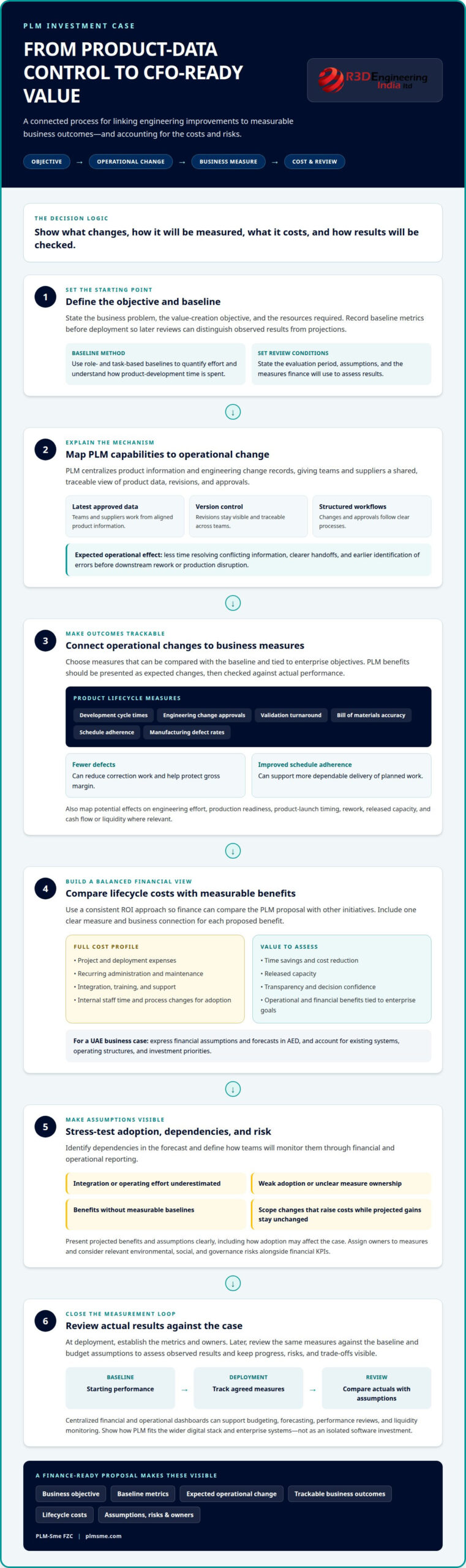
A stronger PLM proposal connects engineering priorities to the organization’s value-creation plan. Define the expected business change, the resources required, and the measures finance will use to evaluate results.
ROI Analysis for Investment Decisions
ROI analysis compares PLM implementation and operating costs with measurable financial benefits. It gives CFOs a consistent basis for comparing initiatives and deciding whether projected value supports the investment. To justify PLM investment, ensure each proposed benefit has a clear measure and business connection. Establishing metrics at deployment also makes later reviews more useful, linking performance to outcomes such as reduced rework or released capacity.
Quantifying Strategic Decision Effects
To quantify strategic decisions, trace operational changes to their financial effects. Map how better product information could affect engineering effort, production readiness, or product-launch timing, then connect those changes to business measures. A CFO’s organization-wide perspective helps assess dependencies, resource needs, and potential effects on cash flow and liquidity. Record a baseline and review the same measures later to distinguish observed results from projections.
Building a PLM Investment Proposal
A PLM investment proposal presents the business problem, investment logic, and measurement approach in a form finance leaders can evaluate. To show how engineering leaders justify PLM investments to CFOs, define the objective, establish baseline metrics, map PLM capabilities to expected changes, estimate implementation and operating costs, and assign owners to measures. Present projected benefits and assumptions clearly, including how adoption may affect the case. This helps CFOs compare the proposal with other uses of capital.
Financial reporting systems make the case easier to monitor. CFOs can use centralized dashboards for financial metrics and involve business leaders in budgeting and forecasting. ESG considerations also belong in investment decisions: assess relevant environmental, social, and governance risks alongside financial KPIs. This connects PLM’s rationale to organizational priorities and supports transparent capital allocation.
Comparing PLM implementation and operating costs with financial benefits
A PLM business case compares lifecycle costs with measurable benefits. For a UAE business case, express financial assumptions in AED and connect them to enterprise priorities.
Implementation and Operating Costs
Implementation and operating costs cover the resources needed to deploy PLM and sustain it. Separate project expenses from recurring administration, maintenance, integration, training, and support. Include internal staff time and process changes needed for adoption. This breakdown helps finance assess the total cost profile, including ongoing commitments rather than just initial deployment. State the evaluation period and assumptions clearly.
Financial Benefits and Enterprise Goals
Financial benefits link measurable operational improvements to company goals. Assess time savings, cost reduction, and released capacity alongside transparency and decision confidence. A consistent ROI method lets finance and engineering compare initiatives using shared assumptions. To explain the value of a PLM investment, tie each expected benefit to an enterprise objective and a trackable measure.
The business case for PLM is an investment in product data and processes, backed by expected operational and financial benefits. Show how those benefits advance enterprise goals and how results will be assessed after deployment.
Risks include underestimating integration or operating effort, weak adoption, unclear ownership, and benefits without measurable baselines. Scope changes can also weaken governance if costs rise while projected gains remain unchanged. Identify these dependencies in the forecast and define how teams will monitor them through financial and operational reporting.
For UAE companies, use AED forecasts and account for existing systems, operating structures, and investment priorities. Include sustainability objectives in financial transparency while reflecting the organization’s own goals and reporting needs.
Finance and engineering can use operational dashboards to compare actual performance with budget assumptions and monitor liquidity. Engineering leaders can justify PLM investment by making progress, risks, and trade-offs visible as the case develops.
How Does PLM Improve Product Quality and Reduce Costly Errors?
PLM can reduce development delays by centralizing product information and engineering change records. Teams and suppliers can work from the latest approved data, while structured workflows and version control help prevent change errors from reaching production. These improvements can limit rework and protect margin. Faster launches can also extend the selling window and accelerate returns on R&D.
How do PLM systems reduce product development costs and time to market? They give teams a shared, traceable view of product data, changes, and approvals, reducing time spent resolving conflicting information. Clear workflows can shorten handoffs and help teams find errors earlier, before they cause downstream rework or production disruption.
To connect operational changes to executive priorities, establish role- and task-based baselines. The ROI-BVF method maps roles to core activities, quantifies effort, and collects data on how product-development time is spent. Compare the baseline with product lifecycle KPIs such as development cycle times, engineering change approvals, validation turnaround, bill of materials accuracy, schedule adherence, and manufacturing defect rates.
Use those measures to show where efficiency affects revenue or cost. For example, fewer defects can reduce correction work and help protect gross margin; improved schedule adherence can support dependable delivery. In one example, a role freed 22 hours per month. The value depends on how that capacity is used, such as supporting innovation or addressing a delivery constraint.
CFO oversight can extend into operational performance. Nearly two-thirds of CFOs surveyed across multiple industries said their responsibilities overlapped with the COO role. A study following more than 3,500 companies over 16 years found that CFOs taking on operational responsibilities improved reporting quality without hurting performance. These findings support regular finance and engineering reviews of operational measures.
For a global organization, connecting PLM data to executive reporting makes product performance easier to interpret alongside financial outcomes. CFOs can act as operational growth leaders by reviewing trends, identifying execution bottlenecks, and directing capital toward improvements that support revenue, margin, and innovation.
Enterprise systems and digital stack priorities
A PLM investment should fit the enterprise stack and connect engineering processes with business systems. That fit shapes integration effort, data flow, and how leaders assess digital returns.
PLM, Spreadsheets, ERP, and PDM
PLM manages product information and processes across the lifecycle, while spreadsheets typically support flexible, locally maintained records. ERP systems coordinate business operations such as purchasing and production planning; PDM focuses on engineering data and document control. These roles can overlap, so the key question is how information moves between systems. Map a product change from engineering approval through manufacturing planning to identify handoffs, duplicate entry, and integration needs.
Returns on AI and Digital Investments
Proving returns means connecting a digital capability to an observable business result. For AI or analytics, establish a baseline for the process being changed, then track the same measure after deployment. For example, a workflow automation case should identify which manual steps it changes and how teams will measure time, errors, or capacity. In a 2024 survey, 81% of CFOs cited data analytics or business intelligence as high-impact technology, while about half named AI and cloud computing.
CFO Involvement in Digital Transformation
CFO involvement means shaping technology priorities alongside engineering and IT, then reviewing performance against agreed business measures. In a 2024 study, 69% of CFOs reported active involvement in their company’s technology roadmap. That role helps connect investment decisions to operational constraints, capital allocation, and enterprise objectives. CFOs can also collaborate with CIOs on transformation, assess risks, and stop initiatives that fail to deliver their intended outcomes.
Risk belongs in the decision, not just the implementation plan: 44% of CFOs in the survey identified risk as a dealbreaker for technology investment approval. Show dependencies such as data quality, integration, adoption, and system ownership, then explain how governance will track them. To map PLM to your enterprise architecture, connect system boundaries and data flows to the business processes the investment needs to transform.
PLM-Sme FZC
PLM-Sme FZC helps engineering leaders connect PLM priorities with business objectives, operational needs, and digital strategy. Turn to the team for a clearer view of current capabilities, an investment roadmap, or an architecture designed to fit your enterprise systems.
Digital maturity assessments and reports can identify gaps and establish priorities. Digitalisation Vision & Roadmap Consulting connects those findings to a structured transformation direction. System and Solution Architecture helps determine how platforms and data fit together, while industrial automation and AI solutions address opportunities to improve operational processes. Together, these capabilities can frame a PLM proposal around business needs, not software features alone.
If you’re assessing PLM’s fit, expected value, or place in your digital roadmap, contact PLM-Sme FZC to discuss your priorities.
Turn the Business Case Into a Decision
Understanding how engineering leaders justify PLM investments to CFOs is the starting point, not the finish line. The next step is to turn the case into a decision framework connecting business priorities, implementation choices, and measurable outcomes. Keep ownership clear among engineering, finance, and IT so each team understands its contribution and how progress will be assessed.
For UAE organizations, a well-structured proposal can make trade-offs easier to discuss in AED while keeping assumptions visible to decision-makers. This clarity helps leaders refine scope, prioritize important capabilities, and make the investment conversation part of wider digital planning.
PLM-Sme FZC can help shape that next phase around your organization’s objectives and technical environment. Discuss your PLM priorities with PLM-Sme FZC, and take the next step with a business case built for informed decisions.
Frequently Asked Questions
How Does PLM Reduce Compliance Risk and Costs?
PLM can reduce compliance risk by preserving product records, approvals, and lifecycle traceability in a structured system. During an audit, teams can retrieve the approved revision and its change history instead of assembling evidence from separate files. This can reduce preparation effort and help identify documentation gaps. The financial case should connect these operational improvements to actual audit work and risk controls.
What measurable KPIs demonstrate PLM ROI to a CFO?
Useful KPIs include engineering change approval time, validation turnaround, bill of materials accuracy, development cycle time, production schedule adherence, and manufacturing defect rates. Choose measures that reflect the business problem, then define how each affects cost, capacity, delivery, or revenue. For example, assess improved bill of materials accuracy alongside material discrepancies and the effort needed to resolve them.
How long does it take for PLM investments to achieve payback?
Payback occurs when cumulative financial benefits equal or exceed cumulative implementation and operating costs. Timing depends on project scope, integration complexity, adoption, ongoing administration, and when operational improvements translate into financial results. Model benefits based on when they are expected to materialize instead of treating projected annual savings as immediate. Comparing actual performance with those assumptions shows whether payback is progressing as planned.
How can engineering leaders calculate PLM total cost of ownership and ROI?
Calculate total cost of ownership by adding implementation, integration, migration, internal project effort, training, and ongoing operating costs across the evaluation period. Convert financial inputs to AED for a UAE business case. Compare the total with quantified benefits, such as reduced rework or released capacity. A simple ROI calculation is net benefits divided by total costs; state the assumptions and measurement period alongside the result.