
Discrete Manufacturing Industry 4.0 Roadmap in the UAE: A Practical 2026 Guide
A factory can invest in sensors, automation, and AI yet still struggle to improve delivery, quality, or engineering change control. The difference is sequencing. A discrete manufacturing Industry 4.0 roadmap UAE manufacturers can execute starts with product and production outcomes, then selects the digital capabilities that address them. Technology adoption is a means, not the goal.
That discipline matters as the UAE accelerates industrial digitalisation. The Ministry of Industry and Advanced Technology launched the Factory Forward UAE initiative on September 14, 2026, bringing greater focus to technology transformation across manufacturing. National momentum doesn’t remove the practical questions: what should come first, how can pilots avoid becoming isolated experiments, and how can engineering, production, IT, and executive teams align around measurable value?
This guide sets out a practical sequence for turning priorities into an actionable roadmap. You’ll learn how to assess digital maturity, select use cases, assign ownership and measures, and scale capabilities with a fit-for-purpose architecture. It also explains how PLM can connect product-lifecycle information with engineering and downstream manufacturing systems, and how implementation workstreams can progress from focused pilots to sustainable operations.
Key Takeaways
- Define roadmap success through operational outcomes, accountable owners, and measurable evidence, not a list of technologies.
- Map how product data moves from engineering into planning and shop-floor execution to expose gaps in change control and traceability.
- Rank candidate use cases by value, feasibility, data readiness, risk, and potential to scale before committing to pilots.
- Use a phased discrete manufacturing Industry 4.0 roadmap UAE manufacturers can adapt, with decision gates to guide progress from baseline to continuous improvement.
- Choose architecture and PLM workstreams, including Teamcenter where appropriate, according to integration and lifecycle-data requirements.
Why UAE discrete manufacturers need an outcome-led Industry 4.0 roadmap
A digital transformation programme can generate visible activity without resolving the production problems that affect delivery, quality, or engineering responsiveness. An Industry 4.0 roadmap helps close that gap by sequencing business outcomes, required capabilities, accountable owners, dependencies, and delivery decisions. It shows leadership how an investment is expected to move from an identified constraint to an operational result.
For UAE manufacturers, this company-level discipline translates wider industrial transformation ambitions into decisions suited to their own products, processes, and systems. National direction can encourage productivity, advanced manufacturing, and local industrial capability, but it doesn’t prescribe one technology stack for every factory. A manufacturer’s roadmap should reflect its strategy and operational baseline.
A roadmap is not a catalogue of digital technologies; it is a sequenced plan for using the right capabilities to achieve defined manufacturing outcomes. This keeps teams focused on the problem to solve before they commit to a platform, automation project, or AI use case.
What makes discrete manufacturing transformation distinct?
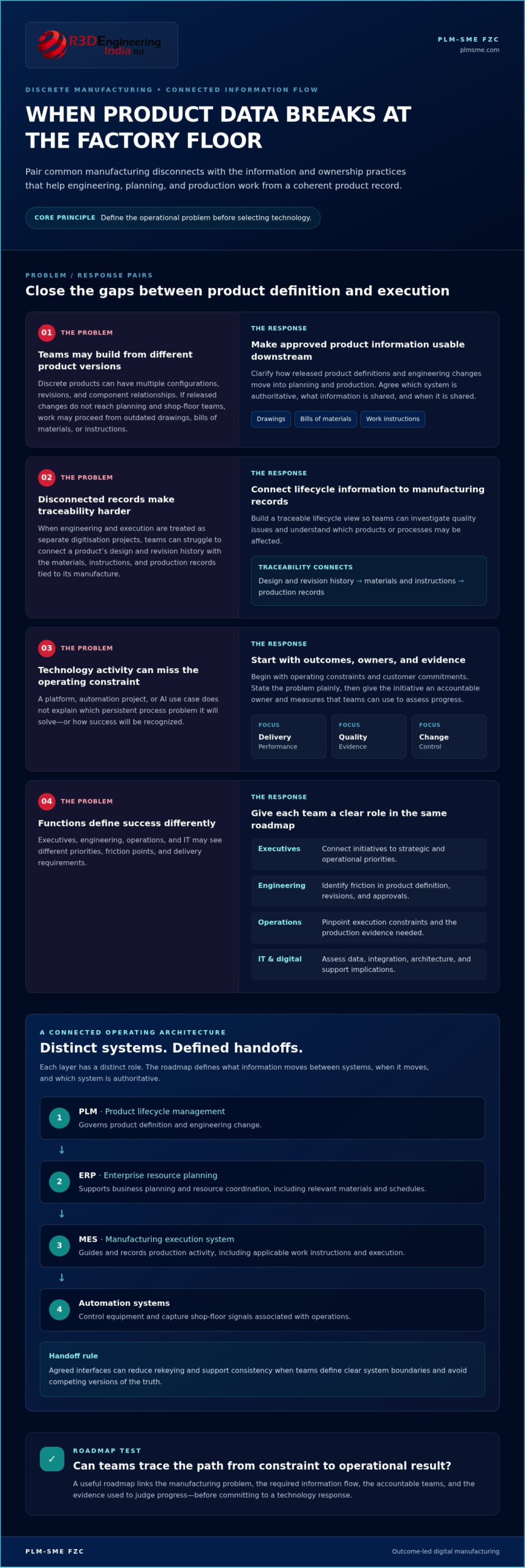
Discrete manufacturers build identifiable products, often with multiple configurations, revisions, and component relationships. An engineered product may have several approved variants, while an engineering change alters a drawing, bill of materials, or work instruction. If production planning and shop-floor teams don’t receive the current released information, they may work from different versions, creating avoidable rework or delays.
Traceability connects a product’s design and revision history to the materials, instructions, and production records associated with its manufacture. This lifecycle view helps teams investigate quality issues and understand which products or processes may be affected. The roadmap should examine how information moves between engineering and execution, rather than treating those functions as separate digitisation projects.
What should a roadmap solve before selecting technology?
Begin with operating constraints and customer commitments. Where are schedules vulnerable, changes difficult to absorb, or production records hard to reconcile? Then distinguish the persistent process problem from a proposed solution. “Late visibility of approved revisions” describes a problem; “install a new system” is a technology response that still needs justification.
Make the intended result clear across functions. Executives may prioritise delivery performance, quality, or investment control. Engineering may need reliable configuration and change management. Operations may need usable instructions and stable production plans. Agreeing on measures and ownership early gives each use case a shared test for progress.
- Executives: connect initiatives to strategic and operational priorities.
- Engineering: identify where product definition, revisions, and approvals create friction.
- Operations: pinpoint execution constraints and the production evidence needed to improve them.
- IT and digital teams: assess data, integration, architecture, and support implications.
A useful discrete manufacturing Industry 4.0 roadmap UAE manufacturers can act on brings these perspectives together before pilots are chosen. Digital maturity findings inform the sequence, while roadmap consulting translates them into owned workstreams and implementation decisions. The next step is to connect capabilities across product, engineering, and production so each initiative supports a coherent flow of information.
Connecting Industry 4.0 capabilities across product, engineering, and production
Connected manufacturing requires more than linking machines to software. It depends on a coherent flow of trusted information between the systems that define a product, plan its manufacture, and record how it was built. Treat these capabilities as layers in an operating architecture: product lifecycle management (PLM) governs product definition and engineering change; enterprise resource planning (ERP) supports business planning and resource coordination; manufacturing execution systems (MES) guide and record production activity; automation systems control equipment and capture shop-floor signals.
Each layer has a distinct role. The roadmap should define what information moves between them, when it moves, and which system is authoritative. Clear boundaries prevent overlapping records from becoming competing versions of the truth.
Linking product lifecycle data to manufacturing execution
Consider a released product revision. PLM holds its approved definition and engineering change. ERP can use relevant product and planning data to coordinate materials and schedules, while MES can make applicable work instructions available and record execution. Automation systems may provide machine or process signals associated with the operation. The exact flow depends on the manufacturer’s processes and architecture.
Agreed interfaces reduce rekeying and help maintain consistency, but only when teams define identifiers, revision rules, update timing, and error handling. Integration works when every data object has a clear owner and every interface has a defined purpose.
Establishing the foundations for connected operations
Before designing integrations, map the current system boundaries and inspect key data, including product identifiers, bills of material, routings, revisions, and production records. Record where information is created, approved, changed, and consumed. This shows whether a gap needs an interface, a process correction, or clearer responsibility rather than another application.
Make cybersecurity and access governance part of architecture decisions from the outset. Define which roles can view, change, approve, or transmit information, and consider how connected systems are segmented and managed. The design should account for operational continuity as well as data protection.
Automation, analytics, and AI depend on usable operational data. If production events lack consistent context, an analysis may not reliably distinguish a product revision, machine condition, or process deviation. Establish data definitions and collection practices before treating dashboards or models as decision-ready.
- Set ownership: name the function accountable for each critical data domain and its quality.
- Specify interfaces: document the data exchanged, trigger, frequency, validation, and exception handling.
- Check readiness: assess data completeness, access controls, integration constraints, and operational support.
These foundations help a discrete manufacturing Industry 4.0 roadmap UAE organisation develop from a collection of tools into a connected capability plan. Where product lifecycle information is a key thread, roadmap decisions can lead into PLM architecture and integration work, including Teamcenter where it fits the required architecture. The platform is one possible workstream, not a default answer. Let the target information flow and business need determine its role.
Choosing Industry 4.0 priorities without creating disconnected pilots
A promising use case isn’t automatically the right first investment. Compare candidate initiatives against the same decision criteria, then separate what is supported by evidence from what remains an assumption. This makes trade-offs visible across engineering, operations, IT, and leadership, and reduces the risk of choosing pilots simply because a technology is available.
For example, a manufacturer might consider automating an inspection step, improving visibility of engineering changes, or using production data to strengthen planning. Each could address a real constraint, but the best starting point depends on its expected contribution, prerequisites, and fit with the broader operating model.
Scoring use cases against value and readiness
Assess how each initiative could affect quality, throughput, engineering change, traceability, or planning reliability. Then test feasibility: are the relevant processes stable enough to change, is the required data usable, are system dependencies understood, and is an accountable owner available? Record evidence separately from assumptions so discovery can test uncertain value or readiness before a commitment is made.
Use the comparison to discuss relative strengths and gaps, not to create a score that hides uncertainty. A high-value use case with weak data readiness may need data and process preparation first. A technically feasible initiative with no clear outcome or accountable owner should not advance simply because it is easy to demonstrate.
Deciding what to pilot, scale, or defer
A bounded pilot is useful when a specific hypothesis can be tested in a contained process, product family, or production area. An enterprise-wide rollout may suit a capability that is already understood and needs consistent deployment. Neither approach is inherently better. Choose based on uncertainty, operational exposure, dependencies, and how much evidence is needed before expanding.
Before a pilot begins, define its intended outcome, baseline, measures, owner, and scale-up conditions. For example, a pilot for engineering-change visibility should establish what information users need, where delays occur, and what evidence would show the revised process is working. Capture lessons about integration, roles, and data as well as the performance result.
- Pilot: proceed when the hypothesis is testable and scope, ownership, and measures are clear.
- Scale: proceed when results meet agreed conditions and operations can support repeatable deployment.
- Defer: pause when value, dependencies, data readiness, or governance remain unresolved.
This discipline keeps the discrete manufacturing Industry 4.0 roadmap UAE manufacturers build tied to outcomes rather than a technology wish list. Every initiative should name the problem, intended result, accountable owner, and evidence required for the next decision. The resulting portfolio can then progress into a phased delivery plan.
Building a phased UAE Industry 4.0 roadmap with measurable delivery
A practical roadmap turns priorities into a sequence of decisions, not a fixed technology shopping list. Each phase should identify an accountable role, dependencies, a decision gate, and evidence that justifies moving forward. Adapt the sequence to the manufacturer’s operating context and existing systems.
Setting the baseline and defining the target state
Start with a focused baseline: document the workflows, systems, data ownership, recurring constraints, and strategic limits relevant to the selected priorities. Describe the target in operational terms before naming technologies. For example, specify what information teams need to act on, who needs it, and what process result should change. This creates a usable starting point without turning the roadmap into an open-ended assessment.
- Set ambition and baseline. The executive sponsor and process owners agree on business outcomes and current-state evidence. This depends on access to operational information and the people who understand the workflow. Gate: approve the problem statement and baseline. Evidence: documented constraints, current measures, and named owners.
- Design the target and sequence. Business, engineering, operations, and IT leads define the target process, capability gaps, architecture needs, and dependencies. Gate: approve a feasible design and priority order. Evidence: an agreed future-state description, workstreams, responsibilities, and delivery assumptions.
- Run a bounded pilot. A process owner leads delivery with technical and user representatives. The pilot depends on prepared data, access, integration decisions, and an agreed baseline. Gate: compare results with pre-set success criteria. Evidence: measured outcomes, user feedback, and lessons about implementation and support.
- Scale proven capabilities. Operations owns adoption while IT and engineering manage relevant system and data changes. Gate: confirm repeatability, operational readiness, and resources for wider deployment. Evidence: performance against agreed measures, trained users, and a support model.
- Improve continuously. Process owners review results with executive and technical leads, then adjust priorities as evidence or business needs change. Gate: continue, revise, or retire each workstream. Evidence: trend data, resolved issues, and updated roadmap decisions.
Governing implementation and tracking progress
Keep accountability explicit: executives sponsor outcomes, process owners are responsible for operational change, technical leads manage architecture and integration, and designated change leads support adoption. Review progress at agreed intervals using measures that reflect the intended result rather than technology activity alone. A compact KPI set might track schedule adherence, first-pass quality, engineering-change turnaround, traceability completeness, or planning reliability, depending on the selected priorities. Set baselines and targets from the manufacturer’s own data, not unsupported benchmark figures.
Consider how the industrial digitalisation roadmap for UAE manufacturing relates to your organisation’s priorities, while grounding company-level decisions in its own evidence. PLM-Sme’s roadmap consulting connects maturity findings to sequenced implementation decisions. Explore digitalisation roadmap consulting to understand how roadmap work can shape a practical delivery sequence for manufacturing priorities.
Turning the roadmap into connected PLM implementation and lasting capability
A roadmap creates value when its priorities move into a workable architecture, implementation sequence, and operating model. Not every Industry 4.0 plan needs a PLM programme. Where product definition, revision control, or engineering changes are central to the desired outcomes, PLM can help connect product-lifecycle information with downstream manufacturing processes.
Connecting PLM decisions to the wider manufacturing architecture
Start with the workflow and information responsibilities, then make platform, architecture, and implementation decisions in sequence. Product structures, approved revisions, and engineering changes may need to inform ERP planning, MES execution, or CRM and MOM processes. Integration design should specify which system owns each data object, what triggers an exchange, and how exceptions are handled. This keeps interfaces aligned with operational needs.
Siemens Teamcenter is a relevant PLM option for organisations whose requirements fit its role in managing product-lifecycle information. It isn’t mandatory for every roadmap. A sound decision considers required capabilities, existing systems, integration boundaries, and the organisation’s target architecture before implementation begins. PLM-Sme designs Teamcenter architecture, implements the platform, and develops integrations, connecting roadmap priorities to defined technical workstreams.
For teams developing their starting point, a strategic digital maturity report for manufacturing can clarify capability gaps and priorities. A Siemens Teamcenter consulting approach can provide context for platform architecture and implementation decisions. Each should support the manufacturer’s roadmap rather than determine it in isolation.
Moving from roadmap ownership to sustained improvement
Implementation doesn’t end at go-live. Plan for user adoption, clear process ownership, system administration, and ongoing review as part of the delivery model. Teams need to know how product-data changes are governed, who maintains integrations, and how operational feedback becomes a controlled improvement request. Without this ownership, a successful pilot can remain disconnected from routine work.
Governance should continue after initial deployment. Assign business and technical owners to review whether capabilities still support the intended outcomes, whether data and interfaces remain fit for use, and whether new priorities affect the sequence. PLM-Sme provides ongoing system administration and integration development to support this continuing capability where PLM is a relevant roadmap workstream.
A discrete manufacturing Industry 4.0 roadmap UAE manufacturers can sustain ties strategic priorities to architecture, implementation, and accountable operations. PLM-Sme connects digital maturity findings and roadmap decisions with PLM architecture, Teamcenter implementation, and integration work where these fit the target state. Discuss a tailored digitalisation vision and roadmap with PLM-Sme to define practical next steps for your manufacturing environment.
Turn your next priority into a practical transformation step
The next step doesn’t need to be a factory-wide programme. Choose one business priority, establish who owns it, and identify the evidence that would justify moving from a focused initiative to wider implementation. This gives your team a concrete basis for aligning investment decisions with operational needs while keeping future capabilities in view.
A discrete manufacturing Industry 4.0 roadmap UAE manufacturers can act on should evolve as processes, evidence, and priorities change. PLM-Sme FZC focuses on industrial digitalisation through PLM and is a Siemens Digital Industries Alliance Partner, with capabilities spanning roadmap consulting, architecture, implementation, integrations, and system administration.
Bring your priorities and current challenges into a focused roadmap discussion. Discuss a tailored digitalisation vision and roadmap with PLM-Sme, and take the next step toward a transformation sequence your teams can own and deliver.
Frequently Asked Questions
Is Industry 4.0 suitable for small and medium-sized discrete manufacturers?
Yes. A small or mid-sized manufacturer can begin with a tightly scoped operational challenge instead of a large enterprise programme. A discrete manufacturing Industry 4.0 roadmap UAE manufacturers can use should reflect available skills, systems, and management capacity. For example, a team might first address a recurring information delay in one workflow, then review whether staff can maintain the change and whether the result justifies extending it elsewhere.
Can a UAE manufacturer build an Industry 4.0 roadmap without replacing its existing systems?
Often, yes. Start by checking whether existing applications can support the intended workflow through configuration, improved data practices, or a well-defined interface. For example, a manufacturer may be able to pass approved product-revision information between current systems rather than replace them. Replacement becomes a consideration if a documented capability gap or technical dependency prevents the target process from working reliably.
How should manufacturers address cybersecurity in an Industry 4.0 roadmap?
Include cybersecurity in early architecture and use-case decisions. Map which systems exchange information, which accounts or roles can access them, and where sensitive operational or product data is stored. For a proposed shop-floor connection, define who can change settings and how changes are reviewed. Assign an owner for risk decisions, involve the organisation’s security team, and align controls with internal policies and applicable requirements.
What information should a manufacturer prepare before developing a roadmap?
Prepare a concise view of business priorities, workflow pain points, application and equipment inventories, known interfaces, and available performance measures. A sample transaction can make gaps easier to spot: follow one product change from approval through planning and production, noting where teams re-enter or reconcile information. Include engineering, operations, IT, and leadership representatives. If records are incomplete, identify the uncertainty rather than delaying discussion until every document is perfect.
Can AI be included in a discrete-manufacturing Industry 4.0 roadmap?
Yes, if the use case addresses a defined task or decision and has suitable data. For example, an inspection-support application needs representative images or measurements and a clear process for handling uncertain results. Define how performance will be assessed, who reviews its output, and what happens when the system’s recommendation is wrong or unavailable. If the data or workflow isn’t ready, make preparation a prerequisite rather than treating AI as the first step.
How can a manufacturer tell whether an Industry 4.0 pilot is ready to scale?
Scale when the pilot’s agreed outcomes are supported by repeatable evidence, not just a successful demonstration. Check whether results hold across normal operating conditions, whether users can follow the process without exceptional manual intervention, and whether support and maintenance responsibilities are clear. Review edge cases and any disruption introduced by the change. If the pilot works only with special data preparation or individual expertise, resolve that dependency before broader deployment.
Does every discrete manufacturer need PLM as part of its Industry 4.0 roadmap?
No. PLM is relevant when managing product definitions, configurations, revisions, or engineering changes is important to the intended business outcome. A manufacturer with a specific need to connect approved design information to downstream processes may assess PLM as part of its architecture. The decision should follow workflow and information requirements, rather than a general assumption that every digital transformation needs the same platform.