
Discrete Manufacturing Automation Roadmap Consulting in the UAE
A factory automation roadmap should start with digital maturity and data readiness, then define how MES, IoT, enterprise systems, and analytics will work together before changes are introduced in controlled phases. Effective discrete manufacturing automation roadmap consulting in the UAE connects these decisions to production priorities, IT-OT integration, workforce readiness, and legacy system constraints.
It’s understandable to want better visibility and more dependable operations without adding another disconnected technology layer. A practical approach is to assess the current environment, prioritise processes and data, design the target architecture, and pilot changes against measurable business outcomes. This guide explains how to plan integration, develop a phased digitisation roadmap, evaluate consulting approaches, and identify implementation considerations. You’ll have a clearer basis for deciding what to address first and how each step can support the factory’s wider objectives.
Key Takeaways
- Assess item masters, bills of materials, routings and inventory records before connecting factory systems; unreliable inputs can compromise downstream decisions.
- Build the roadmap around business priorities, data readiness, integration complexity and workforce capability, not technology selection alone.
- Define how machine-level controls, MES, enterprise platforms and analytics exchange information so operational decisions can use consistent data.
- Select a consulting approach that fits your manufacturing processes and can carry architecture, governance, testing and adoption through delivery.
- Reduce implementation risk by moving from discovery and process design to a measured pilot, controlled release and ongoing improvement.
MES, IoT, enterprise systems, and data analytics integration
Discrete manufacturers in the UAE, including automotive, aerospace, electronics, machinery, and metal-fabrication operations, can benefit from automation when it addresses a defined production need. Plants coordinating parts, routings, work orders, and quality records may improve visibility by connecting shop-floor systems with enterprise planning. Suitability depends on the operational problem, such as limited work-in-progress visibility or inconsistent production reporting.
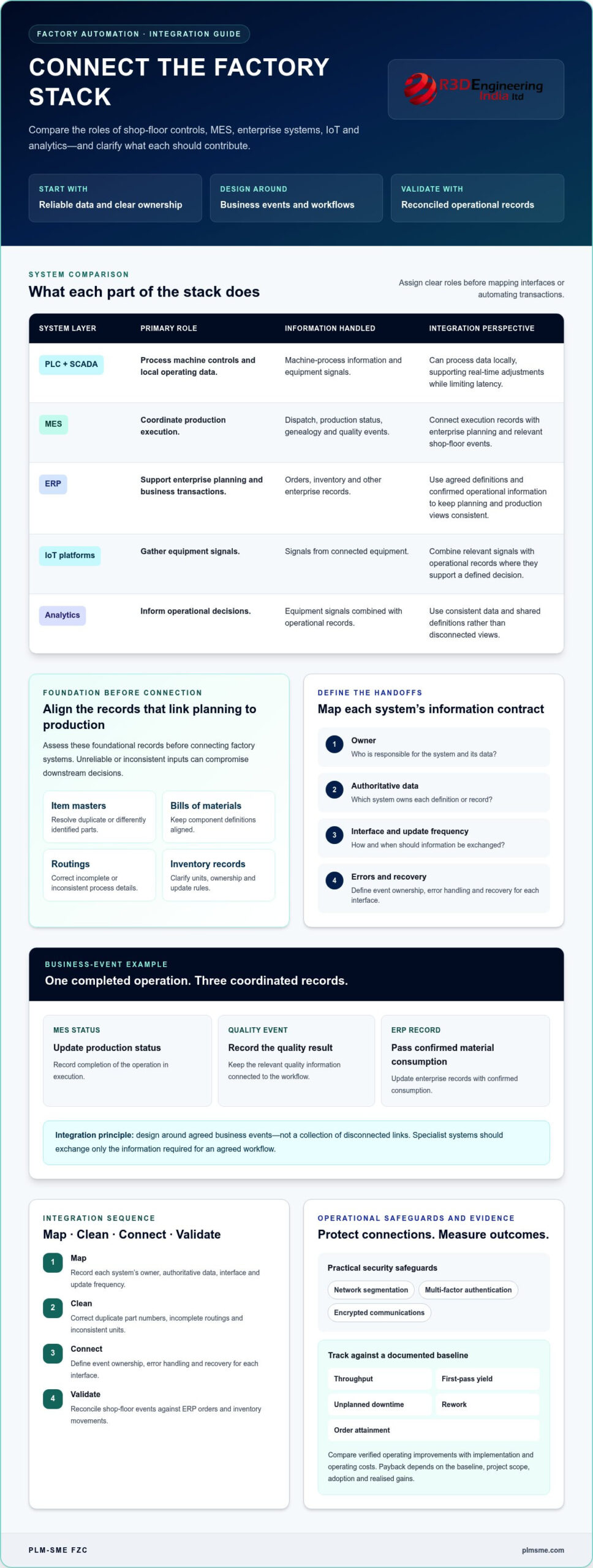
Start integration planning by assessing item masters, bills of materials, routings, and inventory records. These foundational records connect engineering plans with procurement, scheduling, execution, and reporting. If ERP identifies a component differently from MES, production and inventory views can diverge. Resolve data ownership, definitions, and update rules before mapping interfaces or automating transactions.
A digital transformation roadmap should map the IT-OT boundary and legacy constraints. PLC and SCADA systems can process data locally, supporting real-time adjustments while limiting latency. MES can coordinate dispatch, production status, genealogy, and quality events; ERP supports enterprise planning and business transactions. IoT platforms can gather equipment signals, while analytics combine them with operational records to inform decisions.
Key risks include fragmented data across ERP, WMS, MES, and IoT platforms, outdated infrastructure, unclear process ownership, and gaps in workforce readiness. Poorly planned connections or access controls can increase security exposure. Network segmentation, multi-factor authentication, and encrypted communications are practical safeguards for digitised plants.
Design integration around business events rather than a collection of disconnected links. For example, completing an operation can update MES status, record a quality result, and pass confirmed material consumption to ERP. Specialist systems for maintenance, inspection, or product lifecycle data should exchange only the information required for an agreed workflow.
- Map: Record each system’s owner, authoritative data, interface, and update frequency.
- Clean: Correct duplicate part numbers, incomplete routings, and inconsistent units.
- Connect: Define event ownership, error handling, and recovery for each interface.
- Validate: Reconcile shop-floor events against ERP orders and inventory movements.
Integrated business planning connects demand, capacity, material availability, and production constraints. Shared definitions help planners compare a proposed schedule with actual machine status and confirmed inventory instead of relying on separate spreadsheets. This improves visibility while preserving clear system ownership.
Measure automation ROI against a documented baseline. Track throughput, first-pass yield, unplanned downtime, rework, and order attainment. Compare verified operating improvements with implementation and operating costs. Payback depends on the baseline, project scope, adoption, and realised gains.
Discrete manufacturers in the UAE, especially automotive, aerospace, electronics, machinery, and metal-fabrication operations, can be strong candidates for automation when it addresses a defined need.
Technology strategy and roadmap development
A technology strategy turns factory priorities into sequenced decisions about systems, capabilities, ownership, and investment. In the UAE, the Technology Transformation Program uses the Industrial Technology Transformation Index (ITTI) to benchmark manufacturers’ digital maturity. Use that benchmark alongside operational evidence, such as missed production targets, manual approvals, or recurring quality issues, to identify the gaps a roadmap must address.
Begin with technology discovery sessions involving production, engineering, IT, maintenance, quality, and finance. Ask each team to describe a specific workflow, including its inputs, decisions, exceptions, and outputs. For example, trace a production order from enterprise planning through machine execution and quality release. Record where information is re-entered, where approvals stall, and who owns each decision. This helps distinguish a technology problem from an unclear process.
Next, rank potential AI and automation workflows by volume, risk, rule clarity, data readiness, integration complexity, and expected business value. Start with a workflow that has stable inputs, repeatable rules, meaningful volume, and measurable impact. A predictive maintenance recommendation, for instance, requires usable equipment data and a defined response process. Specify where the model produces recommendations, where actions occur, which decisions require approval, and how teams review the output.
Choose platforms only after defining these requirements. Compare robotics, PLCs, MES, and digital twins according to their intended roles: robotics handles physical movement or operations, PLCs control machine processes, MES coordinates production execution, and digital twins model assets or processes for analysis. Assess compatibility with existing equipment, integration needs, operational support, security, and the skills required for adoption.
For vendor recommendations, translate requirements into a neutral evaluation matrix. Assess functional fit, architecture, integration capability, data handling, implementation approach, and support against documented use cases. Demonstrations should use representative scenarios, such as an order change, a machine alarm, or a quality hold. This shows whether a platform fits actual work, beyond a polished presentation.
Sequence the roadmap into achievable releases, linking each initiative to dependencies, accountable owners, readiness criteria, and a business measure. Comprehensive digital transformations are described as typically taking 12 to 18 months, but the roadmap should divide that horizon into decision points and deliverables. Review sequencing when process needs, infrastructure, or workforce readiness changes, keeping efficiency and adoption visible throughout.
For a structured starting point, explore technology discovery sessions that connect operational needs with architecture and roadmap decisions.
For large government transformation programs, procurement can follow a six-month strategy engagement and a twelve-month implementation program. Companies with strong digital strategies have 3x higher profit margins.
Connected factories and value-chain digitisation
A connected factory extends beyond machine monitoring: it links production decisions with engineering, suppliers, inventory, and customer demand. For example, a drawing revision can trigger an approved bill-of-material update, procurement action, and revised production plan. This digital transformation depends on consistent identifiers and clear ownership across systems, not simply on adding more sensors. A value-chain strategy should map the information required at each handoff and identify where delays or duplicate entry disrupt operational decisions.
Digital transformation action planning turns that map into defined work. Set an objective, such as reducing schedule disruption from engineering changes, then document the process, systems, data owners, and decision points involved. A digital twin can model an asset, line, or process using operational data, helping teams examine scenarios before changing production. AI and machine-learning solutions can analyse patterns or generate recommendations, but teams need defined review and escalation paths before acting on outputs.
In the UAE, manufacturers should test system workflows against country-specific VAT, invoicing, and document requirements. The UAE e-invoicing mandate for 2027 should also be considered in integration planning. The UAE R&D Tax Incentive Program offers manufacturers a non-refundable credit of up to AED 2 million for eligible technical advances, for tax periods starting January 1, 2026. These factors can affect system design and project planning, so include them during requirements definition.
Factory automation planning should also account for the UAE’s Operation 300bn, which aims to increase the industrial sector’s economic contribution to AED 300 billion by 2031. Customs duty exemptions on imported industrial machinery and raw materials are available to reduce automation project costs. Eligibility and project implications depend on the specific circumstances, so model incentives and import considerations separately from operational benefits.
For an SAP S/4HANA digital core strategy, define which business processes and records belong in the enterprise core, then specify how MES, product data, and specialist applications exchange information. Avoid duplicating master data across platforms. For instance, agree which system controls product identifiers, engineering revisions, purchase commitments, and confirmed production quantities. A technology partner should document integration boundaries, data governance, and exception handling rather than treat connectivity as a collection of isolated interfaces.
- Prioritise: Choose a value-chain issue with measurable operational consequences.
- Model: Use a digital twin to explore a defined asset or process scenario.
- Govern: Assign owners for data, AI recommendations, approvals, and exceptions.
- Sequence: Align enterprise, factory, and compliance-related changes through a single action plan.
Applicable standards depend on the product, process, and site requirements. Identify them during planning, then reflect relevant controls in system workflows, technical specifications, and acceptance testing.
Firm selection by organizational needs
The right consulting firm should fit your production processes, integration complexity, and internal delivery capacity. A plant modernising one work cell needs a different approach from a multi-site manufacturer connecting engineering, MES, and enterprise systems. Define the operational problem, affected teams, existing platforms, and decision owners before comparing proposals. This gives each firm the same context and makes differences in scope easier to assess.
Use a weighted scorecard to compare capability rather than relying on broad claims. A manufacturing partner scorecard assigns 25% to manufacturing process and industry fit, and 20% to the proposed team and relevant references. It gives 15% each to discovery, design and governance methodology; data, integration and architecture capability; and testing, cutover and adoption approach. The remaining 10% covers support model and commercial clarity.
- Process fit: Check whether the proposed approach addresses your production model, product variation, quality controls, and engineering changes.
- Team relevance: Assess the named delivery team’s roles and the relevance of its project references to your systems and processes.
- Architecture: Compare how each proposal handles interfaces, data ownership, access, and legacy applications.
- Delivery: Look for defined testing, cutover, training, and adoption activities, with responsibilities assigned.
- Commercial clarity: Compare scope boundaries, assumptions, dependencies, and support arrangements.
Match the engagement to your organisation’s readiness. If process ownership is unclear, begin with discovery and governance design. If requirements and system boundaries are established, focus on architecture and implementation planning. If your internal team can lead technical delivery, define where specialist input is needed, such as MES integration, product data flows, or change-impact analysis. Clear interfaces between internal and external responsibilities help reduce duplicated effort.
For each proposal, map deliverables to acceptance criteria. A roadmap should identify priorities, dependencies, accountable owners, and decision gates. An architecture deliverable should show system boundaries and information flows. A production pilot plan should define test scenarios, cutover conditions, training, and escalation procedures. These details show whether the firm’s approach can support your actual complexity.
Use reference projects to test relevance, not just sector labels. A discrete manufacturer should compare examples involving similar production processes, engineering changes, traceability needs, or ERP and MES connections. General digital experience may not include the specific integration knowledge your environment requires.
Finally, align governance with your operating model. Business leaders should own rules, approvals, service expectations, and risk tolerance; IT and automation teams build the capability. Select a partner whose proposed decision structure supports that division and keeps production accountable for operational outcomes.
Phased implementation and controlled releases
Discrete manufacturing automation should progress from defined operational needs to tested production releases. A staged approach helps teams manage dependencies, governance, workforce adoption, and measurable outcomes.
Automation Roadmap Stages
A practical sequence is discovery, process design, pilot, controlled production release, monitoring, and improvement. During discovery, document scope and constraints. Process design then defines workflow changes, roles, and acceptance criteria before configuration begins.
- Discover: Select a production workflow and document its inputs, owners, risks, and baseline measures.
- Design: Define future-state steps, system responsibilities, exception handling, and test scenarios.
- Pilot: Run the workflow in a bounded setting and record operational and technical results.
- Release: Expand only after acceptance criteria, training, access, and recovery procedures are ready.
- Improve: Monitor results, resolve exceptions, and adjust the workflow before further growth.
Set measurable outcomes before production release, such as order completion accuracy or reduced manual re-entry. Assign business owners to approve rules and escalation paths, while IT and automation teams manage technical controls. This governance helps prevent teams from treating exceptions as afterthoughts or rebuilding manual workarounds.
Project Costs and Timelines
Automation project costs in the UAE depend on scope, process complexity, existing infrastructure, integration requirements, equipment changes, testing, and workforce preparation. Separate assessment and design from implementation, change management, and ongoing support when building a budget, since each workstream has different deliverables and resource needs.
Comprehensive digital transformations typically take 12 to 18 months. Phased approaches can deliver value within 3 to 4 months for specific initiatives, while broader timelines depend on dependencies, approvals, data readiness, and production access. Treat each release as a decision point, not a promise that every factory or system will follow the same schedule.
Track actual effort and outcomes against the approved scope at each stage. If a pilot reveals unstable inputs or unclear ownership, redesign the workflow before expanding it. A delayed release can be more controlled than scaling a process that produces unreliable results.
For a roadmap that connects staged delivery with PLM implementation planning, plan your automation roadmap around clear milestones and release criteria.
Define approval criteria so teams can judge whether a workflow is ready to move forward. Leaders should set measurable outcomes before automation enters production. Choose measures that reflect the workflow’s purpose and ensure owners can review them consistently. Document the expected result, the evidence needed to assess it, and who decides whether the release meets the agreed criteria. This gives the production decision a clear basis rather than relying on general impressions of success.
Keep release decisions tied to workflow readiness. If results do not meet the intended outcome, use the findings to clarify requirements, address exceptions, or adjust the design before expanding use. Make responsibilities clear to the people who operate, support, and approve the process, and explain how the release plan will raise and handle concerns. Once a workflow is in production, continue reviewing its outcomes and use those observations to guide further changes. Expand deliberately, with evidence that the process works as intended and clear ownership for follow-up.
PLM-Sme FZC: Digital maturity assessments and reports
PLM-Sme FZC helps discrete manufacturers turn digital priorities into an actionable transformation plan. Its digital maturity assessments and reports identify capability gaps across processes, data, systems, and workforce readiness, giving decision-makers a structured basis for prioritising investment.
Turn to this work when production, engineering, and IT initiatives need a shared direction, or when integration decisions are difficult to sequence. Digitalisation Vision & Roadmap Consulting connects assessment findings to phased priorities, while System and Solution Architecture helps define how enterprise and factory platforms fit together. Industrial automation and AI solutions address opportunities where defined processes and business outcomes support automation.
Contact PLM-Sme FZC to discuss your manufacturing roadmap needs and define a practical next step.
Move from roadmap decisions to factory action
The next step is to turn priorities into a decision-ready programme: establish who owns each outcome, what evidence will guide investment, and how operational teams will shape adoption. For manufacturers considering discrete manufacturing automation roadmap consulting in the UAE, the value lies in connecting strategic choices to the realities of production, engineering, and enterprise systems.
PLM-Sme FZC offers digital maturity assessments and reports, Digitalisation Vision & Roadmap Consulting, and industrial automation and AI solutions. These services help manufacturers clarify current capabilities, set a practical direction, and evaluate where automation or AI fits their objectives. The right starting point is the question your factory needs to answer, whether that concerns readiness, priorities, or a coherent implementation path.
Contact PLM-Sme FZC to discuss your automation roadmap and the decisions shaping your next phase of factory digitisation. A clear first step can give your team a stronger basis for moving forward.
Frequently Asked Questions
What is a discrete manufacturing automation roadmap?
A discrete manufacturing automation roadmap is a sequenced plan for aligning factory processes, systems, and investment with defined operational goals. It identifies intended capabilities, dependencies, accountable owners, and decision points. For example, a manufacturer could map how an engineering revision moves through design approval, production planning, shop-floor execution, and quality release, then identify where automation or integration supports that flow.
Which UAE consultants specialize in discrete manufacturing automation?
PLM-Sme FZC specialises in industrial digitalisation and PLM, supporting discrete-industry clients with maturity assessments, reports, and transformation roadmaps. Its discrete manufacturing automation roadmap consulting in the UAE connects digital priorities with PLM, system architecture, and integration needs. This is relevant when engineering data, production processes, and enterprise applications must support a coordinated transformation direction.
What data and readiness assessments are needed before planning factory automation?
Assess process ownership, data quality, system access, security permissions, compliance needs, change readiness, and post-go-live support. For a practical test, trace one product variant from engineering release to production completion. Note who approves each transition, which system holds the record, and how teams resolve missing or conflicting information. This reveals readiness gaps beyond item and inventory records.
What steps help select and evaluate an automation consulting firm in the UAE?
Give each candidate the same real production scenario, such as a design revision affecting a scheduled order, and ask them to explain the proposed workflow and decision controls. Evaluate the clarity of their assumptions, system boundaries, deliverables, and acceptance criteria. Then compare how their approach addresses your operating model, internal responsibilities, and long-term governance, rather than relying on a general technology presentation.
Which UAE industrial zones and sectors are best suited to discrete manufacturing automation?
Suitable sectors include automotive, aerospace, electronics, machinery, and metal fabrication, especially plants coordinating parts, routings, work orders, and quality records. The material does not identify specific industrial zones.