
Digital Shop Floor Readiness Assessment in the UAE
A useful digital shop floor readiness assessment in the UAE turns scores into decisions, not just a maturity label. It evaluates each dimension on a 1-to-5 scale, then interprets the results against your operational priorities, technology adoption and deployment readiness. The value lies in understanding what the scores mean for your factory and what should happen next.
An assessment should show where digital capabilities are strong and where gaps could slow implementation. But a low score alone does not explain whether the priority is data quality, systems integration, workforce adoption or deployment planning. Professional interpretation connects these factors to shop floor operations, so the roadmap reflects practical needs rather than a generic checklist.
This article explains how specialists assess digital maturity, interpret scorecards and prioritise a practical roadmap for UAE manufacturers. It also covers how technology readiness and deployment conditions shape recommendations, and what a thorough assessment should deliver to support the next transformation decision.
Key Takeaways
- Learn how to interpret readiness scores in context, connecting capability gaps to operational priorities rather than treating a score as a verdict.
- See how technology prerequisites and deployment planning can shape which initiatives should move forward first.
- Understand how digital maturity assessment frameworks help locate your shop floor’s current position and guide transformation priorities.
- Explore how evaluating integration, data, automation and workforce needs can turn assessment findings into a focused roadmap.
Readiness scorecards and prioritised roadmaps
A readiness scorecard converts operational evidence into comparable findings. Each dimension receives a score from 1 to 5, showing relative strengths and constraints. A longer assessment asks 20 questions across six scored areas, then records findings in a readiness scorecard and gap register. The score alone is not a decision: assessors interpret it against shop floor priorities, system dependencies and evidence quality.
UAE manufacturers can face gaps in data management, system integration and traceability when digitising production. Food, pharmaceutical, chemical and medical device manufacturers may need batch traceability, making disconnected production records a practical risk. Inefficient data management and siloed AI efforts can result in annual losses of up to 10% of total revenue. The assessment identifies where fragmented information or isolated automation could undermine a use case.
Regulatory context also shapes priorities. The UAE Federal Data Protection Law is Federal Data Protection Law No. 45 of 2021, according to UAE Legislation. An assessment considers data flows and access needs when evaluating digital initiatives, so governance forms part of the roadmap rather than an afterthought.
The assessor then ranks gaps by operational impact and dependency. For example, an AI quality-control use case may depend on consistent inspection data and reliable integration with production systems. A gap register links each constraint to the affected process, supporting evidence and proposed action, helping decision-makers distinguish prerequisites from later enhancements.
Use-case prioritisation connects each proposed initiative to a measurable outcome. For example, a maintenance initiative can be assessed against unplanned downtime, while automated inspection can be evaluated through defect and rework trends. Baselines, target measures, data owners and system dependencies make the business case structured and reviewable.
AI gaps should be prioritised by their effect on business outcomes and deployment feasibility. The roadmap can sequence data foundations and integration before AI deployment, then define phased milestones, budgets and go/no-go decisions across 12-24 months. This creates a practical order for digital initiatives, linking each investment to an operational need and a decision point.
Technology adoption and deployment scoring
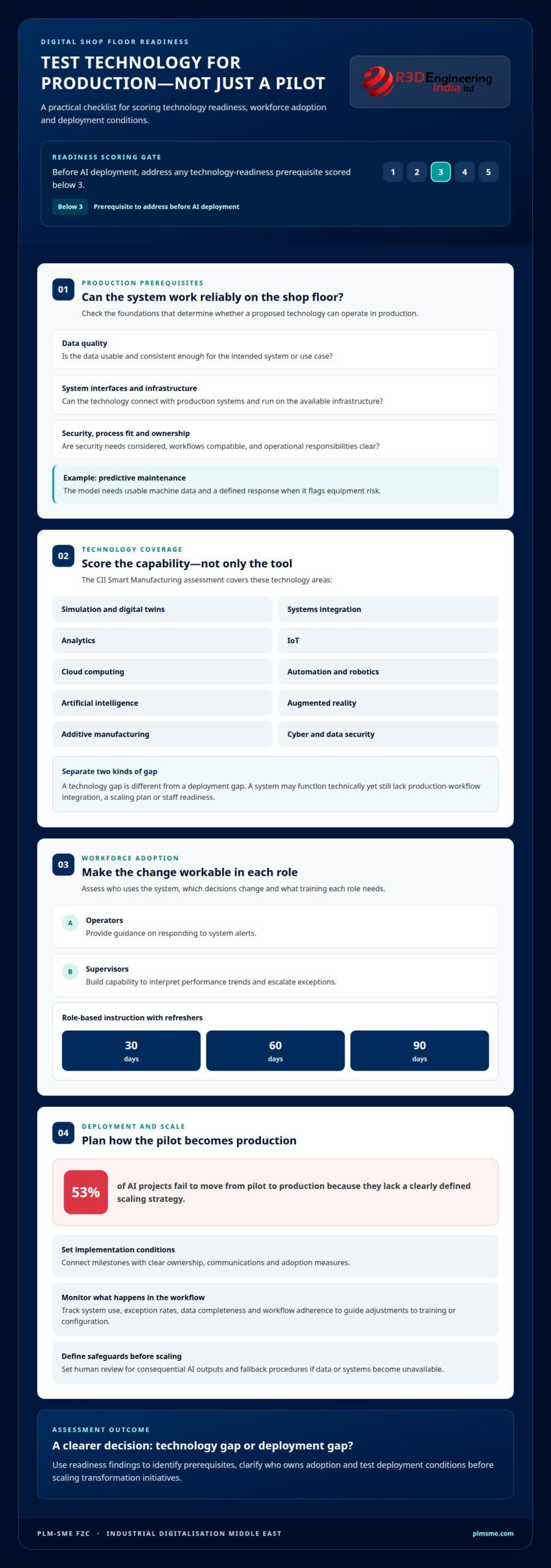
Technology scoring tests whether a proposed system can operate reliably in production, not simply whether it can be demonstrated. Before AI deployment, any technology-readiness prerequisite scoring below 3 should be addressed. Assessors examine data quality, system interfaces, infrastructure, security, process fit and operational ownership. For example, a predictive-maintenance model needs usable machine data and a defined response when it flags equipment risk.
The CII Smart Manufacturing assessment covers simulation and digital twins, systems integration, analytics, IoT, cloud computing, automation and robotics, artificial intelligence, augmented reality, additive manufacturing, and cyber and data security. Scoring these capabilities helps distinguish a technology gap from a deployment gap. A system may function technically but still lack integration with production workflows, a scaling plan or staff readiness. 53% of AI projects fail to move from pilot to production because they lack a clearly defined scaling strategy.
Adoption depends on whether employees can use the technology within their roles. An assessment considers who interacts with the system, what decisions change, and what training each role needs. A practical plan can pair role-based instruction with refresher sessions at 30, 60 and 90 days. For example, operators may need guidance on responding to alerts, while supervisors need to interpret performance trends and escalate exceptions.
Change management should connect implementation milestones with clear ownership, communications and adoption measures. Monitoring can track system use, exception rates, data completeness and workflow adherence, giving managers evidence to adjust training or configuration. Risk mitigation also means defining human review for consequential AI outputs and establishing fallback procedures if data or systems become unavailable. These checks help teams test deployment conditions before scaling transformation initiatives. For organisations advancing from readiness findings to structured PLM deployment, PLM implementation support can help align system delivery with operational requirements.
Digital maturity assessment
A digital maturity assessment maps how manufacturing capabilities support daily operations. It examines more than installed technology: assessors consider how information moves from equipment to production decisions, whether workflows use consistent data, and who owns each process. For example, a machine dashboard may show output, but maturity also depends on whether supervisors act on deviations and record corrective actions. This distinction separates digital tools from integrated operating capability.
The UAE Ministry of Industry and Advanced Technology assessed the digital maturity of 70 industrial companies and prepared individualised roadmaps for 4IR adoption. It adopted the Smart Industry Readiness Index after the World Economic Forum recognised it as a global standard for unifying 4IR concepts. These examples show how maturity assessment can connect a current-state review to a company-specific transformation path, rather than applying one target state to every factory.
The CII Smart Manufacturing model describes progression from Industry 1.0 to Industry 4.0. It can provide industry-average and best-in-class benchmarks when an adequate number of response sets is available. Benchmarks help frame a result, but assessors still interpret it against the factory’s products, process complexity and operating model. A five-minute self-assessment covering seven AI-readiness dimensions can provide an initial view, while a professional review examines evidence behind the responses.
For a UAE manufacturer, the useful output is a maturity profile tied to production realities. Assessors can trace a finding from a capability, such as systems integration, to its effect on a workflow, such as engineering change or quality review. That connection helps leaders distinguish an isolated tool gap from a broader operating constraint. Firms implementing AI without a formal infrastructure readiness assessment face an average 15% increase in operational costs. The finding reinforces why infrastructure, data, process ownership and workforce capability belong in the same maturity picture. A practical assessment therefore identifies current strengths, constraints and the next capability needed for the intended production outcome.
What capabilities are assessed in a digital shop floor readiness assessment?
A capability review examines whether shop floor technology supports reliable production decisions. It considers machine connectivity, data quality, system interfaces, process ownership and workforce workflows. For example, assessors trace how a machine event becomes a maintenance action, including where the event is captured and who responds. This reveals whether digital tools connect to operations or remain isolated from them.
Industry 4.0 capabilities often depend on digital foundations working together. The assessment can examine IoT machine integration, predictive maintenance, automated quality control and AI-driven production optimisation. For a predictive-maintenance use case, the review considers whether relevant machine data is available and whether teams can act on model outputs. For automated inspection, it looks at how quality results enter production records and inform follow-up decisions.
Integration is assessed by reviewing available exchange methods, including APIs, middleware and batch transfers. Each option has different implications for data flow, update frequency and system dependencies. Assessors map connections between shop floor equipment and enterprise systems, then identify handoffs that could affect traceability or decision-making. A batch exchange, for instance, may suit a process that does not need immediate updates, while another workflow may require more frequent data transfer.
- Connectivity: Are equipment signals captured consistently and associated with the correct machine or production activity?
- Analytics and AI: Can available data support a defined use case, such as production optimisation or anomaly detection?
- Operational use: Do quality, maintenance and production teams have clear workflows for acting on digital outputs?
The resulting capability map distinguishes technical gaps from process or adoption constraints. It also shows which prerequisites should come before deployment, such as resolving inconsistent machine records before expanding analytics. This evidence gives decision-makers a grounded view of readiness across systems, data and shop floor workflows.
To translate capability findings into a tailored assessment and report, arrange a digital maturity assessment.
PLM-Sme FZC: Digital maturity assessments and reports
PLM-Sme FZC helps manufacturers in the UAE turn digital maturity findings into a practical view of current capabilities and priorities. Its digital maturity assessments and reports clarify how production systems, data, workflows and technology adoption align with operational goals. An assessment is useful when scores need interpretation, gaps span multiple functions or proposed AI initiatives lack a clear foundation.
Where findings point to broader transformation needs, Digitalisation Vision & Roadmap Consulting can help shape priorities and sequence initiatives. System and Solution Architecture addresses design considerations, while industrial automation and AI solutions support suitable opportunities. The next step depends on the assessment findings and the outcomes your manufacturing operation needs.
To discuss a digital maturity assessment for your shop floor, contact PLM-Sme FZC.
Turn readiness into a managed next step
A digital shop floor readiness assessment for a UAE manufacturer is most useful when its findings inform a clear decision. Before advancing an initiative, define who owns the outcome, which operational measure will indicate progress and what evidence should trigger a change in direction. This creates accountability beyond the assessment and keeps transformation decisions connected to factory priorities.
Use the assessment as a reference for future investment decisions, not as a one-time score. As production needs and system dependencies evolve, decision-makers can revisit priorities and assess whether planned initiatives remain aligned with operational goals. A disciplined review process helps teams focus on the next meaningful improvement.
When you’re ready to discuss how an assessment could support your manufacturing priorities, contact PLM-Sme FZC. A considered next step can help your team move forward with greater clarity and purpose.
Frequently Asked Questions
How Can a Professional Help You Interpret Your Assessment Results?
A professional assessor tests findings against operational evidence and the manufacturer’s priorities. For example, a low MES-readiness score may reflect unclear production data ownership, not a lack of software. The assessor distinguishes root causes from symptoms, checks dependencies between departments and explains which findings could block a planned initiative. This makes the report useful for investment decisions, rather than simply a record of scores.
What is a digital shop floor readiness assessment?
A digital shop floor readiness assessment in the UAE is a structured review of how well a manufacturer’s people, processes, data and systems support digital operations. It considers the intended outcome, such as connecting production records with engineering data, then examines relevant capabilities and constraints. The result helps leaders understand whether their operating environment can support the planned change and where further analysis is needed.
Which UAE consultants and providers offer shop floor readiness assessments?
PLM-Sme FZC provides digital maturity assessments and reports for industrial digitalisation. Its work is relevant when a manufacturer needs an evidence-based view of current capabilities and a clearer direction for transformation. The assessment can inform a digitalisation vision and roadmap, particularly for discrete-industry operations considering PLM, system architecture or AI-related initiatives. This connects readiness findings to the manufacturer’s wider digital environment.
What are the UAE manufacturing sector’s digital transformation priorities and benchmarks?
UAE manufacturers can use national industrial transformation efforts as context, then benchmark against their own processes and goals. The UAE Ministry of Industry and Advanced Technology assessed the digital maturity of 70 industrial companies and prepared individualised 4IR adoption roadmaps. It adopted the Smart Industry Readiness Index after the World Economic Forum recognised it as a global standard. CII benchmarks can add context when enough response sets are available.
How do consultants assess a manufacturer’s readiness for MES, IoT, automation, and Industry 4.0?
Consultants assess whether proposed technology fits existing workflows, system boundaries and data exchanges. For an MES initiative, they examine how production information moves between shop floor systems and enterprise applications. Integration may use APIs, middleware or batch methods. For IoT and automation, the review considers data usability, operational ownership and how teams respond to system outputs before recommending broader deployment.
What should a UAE manufacturer’s digital shop floor roadmap include?
A useful roadmap links each initiative to an operational owner, a defined outcome and the conditions needed to begin. It should show dependencies, such as resolving data definitions before connecting systems, and identify decision points for continuing, revising or pausing work. Include measures that reveal whether the change is working, such as production record completeness or responses to quality exceptions, alongside planned review points.