
De-risking a PLM Migration: A Strategic Framework for Industrial Success in 2026
Treating a PLM transition as a simple software upgrade is the most expensive mistake an industrial enterprise can make. When the cutover begins, the difference between a successful deployment and a month of engineering downtime often comes down to the integrity of your historical CAD relationships. You’ve likely spent years refining your workflows, and the thought of data corruption or broken integrations with your ERP and MES systems is a significant source of operational anxiety. It’s clear that your intellectual property is the lifeblood of your production line, and any threat to its continuity is a threat to the business itself.
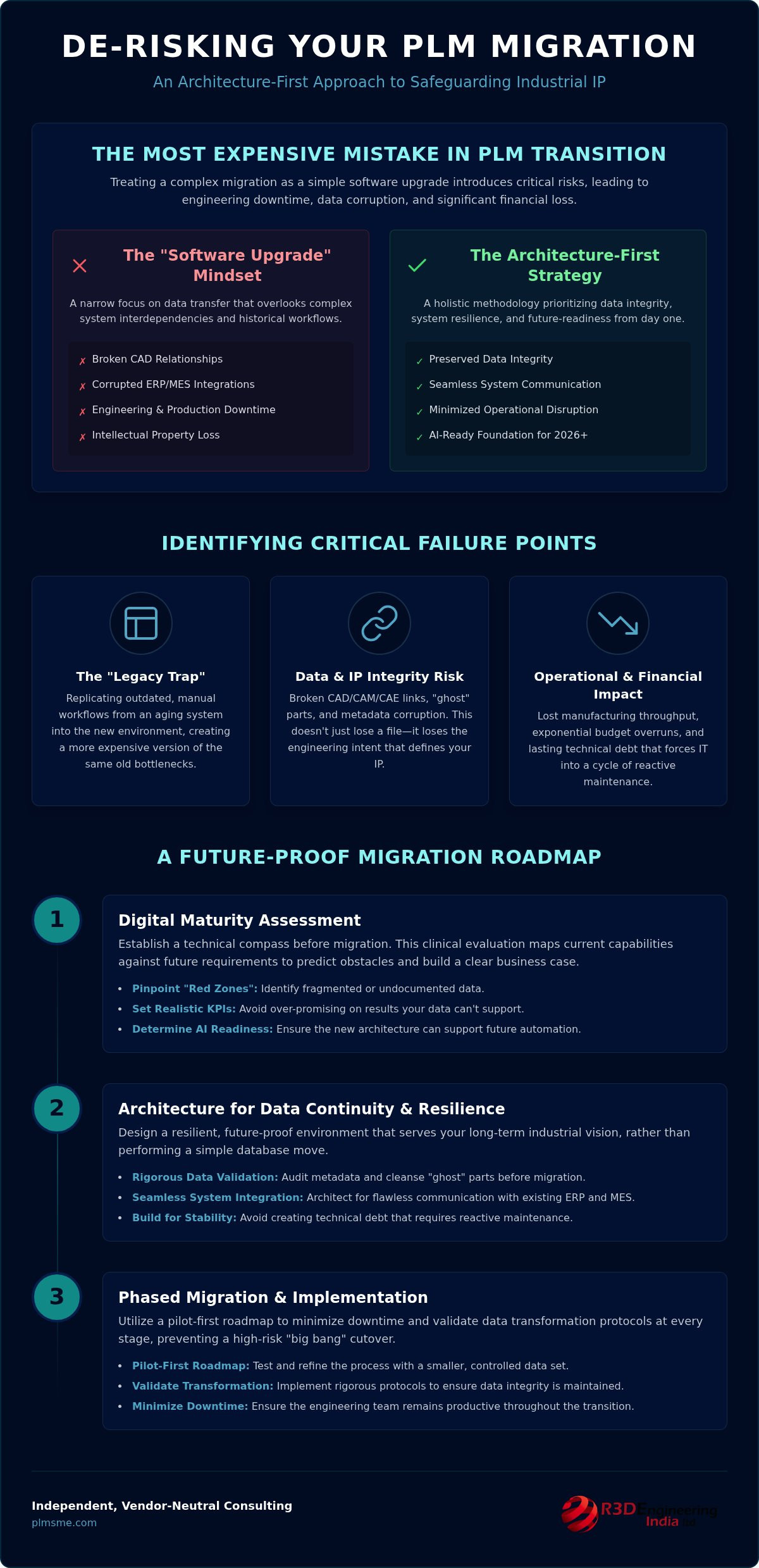
Effectively de-risking a PLM migration demands an architecture-first approach that prioritizes technical precision over vendor-led marketing hype. This article outlines the strategic methodologies required to eliminate data loss and minimize downtime during your transition. You’ll learn how to implement a future-proof framework that supports AI readiness and ensures seamless cross-system communication. We’ll examine the essential steps for digital maturity mapping, rigorous data validation, and building a stable environment that serves your long-term industrial vision for 2026 and beyond.
Key Takeaways
- Learn how to safeguard complex CAD relationships and metadata to prevent intellectual property loss during the transition process.
- Discover the role of digital maturity assessments in identifying hidden organizational silos that can derail technical implementations.
- Master the strategic methodologies for de-risking a PLM migration by utilizing pilot-first roadmaps and validated data transformation protocols.
- Understand how to architect a resilient, future-proof environment that integrates seamlessly with existing ERP and MES systems.
- Recognize the value of independent, vendor-neutral consulting in providing objective oversight and specialized expertise for long-term system stability.
Identifying the Critical Failure Points in PLM Migration
Strategic de-risking a PLM migration isn’t just about technical data transfer; it’s a holistic strategy for ensuring system continuity across the entire industrial value chain. Many organizations treat a migration as a simple database move, yet this narrow focus often overlooks the complex interdependencies within modern engineering environments. A primary failure point is the “Legacy Trap,” where outdated, manual workflows from an aging system are replicated in the new environment. This approach fails to leverage the capabilities of modern software and often results in a more expensive version of the same bottlenecks you intended to solve. True success requires a neutral assessment of current processes before a single byte of data is moved.
Data Integrity and Intellectual Property Risks
Engineering data is inherently more volatile than standard enterprise information. Unlike a simple text document, Product Lifecycle Management (PLM) data involves intricate webs of CAD, CAM, and CAE relationships. When these links break during a migration, you don’t just lose a file; you lose the engineering intent and version history that define your intellectual property. Establishing a rigorous baseline for data quality before the migration begins is essential. This means auditing metadata and clearing out “ghost” parts or orphaned assemblies that could corrupt the new database. Without this cleansing, you’re merely moving digital clutter into a more sophisticated container, leading to metadata corruption that can take years to rectify.
Operational and Financial Impact of Migration Failure
Failure in the migration phase manifests quickly on the balance sheet through lost manufacturing throughput. Quantifying the cost of engineering idle time during an extended cutover reveals the true stakes. If your design team can’t access critical assemblies for even forty-eight hours, the ripple effects hit production schedules and customer delivery dates immediately. This proactive approach to de-risking a PLM migration prevents the common cycle of poor scoping, which typically leads to exponential budget overruns as teams scramble to fix broken integrations with ERP and MES systems post-launch. Furthermore, a poorly architected transition creates lasting technical debt, forcing your IT team into a permanent cycle of reactive maintenance rather than supporting new industrial automation initiatives. Resilience must be built into the architecture from day one to avoid these financial pitfalls.
Leveraging Digital Maturity Assessments to Predict Obstacles
Effective de-risking a PLM migration begins long before the first script is written. It requires a clinical evaluation of where your organization stands today compared to where it needs to be in a post-migration environment. By mapping current state capabilities against future requirements, you can identify the organizational silos that frequently hinder cross-functional data flow. These assessments provide the objective data needed to justify migration budgets and resource allocation to executive stakeholders, transforming a technical necessity into a clear business case for digital transformation.
Establishing a Baseline with a Digital Maturity Report
A successful transition relies on a clear understanding of the strategic value of a digital maturity report in manufacturing. This document serves as your technical compass, pinpointing “Red Zones” in your current digital infrastructure where data is fragmented or undocumented. By setting realistic KPIs based on actual maturity levels, you avoid the trap of over-promising results that your current data quality can’t support. It’s about building a foundation of transparency that allows for a predictable, phased rollout rather than a high-risk “big bang” approach. If you’re unsure of your current baseline, a professional digital maturity assessment can provide the clarity needed to move forward with confidence.
As we look toward 2026, determining AI readiness has become a core component of any modern PLM roadmap. Modern AI tools require highly structured, clean data to provide actionable insights. If your current system is a “black box” of unstructured metadata, your new PLM environment won’t be able to support advanced automation or predictive modeling. A maturity report identifies these gaps early, ensuring your new architecture is built for the future of industrial intelligence.
Predicting Integration Friction Points
Technical friction often occurs at the boundaries between systems. You must assess how existing ERP and CRM systems will react to new PLM schemas before the integration goes live. Many failures happen because the downstream systems aren’t prepared for the increased granularity or different data structures of a modern PLM environment. Evaluating the readiness of the workforce is equally critical. If your engineering team is accustomed to manual workarounds, they may resist the standardized workflows of a new system. By building a risk-mitigation buffer based on these assessment findings, you ensure that both your technology and your people are prepared for the shift, significantly de-risking a PLM migration from a human and technical perspective.
Architecting for Data Continuity and System Resilience
Designing a resilient digital environment is the most effective method for de-risking a PLM migration. While many organizations focus solely on the immediate cutover date, successful industrial leaders prioritize a scalable system architecture that prevents future performance bottlenecks. This requires establishing clear data governance rules that dictate how information moves between design, engineering, and the shop floor. Without these rules, even the most advanced software becomes a repository of inconsistent data, hindering your ability to support complex CAD, CAM, and CAE extensions that are vital for discrete manufacturing.
The Role of PLM System Architecture
Expert PLM system architecture consulting is non-negotiable for enterprises aiming for long-term stability. It’s about more than just server configurations; it’s about creating a blueprint that separates core PLM functions from custom integrations. This separation is vital because it reduces technical debt, making future upgrades less risky and significantly less expensive. By building resilience into the Teamcenter environment, you ensure high-availability for your global teams. This means your engineering departments aren’t sidelined by server failures or synchronization errors during critical product development cycles. A well-designed architecture acts as a buffer, absorbing the complexities of multi-site data sharing while maintaining a single source of truth.
Integrating PLM with ERP and MES Systems
Creating a true Digital Thread involves de-risking the connection between different software vendors. De-risking a PLM migration at the architectural level means ensuring that the exchange between Teamcenter and your ERP or MES systems is both secure and reliable. It’s not enough to simply move data; you must ensure the context and engineering intent remain intact as information flows to the shop floor. This structural integrity is what allows for future AI and automation scaling. When the architecture handles the heavy lifting of data validation, your MES receives accurate engineering definitions every time, reducing scrap and rework. This level of planning transforms the PLM environment from a siloed engineering tool into a central engine for industrial automation and real-time decision-making.
Implementing a Phased Migration Roadmap to Minimize Downtime
Execution is where strategic planning meets technical reality. Adopting a “Pilot-First” approach allows you to test migration scripts in a controlled sandbox environment before touching production data. This iterative testing is vital for de-risking a PLM migration because it uncovers hidden script errors that only surface when exposed to actual engineering data. Whether you choose a “Big Bang” cutover for a smaller site or a “Phased” rollout for global operations depends on your specific risk tolerance and operational complexity. Regardless of the path, a robust validation framework including end-user acceptance testing (UAT) ensures the system performs as expected in real-world scenarios.
The Pre-Migration Data Cleansing Phase
Moving every byte of data from a legacy system is rarely the right choice. You should focus on removing “Dark Data”, which includes unstructured, redundant, or obsolete files that add unnecessary weight to the migration load. Standardizing naming conventions and metadata attributes during this phase prevents legacy inconsistencies from polluting your new environment. Automating data validation ensures 100% integrity before the final move, allowing your team to focus on high-value engineering tasks rather than manual data correction. This proactive cleansing reduces the volume of data transferred, which directly shortens the cutover window and minimizes potential failure points.
Executing the Cutover and Post-Migration Support
Managing the actual transition requires surgical precision to ensure zero engineering downtime. During the cutover, your team needs immediate access to technical experts who can resolve unforeseen synchronization issues in real-time. This is why an ongoing PLM administration retainer is essential for post-live stability. It provides a safety net that goes beyond the initial deployment, offering continuous oversight as your team adapts to new Teamcenter workflows. Training the workforce is the final piece of the puzzle; well-informed users are significantly less likely to cause user-error risks that could lead to data corruption. It’s about maintaining momentum when the stakes are highest.
If you’re ready to secure your digital transition with a proven methodology, our team provides end-to-end PLM implementation support to guide your enterprise through every phase of the roadmap.
Securing the Digital Future with Expert Teamcenter Consulting
Selecting an objective partner is the final, most critical step in de-risking a PLM migration. Software vendors are often incentivized by license sales and standardized deployment models that don’t always account for the unique architectural quirks of your specific production environment. An independent consultant acts as a neutral advisor, focusing on your long-term operational stability rather than vendor-specific quotas. By leveraging Siemens Digital Industries Alliance expertise, you ensure that your Teamcenter environment is configured to meet the rigorous demands of discrete manufacturing. This alignment is essential for integrating your technical shift with a broader industrial digitalisaton roadmap, ensuring that your migration serves your 2026 business goals.
The Advantage of Specialized Teamcenter Expertise
Strategic Siemens Teamcenter Consulting provides the specialized knowledge required to navigate complex migration hurdles, which is a vital part of de-risking a PLM migration for discrete industries. This expertise is particularly valuable when developing custom integrations for ERP, CRM, and MES connectivity. A standard “out of the box” connection rarely survives the complexities of real-world industrial data exchange. Specialized consultants build tailored bridges between these systems, ensuring that engineering intent is preserved as data moves across the enterprise. Beyond the initial go-live, managed administration ensures that your system performance remains optimized, preventing the gradual degradation that often follows a major software transition.
Building the Foundation for Industrial AI
A successfully executed transition does more than just move files; it creates the high-quality, structured data set required for next-generation AI initiatives. Industrial AI and machine learning tools are only as effective as the data they consume. If your migration process hasn’t prioritized data cleansing and relationship validation, your AI results will be unreliable. By establishing a clean architectural foundation now, you’re future-proofing your roadmap for industrial automation solutions that can drive predictive maintenance and autonomous production planning. This strategic foresight ensures your PLM environment remains a competitive asset for years to come. To ensure your transition is handled with technical precision and strategic clarity, consult with PLM-Sme to secure your migration strategy today.
Securing Industrial Continuity in a Digital-First Era
A successful transition to a modern PLM environment is defined by technical precision and architectural foresight. By prioritizing data integrity and adopting a phased roadmap, your enterprise can avoid the common pitfalls of operational downtime and metadata corruption. We’ve explored how a resilient system architecture and rigorous digital maturity mapping serve as the foundation for future AI readiness and industrial automation. Ultimately, de-risking a PLM migration requires an objective partner who understands the intricacies of complex engineering data and cross-system integrations.
As a Siemens Digital Industries Alliance Partner specialized in complex Teamcenter architecture, PLM-Sme provides the expert oversight needed to protect your intellectual property. We offer national coverage for industrial digitalization across the UAE, functioning as a thinking partner for your long-term vision. Taking the first step toward a stable digital future starts with understanding your current baseline.
Secure your industrial transformation with a Digital Maturity Assessment from PLM-Sme and ensure your production line remains resilient in 2026 and beyond.
Frequently Asked Questions
How much does a PLM migration typically cost when de-risking is included?
Total investment varies based on data volume, the complexity of CAD relationships, and the number of existing system integrations. While de-risking adds investigative work like maturity reports, it prevents the exponential costs of post-migration failure and engineering downtime. Expenses depend on whether you require full end-to-end implementation or specialized architecture consulting. It’s best to evaluate costs through a detailed scoping exercise that accounts for your specific technical dependencies and integration requirements.
What happens if we lose CAD data relationships during the migration?
Losing CAD relationships results in broken assemblies and lost version history, which can halt engineering production immediately. When these links are severed, engineers must manually reconstruct parts and assemblies, leading to significant delays and potential errors. This is why de-risking a PLM migration involves pre-migration audits to validate engineering intent. Proper validation ensures that metadata and spatial relationships remain intact, protecting your intellectual property from corruption during the transfer process.
Can we migrate to Siemens Teamcenter while keeping our existing ERP system?
Yes, you can migrate to Siemens Teamcenter while maintaining your existing ERP through specialized integration development. Modern PLM architecture is designed to function as a central hub that communicates with various enterprise tools. By developing robust connectors, your engineering data flows seamlessly into the ERP for procurement and manufacturing without needing a software overhaul. This approach ensures system continuity while leveraging the advanced lifecycle management capabilities of the Teamcenter environment.
Is it safer to perform a “Big Bang” migration or a phased approach?
A phased approach is generally safer for complex industrial environments because it allows for iterative testing and risk mitigation. While a “Big Bang” migration offers a faster transition, it carries a higher risk of total system downtime if an integration fails. Phased rollouts allow your team to pilot migration scripts on specific product lines or departments first. This strategy minimizes the impact on manufacturing throughput and ensures that technical bottlenecks are resolved in a controlled manner.
How long does a digital maturity assessment take before starting the migration?
A comprehensive digital maturity assessment typically takes several weeks to complete, depending on the scale of your organization. This process involves interviewing key stakeholders, auditing existing data quality, and mapping current workflows. The resulting report provides a clear roadmap for your digitalization journey. Taking this time upfront is essential for identifying hidden obstacles and setting realistic KPIs, ensuring that the subsequent migration is built on a foundation of accurate and documented information.
What is the role of an independent PLM consultant vs. a software vendor?
An independent consultant provides objective advice focused on your specific operational needs, whereas a software vendor is often focused on license sales. Consultants act as a neutral thinking partner, evaluating multiple integration paths and architectural configurations without bias. They prioritize long-term system stability and performance. This independence is crucial when you need a bespoke solution that integrates Teamcenter with diverse ERP or MES platforms, ensuring the architecture truly serves your industrial vision.
How does de-risking a PLM migration impact our AI readiness?
Effective de-risking a PLM migration directly improves AI readiness by ensuring your system is populated with clean, structured metadata. Industrial AI tools require high-quality data sets to generate accurate predictive models and automation insights. If your migration moves unstructured or dark data into the new system, your AI initiatives will fail to deliver value. A de-risked framework cleanses and validates your data, creating the necessary foundation for future machine learning and advanced industrial automation.
What are the most common mistakes in PLM data cleansing?
The most common mistakes include moving redundant dark data and failing to standardize metadata attributes across different departments. Many organizations neglect to clear out orphaned parts or ghost assemblies, which leads to database corruption in the new environment. Another error is performing cleansing manually rather than using automated validation scripts. These oversights increase the migration load and result in inconsistent data that hinders cross-functional collaboration and downstream manufacturing execution on the shop floor.