
Common Pitfalls in PLM Projects: A Strategic Guide to Avoiding Implementation Failure
PLM failure is rarely a software problem; it’s an architectural and maturity mismatch that stems from treating a strategic shift as a simple IT installation. You’ve likely seen the symptoms: high implementation costs, low user adoption, and engineering teams that still prefer the familiarity of Excel over a complex enterprise system. It’s frustrating to watch data silos persist between PLM, ERP, and MES despite significant investment. Identifying the common pitfalls in PLM projects is the first step toward reclaiming your digital strategy and ensuring your software serves your business goals, not the other way around.
This guide identifies the hidden technical and organizational traps that derail initiatives, providing the architectural framework needed to ensure long-term ROI. We’ll examine how to fix current implementation issues and move beyond fragmented processes. You’ll gain a clear roadmap for selecting a robust system architecture, such as Siemens Teamcenter, and successfully integrating the digital thread across your entire product lifecycle. By shifting from a vendor-driven approach to an objective maturity model, you can transform your PLM from a cost center into a competitive engine.
Key Takeaways
- Understand why prioritizing system architecture over software features is the only reliable method for preventing permanent technical debt.
- Identify the common pitfalls in PLM projects, such as the “Excel trap” and organizational resistance, to ensure your engineering teams embrace the new digital workflow.
- Learn how a digital maturity report provides the necessary baseline to align your industrial automation goals with your current data capabilities.
- Discover the strategic framework required to bridge data silos between PLM, ERP, and MES, creating a seamless and functional digital thread.
- Shift your implementation strategy from a temporary IT project to a long-term lifecycle mindset supported by specialized Siemens Teamcenter expertise.
Defining the Stakes: Why PLM Projects Often Fail to Deliver
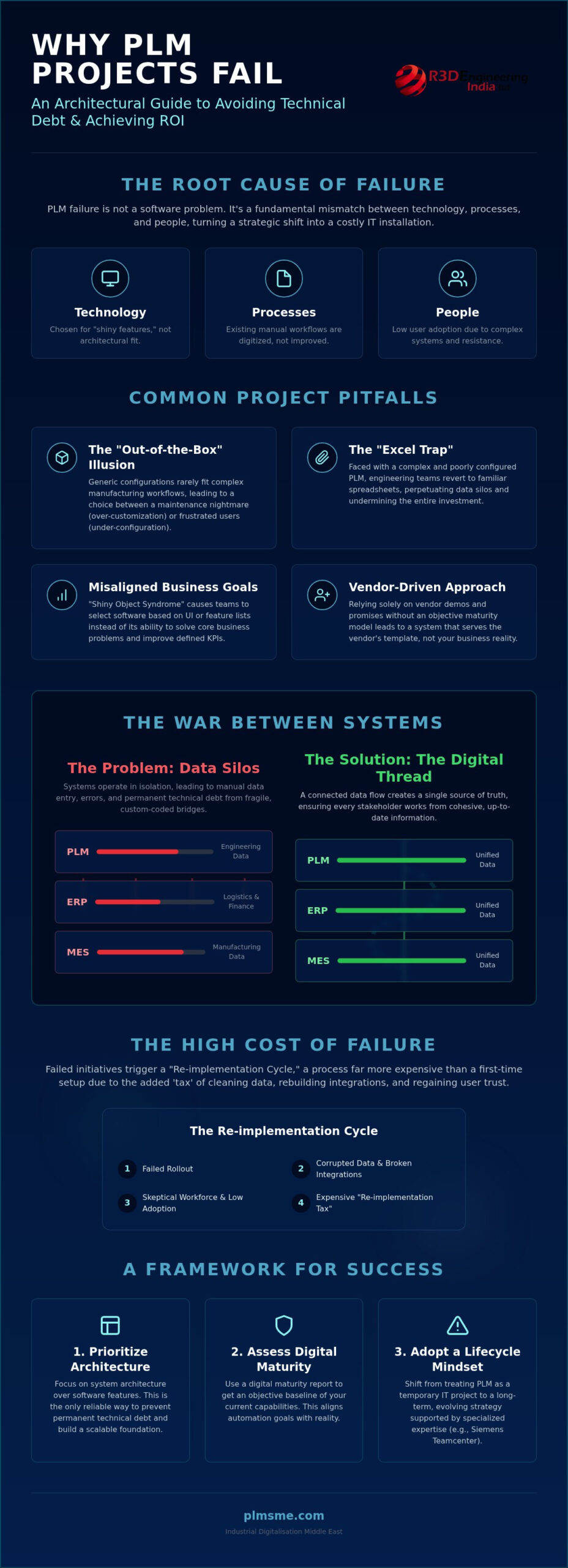
Industrial leaders often approach digitalization with high expectations. They anticipate that a new system will automatically streamline operations and reduce time-to-market. However, the gap between the software’s promise and the technical reality is often vast. A PLM pitfall is a systemic misalignment of technology, process, and people. When these three pillars don’t align, the investment yields little more than an expensive, digital version of a manual filing system. Understanding the common pitfalls in PLM projects is essential for any executive looking to avoid the high costs of a failed rollout.
The ultimate goal of industrial digitalization isn’t just a central database; it’s the creation of a robust digital thread. This connected data flow ensures that every stakeholder, from design to service, works from a single source of truth. The digital thread acts as the backbone of modern engineering, connecting design, manufacturing, and service data into a cohesive narrative. Without this connectivity, you aren’t digitalizing; you’re just digitizing paper processes without improving the underlying logic. A fragmented Product Lifecycle Management (PLM) strategy prevents this thread from forming, leaving teams to work with outdated or mismatched information.
Failed initiatives lead to the “re-implementation cycle.” This process is significantly more expensive than a first-time setup. It involves cleaning up corrupted data, untangling redundant integrations, and rebuilding trust with a skeptical workforce. This “re-implementation tax” drains budgets and erodes organizational confidence. It’s often more difficult to fix a broken system than to build one correctly from the start because you must first unlearn bad habits and untangle complex technical debt.
The Illusion of the ‘Out-of-the-Box’ Solution
Many vendors pitch “out-of-the-box” (OOTB) configurations as a shortcut to value. In complex discrete manufacturing, these standard settings rarely address specific engineering workflows. You face a choice between over-customization, which creates a maintenance nightmare, or under-configuration, which leaves users frustrated and looking for workarounds. Shiny demos often hide the complex PLM system architecture consulting required to make the software actually work in a live production environment. Relying on generic templates without a tailored strategy is a recipe for system rejection.
Misaligning Business Goals with Technical Execution
One of the most common pitfalls in PLM projects is prioritizing software features over actual process flow. Organizations often suffer from “shiny object syndrome,” selecting tools based on UI aesthetics rather than architectural fit. Before choosing a system, you must define clear KPIs that relate to your business outcomes. Executive buy-in shouldn’t end at the signing of the check; leadership must stay engaged to resolve the cross-departmental conflicts that inevitably arise during a digital transformation. A digital maturity report in manufacturing can clarify these goals and reveal where your infrastructure is truly ready for change.
Architecting Success: Overcoming Technical and Integration Barriers
The friction between Product Lifecycle Management and Enterprise Resource Planning often resembles a “war between systems.” While PLM focuses on the iterative, fluid nature of engineering, ERP prioritizes the rigid execution of logistics and finance. One of the most common pitfalls in PLM projects is failing to define clear handover points between these environments, which leads to duplicated data and manual entry errors. Without objective PLM system architecture consulting, organizations inadvertently create permanent technical debt. This debt accumulates as fragile, custom-coded bridges that break during every software update, stalling innovation and increasing maintenance costs.
Data migration presents another significant hurdle that can derail even the best-funded projects. Migrating “dirty data” from legacy spreadsheets into a modern PLM environment doesn’t solve quality issues; it simply digitizes them at scale. It’s vital to cleanse and validate data before the transition to prevent systemic errors from infecting the new digital thread. Leveraging Teamcenter CRM integration benefits ensures this thread extends beyond engineering to the customer, allowing sales and service teams to access accurate product configurations and history in real time.
Designing for Scalability and Integration
A successful implementation requires a robust solution architecture established before a single line of code is written. This architecture must account for the shop floor, connecting Siemens Teamcenter with Manufacturing Execution Systems (MES) and Manufacturing Operations Management (MOM). When these systems communicate effectively, the “as-designed” model aligns perfectly with the “as-built” reality on the floor. Managing CAD, CAM, and CAE extensions also requires a delicate balance. You must ensure these tools enhance productivity without bloating the core system or complicating future upgrades. Investing in professional system and solution architecture ensures your platform remains agile as your product portfolio grows.
The Pitfall of Neglected System Administration
Many firms treat PLM as a “set it and forget it” installation, which is a critical error. This neglect leads to system slow-downs, data bloat, and mounting user frustration. Proactive administration in Siemens Teamcenter environments involves regular health checks, database tuning, and license optimization to maintain peak performance. Moving from reactive “firefighting” to proactive support ensures the system evolves alongside your business requirements. If your internal team lacks the bandwidth for this level of maintenance, utilizing a PLM administration retainer provides the specialized oversight needed to manage complex interdependencies and prevent system degradation.
Navigating Organizational Resistance and the ‘Excel Trap’
Engineering teams are inherently pragmatic. If a new PLM system adds thirty minutes of administrative friction to a ten-minute design task, they’ll instinctively find a workaround. This is the origin of the “Excel trap.” Spreadsheets offer immediate flexibility and local control that rigid, poorly configured enterprise systems lack. To effectively wean teams off these silos, the system must mirror actual workflows rather than forcing engineers into a generic process. Avoiding common pitfalls in PLM projects requires recognizing that software is a tool for people, not a cage for data. When the system feels like a burden, the digital thread breaks before it even begins.
The “Mister-Know-it-all” consultant often exacerbates this organizational resistance. These advisors arrive with a fixed template and ignore the unique nuances of your production environment. One of the most common pitfalls in PLM projects is failing to address the human element, assuming that a technical installation automatically equals adoption. Building a culture of data ownership starts with involving engineers early in the configuration phase. This ensures the interface simplifies their daily tasks rather than complicating them. You want a partner who acts as a thinking partner, engaging deeply with your long-term vision rather than just executing a software install.
Bridging the Gap Between Engineering and IT
When IT departments seem indifferent to engineering needs, it’s usually a symptom of poor roadmap consulting. A PLM Concept Owner must act as the essential bridge, translating engineering requirements into technical specifications. This role ensures the system evolves with the users rather than becoming a static obstacle. Training shouldn’t be a one-time event during rollout; it needs to be a continuous process that addresses new features and evolving best practices. Continuous education helps teams move away from paper-based processes by showing them the direct benefits of a centralized, digital environment.
Demonstrating Tangible ROI to Stakeholders
Vague promises of “better quality” don’t resonate with the C-suite or financial directors. Instead, focus on measurable metrics like reduced Engineering Change Order (ECO) cycle times or decreased scrap rates. Using the findings from a digital maturity report in manufacturing, you can show exactly where your current data flows are leaking value. Communicating success in financial terms transforms PLM from an IT expense into a strategic asset that drives profitability. When stakeholders see a clear link between system adoption and reduced time-to-market, executive support remains steady throughout the lifecycle of the project.
Establishing a Digital Maturity Framework to Pre-empt Failure
One of the most common pitfalls in PLM projects is the tendency to bypass assessment in favor of immediate procurement. Many organizations rush into software selection without understanding their current baseline, leading to a mismatch between system capabilities and organizational readiness. A digital maturity report in manufacturing serves as the essential first step to prevent this. It provides an objective evaluation of your data health and process alignment, ensuring you don’t buy a Ferrari when your infrastructure can only support a bicycle. By identifying gaps early, you can address them before they become expensive liabilities during the implementation phase.
The 5 levels of PLM maturity provide a benchmark for this journey. Most firms start at the Ad-hoc level, characterized by manual processes and disconnected silos. Moving to Repeatable and Defined levels requires standardizing workflows across departments. The ultimate goal is reaching the Managed and Optimized stages, where real-time data integration and AI-driven predictive modeling drive continuous improvement. Attempting to jump from Ad-hoc to Optimized without intermediate steps is a primary reason why digital transformation initiatives fail. You need a stable foundation before you can scale.
The Independent Consultant Advantage
Vendor neutrality is a critical asset when navigating the PLM landscape. Software vendors are incentivized to sell licenses, often overlooking the architectural nuances that determine long-term success. An independent architect focuses on your specific technical requirements rather than a sales quota. This objectivity is vital when building an industrial digitalization roadmap that accounts for regional market dynamics. A thorough assessment of current workflows allows for a bespoke strategy that balances high-level vision with practical, grounded execution. Request an objective digital maturity assessment to define your starting point before investing in software.
Preparing for the AI and Automation Surge
AI is a hungry engine that requires structured, high-quality data to function. Without rigorous data governance, your automation initiatives will likely stall at the proof-of-concept stage. PLM serves as the foundation for industrial automation solutions in the GCC, providing the organized data thread that AI needs to classify parts or predict maintenance cycles. Future-proofing your architecture means designing for the next decade, not just next year. This involves establishing strict data standards today so that your system remains compatible with the Manufacturing AI tools of tomorrow. If your data is messy, your AI will be useless.
Implementing the Solution: The Strategic Path Forward
To avoid the common pitfalls in PLM projects, organizations must shift their perspective from viewing implementation as a finite IT task to embracing a continuous lifecycle mindset. A “one-and-done” approach fails to account for the evolving nature of engineering data and the shifting demands of the industrial sector. Successful digital transformation requires end-to-end implementation support that addresses the technical complexities of system architecture while managing the high-risk phase of data migration. In the UAE, specialized Siemens Teamcenter consulting provides the necessary expertise to bridge the gap between high-level strategic vision and grounded, practical execution on the shop floor. This strategic path ensures that your system remains a functional asset rather than a legacy burden.
Securing your digital roadmap starts with a commitment to transparency and objective assessment. Many initiatives stall because they lack a clear trajectory from their current state to their desired future maturity. By defining a structured path, you can pre-empt the organizational and technical traps that typically derail Product Lifecycle Management initiatives. This involves not only selecting the right technology but also ensuring your team is equipped to handle the transition without reverting to siloed habits. A well-executed implementation serves as the foundation for all future industrial digitalization efforts, from automation to AI integration.
Selecting the Right Partner for the Journey
Evaluating a PLM implementation partner requires looking beyond simple software certifications. You need a thinking partner who understands the specific hurdles of discrete manufacturing and the nuances of the regional market. Boutique specialists offer an agile, tailored quality that mass-market providers often struggle to replicate. These specialists focus on the long-term integrity of your system architecture rather than just meeting a generic go-live date. Initiating a professional digital maturity report is the most effective way to start this partnership. It provides a transparent baseline for your digitalization vision and ensures every stakeholder is aligned on the technical requirements from day one.
Sustaining Excellence with Managed Support
Maintaining a high-performing PLM environment requires constant oversight to prevent system degradation and the accumulation of technical debt. A PLM system administration retainer ensures that your platform remains optimized as your business grows. This proactive approach allows for continuous updates to your roadmap, ensuring that your digital thread remains intact even as new industrial automation and AI solutions are integrated. Moving from reactive troubleshooting to a state of sustained operational excellence protects your initial investment and guarantees long-term ROI. If you’re ready to fix current implementation issues and secure your technical future, contact PLM-Sme for a comprehensive Digital Maturity Assessment.
Securing the Future of Your Digital Thread
Avoiding the common pitfalls in PLM projects requires a shift from viewing software as a simple tool to seeing it as the strategic backbone of your industrial operations. We’ve explored how a robust system architecture and a clear digital maturity framework prevent the technical debt that often stalls digitalization efforts. By prioritizing user workflows over generic features, you ensure that your engineering teams move beyond spreadsheets and into a unified, high-performing environment.
Success in this transition depends on objective guidance and deep technical expertise. As a Siemens Digital Industries Alliance Partner, PLM-Sme operates as a boutique consultancy with specialized end-to-end Teamcenter expertise tailored for GCC industrial digitalization roadmaps. We provide the neutral, authoritative perspective needed to navigate complex integrations and secure long-term ROI. Secure your industrial future with a professional Digital Maturity Assessment from PLM-Sme. Taking this structured step today ensures your digital transformation remains on track for the next decade of innovation.
Frequently Asked Questions
What are the most common reasons PLM projects fail in manufacturing?
One of the most common reasons is the disconnect between high-level IT goals and the practical workflows of engineering teams. Projects often fail when organizations prioritize software features over system architecture or fail to address legacy data quality issues before migration. Without a clear digitalization vision, firms end up with fragmented silos rather than a cohesive digital thread. Addressing these common pitfalls in PLM projects requires a strategic approach that aligns technology with people and processes.
How can we avoid the ‘Excel trap’ during PLM adoption?
Avoiding the “Excel trap” requires making the PLM system more efficient than a spreadsheet. You should involve end-users early in the configuration phase to ensure the interface simplifies their daily tasks. If the system adds unnecessary complexity, engineers will naturally revert to local files. Providing continuous training and establishing a PLM Concept Owner helps bridge the gap between technical requirements and user expectations, ensuring the system supports rather than hinders productivity.
What is a Digital Maturity Report and why do I need one before implementation?
A digital maturity report is an objective assessment of your organization’s current data health, process alignment, and technical readiness. You need this report before implementation to establish a realistic baseline and identify potential risks. It prevents the costly mistake of purchasing software that your infrastructure isn’t ready to support. By clarifying your starting point, the report allows you to build a tailored roadmap that ensures long-term ROI and successful system adoption.
Is Siemens Teamcenter suitable for small to medium-sized industrial firms?
Yes, Siemens Teamcenter is highly suitable for small to medium-sized firms due to its modular architecture. You don’t need to deploy every feature at once. Instead, you can start with essential functions like document management or Bill of Materials control and scale as your business grows. This phased approach allows smaller organizations to benefit from enterprise-grade digitalization without the overwhelming initial complexity or the high costs associated with massive, all-at-once rollouts.
How do I integrate PLM with my existing ERP and MES systems?
Integrating PLM with ERP and MES involves establishing clear data handover points and using specialized integration development tools. You must define which system owns specific data, such as part numbers or manufacturing instructions, to prevent duplication. Successful integration ensures that the “as-designed” model in PLM flows seamlessly into the “as-built” reality on the shop floor. Utilizing a robust solution architecture prevents fragile connections that break during software updates, maintaining a reliable digital thread.
What is the role of an independent PLM consultant vs. a software vendor?
A software vendor is primarily focused on license sales and meeting specific product quotas. In contrast, an independent PLM consultant acts as a neutral advisor and thinking partner focused on your long-term success. They provide objective maturity reports and bespoke advice that isn’t biased toward a specific software version. This independence is crucial for architecting a system that truly fits your business needs, rather than one that merely satisfies a vendor’s sales target.
How long does a typical end-to-end PLM implementation take in the UAE?
A typical end-to-end implementation in the UAE can range from six to eighteen months, depending on the project scope and data complexity. Initial phases, including the digital maturity assessment, usually take several weeks. The implementation phase follows, involving configuration, data migration, and training. Phased rollouts help organizations avoid common pitfalls in PLM projects by allowing for incremental testing. This approach ensures the system remains stable and achieves user acceptance across the entire national landscape.
Can PLM really help with my company’s AI and automation roadmap?
PLM is the essential foundation for any AI or industrial automation roadmap. AI engines require structured, high-quality data to function effectively, and PLM provides the organized data thread necessary for these technologies. Without the data governance established through a robust PLM system, automation initiatives often fail at the pilot stage. By centralizing engineering data and standardizing workflows, you create the clean dataset required for predictive maintenance, generative design, and other advanced manufacturing AI applications.