
Building a Digital Thread Roadmap for Machinery Manufacturing in 2026
Ripping and replacing core enterprise software isn’t the key to modernization; it’s often the fastest path to budget overruns and operational fatigue. Building a viable digital thread roadmap for machinery manufacturing requires deliberate architectural alignment across your existing engineering and production platforms, not disruptive system replacements.
If your teams struggle with disjointed data handoffs across multi-CAD, PLM, ERP, and shop-floor MES environments, you already know the cost. Untracked revisions routinely slip past design reviews, triggering expensive rework on the assembly floor, configuration errors, and engineering change cycles that drag on for weeks.
You can resolve this friction without abandoning your established infrastructure. In this guide, you’ll discover how to design, execute, and govern an end-to-end digital thread roadmap tailored for complex machinery manufacturing. We walk through establishing closed-loop traceability from CAD models to field service, setting phased modernization steps tied to verified operational milestones, and leveraging interoperability standards like STEP AP242 to protect your architecture over the long haul.
Key Takeaways
- Conducting a structured digital maturity assessment across systems, processes, and culture establishes the essential baseline required before committing to architecture changes.
- Constructing a phased digital thread roadmap for machinery manufacturing ensures core engineering definitions in PLM are fully synchronized before scaling downstream to the shop floor.
- Harmonizing functional boundaries among PLM as author, ERP as coordinator, and MES as executioner eliminates data friction and prevents configuration drift.
- Establishing cross-functional governance councils and continuous architectural oversight preserves data integrity and protects against compounding technical debt.
Deconstructing the Digital Thread Framework in Machinery Manufacturing
At its core, a digital thread is an unbroken, bidirectional stream of synchronized lifecycle data that links every stage of a machine’s development. While academic models often frame smart factories around autonomous sensor fabrics, machinery manufacturers face a more practical reality: data breakages between core enterprise systems. When deconstructing the digital thread framework across industrial operations, the priority is transforming siloed, document-centric exchanges into structured, model-based data flows.
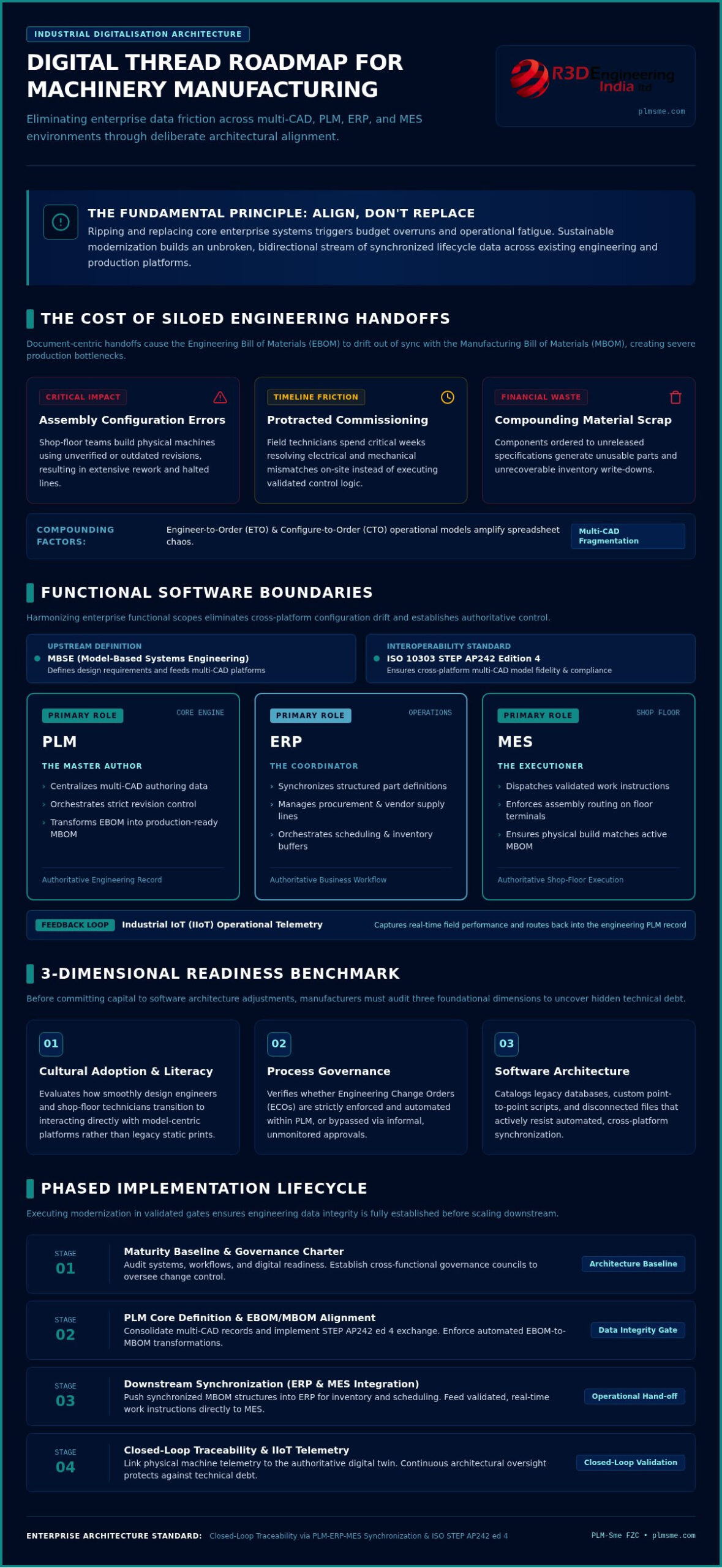
Traditional industrial production relies heavily on disconnected handoffs. Mechanical engineers complete CAD models, generate static PDFs, and manually push records into enterprise databases. Without an integrated architecture, the Engineering Bill of Materials (EBOM) drifts out of sync with the Manufacturing Bill of Materials (MBOM). This disconnect leads to severe operational consequences:
- Assembly configuration errors: Shop-floor teams assemble physical machines based on outdated revisions, causing extensive rework.
- Protracted commissioning cycles: Field technicians spend weeks resolving electrical and mechanical mismatches on-site rather than executing validated control logic.
- Compounding material scrap: Parts ordered to unreleased specifications generate unrecoverable inventory write-downs.
Establishing an effective digital thread roadmap for machinery manufacturing resolves these disconnects by enforcing a single, authoritative data pipeline across the entire enterprise.
Understanding the Core Architectural Components
A functional architecture establishes clear boundaries across systems. Model-Based Systems Engineering (MBSE) defines requirements upfront, feeding multi-CAD authoring tools. Product Lifecycle Management (PLM) orchestrates revision control and transforms the EBOM into a production-ready MBOM. Enterprise Resource Planning (ERP) then synchronizes these part structures with procurement, scheduling, and inventory. Finally, Manufacturing Execution Systems (MES) deliver validated work instructions directly to shop-floor terminals, while Industrial IoT platforms capture operational telemetry back into the engineering record.
Industrial Machinery Realities and Friction Points
Complex Engineer-to-Order (ETO) and Configure-to-Order (CTO) operational models amplify enterprise friction. Machinery builders frequently support heterogeneous environments containing electrical, mechanical, and software CAD tools from competing software providers. When these multi-CAD records live in departmental file shares or disconnected spreadsheets, configuration management collapses.
Spreadsheet-driven engineering handoffs destroy component-level traceability. When machine builders cannot trace installed subassemblies back to precise engineering changes, regulatory compliance audits stall and warranty liabilities skyrocket. A modern digital thread roadmap for machinery manufacturing replaces these ad-hoc workarounds with open exchange protocols like ISO 10303 STEP AP242 edition 4, establishing a durable foundation for cross-platform model fidelity.
Conducting Maturity Assessments to Benchmark Industrial Readiness
Embarking on architectural change without an objective audit guarantees wasted capital. While internal engineering teams often assume their primary challenges stem from software limitations, operational failures usually trace back to fractured governance and outdated process models. Rigorous maturity assessments serve as the mandatory prerequisite for establishing a viable digital thread roadmap for machinery manufacturing, identifying hidden technical debt before it compromises enterprise integrations.
Relying on high-level self-assessments often creates a false sense of security. A thorough audit evaluates operational capabilities across three core dimensions:
- Cultural adoption and digital literacy: Benchmarking how comfortably design engineers and shop-floor personnel interact with modern model-centric platforms rather than physical prints.
- Process governance: Reviewing whether change management rules are strictly automated within PLM systems or circumvented through informal approvals.
- Software architecture maturity: Cataloging legacy databases, point-to-point scripts, and disconnected databases that resist automated synchronization.
Evaluating the Core Maturity Dimensions
Engineering assets must progress along a clear maturity curve. Machinery builders often operate with legacy drawings, unlinked 3D geometry, and fragmented revision controls. Benchmarking these assets helps leadership determine whether the engineering baseline can support downstream automation. Leveraging a comprehensive digital maturity report in manufacturing provides an impartial evaluation, identifying process bottlenecks across industrial planning, production handoffs, and field maintenance.
Mapping Process Gaps to Economic Outcomes
A technical assessment must translate architectural deficiencies into quantified business outcomes. Process gaps directly inflate delivery lead times and operational overhead. Identifying these gaps establishes clear return on investment milestones for executive sponsors:
- Engineering Change Order (ECO) cycle durations: Measuring the days required to route, approve, and propagate a design update across ERP and MES environments. Research indicates that structured digital thread traceability can compress engineering change delays by roughly 34%.
- BOM translation overhead: Calculating engineering hours lost to manually re-entering part structures from CAD outputs into ERP bills of materials.
- Design reuse efficiency: Tracking the percentage of standardized machine subassemblies leveraged across new customer orders versus newly drafted components.
Understanding these metrics enables leadership to benchmark operations against formal protocols for governing the connected manufacturing ecosystem developed by research institutions like NIST. If your plant is preparing to modernize its operational core, engaging an independent advisory partner to complete a targeted maturity assessment ensures your implementation strategy targets verified structural constraints rather than assumptions.
Structuring the Step-by-Step Digital Thread Implementation Roadmap
Attempting a monolithic enterprise software overhaul rarely delivers expected outcomes. Machinery builders operate on active production schedules where unscheduled factory floor downtime is intolerable. Rather than pursuing high-risk, all-at-once migrations, companies must structure a phased digital thread roadmap for machinery manufacturing that locks in stability at each integration tier before expanding downstream.
A proven deployment model divides the modernization initiative into four clear operational stages:
- Phase 1: Engineering Single Source of Truth: Consolidate heterogeneous CAD environments within an authoritative PLM system to centralize revision control and baseline data schemas.
- Phase 2: Manufacturing Planning Alignment: Bridge engineering release management with industrial process routing, synchronizing EBOM and MBOM records.
- Phase 3: Production Execution Integration: Connect physical shop-floor machinery, programmable logic controllers, and MES platforms to enforce real-time recipe execution.
- Phase 4: Closed-Loop Lifecycle Traceability: Extend digital tracking past factory gates into operational commissioning, IoT telemetry, and field service management.
Phase 1 and Phase 2: Foundational Architecture and Planning
Execution begins inside the design repository. Engineering teams must first consolidate multi-CAD mechanical models, electrical schematics, and embedded software builds into a centralized PLM baseline. Standardizing part classifications ensures engineers select qualified components instead of generating duplicate part numbers. Aligning with standards highlighted in NIST’s Digital Thread for Manufacturing project guarantees that 3D product definitions maintain semantic fidelity across platforms without proprietary lock-in.
Once design assets are stable, Phase 2 synchronizes the EBOM with plant process plans. Engineering updates automatically generate provisional manufacturing bills of materials, signaling industrial planners to modify routings before production batches launch.
Phase 3 and Phase 4: Production Execution and Field Traceability
Phase 3 brings digital models to physical workstations. Production terminals draw validated visual work instructions directly from current PLM records. Enterprise schedulers coordinate work order flows, while connected machines execute exact parameter sets without manual data entry. Integrating intelligent edge nodes and modern industrial automation solutions in the GCC empowers assembly lines to report cycle times and assembly deviations instantly.
Phase 4 completes the loop. As industrial machinery enters operation, connected telemetry streams runtime sensor data back to original engineering models. Design teams analyze real-world operating loads to optimize subsequent revisions, converting after-sales maintenance into a rich feedback loop for product design.
Evaluating Enterprise Software Harmonization: PLM, ERP, and MES
Operational bottlenecks rarely stem from a total absence of software; they occur when enterprise systems fight over master data ownership. While protocol-level messaging like OPC UA connects shop-floor equipment, it cannot resolve business logic overlaps between your core platforms. A resilient digital thread roadmap for machinery manufacturing must establish strict system boundaries, preventing costly integration failures and configuration drift.
Every enterprise platform serves a distinct operational role across the machine lifecycle:
- PLM functions as the author: Governs product definitions, 3D CAD geometries, variants, and engineering change baselines.
- ERP functions as the coordinator: Directs procurement, commercial costing, plant schedules, and inventory tracking.
- MES functions as the executioner: Manages physical routing, operator dispatches, quality inspections, and machine build records.
Friction arises when platforms step outside their core competencies, such as drafting bills of materials directly in ERP or managing routing sequences inside spreadsheets.
System Boundary Definition and Master Data Governance
Clean system boundaries require clear master data ownership. PLM must remain the undisputed master of parts and product configurations. ERP coordinates execution timing, pulling released assemblies from PLM while managing vendor logistics. MES consumes these work orders to drive the factory floor, capturing actual production timestamps and serial numbers. Data movement must balance push and pull mechanics: design revisions push downstream unidirectionally from PLM, while as-built operational variances sync bi-directionally back to engineering records.
Establishing Robust Integration Architectures
Connecting these systems using brittle, point-to-point scripts guarantees long-term architecture failure. Batch file transfers create latency, leaving manufacturing lines operating on stale engineering revisions. Modern integration architectures rely on event-driven APIs and service-oriented middleware that trigger data synchronizations instantaneously upon engineering sign-off.
Machinery builders often partner with external specialists to configure these complex enterprise backbones. Engaging strategic Siemens Teamcenter consulting allows organizations to implement proven connectors and federated query architectures, ensuring high-speed data exchanges between Teamcenter, SAP, and production MES without data bloat.
To eliminate operational risk across your plants, team up with our independent system architects to schedule an enterprise architecture consultation and align your multi-system integrations today.
Governing, Sustaining, and Scaling the Connected Manufacturing Ecosystem
A digital thread isn’t a project with a fixed endpoint; it’s a permanent operational discipline. Many machinery builders invest heavily in deployment only to watch their architecture slowly degrade over time. Without ongoing governance, custom scripts break during minor version updates, user workarounds creep back into daily routines, and data models drift out of synchronization. Sustaining long-term success requires treating your digital thread roadmap for machinery manufacturing as an evolving enterprise capability.
Preventing system erosion requires strong organizational leadership. Establishing a cross-functional digital governance council provides direct operational oversight. This council must unite representatives from three key domains:
- Design engineering leads: Enforce 3D modeling standards, model-based definition adherence, and unified part classification rules.
- Plant operations managers: Supervise shop-floor execution fidelity, routing updates, and feedback capture.
- Enterprise IT architects: Monitor server health, API latency, schema integrity, and access controls across systems.
Structuring Architectural Oversight and Administration
Technical debt often accumulates silently beneath the surface. Engaging specialized PLM system architecture consulting helps manufacturers evaluate data structures objectively and identify vulnerabilities before software updates occur. Structuring a PLM system administration retainer provides critical insurance against performance degradation. These ongoing retainers handle complex schema updates, database indexing, user privilege auditing, and integration connector testing across PLM, ERP, and MES environments.
Scaling the Thread into Predictive and Cognitive Operations
Once baseline governance stabilizes your data, you can scale toward cognitive manufacturing. The digital thread provides the structured dataset required to deploy practical artificial intelligence models. These systems evaluate proposed engineering change orders against historical fabrication data, forecasting shop-floor cost impacts and assembly challenges before drawings ever hit production.
High-fidelity operational data also enables scalable digital twins. By combining design geometry, manufacturing tolerances, and field IoT telemetry, machinery builders can replicate physical operating conditions in virtual environments. These simulations inform subsequent machine iterations, improving energy efficiency and mechanical reliability.
Scaling these advanced capabilities requires an objective strategy aligned with real industrial constraints. Partner with independent technical advisors to build your custom digitalization roadmap, establishing stable, interoperable architectures that deliver long-term operational resilience nationwide.
Executing Your Phased Path to Connected Manufacturing
Achieving closed-loop industrial traceability doesn’t require high-risk, all-at-once software migrations. Long-term operational success comes from disciplined architectural alignment: validating core engineering baselines within PLM, establishing clear master data boundaries across ERP and MES, and maintaining active governance. Following a structured digital thread roadmap for machinery manufacturing enables your teams to eliminate configuration drift, compress engineering change cycles, and transform lifecycle telemetry into a lasting competitive advantage.
As an independent consultancy and Siemens Digital Industries Alliance Partner specializing in Teamcenter architecture, PLM-Sme FZC prioritizes objective technical outcomes over generic software reselling. We support your transformation journey at every milestone, delivering comprehensive end-to-end implementation and ongoing, retainer-based architecture governance that keeps your digital backbone resilient against technical debt.
Modernizing your enterprise data flow starts with identifying your current operational constraints. Schedule a Digital Maturity Consultation to benchmark your infrastructure and build an actionable, future-ready roadmap today.
Frequently Asked Questions
What is the primary difference between a digital twin and a digital thread in machinery manufacturing?
The digital thread is the communication and data pipeline, while the digital twin is the virtual representation of the physical machine. The thread connects lifecycle records across engineering, procurement, and operations. The twin uses that connected data to simulate operating states and performance in real time. Without the thread feeding continuous updates, a twin remains a disconnected, static model.
How long does it typically take to deploy a functional digital thread roadmap across an industrial plant?
Deploying a structured digital thread roadmap for machinery manufacturing typically unfolds across phased milestones spanning twelve to twenty-four months. Initial stages, such as consolidating multi-CAD records into PLM and completing a baseline maturity audit, usually require three to six months. Integrating downstream ERP scheduling, shop-floor MES, and field telemetry proceeds incrementally, ensuring core machinery production faces minimal operational disruption during each rollout phase.
Can we establish a digital thread without replacing our existing legacy ERP or CAD software?
Yes, successful modernization connects your existing toolset rather than ripping and replacing core infrastructure. Standard exchange protocols like ISO 10303 STEP AP242 and event-driven APIs link heterogeneous CAD authoring platforms directly with legacy ERP and MES environments. Independent architecture specialists build middleware connectors that extract, translate, and synchronize master data across legacy systems without requiring disruptive software replacements.
How does digital thread implementation directly reduce engineering change order processing times?
It eliminates manual re-entry and administrative routing delays by automating revision propagation across systems. When an engineer approves a change in PLM, downstream BOM transformations and shop-floor MES work instructions update immediately through synchronized data links. Research demonstrates that automated traceability can compress engineering change delays by around 34%, preventing outdated prints from circulating on the shop floor.
Why is a digital maturity assessment necessary before investing in digital thread software solutions?
A formal digital maturity assessment benchmarks operational readiness across processes, culture, and software architectures before capital is committed. It identifies legacy technical debt, disconnected data models, and workflow bottlenecks that derail integrations. Establishing this baseline ensures your digital thread roadmap for machinery manufacturing targets verified operational friction points rather than speculative platform purchases.
What role does Siemens Teamcenter play in establishing an industrial machinery digital thread?
Siemens Teamcenter acts as the centralized data backbone that governs product structures, multi-CAD revisions, and change processes across the machine lifecycle. As an authoritative PLM foundation, it synchronizes the engineering bill of materials directly with manufacturing planning, providing the single source of truth needed to feed downstream ERP workflows, MES execution terminals, and IoT analytics pipelines.
How do manufacturers handle data security when connecting engineering designs with factory equipment?
Manufacturers protect intellectual property by enforcing role-based access controls and perimeter network segmentation between enterprise IT and operational technology (OT) layers. Sensitive design geometry stays governed inside PLM, while the shop floor receives lightweight, neutral representations stripped of proprietary mathematical models. Automated audit logging tracks access rights across all integrated terminals to prevent unauthorized data extraction.