
Bridging the Digital Thread: A Strategic Guide to PLM MOM Integration in 2026
In 2026, treating your engineering office and your production floor as separate entities is no longer just an operational inefficiency; it’s a structural failure that compromises your competitive edge and regulatory standing. You’ve likely felt the friction of data silos where R&D insights vanish before reaching the factory floor, or perhaps you’re battling the high error rates and quality blind spots that stem from manual data entry. Achieving a seamless PLM MOM integration is the only way to ensure that your technical vision translates accurately into physical reality without the drag of legacy communication gaps.
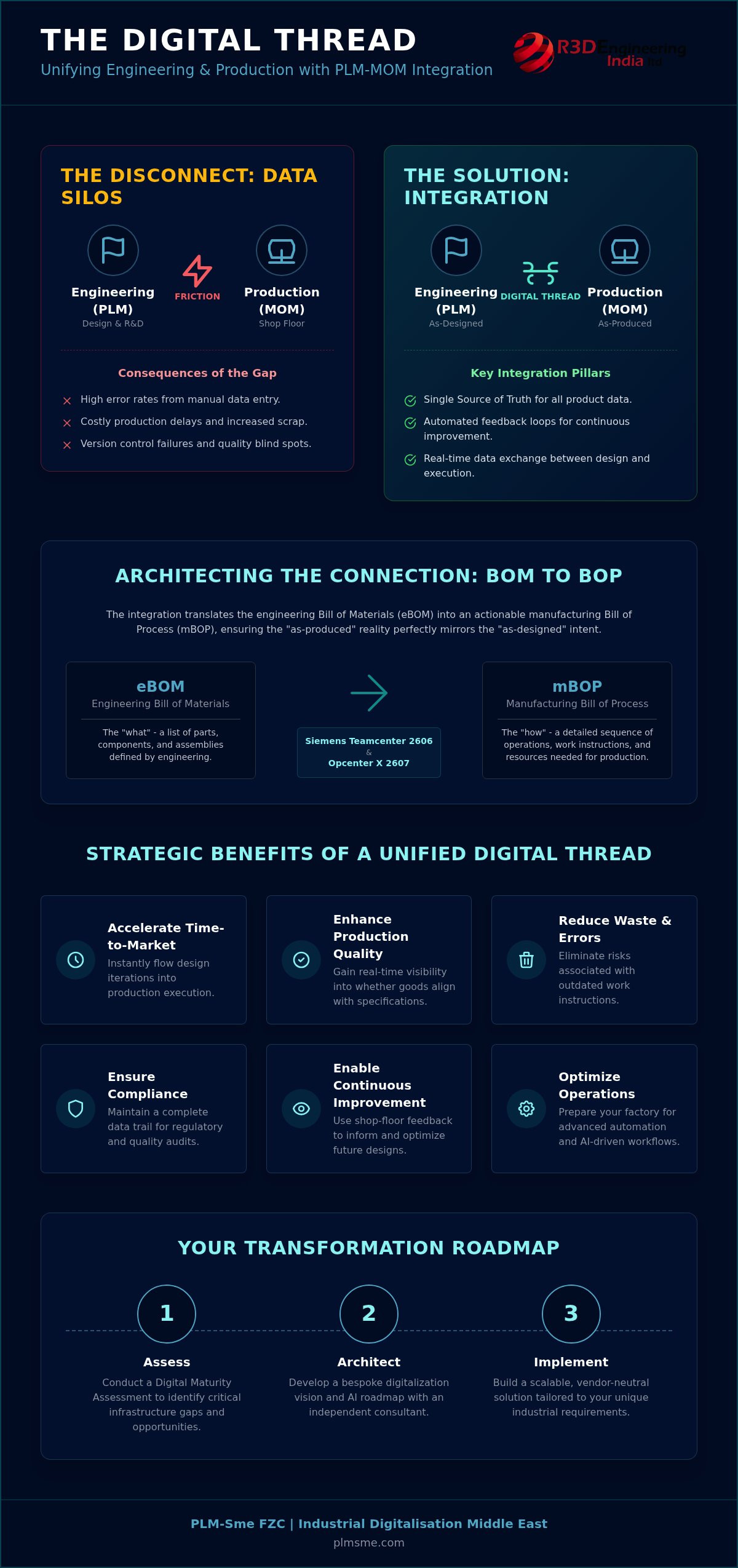
This strategic guide explores how a robust integration transforms these disconnected points into a high-velocity digital thread, ensuring every design iteration flows instantly into production execution. By leveraging the latest capabilities in Siemens Teamcenter 2606 and Opcenter X 2607, you can establish a single source of truth that automates feedback loops and slashes time-to-market. We’ll examine the technical methodologies for architecting these systems to ensure your UAE manufacturing operations remain agile, compliant with global AI standards, and fully optimized for the industrial demands of the next decade.
Key Takeaways
- Eliminate operational silos by establishing a digital thread that connects engineering intent to shop-floor execution, reducing the risks associated with manual data transfers.
- Learn how a structured PLM MOM integration creates a high-frequency data exchange between Siemens Teamcenter and manufacturing operations to accelerate time-to-market.
- Enhance production quality through automated feedback loops that provide real-time visibility into whether manufactured goods align with original engineering specifications.
- Identify critical infrastructure gaps by conducting a digital maturity assessment, a prerequisite for developing a successful digitalization vision and AI roadmap.
- Discover the strategic advantage of partnering with an independent consultant to architect bespoke, vendor-neutral solutions tailored to unique industrial requirements.
Synchronizing Engineering and Production: The Necessity of PLM MOM Integration
Industrial success in today’s discrete manufacturing sector hinges on the precision of data transfer between the design office and the factory floor. While Product Lifecycle Management (PLM) serves as the definitive source for engineering intent, Manufacturing Operations Management (MOM) governs the physical execution of those designs. Without a robust PLM MOM integration, these two critical systems operate as isolated islands. This disconnect forces teams to rely on manual data entry, which inevitably leads to version control errors and costly production delays.
Achieving closed-loop manufacturing requires a fundamental shift from viewing these systems as separate silos to seeing them as a unified ecosystem. The strategic objective is simple: ensure the “as-produced” reality perfectly mirrors the “as-designed” specifications. When these layers are synchronized, engineering feedback from the shop floor flows back into the design phase, creating an environment of continuous improvement and reduced time-to-market.
Defining the Data Gap in Modern Manufacturing
Engineering changes often fail to reach the shop floor in real-time, creating a dangerous lag between design updates and physical production. If a technician uses outdated work instructions, the result is often an increase in scrap rates and non-conformance reports. These gaps aren’t just technical glitches; they represent a break in the Digital Thread. The Digital Thread is the continuous flow of product data from conception to disposal. When this thread snaps, manufacturers lose visibility into the lifecycle of their assets, making it nearly impossible to maintain high quality standards or comply with the stringent regulatory and compliance requirements governing modern industrial operations.
The Role of MOM as the Production Nervous System
Effective manufacturing goes beyond simple execution. While traditional Manufacturing Execution Systems (MES) track production, a comprehensive MOM platform acts as the production nervous system. It manages quality control, equipment maintenance, and labor allocation alongside standard production tasks. This broader scope is essential for preparing the shop floor for high-fidelity data exchange with engineering. By establishing a PLM MOM integration, companies can track production progress against engineering specifications with surgical precision. It allows for the synchronization of the Bill of Materials (BOM) and the Bill of Process (BOP), ensuring that what is built matches the latest engineering revision. This level of oversight is a prerequisite for any organization looking to implement advanced automation or AI-driven workflows on the factory floor.
Architecting the Connection: Technical Frameworks for Teamcenter MOM Integration
Successful PLM MOM integration requires more than a simple software plug-in. It demands a scalable system architecture capable of handling high-frequency data exchanges between the engineering environment and the production floor. At the center of this framework sits Siemens Teamcenter, acting as the authoritative hub for all engineering data. By utilizing the latest features in Teamcenter 2606, organizations can manage complex product data while ensuring that downstream manufacturing systems receive precise, version-controlled information.
Building these interfaces isn’t just a technical task; it’s a strategic alignment of data models. When you connect Teamcenter to MOM modules like Opcenter X 2607, you create a pathway for real-time synchronization. This ensures that every design update is instantly reflected in the manufacturing environment. For many UAE manufacturers, the challenge lies in maintaining data integrity during these transitions. It’s helpful to engage in System and Solution Architecture consulting to ensure your foundation is built for long-term scalability rather than short-term fixes.
Mastering the BOM to BOP Transformation
Translating engineering intent into actionable manufacturing steps is often where digital threads fray. The transformation from the Engineering Bill of Materials (EBOM) to the Manufacturing Bill of Materials (MBOM) must be seamless. Through automation, Teamcenter allows for the rapid creation of the Bill of Process (BOP), which outlines exactly how a product is assembled. This process reduces lead times by automatically generating work instructions based on the latest 3D models and engineering specifications. It eliminates the need for manual transcription, which is a primary source of shop-floor errors.
Standardizing Integration Protocols
Interoperability between heterogeneous systems depends on adhering to industry standards like ISA-95. This framework provides a common language for the interface between enterprise and control systems. When architecting your PLM MOM integration, you must decide between direct API-based connections or middleware solutions. APIs offer high speed and low latency, while middleware provides a more flexible, decoupled approach for complex environments. Regardless of the choice, ensuring cybersecurity and data sovereignty is critical, especially when managing sensitive industrial data within the UAE’s regulatory framework. Standardized protocols ensure that your network remains secure while facilitating the transparent flow of data necessary for industrial AI applications.
Realizing Operational Excellence: Strategic Benefits of a Unified Digital Thread
Establishing a unified digital thread provides a level of operational clarity that siloed systems cannot match. When your engineering specifications are directly linked to shop floor activities, real-time visibility becomes a standard capability. Managers can track production progress against precise engineering benchmarks, ensuring that any deviation is identified before it impacts the final delivery. This synchronization is the cornerstone of PLM MOM integration, allowing for a level of precision that is essential in the UAE’s increasingly competitive industrial sector.
Concurrent engineering and manufacturing planning significantly reduce time-to-market. By allowing teams to work on production processes while the design is still being finalized, companies avoid traditional “over-the-wall” delays. This overlap ensures that the factory is ready for the first production run the moment the design is released. It eliminates the friction that typically occurs when manufacturing engineers receive a completed design only to discover it requires significant tooling adjustments.
Closing the Quality Loop
Quality control transforms from a reactive inspection process into a proactive management strategy. When production deviations occur, they’re instantly flagged back to the engineering team for review. This closed-loop feedback ensures that recurring issues lead to design refinements rather than repeated scrap. Implementing automated root cause analysis becomes possible because the data sets from both design and execution are integrated. Leveraging Teamcenter system architecture consulting helps build these resilient quality frameworks, ensuring the software layer supports the physical demands of high-precision manufacturing.
Driving Agility in Discrete Manufacturing
Modern manufacturing environments must handle increasing product complexity without a corresponding rise in overhead. A unified digital thread enables mass customization by allowing flexible production lines to adjust based on the specific engineering variant being produced. This agility is vital for manufacturers serving diverse global markets. Standardizing the data flow via PLM MOM integration ensures companies avoid brittle, custom-coded connections that often plague older factories. This clean architecture makes it easier to adopt future AI-driven optimizations or industrial automation solutions.
Finally, data-driven production scheduling optimizes resource utilization. With accurate data on both design requirements and machine capacity, manufacturers can maximize throughput and minimize downtime. This holistic view ensures that labor, materials, and equipment are used as efficiently as possible, protecting margins and enhancing productivity across the entire enterprise.
Developing a Transformation Roadmap: Navigating Integration Challenges
Many manufacturers rush into technical deployment without assessing their structural readiness. A successful PLM MOM integration requires a phased approach that begins with a clear understanding of your current data landscape. By conducting a digital maturity assessment, you identify the specific gaps between engineering intent and factory execution. This baseline allows you to establish a digitalisation vision that aligns technical investments with long-term business goals. It’s a process of ensuring that your infrastructure is capable of supporting high-frequency data exchange before you flip the switch on a live environment.
Managing the cultural shift is often more difficult than the technical integration. Engineers and operators must understand how their daily workflows will change. Training programs should focus on the collaborative benefits of the system, showing how shared data reduces the burden of manual reporting. Prioritizing integration phases based on operational impact ensures that the most critical bottlenecks are addressed first. If you’re ready to define your technical strategy, our team provides Digitalisation Vision & Roadmap Consulting to guide your transition.
Assessing Industrial AI Readiness
Clean, integrated data isn’t just a convenience; it’s the prerequisite for industrial automation solutions in the GCC. Before migrating to an integrated environment, evaluate the quality of your legacy data. Inconsistent naming conventions or missing metadata in older systems will only amplify errors once the systems are linked. Identifying “Quick Wins”-such as automating a single high-error manual data transfer-builds stakeholder trust and demonstrates immediate ROI. This measured start ensures that subsequent, more complex phases have the necessary internal support and reliable data foundations.
Phasing the Implementation
Avoiding the “Big Bang” approach is essential to minimize operational risk. We recommend a three-step progression that builds momentum without overwhelming your resources. First, solidify the PLM foundation to ensure engineering data is version-controlled and accessible. Second, launch a pilot MOM integration on a single production line to test the data flow in a controlled setting. Third, scale to a full-scale Digital Thread across the entire facility. It’s vital that manufacturers secure a digital maturity report manufacturing before investing in hardware. This strategic document prevents over-provisioning and ensures every dirham spent contributes to a cohesive, high-performance architecture.
Optimizing Industrial Digitalization with Independent PLM Consulting
Selecting the right partners for a PLM MOM integration is as critical as the software selection itself. Many manufacturers find themselves constrained by vendor-driven biases that prioritize license sales over operational efficiency. An independent perspective ensures that your system architecture serves your specific production goals rather than a software provider’s roadmap. By leveraging specialized Siemens Teamcenter consulting, organizations can design bespoke architectures that address the unique complexities of their shop floor environments.
PLM-Sme FZC functions as a thinking partner, bridging the often-wide gap between high-level strategic vision and the granular technical execution required for success. We focus on creating a stable, neutral framework where data flows freely across departments. This objective approach prevents the common pitfall of vendor lock-in and ensures that your technology stack remains agile enough to adapt to changing market demands. It’s about building a system that works for your engineers and operators, not just your IT budget.
Building a Future-Proof System Architecture
Your industrial digitalization roadmap UAE must look beyond immediate integration needs to account for future AI and IoT scaling. A truly future-proof architecture prioritizes interoperability between ERP, CRM, and MOM systems, ensuring that no data point exists in a vacuum. Specialized Teamcenter integration development is essential in these environments to handle the custom data mappings and synchronization logic that off-the-shelf connectors often miss. This level of technical depth ensures that as you add sensors or AI agents, the underlying PLM layer remains a reliable, scalable foundation.
Ensuring Continuous Improvement
The journey doesn’t end when the systems are first connected. Transitioning from implementation to optimization requires ongoing vigilance and performance tuning. Utilizing a PLM system administration retainer allows manufacturers to manage software updates, security patches, and database optimizations without overstretching their internal IT teams. This continuous support ensures that the PLM MOM integration maintains peak performance as production volumes scale and product designs evolve. Regular audits and updates prevent technical debt from accumulating, keeping your digital thread lean and efficient. If you’re ready to identify the next steps in your journey, contact PLM-Sme FZC to begin your digital maturity assessment today.
Securing Your Industrial Future through Integrated Digital Architecture
The transition to a unified digital thread is a strategic necessity for UAE manufacturers aiming to maintain a competitive edge in 2026. By establishing a robust PLM MOM integration, you eliminate the friction between engineering intent and production execution, ensuring that every design iteration translates into high-quality physical output. We’ve explored how a phased roadmap, supported by specialized Teamcenter architecture, prevents the accumulation of technical debt and prepares your facility for future AI-driven optimizations.
As an independent Siemens Digital Industries Alliance Partner, PLM-Sme FZC provides the authoritative implementation support and neutral guidance required to navigate complex industrial digitalization roadmaps. We specialize in bridging the gap between high-level vision and technical reality, offering bespoke solutions that prioritize your operational efficiency over vendor-driven agendas. Take the first step toward a more resilient, data-driven factory floor today. Establish your digitalization vision with a professional maturity assessment. Your journey toward closed-loop manufacturing excellence is within reach.
Frequently Asked Questions
What is the primary difference between MES and MOM integration?
MOM is a broader architectural framework that encompasses MES. While MES focuses specifically on production execution, MOM integration includes quality management, maintenance, and labor scheduling. A comprehensive PLM MOM integration ensures that engineering data influences every operational layer, not just the assembly line. This holistic approach provides a more complete digital twin of the manufacturing environment compared to a standard MES connection.
How does PLM MOM integration support closed-loop manufacturing?
It establishes a bidirectional data flow where engineering intent informs production and shop-floor results inform design. When a non-conformance is detected in the MOM layer, the system automatically flags it back to the PLM environment. This allows engineers to refine designs based on real-world manufacturing performance. By closing this loop, manufacturers can continuously optimize their processes, reduce waste, and ensure the ‘as-built’ product matches the ‘as-designed’ specification.
What are the common challenges when integrating Siemens Teamcenter with MOM systems?
The most frequent obstacles involve data mapping inconsistencies between the Engineering Bill of Materials (EBOM) and the Manufacturing Bill of Materials (MBOM). Legacy data quality often complicates the transformation process, leading to synchronization errors. Additionally, many organizations struggle with the cultural shift required to manage shared workflows. Working with a specialized Siemens Digital Industries Alliance Partner helps mitigate these risks through structured system architecture and specialized Teamcenter integration development.
Can PLM MOM integration reduce manufacturing scrap and rework?
Yes, it directly reduces scrap by ensuring that technicians always work with the most current, version-controlled instructions. When engineering changes occur in Teamcenter 2606, they’re instantly pushed to the shop floor via the integrated MOM system. This eliminates the use of outdated paper drawings or manual data entries that cause assembly errors. Accurate data flow minimizes the risk of producing non-conforming parts, protecting your margins and material resources.
How long does a typical PLM MOM integration project take to implement?
Implementation timelines vary based on the complexity of the existing infrastructure and the scope of the digital thread. A pilot project focusing on a single production line might take three to five months to establish. A full-scale enterprise integration typically requires nine to twelve months or longer to ensure complete data synchronization and user training. We recommend a phased approach to manage operational risks and deliver incremental ROI throughout the process.
Is a digital maturity assessment necessary before starting an integration?
Conducting a digital maturity assessment is a critical prerequisite for any integration project. It identifies technical gaps, data quality issues, and infrastructure readiness before you commit to a specific architecture. Without this baseline, manufacturers risk over-engineering solutions or building on unstable legacy data. A professional maturity report provides a clear digitalisation vision, ensuring that your investment aligns with the long-term strategic goals of your UAE manufacturing operations.
How does integration improve the accuracy of work instructions on the shop floor?
Integration automates the generation of work instructions directly from 3D engineering models and the Bill of Process. This removes the need for manual transcription, which is a primary source of shop-floor inaccuracies. Operators receive visual, interactive instructions that update in real-time whenever a design revision is released in the PLM system. This ensures that the physical assembly process is always perfectly synchronized with the latest engineering intent.
What role does AI play in a fully integrated PLM and MOM environment?
AI functions as an active operating layer that analyzes the massive datasets generated by the digital thread. In an integrated environment, AI agents can predict quality deviations by correlating design parameters with real-time production variables. Features like the Teamcenter Copilot assist in BOM management and requirements analysis. This moves the system from a passive repository to a predictive platform that optimizes scheduling and maintenance before bottlenecks occur.