
Industrial Equipment Lifecycle Management: Plan Replacement
A maintenance log alone can’t show whether an industrial asset is still worth keeping. An equipment lifecycle analysis brings together an asset’s condition, performance, repair history and operating costs to guide decisions about continued maintenance, upgrades or replacement. An industrial equipment lifecycle management roadmap turns that analysis into a structured plan for what needs attention and why.
Decisions are rarely as simple as replacing an older machine or repairing a failed component. Production demands, recurring faults, maintenance effort and the consequences of downtime all shape the right course. A connected view of equipment data helps teams identify patterns and base decisions on operating evidence, not intuition alone.
This article explains what lifecycle analysis covers, how it supports repair-or-replacement decisions, and where connected technologies such as industrial automation and AI can contribute. It also outlines how a roadmap links asset priorities with digital systems and longer-term operational goals, giving UAE industrial teams a clearer basis for planning equipment management.
Key Takeaways
- Use asset histories and as-maintained configurations to understand what equipment is installed, how it has changed and where records need to connect.
- Compare the full cost of ownership, including maintenance, energy use and downtime, to identify when continued repair no longer supports operational priorities.
- Link planning, procurement, operation, maintenance and end-of-life decisions so each lifecycle stage informs the next.
- Connect sensor readings with maintenance, production and procurement data to make monitoring and predictive maintenance more useful for equipment decisions.
What is an Equipment Lifecycle Analysis?
An equipment lifecycle analysis connects asset condition, performance, repair history and operating costs to guide decisions throughout an asset’s service life. Preventive maintenance follows planned intervals, predictive maintenance uses condition signals, and reactive maintenance addresses faults after they occur.
Asset Traceability and Maintained Configurations
Full asset traceability records an asset’s identity, location, history and as-maintained configuration throughout its service life. This configuration shows the equipment as it currently exists, including recorded changes from its original design. For example, linked work orders can show when a motor or control component was replaced. An industrial equipment lifecycle management roadmap uses these records to clarify which configuration teams are maintaining and link changes to subsequent performance.
Maintenance Approaches and Performance Monitoring
Preventive maintenance schedules inspections and servicing to identify wear before it causes failure. Predictive maintenance uses condition information to indicate when intervention may be needed, while reactive maintenance responds after a fault. Performance monitoring adds operating data, such as recurring alarms or changing output, to maintenance history. Together, these records help teams distinguish isolated faults from patterns and focus on asset condition and operational consequences.
Lifecycle Value and Return on Investment
Asset lifecycle management coordinates decisions from acquisition through disposal to maximize physical asset value. Analysis can provide a 360-degree overview of the installed base, connecting performance, repair history and recorded costs. That evidence helps teams assess whether maintenance, an upgrade or replacement best supports operational objectives. Return on investment depends on value gained across an asset’s life, so performance optimization considers reliability and operating demands alongside maintenance needs.
Digital Readiness and Management Maturity
Digital readiness describes whether asset information, processes and systems can support connected management decisions. The 2024 updates to the ISO 55000 series address data quality and cross-functional asset management. A maturity assessment can identify gaps in record ownership, consistency and system integration before digital tools are selected. An industrial equipment lifecycle management roadmap can then align digital priorities with obsolescence data, technology forecasting, logistics and business trends, as described by MDPI.
When should you replace equipment versus continuing maintenance?
Rank assets, consolidate lifecycle data, then compare repair, upgrade and replacement scenarios. Phase priorities according to operational impact, procurement risks and total cost of ownership.
Replacement Timing and Total Cost of Ownership
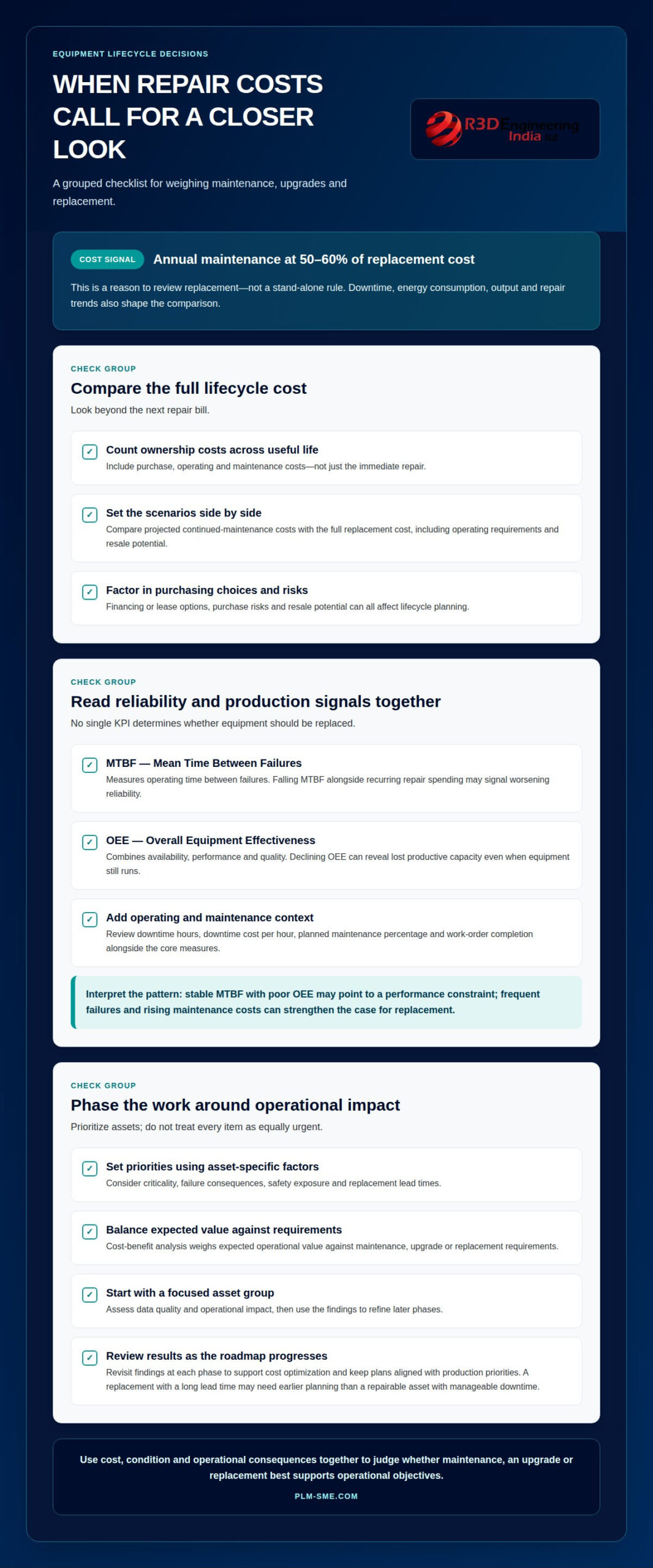
Total cost of ownership combines purchase, operating and maintenance costs across an asset’s useful life. It matters because a low-cost repair can preserve production now while adding recurring expense later. Replacement is commonly justified when annual maintenance costs reach 50-60% of the asset’s replacement cost. This is a decision signal, not a stand-alone rule: downtime, energy consumption, output and repair trends also affect the comparison.
For manufacturing equipment, compare the projected cost of continued maintenance with the full cost of replacement, including operating requirements and resale potential. Financing or lease options and purchase risks also shape lifecycle planning. This comparison helps determine whether maintenance reduces overall expenditure or simply postpones a larger investment.
Lifecycle Cost and Equipment Performance Metrics
Mean time between failures (MTBF) measures operating time between failures, while overall equipment effectiveness (OEE) combines availability, performance and quality. These metrics show how reliability and production losses affect lifecycle cost-efficiency. Falling MTBF alongside recurring repair spending may signal worsening reliability; declining OEE can reveal lost productive capacity even when equipment still runs.
Interpret these measures alongside downtime hours, downtime cost per hour, planned maintenance percentage and work-order completion. No single KPI determines whether to replace equipment. Stable MTBF with poor OEE, for example, may point to a performance constraint, while frequent failures and rising maintenance costs can strengthen the case for replacement. This combined view helps teams prioritize interventions.
Phased Implementation and Cost-Benefit Analysis
Phased implementation introduces lifecycle changes in planned stages, prioritizing assets according to criticality, failure consequences, safety exposure and replacement lead times. Cost-benefit analysis compares expected operational value with maintenance, upgrade or replacement requirements. This helps teams sequence investment without treating every asset as equally urgent.
Start with a focused asset group, assess data quality and operational impact, then use the findings to refine later phases. Procurement analysis considers purchase risks, useful life, operating costs, financing or lease options and resale potential. For example, a replacement with a long lead time may need earlier planning than a repairable asset with manageable downtime. Reviewing results at each phase supports cost optimization and keeps the roadmap aligned with production priorities.
What makes Industrial Equipment and Cyber-Physical products especially challenging to manage?
Equipment and connected products move through linked stages, from planning and procurement to operation, repair and disposal. In the UAE, ISO 55001:2024 offers an asset-management framework, while ISO 9001:2015 connects quality management with asset management integration; applicable regulations depend on the equipment and operating context.
Equipment and Product Lifecycle Stages
Lifecycle management coordinates equipment from initial planning through procurement, commissioning, use, maintenance and final disposal. Product lifecycle planning follows an idea through design, production, support and phase-out. These stages matter because early decisions about capabilities, components and support needs shape later maintenance and replacement options.
For a complex product portfolio, teams align engineering, operations, finance and procurement across product lines. Long lead times and changing market demands can affect phase-out timing, so tracking obsolescence and logistics data supports planning. At end of life, teams can consider remanufacturing or recycling alongside responsible disposal requirements.
Replacement Planning and Operational Continuity
Replacement planning coordinates asset renewal with production needs, procurement timing and available resources. It matters because an equipment change can affect connected processes, staffing and output, not just the machine being replaced. A phased transition can help preserve operational continuity while teams commission new capabilities and retire outdated equipment.
Financial planning compares expected operating and maintenance demands with investment priorities. Decommissioning criteria can include declining performance, recurring repair needs, obsolescence and the feasibility of continued support. For example, a facility may schedule renewal around production plans while accounting for procurement lead times and the resources needed to install and commission replacement equipment.
Lifecycle Management Risks and Mitigation
Poor lifecycle management can leave teams with incomplete records, unplanned failures, unsupported components or unclear retirement decisions. These risks can disrupt production and weaken investment planning. In multi-site operations, inconsistent asset records can also make it difficult to coordinate maintenance practices and identify which equipment needs priority.
Mitigation starts with assigning lifecycle responsibilities and maintaining connected records for asset condition, repairs, configuration and planned changes. Review obsolescence, logistics and business trends during strategic planning, then prioritize investments by operational impact. For end-of-life assets, documented decommissioning and consideration of remanufacturing or recycling connect disposal decisions with sustainability objectives.
IoT, AI, digital twins and real-time monitoring
Connected technologies turn machinery signals and operating records into information for lifecycle decisions. Their value depends on linking reliable asset data with maintenance and production context.
Equipment lifecycle management typically draws on sensor readings, ERP and procurement records, maintenance history, production data and field reports. ERP can work alongside EAM, CMMS or IIoT platforms to support maintenance functions. Choose the combination according to the decisions teams need to make, from identifying developing faults to planning parts and service work.
IoT devices capture operating conditions, while real-time monitoring highlights changes that may indicate a developing failure. For example, review a new vibration trend alongside work orders and production records. This context helps distinguish an emerging machinery issue from a signal with little operational consequence.
A digital twin is a digital representation of equipment or a process, connected to information about its physical counterpart. With current asset and operating data, teams can examine performance patterns and assess the implications of a proposed change. Its usefulness depends on accurate configuration records and data that reflect how equipment is actually maintained.
AI and machine learning can analyze combined sensor and historical records to identify patterns associated with equipment faults. Predictive maintenance programs are more useful when models draw on maintenance, procurement and production information, not sensor readings alone. Teams can then connect an alert with repair history, operational impact and parts planning.
Remote monitoring gives support teams visibility into equipment conditions across locations. Teams can assess a developing issue using operating data and reported symptoms to determine whether remote troubleshooting may resolve the fault or an on-site visit is needed. Digitized records also make monitoring and support more consistent across machinery and facilities.
To align connected data, systems and monitoring with lifecycle priorities, plan your digital asset management approach.
PLM-Sme FZC: Digitalisation Vision & Roadmap Consulting
PLM-Sme FZC helps industrial teams turn equipment lifecycle priorities into a practical digitalisation direction. Digitalisation Vision & Roadmap Consulting is relevant when asset data, maintenance processes and technology plans need to align with operational goals.
A digital maturity assessment and report establishes a view of current capabilities and identifies areas for development. System and Solution Architecture helps shape how information and platforms fit together, while industrial automation and AI solutions address relevant operational needs. These services support a joined-up plan rather than disconnected technology decisions.
For UAE organisations planning connected asset management, the next step is to define the business priorities, existing systems and lifecycle challenges the roadmap should address. Contact PLM-Sme FZC to discuss your digitalisation priorities.
Turn lifecycle insight into your next operational decision
Equipment renewal is more manageable as a portfolio decision than as a series of isolated responses to breakdowns. Connect lifecycle priorities with production plans, investment timing and the digital capabilities the organisation wants to build. That alignment gives engineering, operations and leadership a shared basis for sequencing change.
An industrial equipment lifecycle management roadmap translates priorities into a practical direction for systems, processes and implementation. Its value lies in making decisions coherent across teams: each proposed technology or equipment change should address an identified operational need and fit the wider architecture. This creates a stronger foundation for adapting plans as asset conditions and business priorities evolve.
If your organisation is ready to turn lifecycle priorities into a structured digitalisation plan, discuss your roadmap with PLM-Sme FZC. A focused conversation can help clarify the decisions and capabilities that should shape your next step.
Frequently Asked Questions
What are the challenges of navigating complex product roadmaps in Manufacturing?
Manufacturing roadmaps must coordinate multiple product lines, cross-functional teams, long lead times and changing market demand. A design revision for one line can affect engineering priorities, procurement timing and production planning elsewhere. Reduce conflicts by making dependencies visible, distinguishing shared capabilities from product-specific work, and revisiting the sequence as demand or technology assumptions change. A roadmap therefore needs clear governance as well as milestones.
What is asset lifecycle management?
Asset lifecycle management is the coordinated oversight of physical assets from acquisition through operation and eventual retirement. It connects decisions that might otherwise sit in separate departments. For example, an engineering change can affect maintenance records, spare-part planning and future investment decisions. Linking these records helps organisations understand how one asset decision influences its ongoing use and the wider operation.
What is industrial equipment lifecycle management?
Industrial equipment lifecycle management applies lifecycle planning to machinery and systems used in production, processing, logistics and facilities. It considers how equipment choices affect operational requirements over time, including support needs and integration with surrounding systems. For example, a production line upgrade may require coordinated decisions about connected machines, control systems and maintenance processes, rather than treating each asset as an isolated purchase.
What are the key stages of an industrial equipment lifecycle management roadmap?
A roadmap typically covers planning, equipment selection, procurement, commissioning, operation, maintenance, upgrades and retirement. Each stage should produce information that supports the next decision: selection establishes requirements, commissioning records the installed configuration, and operational reviews inform maintenance or upgrade planning. Retirement planning then addresses decommissioning and disposal. The sequence and emphasis depend on the asset’s role and the facility’s operating needs.
How do professionals prioritize equipment replacement and maintenance investments?
Prioritize by comparing asset criticality, failure consequences, safety exposure, operating duty and replacement lead times. Also consider performance trends, repair history and the effect of downtime on production. A constrained investment plan may sequence a difficult-to-replace critical asset ahead of equipment with lower operational impact. This directs attention to operational risk and continuity, rather than age alone.
What are typical industrial equipment lifecycle costs and replacement costs?
Lifecycle cost estimates combine acquisition, operation, maintenance and end-of-life considerations across an asset’s useful life. Replacement estimates also depend on the selected equipment and the work required to integrate it into the facility. Compare these factors with expected output, energy use and downtime to evaluate alternatives. Assess costs for the specific equipment and operating context, rather than assuming a generic industry figure.