
Industrial robotics and PLM workflow integration with existing lines
You don’t have to redesign an entire production line to add robots. Industrial robotics and PLM workflow integration can be introduced incrementally, reusing suitable equipment and infrastructure while connecting each new robot or mobile system to the workflows around it.
It’s understandable to assume that automation requires a major rebuild: robots must coordinate with production equipment, material movement, and engineering information, rather than operate in isolation. This article explains how manufacturers can start with a targeted robot cell or AMR route, connect legacy systems through interfaces where needed, and link operational changes to PLM workflows. You’ll learn how automation, AI, equipment, and product data fit together, what affects integration quality, and why cycle times and product variation matter when planning a practical rollout.
Key Takeaways
- Add automation at a targeted cell, transfer point, or material-movement route instead of assuming the whole line needs replacement.
- Plan connections between robots, existing controls, and business systems; interface development may help bridge older platforms.
- Use PLM workflows to link engineering revisions and approvals with manufacturing requirements and robot-related changes.
- Choose software architecture around the equipment, data flows, and workflow needs already present in the operation.
AI and robotics in Industry 4.0
Industry 4.0 connects equipment, control systems, and engineering data into one operating model. A programmable logic controller (PLC) receives sensor inputs, then signals motors or valves to control machinery. Supervisory control and data acquisition (SCADA) gathers information from multiple PLCs, giving production teams facility-level visibility and historical process data.
AI adds analysis to connected environments. For example, a model can compare temperature, pressure, or flow readings with production outcomes to help teams identify patterns linked to quality variation. Its usefulness depends on consistent, relevant data from equipment and business systems. Data from different sources therefore needs clear context, such as machine identity, product variant, and process stage.
Robots turn coordinated decisions into physical actions. In assembly, a robot can position components consistently, while an inspection system identifies defects and directs their removal from the line. In welding applications, robots can perform repetitive work in hazardous environments. Production teams still need to connect robot activity with process controls, quality records, and the engineering information that defines each product.
Automation can combine mobile and fixed equipment. Autonomous mobile robots (AMRs) can move goods between workstations while conveyors continue serving established routes. A warehouse control system can allocate transport tasks, manage mobile-robot traffic, and exchange real-time status with existing automation and manual operations. This coordination helps teams track each task, not just see whether a robot is running.
Integration can expose workflow issues that isolated machines conceal. A robot cell may reveal uneven cycle times between upstream and downstream operations, creating queues or idle periods. Unmanaged product variations can also disrupt a process designed for one configuration. Addressing these conditions helps align equipment behaviour with actual production demands and product requirements.
Modern control networks must support dependable communication between PLCs, SCADA, robots, and connected applications. According to Siemens AG, industrial automation communication systems require encryption, authentication, and redundancy for security and safety. These considerations belong in system architecture alongside data exchange and equipment interfaces, particularly when AI applications use operational data to support production decisions.
Artificial intelligence and robotics in industry
Industrial automation coordinates processes, while robots perform physical tasks such as handling, assembly, and packaging. AI can help interpret operational data or visual inputs, then support decisions about inspection, task priority, or process adjustment. In packaging, for example, a robot may place products into cases while production software schedules work according to changing demand. The system’s value depends on how well its decisions fit actual operating requirements.
Machine vision offers a practical example. A camera can inspect a component moving along a line, classify visible defects, and send the result to the control system. A robot can then separate a rejected item from acceptable production. For consistent results, the application must account for product variation, lighting, inspection criteria, and how rejected items are handled. These details shape the design more than the AI label alone.
Collaborative robots can support manual picking or assembly stations where repetitive tasks cause fatigue or inconsistent handling. A cobot might present a component in a consistent orientation while an operator completes a more variable assembly step. A standalone robot cell can also start at a discrete production point, with manual handoffs at each end. This staged approach lets teams assess workflow effects before connecting the cell to other operations.
For material movement, AMRs can carry components between production areas, while a warehouse control system assigns tasks and manages traffic. Teams can coordinate those movements with inventory levels, production demand, and quality requirements. ROS 2 is relevant to selected industrial robotics systems, but it isn’t a universal AMR prerequisite. The architecture should follow the application and its interfaces. A digitalisation vision and roadmap can help structure decisions about where AI and robotics fit across an operation.
How do industrial robots integrate with PLM workflows?
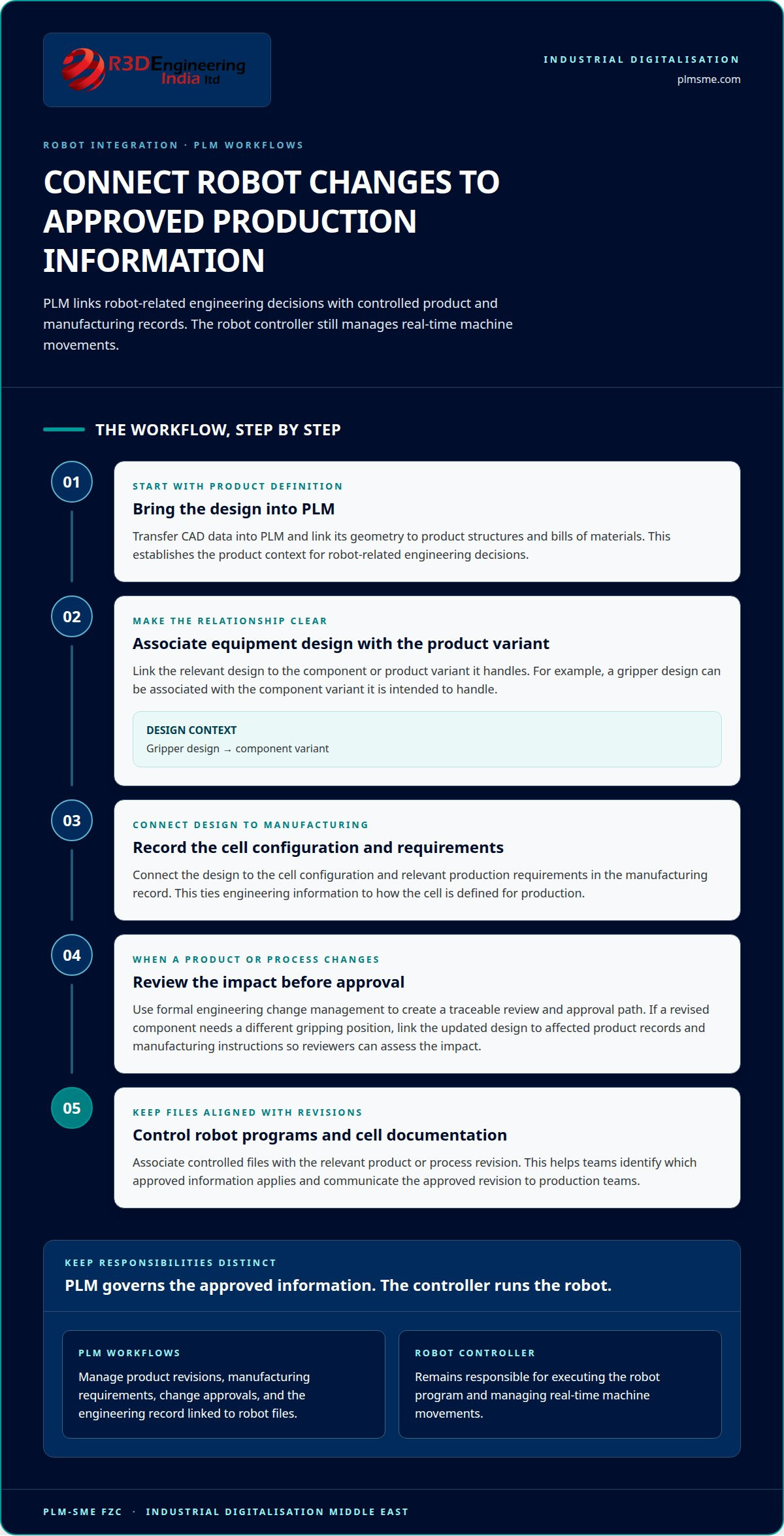
PLM connects robot-related engineering decisions with controlled product and manufacturing records. It doesn’t usually replace the robot controller, which manages real-time machine movements. Instead, PLM helps teams manage the approved information behind a robot cell, including product revisions, manufacturing requirements, and change approvals.
Integration begins with product definition. CAD data can be transferred into PLM, where engineering teams link geometry to product structures and bills of materials. For example, a gripper design can be associated with the component variant it handles. The manufacturing record can then connect that design to the cell configuration and relevant production requirements.
When a product or process changes, formal engineering change management provides a traceable review and approval path. Suppose a revised component requires a different gripping position. The change process can link the updated design to affected product records and manufacturing instructions. Reviewers can assess the impact before the approved revision is communicated to production teams.
Robot programs and cell documentation also need clear revision control. PLM workflows can associate controlled files with the relevant product or process revision, helping teams identify which approved information applies. The robot controller remains responsible for executing its program. Integration defines how that program relates to the controlled engineering record, rather than treating PLM as a real-time motion controller.
System interfaces determine how information moves between PLM and operational platforms. APIs or middleware can bridge legacy ERP or warehouse systems that lack native robot connections. A defined mapping should preserve identifiers, revision status, and ownership as data passes between systems. This reduces ambiguity when an engineering change affects equipment, quality records, or manufacturing instructions.
Finally, operational data can inform engineering decisions. Robot performance records may help identify maintenance needs or process improvements. Linking those findings to product and change records gives teams a traceable path from production evidence to an approved engineering update. This is the practical role of industrial robotics and PLM workflow integration: connecting physical automation with governed product and process information.
CAD data can be transferred into PLM and linked to product structures, bills of materials, and component variants. Robot programs and cell documentation can then be associated with the relevant controlled product or process revision, linking them to the approved engineering record.
What PLM and robotics software platforms support integration?
Integration usually connects several platform roles rather than relying on a single application. A PLM system governs product structures, revisions, and engineering approvals. Robot programming or simulation software defines cell logic and validates movements. MES coordinates production execution, while ERP manages business and resource data. Each system needs a clear responsibility so teams know where information originates and which record governs it.
Teamcenter can serve as the PLM environment for controlled product and process information. Integration design then maps relevant records to robot-cell documentation and manufacturing workflows. For example, a product revision can reference the applicable cell configuration and approved process instructions. The specific data exchanged depends on how engineering and production teams manage revisions, approvals, and operational records.
Robot controllers and PLM systems don’t usually exchange every type of information directly. APIs, middleware, or custom interfaces can translate data between platforms with different structures or protocols. A mapping may connect product identifiers, revision status, and cell references. Interface design also defines which system can create or update each field, preventing conflicting records from becoming competing sources of truth.
Choose platforms according to the integration boundary. Identify which information must move, how frequently it changes, and who owns it. Assess existing PLCs, MES, ERP, and warehouse systems for usable interfaces. A legacy platform may need middleware or interface development. Include security, error handling, and traceability in the architecture, especially where an interface carries approved engineering changes.
Testing should cover routine exchanges as well as exceptions. A changed product revision, rejected message, or unavailable endpoint can reveal gaps before production depends on the connection. The integration should preserve the original record, report failures clearly, and support controlled recovery. These design choices determine whether platform connections remain maintainable as products, equipment, and workflows evolve.
For a tailored architecture around Teamcenter and connected manufacturing systems, plan your platform integration.
PLM-Sme FZC: Industrial automation and AI solutions
PLM-Sme FZC helps manufacturers connect automation priorities with engineering and PLM workflows. Its industrial automation and AI solutions support the integration of robot cells, equipment, and AI applications into existing operations. Teamcenter Integration Development connects Teamcenter workflows with relevant systems, while digital maturity assessments and reports help clarify current capabilities and integration priorities.
For organizations planning a broader transformation, Digitalisation Vision & Roadmap Consulting helps define a structured direction before implementation decisions are made. The work can address system relationships, data flows, and the operational changes needed for an incremental rollout.
Contact PLM-Sme FZC to discuss your robotics and PLM integration requirements.
Move from integration concept to a defined next step
The next decision is not whether to automate everything. It’s where a connected workflow can address a real production need, and how to govern its engineering data as operations evolve. A clear scope helps align technical interfaces, ownership, and change processes before implementation choices become difficult to reverse. This is the foundation of effective industrial robotics and PLM workflow integration: ensuring each connection serves a defined operational and engineering purpose.
PLM-Sme FZC supports this planning through digital maturity assessments and reports, Digitalisation Vision & Roadmap Consulting, and industrial automation and AI solutions. These services help frame priorities and connect automation decisions with the wider digital direction.
To discuss the next step for your operation, contact PLM-Sme FZC about PLM workflows. A well-scoped starting point can help your team move forward with clarity.
Frequently Asked Questions
Do you have to redesign the whole line to add robots?
No, a robot can be introduced at a selected workstation without rebuilding the full line. For example, a manufacturer can automate palletising after a manual packing station while keeping upstream equipment in place. The integration design still needs to account for cell dimensions, material presentation, operator access, and how products enter and leave the automated area.
How Do Engineering Changes Impact Robotics Production?
Engineering changes can affect robot tooling, product handling, inspection criteria, or the production sequence. If a new component shape needs a different grip, teams may need to update the end effector and associated program before using the revision. PLM change workflows help communicate the approved update and when it takes effect, reducing the risk of mixing instructions for different product versions.
How do industrial automation systems actually work in practice?
Automation systems combine sensors, controllers, equipment, and operator interfaces to run a process. For example, a sensor detects a part at a station, a PLC evaluates the input, and the controller signals a motor or robot to act. An HMI lets operators view status, adjust permitted settings, and acknowledge alarms, while supervisory systems gather information across connected equipment.
What Does Integrating Robots with Existing Lines Mean?
It means fitting a robot into the physical process and information flows already used in production. A robot might receive work from an existing conveyor, perform a task, and pass items to a downstream inspection station. Integration also defines how production status, product identifiers, and exceptions reach other systems, so the robot’s activity fits the wider operation.
What are the main challenges of robotic integration?
Common challenges include mismatched interfaces, constrained layouts, changing product variants, and production steps with different cycle times. A robot may also need updated tooling or a buffer area to prevent upstream output from overwhelming its task. Integration planning should address these constraints alongside operator interaction, fault handling, and clear ownership of equipment and software changes.
How are robot programs, versions, and engineering changes managed in PLM?
PLM can associate robot-program files and cell documentation with the relevant product or process revision. For example, a released manufacturing configuration can reference the approved program version for a product variant. Change workflows record review and approval, while access and release rules distinguish working files from approved records. The robot controller executes the program; PLM governs its relationship to engineering information.