
Manufacturing Operations Digitalization in the UAE: What to Automate First
Automating the most visible task first can create a faster island, not a better factory. A manufacturing operations digitalization roadmap in the UAE should start with a clear operational outcome, then simplify and standardise the process before automating it. Prioritise recurring delays, errors or disconnected information that constrain production, and plan system connections alongside the automation.
It’s understandable to focus first on equipment and software, especially when manual handoffs slow operations. But lasting progress depends on how processes, data and systems work together. This guide explains how to assess digital maturity, align priorities with UAE industrial strategies, compare investment opportunities and plan an integrated architecture across manufacturing systems. It also shows why targeted automation is stronger when it fits a practical roadmap with clear business measures and a sequence that accounts for people, data and operational controls.
Key Takeaways
- Use UAE industrial priorities to frame transformation goals, then assess how your plant’s current capabilities support them.
- Rank automation opportunities by business outcome, process readiness and measurable impact before selecting technology.
- Plan system connections across production and business platforms so new automation strengthens the wider operating architecture.
- Use a digital maturity assessment and roadmap consulting to turn transformation priorities into a sequenced, integrated plan.
Alignment with UAE national strategies
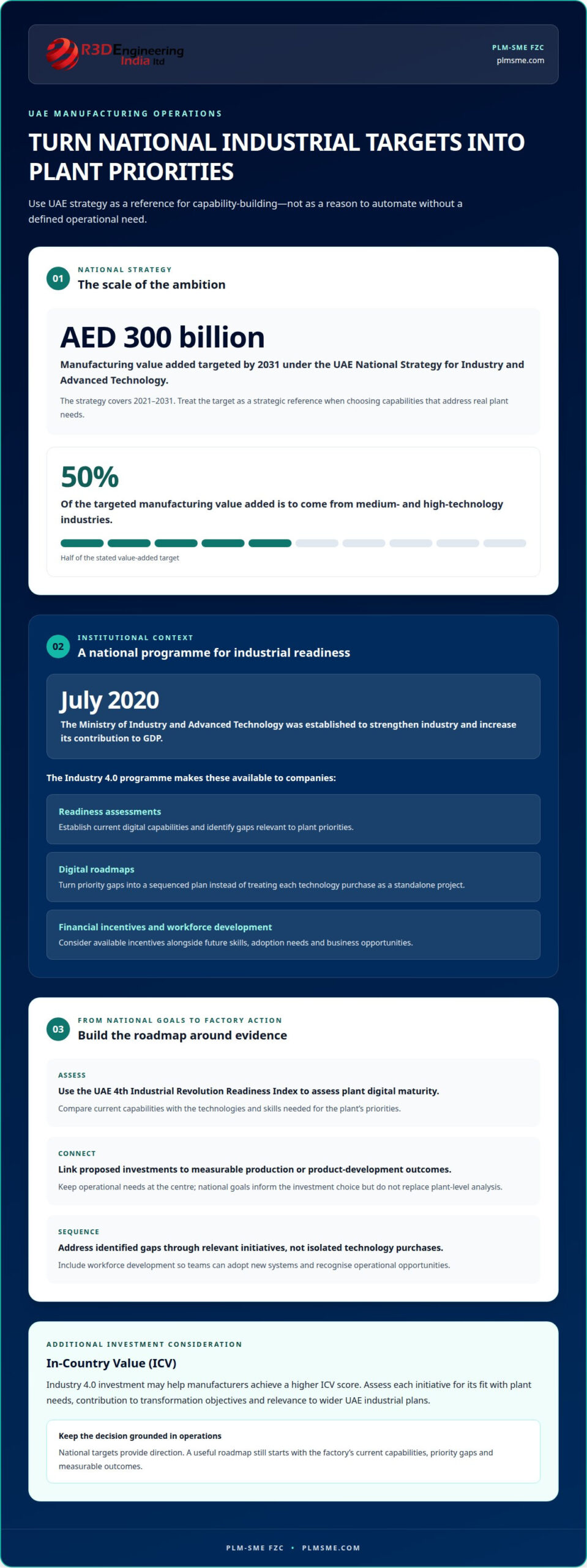
A manufacturing operations digitalization roadmap for UAE plants should connect factory investments to national industrial priorities. The UAE National Strategy for Industry and Advanced Technology covers 2021-2031. It targets AED 300 billion in manufacturing value added by 2031, with medium- and high-technology industries contributing 50% of that value. These targets give manufacturers a strategic reference for selecting capabilities, not a reason to automate without a defined operational need.
The Ministry of Industry and Advanced Technology was established in July 2020 to strengthen industry and increase its contribution to GDP. Its Industry 4.0 programme makes readiness assessments, digital roadmaps and financial incentives available to companies. The programme also supports workforce development, including future skills and recognising business opportunities. An assessment can help identify gaps between a plant’s current capabilities and the technologies or skills needed for its priorities.
For an individual factory, alignment becomes practical when national goals inform investment choices. A manufacturer pursuing more advanced production, for example, can assess whether its production data, engineering information and workforce capabilities support that direction. The UAE’s 4th Industrial Revolution Readiness Index provides a framework for assessing plant digital maturity. Results can inform a sequenced plan, linking identified gaps to relevant initiatives rather than treating each technology purchase as a standalone project.
- Use the readiness assessment to establish current digital capabilities and identify priority gaps.
- Connect proposed investments to measurable production or product-development outcomes.
- Include workforce development so teams can adopt new systems and recognise operational opportunities.
Industry 4.0 investment may also relate to In-Country Value (ICV): manufacturers can use such investments to achieve a higher ICV score. This creates another strategic consideration when assessing initiatives. The value of a project depends on its fit with plant needs, contribution to transformation objectives and relevance to the company’s wider UAE industrial plans. A roadmap should make these connections visible while keeping operational priorities at its centre.
Business case and initiative prioritisation
Start each investment case with an operational outcome, not a software shortlist. A UAE manufacturer might aim to reduce production delays, improve traceability or shorten engineering-change cycles. Define the problem, the affected process and the business measure that will show progress. This keeps proposed initiatives tied to plant priorities rather than technology novelty.
Establish a baseline and target for each expected benefit. Assign an owner, identify the measurement source, set a review frequency and define corrective action. For example, a production-data initiative needs a clear downtime baseline and an agreed method for recording it. Without consistent data definitions, teams can’t distinguish genuine improvement from a change in measurement.
Prioritisation should weigh business value against readiness and dependencies. Simplify and standardise a process before automating it, and redesign broken workflows instead of transferring them unchanged to a new platform. If an initiative depends on inconsistent product or production data, foundational data work may need to come first. This sequence ensures implementation builds on process development instead of locking a weak workflow into software.
- Operational impact: Define which constraint or business outcome the initiative addresses.
- Process readiness: Identify process changes and standardisation needed before automation.
- Data and integration: Map required information, ownership and system connections.
- Adoption and control: Include workforce needs, cybersecurity and privacy in programme design.
- Measurement: Set a baseline, target, accountable owner and review method.
The UAE Product Offtake Initiative has identified AED 168 billion worth of opportunities for locally manufactured products. That context can inform a business case where digital initiatives support product quality, production responsiveness or engineering collaboration. It doesn’t replace plant-level analysis: each proposal still needs a defined outcome, credible measures and a feasible path through dependencies. Where PLM implementation or system integration is part of that path, Teamcenter integration development can connect the investment to the wider operating environment.
Target architecture and system integration
A target architecture defines how plant systems, operational data and business applications work together. For UAE manufacturers, the priority is to connect existing capabilities in a secure, coherent structure that can support advanced operations.
Designing the Target Architecture
The architecture maps manufacturing functions and information flows across Level 1 to Level 4, following the ISA 95 Purdue Model. This structure clarifies where control, production management and enterprise systems operate, and how information should move between them. It helps teams plan growth without treating each new application as a separate island. For example, production data can support operational decisions while remaining connected to higher-level planning and product information.
Integrating Manufacturing Systems
Integration allows applications and equipment to exchange consistent, useful data. A manufacturer can start by linking existing programmable logic controllers (PLCs) and historians to a new data layer without replacing them. That layer can then support connections with manufacturing execution or operations management systems, enterprise resource planning and product lifecycle management. Clear interfaces and shared data definitions help prevent conflicting records, while planned integration lets existing assets contribute to new capabilities.
Security belongs in the architecture from the assessment stage onward. Segmenting operational technology (OT) and information technology (IT) networks helps establish communication boundaries. Design access rules, data ownership and permitted use into system connections rather than adding them after implementation.
Core Industry 4.0 Technologies
Industry 4.0 technologies combine automation, connected equipment, operational data and AI to improve how manufacturing work is monitored and managed. Sensors and PLCs capture equipment signals; historians retain time-series information; analytics can help teams identify patterns, while AI can support selected decisions. Each technology has value when it addresses a defined process need and connects to the architecture, not merely because it is available.
For a UAE plant, a practical sequence could connect existing PLCs and historians first, then use the resulting data layer for targeted analytics or automation. This staged approach builds on current assets and provides a clearer foundation for later system integration.
What are the key Industry 4.0 technologies for UAE manufacturers?
Industry 4.0 combines connected equipment, automation and advanced digital tools to improve manufacturing decisions. For UAE plants, useful choices depend on the production constraint, available data and integration needs. Robotics can handle repetitive or hazardous tasks, while machine vision can inspect products for visible defects. These technologies are most relevant when they address a defined quality, safety or throughput challenge.
Industrial Internet of Things (IIoT) devices connect machines and sensors so teams can monitor operating conditions. Edge computing processes selected data near equipment, supporting timely local decisions. Cloud platforms can enable broader analysis across production sites when the architecture and data controls suit the use case. These capabilities build on plant connectivity, but each needs clear data ownership and a defined operational purpose.
- Robotics and cobots: Automate repetitive handling or assembly tasks, with people overseeing exceptions and changeovers.
- Machine vision: Inspect components or finished products, helping operators identify defects during production.
- Digital twins: Model a product, process or asset to evaluate changes before applying them physically.
- Additive manufacturing: Produce selected parts through layer-based fabrication, where design and production requirements support it.
- AI and machine learning: Analyse suitable operational or quality data to identify patterns and inform decisions.
Adoption works best as a sequence, not a technology catalogue. A plant might first use machine vision to address a recurring inspection bottleneck, then assess whether its data can support AI-assisted analysis. Digital twins can help evaluate process changes, while robotics may address a separate handling constraint. Define an owner, process boundary and success measure for each initiative. Include cybersecurity and workforce readiness in implementation planning.
Technology choices should fit the plant’s operational model and target architecture. Map your Industry 4.0 technology priorities to process needs, data readiness and integration requirements before committing to implementation.
PLM-Sme FZC: Digital maturity assessments and reports
PLM-Sme FZC helps manufacturers turn digitalisation priorities into a structured plan through digital maturity assessments and reports. This work is useful when disconnected systems, unclear data flows or competing automation proposals make it difficult to decide what should come first.
The assessment clarifies current capabilities and gaps, while Digitalisation Vision & Roadmap Consulting turns findings into sequenced initiatives. System and Solution Architecture can define how manufacturing applications and data should connect. Where a priority use case calls for it, industrial automation and AI solutions can support implementation.
This approach is most useful when investment decisions need to account for process readiness, system integration and longer-term operational goals together. Contact PLM-Sme FZC to discuss your manufacturing digitalisation priorities.
Make the Next Move with a Clear Direction
A manufacturing operations digitalization roadmap for UAE manufacturers should be a working guide, not a fixed technology wish list. As production priorities, data quality and system dependencies evolve, revisit the sequence and keep each initiative tied to an operational objective. This discipline helps teams move beyond isolated digital projects towards connected capabilities that support future decisions.
PLM-Sme FZC supports this work through digital maturity assessments and reports, Digitalisation Vision & Roadmap Consulting, and industrial automation and AI solutions. These services help clarify your operation’s current state, shape a practical direction and progress suitable initiatives. The next step is a focused discussion about your priorities, constraints and desired outcomes.
Contact PLM-Sme FZC to discuss your roadmap and identify a considered path forward for your manufacturing operations.
Frequently Asked Questions
What Should You Transform First?
Transform a process that creates a persistent operational bottleneck and has a clear owner. For example, if production teams routinely wait for engineering clarification, examine how design changes reach the shop floor before automating equipment. Trace where information stalls, who resolves exceptions and how delays affect work. This shows whether the first intervention should address workflow, data access or automation, rather than simply digitising a visible task.
Where Should a UAE Business Start Digital Transformation?
Start by defining one business outcome and the operation it affects. A manufacturer aiming to respond faster to customer specification changes could map how approved requirements move from sales through engineering and production. Identify decision owners, handoff points and the records used at each stage. This focused view gives the transformation effort a practical boundary and helps prevent a broad programme from becoming a collection of disconnected software requests.
What is a digitalization roadmap for manufacturing operations?
A digitalisation roadmap is a prioritised plan that connects manufacturing objectives with process changes, digital capabilities and implementation decisions. It should show how initiatives depend on one another, who owns each outcome and what evidence will indicate progress. For instance, a plan might sequence product-data governance before a workflow that relies on consistent engineering records. The roadmap supports coordinated decisions across operations, engineering, IT and leadership.
What are the steps to build a manufacturing digitalization roadmap in the UAE?
Build the roadmap by defining desired business outcomes, assessing current capabilities and documenting important process and system dependencies. Then select initiatives, assign accountable owners and establish how progress will be reviewed. Include workforce adoption, data governance and cybersecurity. For a UAE manufacturer, align relevant initiatives with industrial priorities while keeping the sequence grounded in plant constraints and measurable operational needs.
Which UAE government programs support manufacturing digitalization and Industry 4.0?
The UAE Industry 4.0 programme makes readiness assessments, digital roadmaps and financial incentives available to companies. Its workforce development focus includes future skills and recognising business opportunities. Manufacturers can use these elements to understand capability gaps, plan relevant initiatives and consider the people needed to adopt new processes. The programme can inform transformation planning, while each plant’s operational priorities guide which opportunities belong in its roadmap.
What are the UAE’s Industry 4.0 policies and manufacturing regulations?
The UAE’s Industry 4.0 programme supports readiness assessment and roadmap development, while the UAE Industrial Registry operates in line with Federal Decree-Law No. 25 of 2022 and executive regulations 79/2023. These are distinct elements: the programme concerns industrial digitalisation support, while the cited legislation and regulations govern the Industrial Registry. Manufacturers should identify which framework applies to the specific activity under consideration.