
Discrete Industry PLM Modernization for Cloud and Partner Collaboration
Disconnected product data creates lifecycle risk, not just engineering inconvenience. A discrete industry PLM modernization strategy connects product information across design, manufacturing, quality and service, while establishing traceability and controlled collaboration with suppliers and partners. Cloud can support distributed work, but the right architecture depends on how systems, data and access need to work together.
It is understandable to focus on replacing an ageing PLM platform. Yet a new system alone will not resolve inconsistent product records, unclear change histories or disconnected workflows. Modernization works best when it addresses how product data moves through the full lifecycle and how internal teams and external partners use it.
This article explains how connected product data supports discrete manufacturing, how a digital thread strengthens lifecycle traceability, and what to consider when modernizing PLM for cloud and partner collaboration. It also shows how architecture and integration decisions shape the transition, helping you assess a practical path from today’s environment to a more connected PLM foundation.
Key Takeaways
- Map where product data is created and used to identify gaps between engineering, manufacturing and other lifecycle functions.
- Link requirements, designs, changes and outcomes to make product decisions easier to trace and assess.
- Align cloud migration with system architecture, integrations and access needs rather than treating it as a hosting change alone.
- Use a maturity assessment and roadmap to prioritize modernization work and shape collaboration with suppliers and partners.
Moving from document control to connected product data
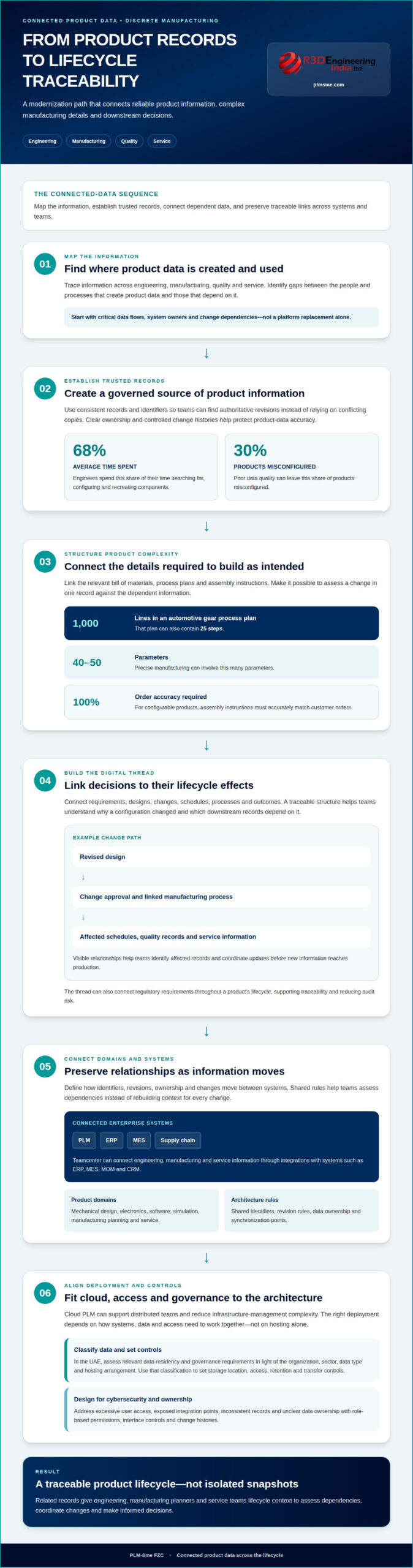
Modernization turns controlled product files into connected data that teams can use across the lifecycle. For a discrete manufacturer, the priority is linking reliable information to the processes that create and use it.
Siemens Teamcenter can connect engineering, manufacturing and service information through integrations with systems such as ERP, MES, MOM and CRM. Platform fit depends on how these systems exchange product data and preserve clear ownership.
In the UAE, assess relevant data-residency and governance requirements in light of the organization, sector, data type and hosting arrangement. Use that classification to set storage location, access, retention and transfer controls.
Key cybersecurity and governance risks include excessive user access, exposed integration points, inconsistent records and unclear data ownership. Build role-based permissions, interface controls and change histories into the modernization design.
Centralized Product Data Accuracy
Centralized product data is a governed source of product information that teams access through consistent records and identifiers. Accuracy matters because errors can flow from engineering into manufacturing, quality and service. Engineers spend an average of 68% of their time searching for, configuring and recreating components; poor data quality can also leave 30% of products misconfigured. A controlled source helps teams identify authoritative revisions and reduce conflicting copies.
Managing Product Complexity
Managing product complexity means structuring precise manufacturing details and variable configurations so each product can be built as intended. An automotive gear process plan can contain 1000 lines and 25 steps, while precise manufacturing can involve 40 to 50 parameters. For configurable products, assembly instructions must be 100% accurate to customer orders. A PLM platform should connect the relevant bill of materials, process plans and instructions, so a change in one record can be assessed against dependent information.
Interoperability Across Product Domains
Interoperability connects mechanical design, electronics, software, simulation, manufacturing planning and service data. It gives engineering and operations a shared thread instead of isolated domain records. Cloud-based product development can support distributed teams, while integrations give each function access to relevant, controlled information. Define how identifiers, revisions and changes move between systems. Doing so makes cross-domain impact assessment more reliable and helps the enterprise use product data consistently across global operations.
Digital thread and lifecycle traceability
In discrete manufacturing, a digital thread connects product decisions to their downstream effects across the lifecycle. It links requirements, designs, changes, schedules, processes and outcomes, creating a traceable structure for lifecycle management.
Lifecycle Visibility and Traceability
Lifecycle visibility means tracing a product decision from its originating requirement through design, production and service records. This helps organizations understand why a configuration changed and which work instructions or quality records depend on it. For example, linking a revised design to its change approval and manufacturing process clarifies the impact before updated information reaches production. Modern PLM can also track regulatory requirements throughout a product’s lifecycle, supporting traceability and reducing audit risk.
Connected Systems and Transformation Agility
A connected-system digital thread preserves relationships as information moves between PLM, ERP, MES and supply-chain systems. Teams can assess dependencies instead of rebuilding context for every change, improving transformation agility. Define shared identifiers, revision rules, data ownership and synchronization points in the system architecture. These decisions maintain useful links across enterprise applications and clarify where changes originate.
Digital twins use connected product and process data to represent a product or manufacturing system. When teams link a twin to relevant design information, operating context and change history, they can analyze how proposed adjustments affect downstream activities. Ongoing analysis depends on the quality and relevance of those connected records, not on a model viewed in isolation.
For example, a design change can affect schedules, manufacturing processes and service information. A digital thread makes those relationships visible, helping teams identify affected records and coordinate updates. Engineers, manufacturing planners and service teams can then make earlier decisions using related lifecycle context rather than separate snapshots.
Organizations planning transformation can map critical data flows, system owners and change dependencies before selecting implementation priorities. A structured review of digital-thread dependencies can help clarify where traceability gaps interrupt lifecycle decisions.
PLM platform modernization and cloud migration
Modernization aligns the PLM application, deployment model and operating processes with product-development needs. These choices affect data access, integrations, scalability and how teams manage change.
Cloud and On-Premise Deployment Models
Cloud PLM runs on provider-managed infrastructure, while on-premises PLM runs within an organization’s own environment. The distinction affects infrastructure responsibilities, access patterns and integration design. Cloud PLM can support distributed teams and reduce infrastructure-management complexity. On-premises deployment may suit organizations whose architecture or operational controls require internal hosting. Compare both options against data governance, connectivity, system dependencies and the ability to maintain the platform over time.
Cloud PLM Adoption and Scalability
Cloud PLM adoption moves product data and processes to a hosted platform, either through a broad transition or phased deployment. A phased approach can start with a defined product group or workflow, then expand after integrations and user processes are tested. Scalability depends on architecture, data volumes, access needs and connected applications. Map those dependencies before migration, including engineering tools and manufacturing systems, so deployment supports product development rather than creating parallel records.
Modernization Costs, Timelines, and ROI
Modernization investment, delivery duration and return depend on migration scope, data condition, integrations, customization and business disruption. A focused deployment with clean product data has different requirements from a programme spanning legacy applications, global teams and manufacturing processes. Set ROI measures before implementation, such as reduced duplicate data entry, faster change-impact assessment or less infrastructure management. Track each measure against a baseline to assess operational value.
Pitfalls and Success Factors
Common pitfalls include migrating inconsistent records, rebuilding excessive customizations and overlooking dependencies between PLM and enterprise applications. These choices can carry old process problems onto a new platform. Define data ownership, target workflows and integration requirements before configuring software. Then test representative product structures, changes and user roles in a controlled deployment. Clear governance and staged decisions help discrete manufacturers connect modernization to innovation priorities and day-to-day operations.
Collaboration with suppliers and partners
PLM can extend collaboration beyond company boundaries, connecting suppliers, partners and customers with controlled product information. For a UAE manufacturer coordinating engineering and procurement across a global supply chain, the aim is to share relevant data without creating competing records.
Integrating PLM with ERP, MES and supply-chain systems supports collaboration between departments and suppliers. Define which system owns each record, then align identifiers, revision status and change notifications across interfaces. For example, a released engineering change can alert procurement to affected parts and give manufacturing planners updated product context. Clear ownership helps prevent supplier workflows from relying on obsolete drawings.
3D visualization gives engineering teams and external collaborators a shared view of product geometry. A supplier reviewing a component model can discuss fit, interfaces or a proposed adjustment before production planning proceeds. Pair the model with its revision and related specifications; otherwise, a visual review can refer to the wrong design state. Access controls should also limit shared information to what each partner needs for its role.
Global collaboration requires workflows that account for different organizations, systems and approval responsibilities. Define how a partner receives a change, submits feedback and returns required documentation. For instance, a component supplier might provide revised manufacturing data through an agreed integration, while the manufacturer retains control of design release. This keeps partner reviews connected to internal engineering decisions.
Reliable operations depend on dependable integration, clear data ownership and agreed partner processes. Start by mapping one supplier-facing workflow, such as reviewing a component change, then identify its PLM, ERP and supply-chain touchpoints. Use the findings to shape broader collaboration requirements, including model access, approval paths and change visibility. This gives teams a practical basis for expanding partner participation without treating every external relationship identically.
To define integration requirements for supplier workflows, map your PLM integration needs and identify the systems involved.
PLM-Sme FZC: Digital maturity assessments and reports
PLM-Sme FZC helps discrete manufacturers assess digital maturity and set practical modernization priorities. Its assessments and reports can clarify gaps in product data, lifecycle traceability, integrations and partner workflows, giving decision-makers a basis for sequencing change.
This work is useful when teams need to align modernization objectives before choosing platform changes or implementation priorities. Digitalisation Vision & Roadmap Consulting connects assessment findings to a transformation direction, while System and Solution Architecture shapes how PLM fits with enterprise applications. Industrial automation and AI solutions can support broader digital initiatives when they match the organization’s priorities.
For a modernization programme that needs a clearer starting point and direction, contact PLM-Sme FZC or visit plmsme.com.
Turn modernization into an operating capability
A discrete industry PLM modernization strategy should extend beyond deployment. Treat it as an ongoing operating capability, with clear ownership of product data, integrations and change governance after implementation. This keeps modernization aligned with evolving engineering and business needs.
Next, identify which decisions need leadership alignment and which depend on technical architecture. A practical roadmap connects these priorities, sequences the work and gives teams a shared basis for evaluating progress. This creates a deliberate path from transformation plans to sustained operational use.
For support shaping that direction, contact PLM-Sme FZC about PLM. A clear starting point can help your team move forward with confidence.
Frequently Asked Questions
What is PLM modernization for discrete manufacturing industries?
PLM modernization changes how a manufacturer manages product information, processes and supporting technology. It may involve replacing or reconfiguring legacy applications, improving data structures and connecting engineering records with manufacturing and service workflows. For example, a change to a machine assembly can link to its approved design, production instructions and service documentation, giving teams a more useful operational record.
What are the main drivers and benefits of PLM modernization in discrete manufacturing?
Manufacturers modernize PLM when disconnected applications, difficult change control or unreliable records obstruct product development. A stronger environment can make revisions easier to manage, clarify ownership of product information and improve coordination between engineering and production. It also provides a more structured base for analytics or AI initiatives. Practical value depends on resolving the specific process and data constraints behind the modernization effort.
What are the key steps in a discrete industry PLM modernization strategy?
A discrete industry PLM modernization strategy starts with defining business outcomes and assessing current processes, applications and data. Next, set target architecture and governance, prioritize integrations, and plan migration around representative product families. Pilot the design with actual users, validate records and permissions, then expand in manageable releases. Review adoption after each release and resolve process gaps before extending the platform further.
How should manufacturers assess legacy PLM systems and define modernization requirements?
Assess a legacy PLM system by tracing a representative product from engineering release to manufacturing use. Document critical workflows, customizations, interfaces, data ownership and recurring workarounds. Then classify requirements as essential, desirable or ready for retirement. For example, a custom approval may encode a necessary quality control, while another may simply preserve an old interface. This distinction helps shape a realistic target design.
How do cloud, SaaS, and on-premises PLM compare for discrete manufacturers?
Cloud describes infrastructure hosted outside the organization, while SaaS usually means software is delivered and operated as a service. On-premises PLM runs in the manufacturer’s own environment. Compare these models by assessing integration needs, data governance, internal IT responsibilities, access patterns and customization requirements. A global engineering team may value browser-based access, while a tightly coupled factory environment may prioritize local system dependencies.
How can manufacturers migrate legacy product data and CAD records to a modern PLM system?
Begin migration by identifying authoritative records, required attributes, CAD relationships and revision history. Clean duplicates, map legacy fields to the target data model, and define how assemblies, documents and linked files should transfer. Test representative products before broader loading, then reconcile record counts and open CAD references. PLM-Sme FZC provides end-to-end PLM implementation support, including data migration and CAD, CAM and CAE extensions.