
Contract PLM Administration Services in the UAE: Roles and Scope
A PLM system can be live yet lack the consistent oversight needed to support engineering work. In the UAE, contract PLM administration services generally involve engaging external support under an agreement to manage a PLM environment and handle its day-to-day administration. The scope depends on the agreement: administration can mean overall management, while administering refers to the practical work of maintaining system processes and records.
“Administration” can describe both overall oversight and hands-on work. This article clarifies the distinction and explains how it shapes a contract administrator’s role in a PLM environment.
You’ll learn what PLM administration can cover, how responsibilities can be divided, which platform capabilities matter, and when contracted support may suit an organisation. The aim is to help you define the scope before work begins.
Key Takeaways
- Define whether contract support covers management oversight, hands-on administration, or both before setting the scope.
- Match the fee model to the work: ongoing system needs and defined project deliverables call for different arrangements.
- Assess an administrator’s PLM platform knowledge alongside practical experience with workflows, data governance, and integrations.
- Compare in-house and outsourced support by weighing internal capability, continuity, workload, and the level of control your team needs.
What PLM platforms do UAE contract administrators support?
A PLM platform manages product information and lifecycle processes. A contract administrator’s platform coverage depends on the system named in the agreement, not on a single UAE-wide standard. In this service context, Siemens Teamcenter is the specific platform. Before assigning work, document the platform, environment, and administrative responsibilities in scope.
Platform administration covers system configuration and user-facing processes. In Teamcenter, this can include managing user access, maintaining workflows, and supporting product data structures. For example, an administrator may investigate a change workflow that is blocking an engineering revision. Redesigning that workflow or implementing a new system is broader project work, not routine administration.
Integration administration supports connections between PLM and other business systems. A PLM environment may exchange information with ERP, CRM, MES, or MOM systems. For example, an approved engineering change may need to align with production or resource records in another system. Define which connections are covered and where responsibility passes between system teams.
The work also depends on how the organisation has configured its system. Teamcenter environments can differ in workflows, access rules, data structures, and connected systems, so administrators need to understand the specific setup rather than assume every task is standard. A practical starting point is to map key processes, such as release approval, and identify their system owners.
When evaluating contract PLM administration services in the UAE, separate routine administration from implementation and integration development. Routine support maintains agreed system processes; implementation establishes or changes the PLM solution; integration work supports data exchange with systems such as ERP or MES. This distinction helps define deliverables, escalation routes, and required expertise without assuming every administrator supports every platform.
For a new Teamcenter environment or substantial system changes, end-to-end PLM implementation support is more suitable than an administration-only scope. For an established environment, first define the platform and processes, then assign administration tasks within that operational boundary.
How are contract PLM administration fees structured: hourly, monthly, or project-based?
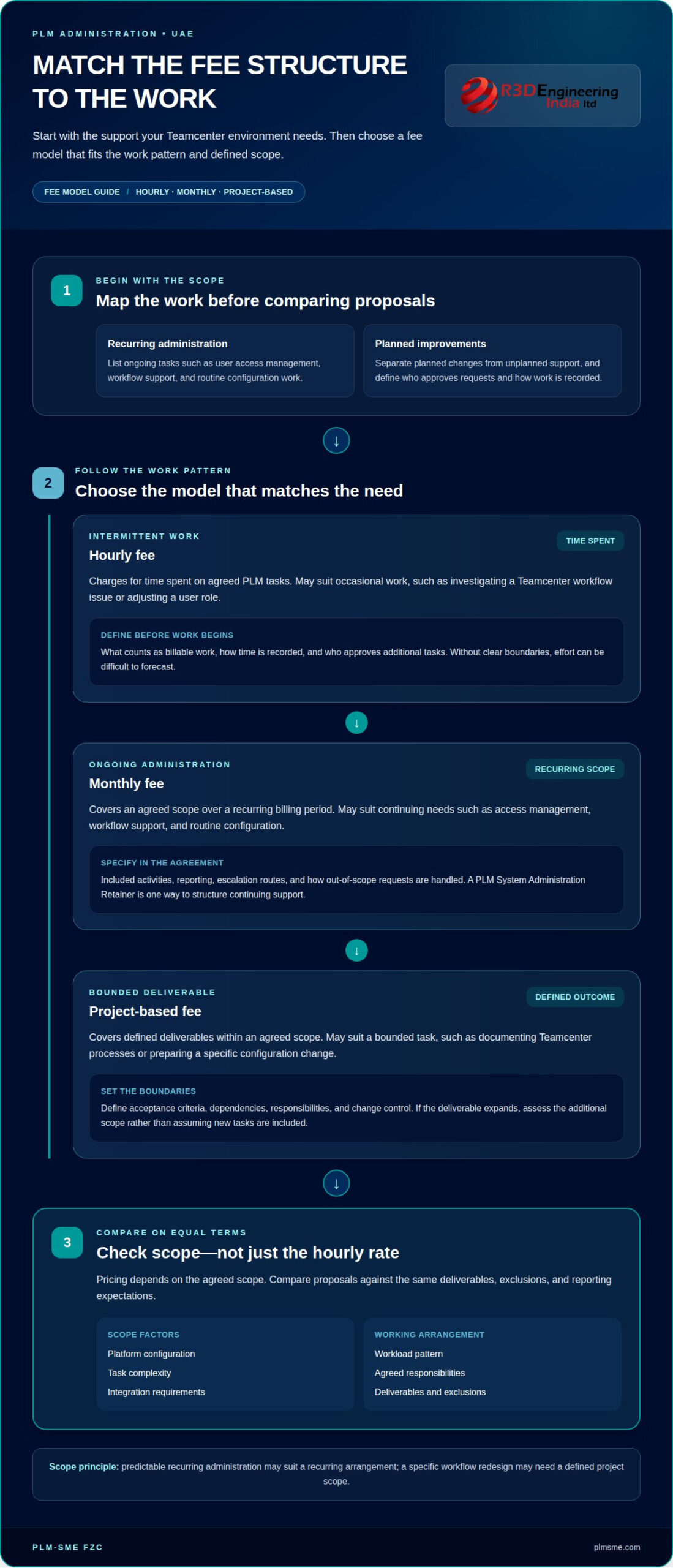
An hourly fee charges for time spent on agreed PLM tasks. It may suit intermittent work, such as investigating a Teamcenter workflow issue or adjusting a user role. Define what counts as billable work, how time is recorded, and who approves additional tasks. Without clear boundaries, it can be difficult to forecast the effort involved.
A monthly fee covers an agreed scope over a recurring billing period. It may suit organisations that need ongoing administration, such as user access management, workflow support, and routine configuration work. The agreement should specify included activities, reporting, escalation routes, and how out-of-scope requests are handled. A PLM System Administration Retainer is one way to structure continuing support.
A project-based fee covers defined deliverables within an agreed scope. It may suit a bounded task, such as documenting Teamcenter processes or preparing a specific configuration change. Before work starts, define acceptance criteria, dependencies, responsibilities, and change control. If the deliverable expands, assess the additional scope rather than assuming new tasks are included.
Map the work before comparing proposals. First, list recurring administration tasks. Then separate planned improvements from unplanned support, and identify who approves requests and how work will be recorded. For example, predictable access administration may suit a recurring arrangement, while a specific workflow redesign may need a project scope.
Pricing depends on the scope and is provided after a quote request. Key factors include the platform configuration, task complexity, integration requirements, workload pattern, and agreed responsibilities. Compare proposals against the same deliverables, exclusions, and reporting expectations. An hourly rate alone does not show the full scope or level of support.
For ongoing Teamcenter administration, consider whether a PLM System Administration Retainer aligns with the recurring tasks your team has identified. For a one-off need, define its deliverable and completion criteria first, then select a fee structure that follows that scope.
What qualifications and experience should a contract PLM administrator have?
Platform proficiency means being able to administer a specific PLM system. For Teamcenter, look for experience with the configured environment and its workflows. Ask the candidate to explain a practical task, such as resolving a stalled approval. Their response should identify the issue, actions taken, and outcome, demonstrating practical knowledge beyond platform terminology.
Process knowledge means understanding how engineering work moves through PLM. A capable administrator can explain how a design revision progresses from review to release and distinguish routine user support from changes to workflow design. Ask how they would investigate a blocked change and which process owners they would involve. Their answer should show an understanding of both system steps and operational context.
Data governance is the structured control of product information. An administrator should understand how access, data quality, and change records affect engineering work. For example, they should be able to explain how permissions relate to user roles and how they would handle inconsistent product records. Clear answers show whether they treat PLM data as a managed business asset.
Integration experience means practical knowledge of connected enterprise systems. PLM environments may exchange data with ERP, CRM, MES, or MOM platforms. Ask the administrator to describe a data handoff they have supported, clarify which system owns each record, and explain how teams investigate mismatches. This helps assess their ability to work across technical boundaries.
Troubleshooting is the ability to isolate causes methodically. For example, when a user cannot complete a workflow, the administrator should distinguish an access issue from a process configuration or data problem. Ask what evidence they would collect and how they would document the resolution. A structured method matters more than confident guesses.
Documentation skill is the ability to record system decisions clearly. For a Teamcenter change, useful records identify the affected process, configuration, approval, and resulting action. Ask for an example of documentation from previous PLM work. Clear records help internal teams understand support history and maintain continuity when responsibilities change.
- Match Teamcenter experience to your actual environment.
- Ask for examples involving workflows, data, and integrations.
- Assess troubleshooting through a realistic support scenario.
Comparing In-house vs Outsourced PLM Services in the UAE
In-house PLM administration means employees oversee the system. Internal staff can work directly with engineering teams and company processes. For example, an administrator can coordinate a Teamcenter workflow change with its process owner. This approach also keeps operational knowledge within the organisation. Its suitability depends on available skills, workload, and continuity needs.
Outsourced PLM administration is support delivered by an external specialist under contract. It can provide defined expertise without assigning every task to an internal role. For example, an external administrator may handle recurring access and workflow tasks. The agreement should specify responsibilities, deliverables, reporting, and escalation paths, while leaving internal teams clear ownership of business decisions.
Capacity is the ability to cover the work a PLM environment requires. Compare recurring requests, planned changes, and support ownership. If one internal administrator handles system requests alongside other duties, backlogs can affect both. With external administration support, internal process owners still need to approve business changes. Account for this shared responsibility when comparing options.
Continuity means preserving system knowledge when responsibilities change. Internal teams can document local processes and decisions; contracted support should also record work, configuration decisions, and open issues. For example, a handover note for an ERP connection can identify owners and unresolved data questions. Compare documentation practices as well as task lists.
Control is the organisation’s ability to direct priorities and access. Define who approves Teamcenter changes, assigns requests, and reviews completed work. Internal administration may provide closer day-to-day coordination. Outsourcing can work alongside internal governance when decision rights remain explicit. In the UAE, document the agreed operating model across relevant teams and locations.
Use this comparison sequence:
- List recurring administration tasks and process owners.
- Separate operational support from project changes.
- Assess internal capacity, skills, and documentation.
- Assign approval, escalation, and reporting responsibilities.
Choose the model that covers identified tasks without blurring accountability. If recurring administration needs external support, explore PLM system administration support and compare its scope with your team’s responsibilities.
PLM-Sme FZC: Digital maturity assessments and reports
PLM-Sme FZC helps organisations assess digital maturity and clarify priorities through assessments and reports. Turn to this service when your team needs to understand its current capabilities before defining the next PLM administration step. The findings can inform Digitalisation Vision & Roadmap Consulting, linking current-state analysis with a structured direction for digitalisation.
When deciding how PLM should fit within a wider technical environment, System and Solution Architecture can help shape the design. Industrial automation and AI solutions may also be relevant when the roadmap identifies those needs. These services connect strategy with technical planning instead of treating administration as an isolated system task.
If you’re assessing your digital maturity or planning the next stage of PLM, contact PLM-Sme FZC to discuss your requirements.
Set a Clear Direction for Your PLM Environment
Connect administration decisions with your organisation’s wider digital priorities. Before changing responsibilities or support arrangements, identify the business outcomes your PLM environment needs to enable. These might include clearer governance, better-connected processes, or a defined path for future system development. Such priorities give your team a practical basis for deciding what to address first.
For organisations assessing their current capabilities, PLM-Sme FZC provides digital maturity assessments and reports. Digitalisation Vision & Roadmap Consulting can turn the findings into a structured direction, while industrial automation and AI solutions can address priorities identified in the roadmap. This broader view places contract PLM administration services in the UAE within a considered digitalisation plan, rather than treating administration as an isolated task.
If you’re ready to shape the next stage of your PLM environment, contact PLM-Sme FZC to discuss your priorities. A clear starting point can help your team move forward with purpose.
Frequently Asked Questions
What does contract PLM administration include in the UAE?
Contract PLM administration combines agreed oversight of a PLM environment with the practical tasks required to operate it. The scope may include managing user permissions, maintaining system records, coordinating change requests, and reporting unresolved issues. For example, a contract can assign the administrator responsibility for logging requests while internal engineering leads retain approval authority. Set out these boundaries, deliverables, and escalation contacts in writing.
How to hire a contract PLM administrator in the UAE: steps and contract terms?
Start by documenting your PLM environment, business priorities, and support gaps. Assess candidates against your platform and real work scenarios, such as handling a permission request or documenting a configuration change. Specify responsibilities, deliverables, reporting, approval rights, confidentiality expectations, and scope-change procedures in the contract. Agree on handover documentation and access procedures so the administrator can work within your organisation’s governance.