
Manufacturing PLM Architecture for Digital Threads and Change Governance
A connected PLM environment can still leave engineering, production and service teams working from different versions of the product truth. A PLM enterprise architecture blueprint for manufacturing defines how PLM, ERP, MES and other systems connect, how product data moves between them, and how changes and lifecycle states are governed. It also sets the target architecture and roadmap for putting that design into practice.
That structure matters because adding integrations alone doesn’t create a reliable digital thread: teams also need clear system roles, controlled data flows and consistent change governance. This article explains what enterprise PLM architecture includes, how it links manufacturing systems and product information, and how deployment choices shape the design. You’ll also see how a practical roadmap can help manufacturers in the UAE align architecture decisions with business capabilities and implementation priorities.
Key Takeaways
- Map systems, product data and infrastructure together to make digital-thread connections clear and expose integration gaps.
- Use shared standards and well-defined interfaces to connect PLM, ERP and MES while reducing reliance on fragile point-to-point links.
- Align information models across systems so product structures, manufacturing data and lifecycle changes retain their meaning as they move.
- Apply configuration governance consistently; according to the International Organization for Standardization, ISO 10007 is the international standard for configuration management practices.
- Build an implementation roadmap around business capabilities, existing-system priorities and deployment needs, then assess where architecture or maturity gaps need attention.
Digital thread architecture and system integration
Manufacturing PLM platforms differ in how they structure product data, applications, integrations and governance. Compare them by how well their architecture supports your product lifecycle, workflows, system connections and supplier relationships, rather than by feature lists alone. Enterprise architecture management maps process, product data, systems and infrastructure to give teams a shared view of the digital environment.
A digital thread connects product information and decisions across engineering, manufacturing and service. Its value depends on traceable relationships, not simply moving files between applications. The shift toward the Digital Thread took shape in the mid-2010s, as manufacturers sought to connect product data across lifecycle stages. For a UAE manufacturer, that architecture can clarify which system owns each record and how approved changes reach production.
Consider a pump whose engineering bill of materials contains 312 line items, two seal types and four port orientations. A useful thread connects each configured product to its design definition, manufacturing instructions and service information. If an engineering change affects one port orientation, connected records should show which configuration is affected and which downstream teams need updated information.
Digital Thread describes connected, traceable product information across systems and lifecycle stages. Digital Cloth offers a useful complementary image: the threads form a connected fabric, where relationships between records matter as much as individual files. For example, a defense-vehicle program may link 30,000 customer requirements to design elements and verification activities. That relationship lets teams trace a requirement to its supporting evidence.
Integration is the practical challenge. Email, spreadsheets and file sharing can make supply-chain exchanges inefficient, while bespoke point-to-point links become harder to maintain as applications change. Open APIs can help MES integrations capture and share data more efficiently. Standards such as OAGIS support electronic business-data exchange. JSON enables lightweight data exchange, while Swagger helps define and document APIs.
Supplier access requires an architectural choice. A single shared PLM database can let suppliers work in an OEM environment, but may not scale well for either party and can expose supplier intellectual property. A synchronized two-system model preserves separate environments but requires OEM maintenance. Bespoke portals can also leave suppliers maintaining separate environments for each OEM, with manual work to prepare and validate exchange packages.
In practice, define system ownership, shared identifiers, interface standards and change-event flows before connecting applications. Then test a representative product configuration across engineering, ERP and MES, including a revision and its downstream effect. One PLM search example reduced engineers’ search time from hours to 30 minutes per day. That outcome illustrates how coherent data relationships can improve access without treating integration as a file-transfer exercise.
Compare platforms by how they organize product records and workflows across the lifecycle, maintain traceable links between engineering, manufacturing and service, and connect with other systems through maintainable integrations. Supplier collaboration is another differentiator. A shared database can provide a common OEM environment but may create scaling and intellectual-property concerns, while a synchronized two-system model offers a different way to exchange information.
CAD, document and lifecycle-state governance
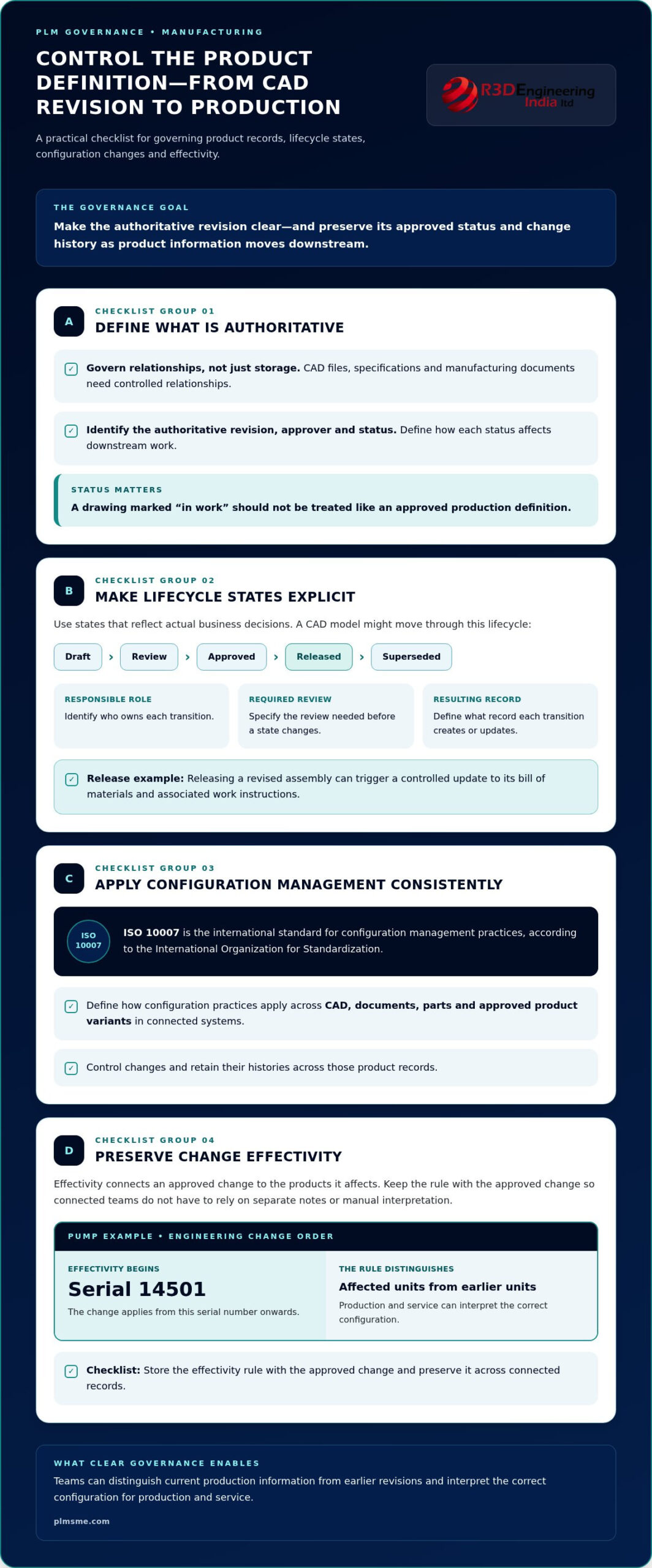
CAD files, specifications and manufacturing documents need controlled relationships, not just central storage. In product lifecycle management, governance defines which revision is authoritative, who can approve it and how its status affects downstream work. A drawing marked “in work” shouldn’t be treated like an approved production definition. Clear lifecycle states make that distinction visible to engineering, manufacturing and service teams.
Start by defining lifecycle states that reflect actual business decisions. A CAD model might move from draft to review, approved, released and then superseded. Each transition should identify the responsible role, required review and resulting record. For example, releasing a revised assembly can trigger a controlled update to its bill of materials and associated work instructions. Teams can then distinguish current production information from earlier revisions.
According to the International Organization for Standardization, ISO 10007 is the international standard for configuration management practices. In an enterprise architecture, that reference supports a consistent approach to identifying product configurations, controlling changes and retaining their histories. The practical design still needs to define how those practices apply to CAD, documents, parts and approved product variants across connected systems.
Change effectivity links an approved change to the products it affects. In a pump example, an engineering change order sets effectivity from serial 14501 onwards. That rule distinguishes affected units from earlier serial numbers, helping production and service interpret the correct configuration. The architecture should preserve the effectivity rule with the approved change, rather than relying on separate notes or manual interpretation.
Document governance also depends on metadata. A controlled specification needs an owner, revision, lifecycle state and relationship to the relevant part or assembly. If a manufacturing instruction references an obsolete CAD revision, reviewers need a visible relationship that helps identify the mismatch. Change workflows should capture the rationale, affected objects, approvals and release decision so later users can understand what changed and why.
Lifecycle management continues after shipment. A tractor’s as-shipped configuration needs to remain recoverable five years later for service parts ordering. That requires preserving the approved product structure and its applicable revisions, not merely keeping the latest design files. Service teams can then identify the configuration associated with the original machine and select information relevant to that build.
For an architecture review, trace one representative change from its request through CAD, document approval, release and production effectivity. Check that each state has an owner and that downstream records point to the intended revision. If these relationships vary between departments, a tailored system and solution architecture can help define consistent governance across the lifecycle.
Different information models across PLM, ERP, and MES
PLM, ERP and MES describe the same product through different operational lenses. PLM manages engineering definitions, revisions and relationships between parts, CAD and requirements. ERP organizes business records such as materials, procurement and production planning. MES uses manufacturing instructions, work orders and shop-floor execution records. Integration must preserve meaning as product data moves between these models.
Consider an assembly released in PLM. Its engineering structure may contain parts, quantities, revisions and design relationships. ERP may represent those parts as material records, with plant-specific planning and procurement attributes. MES may need operations, work instructions and the components required at each production step. A shared identifier can connect the records, but it cannot make their different purposes identical.
Architecture decisions should establish which platform owns each attribute. PLM may govern engineering revisions and design approvals, while ERP governs purchasing and plant-specific material planning. MES records execution against a released production definition. If two systems can change the same field, define which value takes precedence and how updates are reconciled. Otherwise, a valid change in one application can leave a conflicting record elsewhere.
Mapping requires explicit rules for structures and states. For example, an engineering bill of materials may include design items that don’t belong in a manufacturing bill of materials. A transformation can group components by assembly operation, preserve quantities and identify items that require procurement. The mapping should also define what happens when a part is replaced, a revision changes or a manufacturing site uses an approved alternative.
Lifecycle states need translation, too. PLM’s “released” state may permit an ERP material update, while MES may require an additional production-readiness decision. Treat these as related but distinct states. A governed interface can transmit the engineering release, then let ERP and MES apply their own checks before using the data. This keeps lifecycle meaning visible without forcing every system into one vocabulary.
Start an information-model review with a representative product structure and trace it through PLM, ERP and MES. Record the object, owning system, required attributes, identifier, transformation rule and failure response for each exchange. Test missing attributes and obsolete revisions alongside the normal release path. These examples reveal whether integrations preserve context, not merely transfer records.
For manufacturers in the UAE, this model supports clearer coordination across engineering, procurement and production sites. The architecture should give each team the ability to interpret product data in its own workflow while retaining traceability to the governing definition. Documented mappings also make future platform changes more manageable, because teams can distinguish business rules from system-specific implementation details.
Architecture roadmaps and implementation guidance
An enterprise PLM roadmap translates business needs into target applications, data flows, integrations, governance and implementation priorities. It connects engineering and operations goals to architecture decisions instead of treating deployment as a software installation alone.
PLM Deployment Models
Cloud, on-premises and hybrid describe where PLM capabilities run and how they’re managed. The choice matters because performance, security, operating responsibilities and existing systems shape the target design.
Cloud deployment can simplify access across locations, but migration may be lengthy and expected cost reductions may not materialize. On-premises deployment keeps the system within the manufacturer’s managed infrastructure. Hybrid designs retain selected workloads locally while connecting others to cloud services. Multi-tenant PLM can let each company administer its own tenant while sharing selected data.
Map workloads to operational needs before choosing a model. A cloud architecture that misses performance or security targets can leave stakeholders dissatisfied. Modernize and rationalize existing PLM environments before moving them toward cloud-native architecture.
Implementation Costs, Timelines, and Licensing
Implementation costs and timelines depend on scope, data condition, integrations, governance decisions and deployment complexity. Licensing models may include subscription or perpetual arrangements, with terms shaped by the selected platform and its commercial structure. These factors matter because migration, customization and ongoing administration affect the overall investment.
Build estimates from defined work packages rather than a software quote alone. Separate data cleansing, migration, configuration, integration, validation and user adoption. For example, a manufacturer with fragmented product records faces different migration work from one with governed structures. A roadmap should expose these dependencies before engineering and operations changes are scheduled.
Compare license terms against the required capabilities, deployment model and expected user access. Then connect each project phase to a business outcome, such as controlled release or production visibility. Digitalisation Vision & Roadmap Consulting can help organize these priorities into an implementation plan.
Implementation Risks and Failure Points
Common failure points include unclear ownership, poor data quality, uncontrolled customization and integrations that don’t preserve business meaning. These issues matter because disconnected engineering and operations processes can undermine adoption and create inconsistent product records.
Use TOGAF as a framework and methodology for designing, planning, implementing and governing enterprise IT architecture. Its Architecture Development Method connects business strategy, capabilities and technology solutions. Business architecture modelling can identify redundancy, improve data consistency and clarify the value expected from PLM investment.
Structure the roadmap around decision gates. Confirm target-state roles, data ownership, governance and integration responsibilities before implementation work expands. Test representative product changes across affected applications, then resolve gaps before broader rollout. Track dependencies between migration, interfaces and user workflows so a delay in one workstream doesn’t leave another without usable data.
For UAE manufacturers, align sequencing with operational readiness across sites and teams. A System and Solution Architecture plan can translate the target design into interfaces, governance decisions and migration priorities. The roadmap should also define how teams will measure progress, manage change requests and maintain the architecture as applications and business capabilities evolve.
What PLM deployment models are available: cloud, on-premises, and hybrid?
Manufacturers generally choose cloud, on-premises or hybrid PLM deployment. The right model depends on operating requirements, existing infrastructure, integration needs and governance priorities. For a UAE manufacturer with engineering teams across several sites, access patterns and system connections may matter as much as hosting location.
Cloud PLM runs through cloud infrastructure rather than relying solely on systems managed at a manufacturer’s premises. A multi-tenant PLM system can let each company administer its own tenant while sharing selected data. This can support collaboration across organizations, but data-sharing boundaries and administration responsibilities need clear design. Cloud migration can also be lengthy and expensive, with lower-than-expected cost reductions and expected value left unrealised.
On-premises PLM runs within the organization’s own managed infrastructure. It can suit manufacturers whose operating model depends on close control of the environment or existing connections to internal systems. For example, a plant with established engineering and production applications may prioritize continuity and integration behavior. The architecture still needs planned maintenance, capacity management and a route for upgrades.
Hybrid PLM combines locally managed and cloud-based components. A manufacturer might retain a tightly connected engineering workload on-premises while enabling selected collaboration functions through cloud services. The design must clarify where authoritative product records reside, how changes synchronize and what happens during an interrupted connection. Without those rules, users can encounter conflicting data or workflow delays between environments.
Deployment choice also affects performance and security expectations. A cloud PLM architecture that fails to meet agreed targets can leave business stakeholders dissatisfied. Define workload behavior, data access, integration dependencies and governance boundaries before selecting a model. Suppliers also need carefully designed access: sharing selected information differs from placing every participant inside one unrestricted environment.
For an existing PLM estate, modernization should come before a move toward cloud-native architecture. Rationalize applications, remove redundant processes and clarify data ownership before migration planning. Then assess each workload against business need, integration complexity and operational responsibility. This sequence helps distinguish architecture changes from a hosting change, which alone may not address process or information problems.
Use a deployment comparison to make trade-offs explicit:
- Cloud: assess access, tenancy, performance targets and migration effort.
- On-premises: assess infrastructure responsibilities and existing system dependencies.
- Hybrid: define data location, synchronization rules and operational ownership.
For UAE manufacturers, these criteria provide a practical basis for aligning deployment with engineering and plant operations. Plan your PLM deployment architecture around workload needs, integration dependencies and governance priorities.
PLM-Sme FZC: Digital maturity assessments and reports
PLM-Sme FZC helps manufacturers turn architecture findings into clear priorities through Digital maturity assessments and reports. These assessments are useful when product data, integrations or governance practices need an objective review before implementation planning begins.
The findings can inform Digitalisation Vision & Roadmap Consulting, connecting business goals with target capabilities and phased priorities. System and Solution Architecture can then define application roles, data flows and integration points. Where transformation plans include industrial automation or AI, these solutions can be considered alongside the product-data architecture.
Turn to this work when existing systems are difficult to rationalize, teams lack a shared target state or architecture decisions need a structured basis. Contact PLM-Sme FZC to discuss your manufacturing architecture priorities.
Turn the architecture into an evolving capability
Your architecture should continue to guide decisions after implementation, not become a static diagram. As manufacturing priorities shift, use clear ownership and review practices to assess whether the design still supports how teams engineer, produce and maintain products. A PLM enterprise architecture blueprint for manufacturing gives those decisions a durable reference point, connecting future initiatives to established data and governance principles.
PLM-Sme FZC supports this planning through Digital maturity assessments and reports, Digitalisation Vision & Roadmap Consulting, and Industrial automation and AI solutions. These offerings can help clarify current capabilities, shape priorities and determine how emerging initiatives fit the wider architecture. Start by identifying the business outcome your architecture needs to support, then align the roadmap with that outcome.
Contact PLM-Sme FZC to discuss your manufacturing architecture priorities. With a clear direction and an architecture that can evolve, your teams can move forward with greater alignment.
Frequently Asked Questions
What is enterprise PLM architecture?
Enterprise PLM architecture is the design that aligns product lifecycle processes, information, applications and infrastructure across an organization. It establishes how teams create, approve, access and maintain product records. For example, a manufacturer can define how an engineering change affects procurement, production planning and service documentation. The architecture makes those relationships explicit, helping leaders assess whether system responsibilities support business capabilities and where disconnected processes need attention.
What is a PLM enterprise architecture blueprint for manufacturing?
A PLM enterprise architecture blueprint for manufacturing is a target-state design for product lifecycle capabilities and their supporting systems. It records application roles, data flows, integration points, governance and the planned transition from the current environment. For example, a blueprint can show how an approved product definition reaches a plant’s production process. It gives business and technical teams a shared reference for sequencing decisions and evaluating proposed changes.
What are the core layers and components of a manufacturing PLM architecture?
Core components include business processes, product information, applications, integrations, infrastructure and governance. A useful design also defines identity and access controls, data ownership, workflow rules and operational monitoring. For instance, PLM may govern a product structure, while ERP handles plant planning. The architecture documents how these responsibilities connect, where records are mastered and which teams make decisions when information conflicts.
How does PLM integrate with ERP, MES, CAD, QMS, and supply chain systems?
PLM integration connects systems through governed interfaces and mappings that preserve each record’s meaning. CAD contributes design files and relationships; ERP uses material and planning data; MES consumes production definitions; QMS manages quality records; supply-chain systems exchange supplier and sourcing information. A practical interface design specifies identifiers, field mappings, update direction, validation and error handling. For example, a released component change can be mapped to the affected ERP material and quality documentation.
What are the main steps to design and implement a PLM architecture for a manufacturer?
Begin by mapping business capabilities and existing applications, then identify data ownership, governance gaps and integration dependencies. Define the target state and compare it with current processes to prioritize changes. Next, sequence migration, interface development, configuration and user adoption around business readiness. A pilot around a representative product family can expose gaps in access, workflow or data mapping before broader rollout. Track decisions and dependencies in the roadmap.
How should a PLM architecture support digital thread and digital twin use cases?
Support a digital thread by maintaining traceable links among product requirements, design definitions, manufacturing records and service information. A digital twin use case can build on those links by relating a product’s engineering definition to its as-built configuration and operational data. For example, a service engineer needs to distinguish the delivered configuration from a later design revision. Define identifiers, relationships, update ownership and access rules before connecting operational information.
What data governance, security, and regulatory requirements affect manufacturing PLM architecture?
Architecture should define data classification, ownership, retention, access permissions, auditability and supplier boundaries. For UAE operations, identify the rules applicable to the business, product and markets served, then translate them into system controls and records. Export-facing manufacturers may also need to consider the EU Digital Product Passport rollout across batteries, textiles, electronics and construction products. The EU AI Act adds obligations concerning the integrity of data behind industrial AI systems using product data or making product decisions.
How can manufacturers measure PLM architecture performance and business value?
Choose measures tied to operational outcomes, then establish a baseline before implementation. Useful indicators include time to find an approved product record, completeness of required attributes, interface error rates, change-processing duration and the number of duplicate records. Pair technical measures with business effects, such as fewer production interruptions caused by outdated definitions. Review results by process and system so teams can distinguish architecture problems from training, data-quality or workflow issues.