
Industrial Equipment Digital Transformation Consulting: From Strategy to Execution
What if the biggest risk in an industrial transformation isn’t choosing the wrong technology, but connecting it to workflows no one has mapped end to end? When engineering, production, and business systems hold separate versions of product and process information, even promising initiatives can stall as isolated pilots. Industrial equipment digital transformation consulting makes the work practical by linking technology decisions to operational needs, information ownership, and clear implementation priorities.
Legacy applications, complex product data, and competing priorities can make it difficult to know where to begin. A useful transformation plan starts with how equipment is designed, built, delivered, and supported. It then identifies which information and systems need to connect, who owns each decision, and what should be addressed first.
This article explains how to move from current-state assessment to a digital vision, roadmap, and execution plan. You’ll see how PLM can connect engineering workflows with relevant enterprise and engineering systems, and how architecture, integrations, TeamCenter implementation, and ongoing administration can support a staged path from foundational improvements to broader transformation.
Key Takeaways
- Use industrial equipment digital transformation consulting to connect operational objectives with workflows, information, architecture, and implementation priorities.
- Clarify how PLM, CAD, CAE, CAM, ERP, MES, and CRM each contribute to a connected product lifecycle ecosystem.
- Assess consulting approaches by their industrial fit, independence, integration capability, delivery focus, and continuity beyond initial recommendations.
- Sequence transformation from discovery and target outcomes through architecture, implementation, and review, with ownership built into each stage.
- Explore how PLM-S me’s START-EXTEND-TRANSFORM methodology and TeamCenter FOUNDATION can support a staged PLM journey.
Why Industrial Equipment Digital Transformation Consulting Starts With Workflows
Industrial equipment transformation is not a software installation exercise. It is a way to make product and process information usable across the work that designs, builds, commissions, and supports equipment. Effective industrial equipment digital transformation consulting therefore connects operational objectives to workflows, information ownership, system architecture, and the practical steps needed for implementation.
Digital transformation is the redesign of how an organisation uses processes, information, and technology to achieve business objectives, not simply the acquisition of new software. That distinction matters in equipment businesses, where engineering decisions affect manufacturing plans, service procedures, and enterprise records. A foundational overview of Understanding Digital Transformation can help frame the concept, but an industrial approach must examine how information moves through the equipment lifecycle.
Where digital disconnects appear across the equipment lifecycle
Consider a design revision released by engineering. Manufacturing needs the approved definition for planning and production, while service teams may need that revision alongside installed-base and maintenance information. If each function relies on a separate application or record, staff may re-enter data, pass files manually, or reconcile conflicting versions before making a decision.
Those symptoms don’t always reveal the underlying cause. Re-entry may point to a missing integration, but it can also reflect unclear ownership, inconsistent change processes, or different definitions of the same product data. Trace the handoff: identify what information is created, who approves it, which system holds the authoritative record, and what each downstream team needs to act. This makes it easier to distinguish a technology gap from a process or governance issue.
What industrial equipment consulting should make clearer
Consulting should translate business priorities into specific engineering and operational workflows. If the objective is to manage product changes more consistently, for example, the work should clarify how a change is proposed, assessed, approved, communicated to manufacturing, and made available to service. This connects the desired outcome to people, process, data, and system responsibilities rather than treating a new application as the solution by itself.
A digitalisation vision describes the intended future state and why it matters. An implementation plan specifies the sequence of work needed to move towards it, including architecture decisions, integrations, ownership, and delivery priorities. Keeping these distinct makes the vision useful without mistaking it for an executable plan. A digital maturity report in manufacturing can provide context by identifying current capabilities and gaps before priorities are set.
To make the discussion concrete, teams can map one representative product-information flow and ask:
- Where is each key record created and maintained?
- Which handoffs depend on manual interpretation or duplicate entry?
- What information do engineering, manufacturing, service, and enterprise teams need to make decisions?
- Which process or data issue should be addressed before selecting or configuring technology?
These questions turn broad ambition into a clearer starting point. They also keep industrial requirements central as the organisation moves from assessment towards architecture and implementation.
Building the Digital Foundations Behind Industrial Equipment Transformation
Once workflows are understood, the next task is to establish how product information is governed and shared. Product lifecycle management (PLM) provides a structured environment for managing product definitions, revisions, relationships, and lifecycle collaboration. It can connect engineering work with downstream functions while clarifying which records are authoritative and how changes are controlled. PLM is not a replacement for every business application. It provides product context that other systems can use.
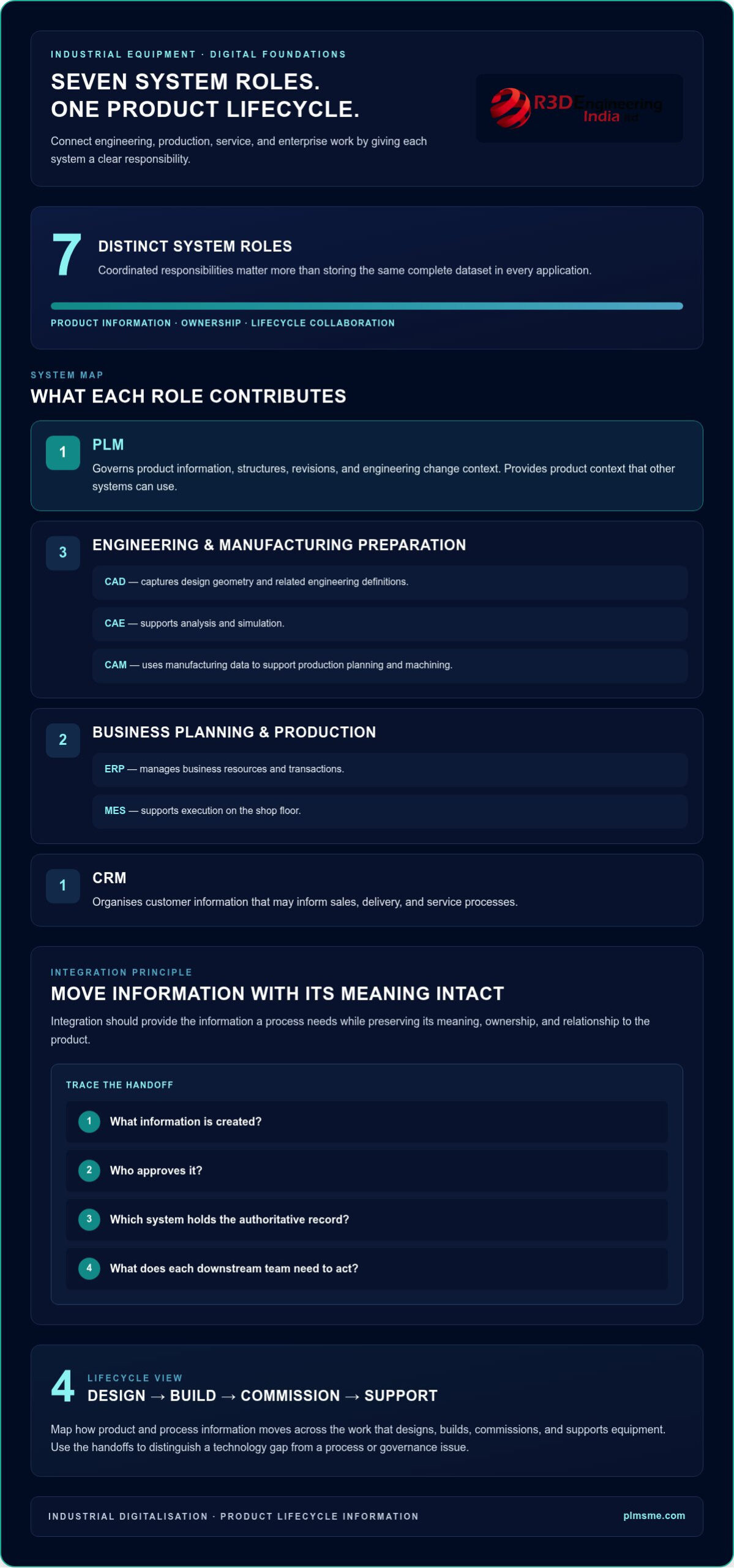
Each system has a distinct role. CAD captures design geometry and related engineering definitions. CAE supports analysis and simulation, while CAM uses manufacturing data to support production planning and machining. ERP manages business resources and transactions, MES supports execution on the shop floor, and CRM holds customer-related information. Their value comes from coordinated responsibilities, not from making every application store the same complete dataset.
- PLM: Governs product information, structures, revisions, and engineering change context.
- CAD, CAE, and CAM: Support design, engineering analysis, and manufacturing preparation.
- ERP and MES: Connect business planning and transactions with production execution.
- CRM: Organises customer information that may inform sales, delivery, and service processes.
Integration should move the information a process needs while preserving its meaning, ownership, and relationship to the product. A released engineering definition sent to ERP, for example, should remain identifiable as the approved revision, rather than arriving as an untraceable file or a second record with ambiguous status. Define what each interface exchanges, which system owns each data element, and how updates and errors are handled. These decisions help prevent duplicate records and unclear revision status.
Connecting engineering systems without creating another silo
Equipment manufacturers may work across multiple CAD environments because teams, suppliers, or acquired businesses use different tools. That diversity can complicate product structures, revision alignment, and collaboration if information is translated or exchanged without clear rules. A multi-CAD approach should preserve useful design context and establish how engineering data relates within PLM. Architecture decisions also need to account for connections to ERP, MES, and other applications, rather than treating each interface as a separate workaround. PLM system architecture consulting can help frame these relationships as part of a coherent system landscape.
Preparing data and processes for automation and AI
Choosing an AI tool or automation platform is not the same as preparing for its use. Teams first need governed data, repeatable processes, and engineering information that can be interpreted in the relevant operational context. If product attributes are inconsistent or approvals vary by team, automation may reproduce those inconsistencies at scale.
Industrial AI is only as useful as the quality, context, and governance of the data and processes behind it. A practical readiness review can identify where data definitions need alignment, which workflows are stable enough to automate, and where human review remains necessary. With those foundations understood, independent industrial digitalisation support can help connect architecture and integration choices to business priorities.
How to Evaluate Industrial Equipment Digital Transformation Consulting
A strategy only has value if it can guide decisions and become implementable work. For equipment businesses, industrial equipment digital transformation consulting should connect business priorities to engineering and operational requirements, then show how architecture, integration, and delivery can turn those priorities into action. A compelling vision without ownership, dependencies, or a realistic path to implementation is not enough.
Use the criteria below to assess whether an advisory approach fits your organisation’s needs. Independence doesn’t mean every platform is interchangeable. It means recommendations should be grounded in your requirements and existing systems rather than a predetermined sale.
| Evaluation area | What to look for |
|---|---|
| Independence | Recommendations reflect operational needs and existing investments, with rationale for technology choices. |
| Industrial fit | Advice accounts for product data, engineering change, manufacturing, service, and lifecycle collaboration. |
| Architecture | Target-state decisions clarify system responsibilities, interfaces, data ownership, and dependencies. |
| Integration | Plans address how PLM connects with relevant CAD, ERP, MES, and other enterprise applications. |
| Delivery | Recommendations translate into scoped work, decision points, responsibilities, and implementation priorities. |
| Continuity | The approach considers administration and support after deployment, not only the initial design. |
Testing whether recommendations can move into implementation
Look for traceability: each proposed workstream should connect to a stated business objective, an affected workflow, and an architecture or process decision. If a recommendation calls for improving engineering change control, for example, it should identify the systems and roles involved and define what must change. Consider migration, integration, customisation, and system administration where relevant, rather than leaving them as unspecified future tasks.
Assumptions matter. Data quality, legacy constraints, interface availability, and internal ownership can all affect sequencing. A sound plan makes these dependencies visible, distinguishes defined scope from open decisions, and identifies who will resolve them. This is how strategic guidance becomes a basis for practical delivery rather than a standalone presentation.
Assessing independence, technical fit, and continuity
Vendor-neutral advice keeps customer requirements central while recognising that platforms differ in capability and fit. Assess whether the approach understands your relevant PLM environment, multi-CAD needs, and enterprise integrations, and whether its recommendations explain trade-offs rather than claiming every option is equally suitable. The discussion of independent PLM consulting compared with vendor choice offers a related perspective.
Also distinguish advisory and implementation support from procurement. Consulting can guide architecture, configuration, integration, and delivery without being a hardware supply or software licensing offer. A credible assessment makes scope, responsibilities, and assumptions clear rather than relying on unsupported outcome guarantees. For organisations seeking a connected path from independent advice to PLM delivery and ongoing administration, PLM-Sme FZC’s industrial digitalisation support connects these areas.
Turning Consulting Recommendations Into a Practical Transformation Sequence
Recommendations become actionable when they define not only what should change, but also what must happen first, who owns each decision, and how progress will be reviewed. Industrial equipment digital transformation consulting can help structure that transition around the organisation’s workflows, technical dependencies, and capacity to deliver. The sequence below is a practical way to move from discovery to execution, not a full roadmap template or maturity-assessment guide.
- Confirm discovery and target outcomes. Select the product, process, or lifecycle challenge in scope, then agree on observable objectives. For example, a team might aim to improve visibility of engineering changes as they pass into manufacturing. Define how progress will be assessed without assuming a particular benchmark or result.
- Establish scope and ownership. Identify affected functions, systems, data, and process owners. Clarify which decisions sit with engineering, operations, IT, or business leadership, and document what is outside the current phase.
- Map architecture and dependencies. Determine how PLM and relevant engineering or enterprise systems need to interact. Record dependencies such as interface design, data cleanup, migration, access, and decisions about existing applications.
- Prioritise and deliver defined work. Break the chosen scope into manageable work packages, with responsibilities, acceptance criteria, and review points. Sequence foundational data or integration work before dependent automation where needed.
- Review and adjust. Compare delivered changes with the agreed objectives, capture issues and user feedback, and use what the team learns to shape the next phase.
For a broader strategic treatment, an industrial digitalisation roadmap can help frame longer-term direction. The sequence here focuses on converting selected recommendations into owned, deliverable work.
Prioritising initiatives around operational value and readiness
Compare candidate initiatives by business relevance, data readiness, dependencies, and organisational capacity. A foundational integration or data-governance task may need to precede a more visible automation or AI use case. Make that order explicit, and define measurable objectives suited to the process, such as tracking whether required information reaches the next workflow stage. Avoid prioritising on novelty alone.
Planning adoption, governance, and ongoing system care
Assign process ownership and decision rights across engineering and operations before delivery begins. Implementation planning should include migration responsibilities, user collaboration, and adoption activities, not just technical configuration. After deployment, administration and maintenance help preserve system continuity as processes and requirements evolve. Treat these responsibilities as part of the operating model, with clear ownership and review arrangements.
To connect priorities with architecture, implementation, and ongoing care, explore PLM-Sme FZC’s digitalisation consulting and implementation support.
Connecting Industrial Equipment Consulting to PLM Implementation and Support
For equipment businesses ready to move from priorities to delivery, PLM implementation can provide a practical foundation for managing product information and collaboration. PLM-Sme FZC provides independent industrial digitalisation support through digital maturity assessments, vision and roadmap consulting, architecture, implementation, integration, and ongoing administration. This pathway can suit organisations seeking connected PLM foundations and staged development, with scope shaped around their requirements and existing environment.
Starting with a PLM foundation and extending to project needs
TeamCenter FOUNDATION is a pre-configured PLM Start deployment. It includes 15 years of configuration knowledge and follows the START-EXTEND-TRANSFORM methodology, which is SISW-supported. The deployment includes industry standards and best practices. The approach connects a PLM foundation with further development and transformation, allowing scope to be shaped around project needs rather than treating implementation as a one-off software installation.
That work can connect the initial PLM scope with data migration, implementation decisions, custom integration, and administration. For example, a project may need to account for how engineering information moves into enterprise processes, how existing records are handled, and who will maintain the system after deployment. PLM-Sme FZC also develops secure HTML-based supplier and client collaboration portals and bidirectional ERP web services. These capabilities can support collaboration and system integration within the defined requirements.
Matching independent expertise to a complex industrial environment
Independent, customer-centric support keeps the organisation’s requirements central to decisions about architecture, configuration, and delivery. Vendor-neutral positioning does not mean every platform is equally suitable. It means technical choices should be considered in the context of current systems, product workflows, integration needs, and the intended operating model. This matters when multiple CAD environments or established enterprise applications need to work together.
PLM-Sme FZC’s capabilities include TeamCenter implementation, multi-CAD environments, customisation, system and solution architecture, and ERP integration development. The company also provides ongoing PLM system administration. These services can be brought into scope according to the complexity of the industrial environment, with administration considered as part of the implementation pathway. A focused overview of Siemens Teamcenter consulting provides more detail on this area.
Industrial equipment digital transformation consulting is most useful when the advice carries through into architecture and implementation while staying aligned with operational priorities. PLM-Sme FZC supports that progression from assessment and vision work to TeamCenter implementation, integration, and system administration, with the scope tailored to the project.
To discuss a practical PLM pathway for your industrial environment, explore PLM-Sme FZC’s implementation and digitalisation support.
Make the Next Transformation Decision Deliberate
The next step doesn’t need to be a large programme. Choose a specific equipment workflow where better information flow could support a clear business priority, then define what evidence would show progress and who needs to own the change. For example, map how an approved engineering revision reaches manufacturing and identify where status or ownership becomes unclear. This gives leaders and delivery teams a shared starting point for deciding what to address, what to sequence later, and how to sustain the work.
For organisations considering industrial equipment digital transformation consulting, the right partner should connect strategic direction with practical PLM decisions while keeping customer requirements central. PLM-S me’s independent, vendor-neutral approach and SISW-supported START-EXTEND-TRANSFORM methodology provide a structured path from PLM foundations towards staged development. TeamCenter FOUNDATION includes 15 years of configuration knowledge.
Use that foundation to shape a conversation around your current systems, product data, and operational priorities. Discuss your industrial digitalisation needs with PLM-S me and explore a practical route from the next decision to sustained execution.
Frequently Asked Questions
Is industrial equipment digital transformation consulting only about implementing new software?
No. Industrial equipment digital transformation consulting should address business objectives, processes, information, and system relationships before implementation scope is set. For example, a manufacturer may find that a production team is using an engineering file without knowing whether it reflects an approved change. The work is to identify the decision or handoff that needs improvement, then determine whether process changes, data governance, integration, PLM implementation, or software configuration can address it.
Can an industrial equipment manufacturer transform without replacing its ERP system?
Yes. Transformation does not automatically require an ERP replacement. A manufacturer may retain its existing ERP while clarifying how product definitions, released changes, and production information should connect with PLM or other systems. The key is to assess whether current capabilities and interfaces support the intended processes. For instance, a gap in engineering-to-planning information flow may call for integration or process changes rather than replacing the system that handles business transactions.
How much does industrial equipment digital transformation consulting cost?
There is no universal fee because the scope can vary with the systems involved, data condition, migration needs, integrations, and implementation responsibilities. A focused digital maturity assessment has different deliverables from an engagement that also covers architecture, PLM implementation, and ongoing administration. Define the intended outcomes and boundaries of the work before comparing proposals. Review what each scope includes, its assumptions, and the outputs it commits to deliver, without treating projected benefits as guaranteed returns.
Can PLM support a multi-CAD industrial equipment environment?
Yes, PLM can provide a governed product context for collaboration across a multi-CAD environment, but the design depends on the tools, data structures, and workflows involved. For example, teams may need to preserve the relationship between native design files, product structures, and released information used by other functions. A technical assessment should determine how those records are represented and exchanged, and how PLM connects with enterprise applications, rather than assuming every CAD environment follows the same pattern.
What should an industrial transformation consultant deliver beyond a strategy document?
Deliverables should help stakeholders make and act on decisions, not leave them with broad recommendations alone. Depending on scope, this may include a prioritised set of initiatives, architecture decisions, integration requirements, migration considerations, and defined implementation work. For example, an initiative can specify which business process it addresses, which system changes it depends on, and who owns the next decision. This traceability helps teams distinguish actionable work from ideas that still need investigation.
How can industrial companies decide whether AI belongs in their transformation plan?
Start with a defined operational or engineering need, then evaluate whether the available process and information can support a relevant use case. A company might examine whether equipment or quality records are consistent enough for analysis before selecting an AI application. A digital maturity assessment can help identify readiness gaps and inform priorities. The decision should account for data governance, process ownership, and practical constraints, so AI is considered as one possible tool rather than a goal in itself.