
Siemens Teamcenter Technical Support Retainer in the UAE
What happens when a Teamcenter issue interrupts engineering work while your internal team is already stretched across administration and project priorities? A Siemens Teamcenter technical support retainer UAE organisations can shape around their operations provides an ongoing framework for administration and technical support, rather than relying on isolated fixes. Its value depends on a clear scope: define what the retainer covers and what should be planned separately as integration or implementation work.
This article explains what ongoing Teamcenter support can cover, how to assess its value, and how to define a practical scope. You’ll learn how to align administration and issue analysis with system continuity, architecture decisions, and integration priorities, while keeping project work distinct. The right structure reflects your Teamcenter environment and the needs of the people who rely on it. PLM-Sme FZC provides retainer-based PLM system administration alongside architecture and integration expertise, connecting day-to-day support with the wider PLM roadmap.
Key Takeaways
- Use a Siemens Teamcenter technical support retainer UAE organisations can tailor to establish ongoing specialist administration under a clear, agreed scope.
- Separate recurring administration and issue analysis from integration development or implementation work that needs its own project scope.
- Choose between a retainer, ad hoc assistance, and a project by considering the pattern of work, continuity needs, and planning priorities.
- Document your Teamcenter architecture, integrations, dependencies, known risks, responsibilities, and review cadence to make support easier to govern.
- Connect day-to-day Teamcenter administration with architecture and integration priorities to support system continuity and the wider PLM roadmap.
Why UAE organisations use a Siemens Teamcenter technical support retainer
Teamcenter does more than store engineering files. It can underpin the workflows that govern how product data is accessed, reviewed, changed, and shared across business processes. An issue with permissions, workflow execution, or a connected system can affect engineers and other teams that depend on reliable information. A Siemens Digital Industries Software overview provides context on the organisation behind Teamcenter, but dependable day-to-day operation also depends on the configuration and connections in your specific environment.
A Siemens Teamcenter technical support retainer UAE organisations can use provides recurring specialist support under an agreed scope. Instead of treating every request as an isolated incident, a retainer establishes a continuing approach to administration, environment oversight, and technical analysis. Set responsibilities and priorities according to how your organisation uses Teamcenter, which teams depend on it, and where internal ownership sits.
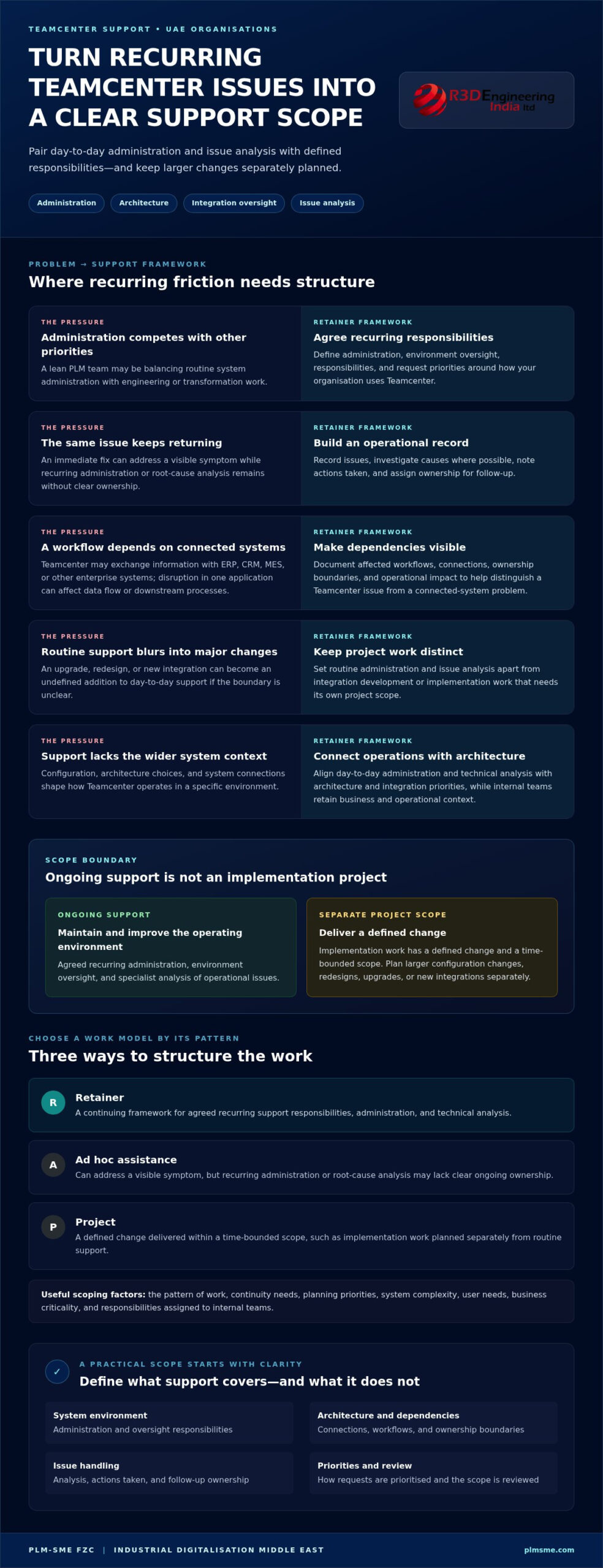
Ad hoc troubleshooting can address a visible symptom, but may leave recurring administration or root-cause analysis without clear ownership. If access or workflow issues keep returning, an immediate fix alone may not uncover a configuration pattern or dependency that needs attention. Ongoing support gives teams a framework to record issues and relate them to the wider environment, while keeping larger changes separately scoped.
Ongoing support maintains and improves the operating environment; an implementation project delivers a defined change within a time-bounded scope. This distinction helps teams plan routine operational work without allowing a major upgrade, redesign, or new integration to become an undefined addition to day-to-day support.
What a Teamcenter support retainer is designed to do
A retainer provides continuity for agreed support responsibilities, which can include recurring administration, oversight of the Teamcenter environment, and specialist analysis of operational issues. Define the work around your system and priorities. Document responsibilities, boundaries, and how requests are prioritised so internal teams know what the retainer covers and which requests need separate project planning.
When UAE organisations consider ongoing support
Ongoing support can help when a lean PLM team must balance routine system administration with engineering or transformation work. It can also suit organisations whose Teamcenter environment relies on connected applications, data exchanges, or shared workflows. A specialist retainer complements internal IT and engineering ownership: your teams retain business and operational context, while agreed external support provides focused Teamcenter administration and technical expertise.
For example, if a workflow issue occurs alongside a problem in a connected system, understanding the relationship matters as much as restoring the immediate process. Record the affected workflow, dependencies, and operational impact to give support discussions a practical starting point. The goal is not to outsource ownership, but to give the people responsible for PLM a structured way to manage recurring needs and connect operational work with broader architecture priorities.
What a Teamcenter technical support retainer can cover
A useful retainer connects recurring operational needs with the expertise required to understand the wider PLM environment. Depending on your system and priorities, support can involve administration, architecture advice, integration support, and investigation of reported issues. Define the activities for your environment rather than treating them as a universal checklist. Consider system complexity, user needs, business criticality, and the responsibilities assigned to internal teams.
A support retainer can bring administration, architecture, integration oversight, and issue analysis into a continuing framework, with specific activities defined for each environment. For organisations considering a Siemens Teamcenter technical support retainer UAE operations can benefit from documenting which activities recur and which need separate planning.
Administration, architecture, and issue investigation
Administration covers the operational configuration and health of the PLM environment, with attention to the routine responsibilities agreed in scope. Architecture support considers how design decisions affect maintainability as the environment changes. When an issue is reported, investigation should identify its cause where possible, record actions taken, and assign ownership for follow-up. This creates a useful operational record instead of leaving knowledge in separate conversations.
For example, a recurring problem affecting a user group may require both an immediate investigation and a review of the relevant configuration or process. A retainer provides a structure for that analysis, while your organisation retains appropriate business and system ownership. Assess larger configuration changes or redesigns as distinct work instead of assuming they fit routine administration.
Integration and release-related support boundaries
Teamcenter may exchange information with ERP, CRM, MES, or other enterprise systems. These dependencies affect support priorities because disruption in one application can affect data flow or downstream processes. Documenting the connections and ownership boundaries helps teams distinguish a Teamcenter issue from a problem originating elsewhere. For context on one of these relationships, see Teamcenter CRM integration benefits.
- Recurring administration: agreed operational oversight and routine support activities.
- Architecture advice: assessment of design choices and their implications for maintainability.
- Integration support: investigation of issues across Teamcenter interfaces and connected systems.
- Issue analysis: diagnosis, recorded actions, and clear ownership of follow-up.
The scope should distinguish support around a release from substantial upgrade or integration development. Reviewing dependencies and discussing operational implications can fit ongoing support, while extensive testing, redesign, implementation, or new development may need a separately planned project. That boundary keeps priorities visible and prevents significant change from becoming undefined retainer work.
PLM-Sme FZC provides Teamcenter system administration support tailored to your environment and agreed scope, with architecture and integration expertise. Organisations shaping a Teamcenter system administration retainer can use these support areas to connect operational responsibilities with longer-term PLM priorities.
Retainer, ad hoc support, or project: choosing the right model
The right engagement model depends on the pattern of work, not simply the seriousness of a single issue. A Siemens Teamcenter technical support retainer UAE organisations choose should reflect whether support needs recur, whether priorities shift, and how much capacity internal teams can commit. A clear model also distinguishes consultancy-led Teamcenter administration from software-vendor maintenance, which may address different responsibilities.
Vendor maintenance generally relates to the software relationship and its applicable support arrangements. Consultancy-led administration focuses on your configured PLM environment, ongoing operational needs, and how Teamcenter fits your architecture. The two can complement each other, but one should not be assumed to replace the other. Define the responsibilities and escalation routes for each so requests have a clear path and owner.
- Retainer: Suits a continuing pattern of administration, investigation, or architecture questions that benefits from planned attention and prioritisation.
- Ad hoc support: Can fit an isolated, clearly bounded need when ongoing work is limited or unpredictable.
- Project engagement: Works for a defined outcome with a beginning, scope, and completion point, such as a migration or major upgrade.
When recurring retainer support is a better fit
A retainer can suit an organisation with routine administrative needs, recurring issue analysis, or architecture decisions that require ongoing attention. Agreed priorities give internal teams a way to manage a continuing backlog and make trade-offs visible, rather than handling every request in isolation. This structure supports continuity of planning, but it does not prevent incidents or guarantee uninterrupted service.
To assess fit, review the work that repeatedly competes for internal capacity: routine environment tasks, unresolved operational questions, and specialist input needed as business needs evolve. Consider the effect of leaving that work unattended, including delays to engineering processes or unresolved dependencies. This is a practical assessment of operational impact, not a promise that a retainer will remove every risk.
When to use a defined project or ad hoc engagement
Major implementation, migration, upgrade, or integration development usually needs a defined project scope, with its own objectives, dependencies, and delivery planning. Ad hoc assistance can suit a discrete issue with a clear boundary and no expected stream of related work. For decisions focused on maintainability and system design, PLM system architecture consulting offers useful context.
Before choosing, review how often requests arise, what internal expertise is available, and whether the need is operational or tied to a specific change. Tailor the commercial structure and scope to your environment rather than relying on a generic task list. If ongoing administration is the recurring need, explore Teamcenter administration support to connect planned operational work with architecture priorities.
How to define a useful Teamcenter support scope and review it
A useful support scope starts with the live Teamcenter environment, not a generic task list. For a Siemens Teamcenter technical support retainer UAE organisations can tailor, document what the system supports, where dependencies sit, and how work will be prioritised. This gives internal teams and the support partner a shared reference for routine activity, issue ownership, and decisions that may need project planning.
- Describe the environment: Record relevant architecture, system context, connected applications, dependencies, user groups, and business-critical workflows. Note known operational risks or technical debt based on available information, without treating undocumented concerns as confirmed issues.
- Identify support priorities: Map recurring administration needs and the business processes they affect. Distinguish work that supports routine operations from requests for new functionality or material system change.
- Assign responsibilities: Specify what your team owns, what the support partner handles, and who provides business or technical decisions. Define how an issue is escalated and who coordinates when a dependency involves another system or team.
- Agree how to review the scope: Set a review cadence and use it to revisit priorities, responsibilities, and the record of work. Choose an interval that suits the environment and the way operational needs change.
Building the support scope around the live environment
Build the scope around how people use Teamcenter. Identify the workflows that matter to engineering and business operations, the user groups involved, and the connected applications that influence those processes. Then document recurring administrative needs and known technical debt, separating verified observations from assumptions. Clear responsibilities for your team and the support partner help prevent requests from sitting between teams without an accountable owner.
For example, if a workflow depends on information from another application, record the dependency and the team responsible for that system. This context helps route an issue for investigation without prematurely assigning its cause. Architecture choices also shape maintainability over time. Broader strategic Siemens Teamcenter consulting can provide useful perspective when operational scope intersects with wider digitalisation priorities.
Reviewing performance, work patterns, and priorities
Use agreed records of reported issues, recurring work, completed actions, and open follow-ups to guide review discussions. Look for patterns and assess whether current priorities still reflect business processes, internal capacity, and system architecture. A review should clarify what has changed and what needs a decision, rather than treating a record of activity as a performance claim.
Emerging upgrade plans or proposed integration changes are useful inputs to scope planning. They may change dependencies, ownership, or the balance between routine administration and project work. Record the impact, agree whether support responsibilities should change, and separate substantial delivery activity into a defined scope where appropriate.
Use this sequence to shape a support scope around your Teamcenter environment. Discuss a tailored Teamcenter administration retainer that connects operational priorities with architecture and integration needs.
Delivering ongoing Teamcenter support with PLM-Sme
Ongoing Teamcenter support works best when routine administration is informed by the system’s architecture and connections. PLM-Sme FZC is a Siemens Digital Industries Alliance Partner serving organisations across the UAE. The company provides retainer-based PLM system administration, system and solution architecture, and Teamcenter integration development, linking operational questions to the technical context in which they arise.
For organisations assessing a Siemens Teamcenter technical support retainer UAE, the key is to shape support around the live environment rather than assume every deployment has the same needs. Recurring administration may sit alongside architecture decisions or issues involving connected systems. Understanding those relationships helps teams separate routine operational work from changes that call for distinct planning.
Combining Teamcenter administration with specialist PLM expertise
System administration provides ongoing attention to the Teamcenter environment, while solution architecture considers how design decisions affect maintainability and future priorities. Together, they frame operational work in the context of how the PLM environment is structured and used. This does not make every architectural change part of a retainer; it clarifies the relationship between daily support and longer-term system decisions.
Integration expertise adds another perspective when a reported issue crosses system boundaries. If a process depends on Teamcenter exchanging information with another application, investigation benefits from understanding the dependency and its ownership. Teamcenter integration development experience informs that analysis, while larger integration changes remain subject to their own scope and planning. This approach connects administration with architecture and integration priorities instead of treating each technical question in isolation.
Planning the next step for UAE operations
A useful scoping discussion starts with a concise picture of the environment and the work your teams need to manage. Bring together the Teamcenter context, recurring administrative challenges, key workflows, connected systems, and current support responsibilities. Note where internal IT and engineering teams retain ownership, where specialist input is needed, and which planned changes could affect priorities.
These details provide a practical basis for defining responsibilities, boundaries, and the focus of ongoing support. They also help align the retainer with wider PLM objectives without folding implementation or development projects into routine administration by default. The engagement scope can then reflect your organisation’s environment and operational needs, with priorities informed by system architecture and dependencies.
If your team is reviewing its support model or planning ongoing Teamcenter administration, discuss your operational context and priorities with PLM-Sme FZC. Discuss a tailored Teamcenter support scope for your operations and connect day-to-day administration with your wider PLM direction.
Build a support model that grows with your operations
Your Teamcenter environment will continue to change as engineering priorities, connected systems, and business processes evolve. Treat the support scope as a working operational agreement, revisiting it when those changes affect ownership or the expertise your teams need. This keeps support relevant without turning every new requirement into an informal addition to existing responsibilities.
A Siemens Teamcenter technical support retainer UAE organisations rely on should give internal stakeholders a clear basis for planning and decisions, not just a route for reporting technical issues. A focused scoping discussion can help identify what the operating model needs to support now and how it should adapt as your PLM roadmap progresses.
Discuss a Teamcenter support retainer tailored to your operations and take a considered next step toward support that fits your environment. With clear priorities and shared ownership, your organisation can build a stronger foundation for ongoing PLM operations.
Frequently Asked Questions
What does a Siemens Teamcenter technical support retainer include?
A Siemens Teamcenter technical support retainer UAE organisations use can cover agreed recurring administration, environment oversight, issue investigation, architecture input, and integration-related support. The exact scope depends on your system and operating priorities. For example, a team might define recurring access or workflow questions as ongoing support while reserving a new integration build for separate planning. Document responsibilities and boundaries so each request can be assessed consistently.
Is a Teamcenter support retainer different from Siemens software maintenance?
Yes, they can address different responsibilities. Software maintenance relates to the software vendor’s support arrangements, while a consultancy-led retainer focuses on ongoing administration and specialist work in your Teamcenter environment. A manufacturer might use vendor channels for software-related matters and administration support for its configured environment or operational processes. Map responsibilities and escalation routes for both arrangements so it is clear where each request should go.
Can a Teamcenter retainer support an existing customised environment?
Yes, support can be scoped around an existing customised environment, with the work shaped by its architecture, configuration, and documented dependencies. Start by capturing custom workflows, integrations, ownership, and known constraints. For instance, if a business process relies on a tailored workflow, that context helps specialists investigate an issue without assuming standard behaviour. The agreed scope should clarify which analysis is ongoing support and which changes need separate planning.
How should a company measure the value of Teamcenter support?
Measure value against operational outcomes and the work the support arrangement is meant to address. Track recurring issues, outstanding administration tasks, completed actions, and the effect of unresolved problems on engineering or business workflows. For example, reviewing whether repeated workflow interruptions are being diagnosed and assigned clear ownership can show whether support is addressing causes, not just symptoms. Consider these records alongside internal workload and agreed priorities, rather than relying on activity volume alone.
Can a Teamcenter support retainer cover ERP or MES integration issues?
It can include investigation of ERP or MES dependencies where those systems interact with Teamcenter, provided that responsibility is defined in the agreed scope. A useful report should identify the affected process, data exchange, and relevant system owners. This helps distinguish a Teamcenter administration issue from a problem elsewhere in the connection. Extensive interface development or redesign differs from investigating an operational issue and may require its own project scope.
When should a manufacturer choose a Teamcenter project instead of a retainer?
Choose a project when the need is a defined change with a specific outcome, such as a migration, major upgrade, implementation, or substantial integration development. These activities benefit from dedicated planning for scope, dependencies, decisions, and delivery. A retainer is better suited to recurring operational needs that continue over time. If a support request grows into a larger change, separate project planning can make ownership and delivery expectations clearer.