
Siemens Teamcenter Implementation in the UAE: A Practical Guide
What if the biggest risk in a Siemens Teamcenter implementation UAE organisations undertake isn’t the software, but the operating model around it? A platform can be technically sound and still create friction if engineering processes, migrated data, connected systems and ownership aren’t designed together from the start.
It’s reasonable to want a clear scope before committing to a complex PLM programme, particularly when incomplete data or difficult integrations could disrupt engineering work. The goal is not simply to deploy Teamcenter, but to shape a system that fits how your organisation works and can be maintained after go-live.
This guide explains how to scope, structure and deliver an implementation around your engineering workflows, existing technology and long-term objectives. It covers phased delivery, accountable decisions and acceptance criteria; data assessment and migration; architecture and integration planning; and the administration and support needed to sustain the platform. You’ll find a practical framework for reducing uncertainty and building a connected PLM environment, rather than a standalone deployment.
Key Takeaways
- Anchor Teamcenter scope to defined engineering and business outcomes, such as stronger revision control and collaboration.
- Structure delivery in phases, with named owners, reviewable decisions and clear acceptance criteria at each stage.
- Plan migration around agreed data: profile, map, cleanse, validate and load it under controlled conditions.
- Assess process ownership, sponsorship, data stewardship and user availability before selecting an implementation partner.
- Use a Siemens Teamcenter implementation UAE plan that connects architecture, integrations and deployment with ongoing administration.
Why UAE manufacturers should define Teamcenter implementation around business outcomes
A Siemens Teamcenter implementation UAE project should begin with the engineering and business problems the organisation needs to solve, not a list of software features. Teamcenter is a Product Lifecycle Management (PLM) platform for managing controlled product information and supporting engineering processes. For a foundational overview of the discipline, see Product Lifecycle Management (PLM).
This distinction shapes the whole programme. A technical deployment might create environments, configure workflows and build interfaces. Business value depends on whether those elements improve how teams access current product data, manage engineering changes and collaborate across functions. Process, data and governance decisions matter just as much as configuration.
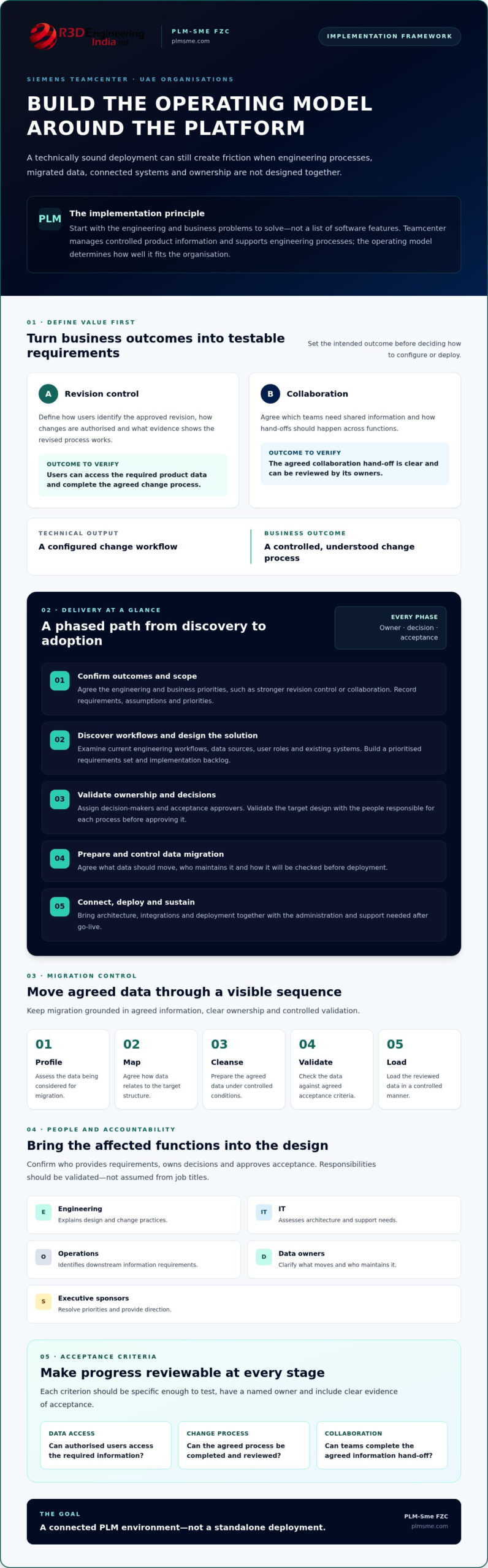
For example, if revision confusion is a priority, stakeholders should define how users identify the approved revision, how changes are authorised and what evidence will show that the revised process works. If collaboration is the goal, agree which teams need access to shared information and how hand-offs should happen. These outcomes guide decisions about workflow design, migration scope, system connections and ongoing administration, rather than leaving them disconnected.
What should a Teamcenter implementation deliver?
Agree on business outcomes before translating them into technical deliverables. A configured change workflow is an output. A controlled, understood change process is the intended outcome. Likewise, loading product records is a technical task, while giving authorised users dependable access to the agreed information is a business objective.
Set acceptance criteria early. Define how the organisation will verify access to required data, completion of a change process or an agreed collaboration hand-off. Criteria should be specific enough to test, with a named owner and clear evidence of acceptance. This gives teams a shared basis for reviewing configuration and migration before deployment.
Which organisations and stakeholders need to be involved?
Include engineering, IT, operations, data owners and executive sponsors wherever their responsibilities are affected. Engineering can explain design and change practices; IT can assess architecture and support needs; operations can identify downstream information requirements. Data owners clarify what should be migrated and who maintains it, while sponsors resolve priorities and provide direction.
Department-only design can encode one team’s assumptions into shared workflows, limiting adoption elsewhere. For each function, confirm who provides requirements, who owns decisions and who approves acceptance. The right roles depend on the operating model, so validate them rather than assuming job titles establish authority. For organisations working across functions, this alignment helps keep Teamcenter connected to real responsibilities and business priorities.
How a UAE Teamcenter implementation moves from discovery to adoption
A clear delivery sequence turns agreed business outcomes into decisions teams can review before moving forward. For a Siemens Teamcenter implementation UAE manufacturers can sustain, each phase needs an accountable owner, documented outputs and acceptance criteria. The sequence below provides control without assuming every organisation has the same starting point.
This disciplined approach aligns with the UAE’s focus on manufacturing transformation, including the Smart Manufacturing initiative. The practical task is to translate strategic intent into a design that fits the organisation’s workflows, data and connected systems.
What happens during discovery and solution design?
Discovery should examine current engineering workflows, data sources, user roles and existing systems. Process owners can distinguish essential requirements from habits that need review. The output is a prioritised set of requirements and an implementation backlog, with assumptions recorded and decisions assigned to named owners.
Before approving the target design, validate it with the people responsible for each process. Architecture and configuration principles should reflect confirmed needs, not untested assumptions.
From there, a phased sequence can guide delivery:
- 1. Confirm discovery and requirements. Document scope, stakeholders, current processes and priorities. Process owners approve the requirements and acceptance criteria.
- 2. Approve solution design. Review the target architecture, configuration principles and backlog. The designated decision-makers sign off before configuration begins.
- 3. Prepare and migrate agreed data. Confirm what data is in scope and how its quality will be checked. Data owners review migration results against agreed criteria.
- 4. Configure and connect systems. Implement the approved workflows and interfaces. Technical owners verify that each connection supports its intended use.
- 5. Test and resolve issues. Run representative scenarios across workflows, migrated records, access roles and interfaces. Owners record defects, assign resolutions and confirm readiness.
- 6. Deploy, adopt and support. Obtain business sign-off, prepare users for role-specific tasks and assign post-launch administration responsibilities.
How should testing, deployment and user adoption be prepared?
Testing should reflect real engineering work, not just confirm that screens open. Include representative records, permissions and system interactions, then document results and unresolved issues. Before deployment, agree who can escalate issues, who decides whether readiness criteria are met and which business owners provide final sign-off.
Prepare role-based guidance around actual tasks, such as finding controlled product information or progressing an engineering change. Timing depends on verified scope, data condition, interfaces and organisational readiness, so avoid committing to a schedule before assessing these factors. For delivery and planning support, organisations can review Teamcenter implementation support from PLM-Sme.
Designing Teamcenter architecture, data migration and system connections
Architecture, migration and interfaces need to be designed as one operating environment. In a Siemens Teamcenter implementation, UAE organisations should assess architecture options against workflow fit, maintainability, security requirements and who will own administration after deployment. A design that meets current engineering needs but depends on undocumented decisions or unclear ownership can be difficult to sustain.
Start by defining system boundaries: which information Teamcenter controls, which systems remain authoritative for other records, and how approved data moves between them. Document these choices alongside the rationale, responsible owners and operational expectations. That gives engineering and IT a shared basis for reviewing the design as requirements evolve.
How should teams scope Teamcenter data migration?
Build an inventory of source systems and files, formats, relationships, quality issues and business-critical records. Then have accountable data owners agree what to migrate, transform, archive or exclude. Avoid treating migration as a bulk transfer: duplicate or incomplete records can carry old inconsistencies into the new environment.
A controlled migration typically profiles the source, maps fields and relationships, cleanses agreed data, validates representative results and loads approved records. Reconcile loaded data against the source and require user validation before teams rely on it. The scope and acceptance criteria should make clear which records and relationships have been checked.
Where do CAD, ERP, MES and CRM connections fit?
Map each product-related object to the system that creates, consumes or governs it. For example, clarify where engineering data is maintained and which information another system needs to receive. Then define interface direction, ownership, exchange timing, error handling and monitoring. These rules matter more than simply listing systems to connect.
Not every application needs a custom interface. Confirm the business use case and data responsibility first, then assess whether an exchange is necessary and how it should be maintained. This avoids building connections that duplicate ownership or move information without a clear operational purpose.
For a deeper discussion of interface strategy, see the published guide on Teamcenter CRM integration benefits. Use it to consider the business case for CRM connectivity, while keeping project-specific ownership and exchange rules grounded in your own architecture.
How to assess implementation readiness and choose a Teamcenter partner
Deployment alone won’t resolve inefficient processes. If approval paths are unclear or teams maintain conflicting records, configuring those practices into Teamcenter can preserve the same problems in a new system. Readiness means understanding what needs to change, who can make decisions and whether the organisation can support the work through deployment and beyond.
For a Siemens Teamcenter implementation, UAE organisations should assess sponsorship, process ownership, data stewardship, technical capacity and user availability before approving scope. Executive sponsors need to resolve priorities; process owners must validate requirements; data stewards need authority to confirm information quality. IT and system owners should assess dependencies, while engineering and operations users need time to test and adopt agreed workflows.
What should an organisation confirm before approving the project?
Check that scope, owners, dependencies, success measures and decision rights are documented. Identify legacy constraints and operational windows that could affect testing or deployment, such as periods when key users or systems aren’t available. Record unresolved assumptions, assign someone to validate each one and decide whether it must be resolved before commitment or can be managed as a tracked project risk.
A practical readiness review asks: who approves process changes, who accepts migrated information, who signs off testing, and who owns the platform after launch? If these answers are unclear, address the gaps before treating the project plan as settled.
Which partner capabilities matter beyond configuration?
Assess how a prospective partner works across requirements, architecture, migration, CAD/CAM/CAE extensions, integration and administration. Ask about its approach to documenting design decisions, managing scope changes, validating migrated data and testing interfaces. Evaluate the quality of the proposed method and accountability, not just a list of technical capabilities.
Also clarify how knowledge transfer will work. Your team should know what has been configured, how key decisions were made and which responsibilities remain with your organisation. Confirm who handles administration after deployment and how ongoing support is structured. PLM-Sme is an independent PLM consultancy offering implementation, integration development and PLM system administration support. Its published Siemens Teamcenter consulting guide can provide further advisory context as you compare approaches.
Once your readiness questions and evaluation criteria are clear, discuss your Teamcenter implementation requirements with PLM-Sme.
Planning a Siemens Teamcenter implementation UAE organisations can support long term
A well-scoped Teamcenter programme needs a partner who can connect early assessment and architecture decisions with delivery and ongoing platform administration. PLM-Sme FZC is an independent PLM consultancy and Siemens Digital Industries Alliance Partner serving organisations across the UAE. It supports implementation work rather than selling software licences or hardware.
For organisations planning a Siemens Teamcenter implementation UAE, this approach connects business objectives to the roadmap, the roadmap to the architecture, and the approved design to implementation. PLM-Sme’s services include digital maturity assessments and reports, Digitalisation Vision & Roadmap Consulting, system and solution architecture, end-to-end PLM implementation support, data migration, CAD/CAM/CAE extensions, Teamcenter integration development and ongoing PLM system administration.
How can PLM-Sme support the implementation lifecycle?
An assessment can help establish current readiness, priorities and capability gaps. Those findings can inform a roadmap and architecture aligned with agreed processes, data needs and system connections. With scope and responsibilities defined, implementation support can address configuration and delivery activities alongside migration and integration requirements.
After deployment, a PLM System Administration Retainer is an option for ongoing administration, subject to the organisation’s agreed requirements. Define its responsibilities, ownership boundaries and expected outcomes as part of planning, rather than leaving operational support until go-live. For a fuller delivery walkthrough, consult PLM-Sme’s published end-to-end PLM implementation guide.
What should the first implementation discussion establish?
Start with the decisions that will shape scope: What business outcomes matter most? Which engineering processes are in scope? Where does product data currently reside, and which systems need to exchange information with Teamcenter? Discuss project constraints, internal owners, user availability and known dependencies as well.
Not every detail needs to be settled in an initial discussion. Identify which deliverables require discovery, such as a data assessment, target architecture or integration definition, before confirming scope and sequencing. This creates a more useful basis for planning than assuming requirements are already complete.
If your organisation is assessing readiness or shaping its next steps, discuss a Teamcenter implementation plan with PLM-Sme.
Build a Teamcenter foundation that lasts
A successful Siemens Teamcenter implementation UAE starts with defined business outcomes, then connects engineering processes, data, architecture and integrations to those goals. Phased delivery, clear decision owners and measurable acceptance criteria help teams manage risk. Planning for administration and support from the outset helps keep the platform aligned with changing operational needs after deployment.
PLM-Sme is an independent PLM consultancy and Siemens Digital Industries Alliance Partner. Its services span assessment, architecture, implementation support, integration and administration, providing a route from early planning through ongoing platform support. Software licences and hardware are outside its offering.
If you’re defining readiness, scope or next steps, discuss your Siemens Teamcenter implementation requirements with PLM-Sme. A clear starting point can help your organisation shape a practical plan around its people, processes and long-term objectives.
Frequently Asked Questions
Is Siemens Teamcenter suitable for manufacturers in the UAE?
Teamcenter may suit manufacturers that need structured control of product information, engineering workflows and collaboration across teams. For a Siemens Teamcenter implementation, UAE organisations should assess business objectives, existing systems, data quality, technical requirements and user needs before setting scope. For example, clarify whether revision control or change management is a priority and which teams need access to product records. Choose based on verified needs, not a feature list alone.
How long does a Siemens Teamcenter implementation take?
There’s no reliable single duration for every Teamcenter implementation. Timing depends on agreed scope, solution architecture, data quality and volume, integrations, stakeholder availability, testing needs and deployment approach. During discovery, a delivery partner should identify dependencies, decision gates and responsibilities, then use those findings to validate the schedule. Treat early estimates as provisional until key assumptions are documented and the organisation understands what could affect sequencing.
What systems can Siemens Teamcenter integrate with?
Teamcenter may exchange information with CAD, ERP, MES, MOM or CRM systems, depending on the organisation’s processes and operational requirements. Start by mapping which system creates, consumes or governs each product-related information object. Then define the direction and timing of exchanges, along with error handling and support ownership. Not every system requires a custom integration, so confirm the use case and data responsibilities before selecting an approach.
Can existing engineering data be migrated into Teamcenter?
Existing engineering data can be assessed for migration, but teams shouldn’t assume every record should transfer unchanged. Inventory the sources, formats, quality issues and relationships, then have data owners agree what to migrate, transform, archive or exclude. Define mapping rules and test them with representative records. Migration trials and reconciliation can reveal issues before deployment. Validate the resulting information with users before they rely on it for engineering work.
What should a UAE manufacturer prepare before starting a Teamcenter implementation?
Prepare clear business objectives, process owners, an inventory of relevant systems and data, and access to representative users. Identify decision-makers, dependencies, operational constraints and current engineering pain points. These inputs help shape realistic scope and architecture decisions. A readiness assessment can expose gaps in ownership, data stewardship or user availability that should be addressed before configuration or migration proceeds. Validate requirements with the teams who will use and maintain the system.
How do I choose a Siemens Teamcenter implementation partner?
Assess whether the partner can connect business requirements with PLM architecture, engineering processes, data migration, integrations, testing and ongoing administration. Ask how decisions and assumptions are documented, how knowledge is transferred, and who owns responsibilities after deployment. Verify current partner status and relevant capabilities directly. Compare each proposed approach against your objectives, existing systems and constraints rather than relying on broad claims or a generic feature checklist.
Does PLM-Sme provide Teamcenter licences or hardware?
No. PLM-Sme’s services focus on digitalisation consulting, architecture, implementation support, integration development and PLM system administration. It doesn’t sell off-the-shelf PLM software licences or hardware. Organisations should confirm how software licensing and any infrastructure procurement will be handled within their own project arrangements. Clarifying these boundaries during initial scoping helps establish responsibilities and identify procurement activities that sit outside the consultancy’s scope.