
Expert Teamcenter Data Migration Services for Industrial Digitalization
If 89% of operations leaders feel their digital investments are falling short, the culprit is rarely the software itself; it’s the broken data foundation beneath it. Transitioning to a new PLM environment shouldn’t feel like a gamble with your intellectual property. Expert Teamcenter data migration services aren’t just about moving files from one server to another. They’re about re-architecting your entire data ecosystem to ensure engineering and manufacturing finally speak the same language. You’ve likely felt the friction of data silos or the fear of losing decades of historical CAD metadata during a system overhaul.
It’s a common challenge, but it doesn’t have to be your reality. Discover how a structured, architect-led approach to Teamcenter data migration secures your digital thread and prepares your enterprise for an AI-driven future. We’ll show you how to move beyond inconsistent taxonomies to achieve a seamless transition to Siemens Teamcenter. This guide covers building a future-proof PLM architecture that integrates fully with your ERP and MES systems, ensuring technical data becomes a strategic asset rather than a legacy burden. We’ll explore the methodologies that keep your digital thread intact while positioning your UAE-based operations for the next wave of industrial automation.
Key Takeaways
- Understand why viewing migration as a strategic realignment of assets is vital for securing a unified digital thread across your enterprise.
- Discover a methodical framework for Teamcenter data migration services that prioritizes data cleansing to ensure long-term architectural integrity.
- Learn how to synchronize PLM data with ERP and MES ecosystems to bridge the gap between business planning and shop-floor execution.
- Identify common pitfalls in PLM implementation to mitigate technical debt and avoid costly downtime or compliance failures.
- Explore how proactive administration and system monitoring secure the long-term performance of your industrial digital infrastructure.
Navigating the Complexity of Teamcenter Data Migration in 2026
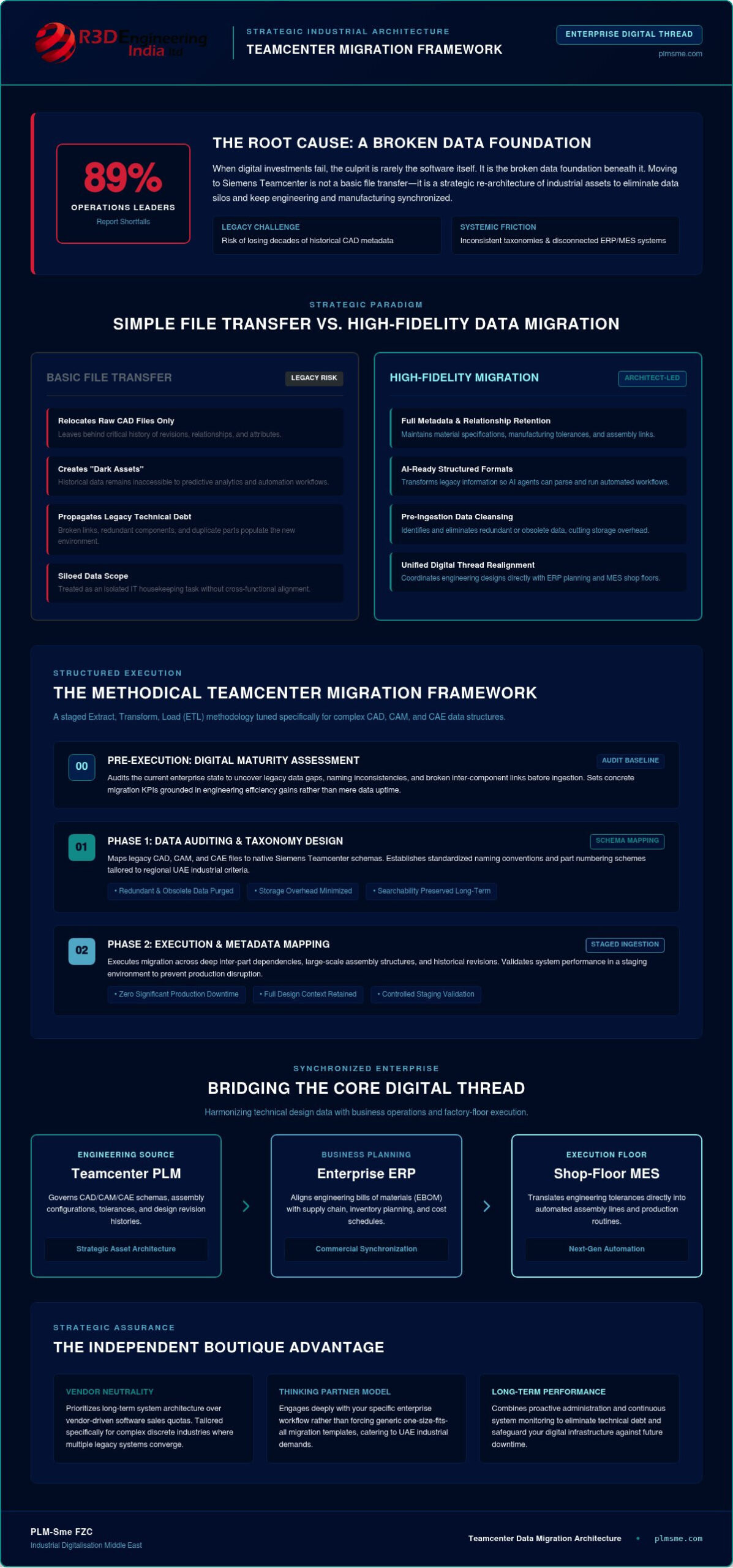
Industrial leaders often mistake data migration for a simple IT housekeeping task. In reality, successful Teamcenter data migration services represent a strategic realignment of your industrial assets. As we move through 2026, the standard for migration has shifted from basic data persistence to the creation of AI-ready data structures. You aren’t just moving files; you’re re-engineering the information architecture that supports your entire Product Lifecycle Management (PLM) strategy. A unified digital thread requires that every piece of metadata, from material specifications to manufacturing tolerances, remains intact and searchable across the enterprise.
Distinguishing between simple file transfers and complex metadata migration is crucial. A basic transfer might move a CAD file, but it often leaves behind the rich history of revisions, relationships, and attributes that give that file value. High-fidelity migration ensures that legacy data is transformed into a structured format that AI agents can actually parse. Without this transformation, your historical data becomes a “dark asset” that’s inaccessible to the predictive analytics and automated workflows that define modern industrial digitalization.
Aligning Migration with Digital Maturity Assessments
Effective data movement doesn’t happen in a vacuum. A comprehensive digital maturity report manufacturing must precede any technical execution. This assessment identifies legacy data gaps that could potentially derail your digitalization efforts. By auditing your current state, you can set realistic KPIs for migration success based on actual engineering efficiency gains rather than just “data uptime.” We look for inconsistencies in naming conventions and broken links between components that would otherwise lead to costly errors in a live Teamcenter environment. It’s about ensuring your data is clean enough to support your long-term vision before the ingestion process begins.
The Independent Consultant Advantage
Choosing a partner for Teamcenter data migration services requires a balance between technical skill and objective strategy. As an independent advisor, we prioritize your system architecture over vendor-specific quotas or software sales. This neutrality is vital when navigating complex discrete industry environments where multiple legacy systems must converge. A boutique specialist acts as a “thinking partner,” engaging deeply with your enterprise’s unique workflow rather than offering a one-size-fits-all solution. This collaborative approach ensures that the final architecture isn’t just functional, but tailored to the specific operational demands of the UAE industrial sector. You get a steady, results-oriented delivery that focuses on quality and long-term stability.
Implementing a Methodical Teamcenter Migration Framework
A structured framework is the only way to avoid the common delays seen when scaling industrial production. Our approach to Teamcenter data migration services utilizes a rigorous Extract, Transform, Load (ETL) methodology specifically tuned for complex CAD data. We don’t just dump information into a new container. Instead, we validate system performance in a staged environment to prevent any unexpected production disruptions. This methodical progression ensures that the final ingestion is predictable, low-risk, and aligned with your broader digital vision.
Phase 1: Data Auditing and Taxonomy Design
Success begins by mapping legacy CAD, CAM, and CAE data to native Teamcenter schemas. This phase is critical for standardizing naming conventions and part numbering to align with UAE industrial requirements. We focus on identifying and eliminating redundant or obsolete data, which significantly reduces storage overhead and simplifies the digital thread. By establishing a clean taxonomy now, you prevent the migration of legacy technical debt into your new environment. It’s a vital step for ensuring that your data remains searchable and actionable for years to come.
Phase 2: Execution and Metadata Mapping
Preserving historical revisions and complex relationships is where most generic migration tools fail. Our process handles deep inter-part dependencies and large-scale assembly structures without requiring significant production downtime. We maintain the integrity of metadata so that your engineers don’t lose the context behind their designs. As a thinking partner, we ensure that the transition respects your existing workflows while optimizing them for the new platform. If you’re ready to evaluate your current system readiness, you can schedule a consultation for system and solution architecture to map out your specific needs.
Phase 3: Validation and User Acceptance Testing
We combine automated validation scripts with manual spot checks to ensure that all CAD/CAM/CAE extensions remain fully functional post-migration. It’s not enough for the file to simply exist in the database; the geometry and its associated manufacturing instructions must be 100% accurate. We use iterative testing cycles to catch discrepancies before they reach the production environment as part of our comprehensive Teamcenter data migration services. Data Integrity Validation is the definitive benchmark that confirms your migrated assets are accurate, complete, and ready for immediate operational use.
Synchronising Migrated Data with ERP and MES Ecosystems
Synchronising data across the enterprise is where the true ROI of a digital transformation project is realized. While many view the move to a new system as a destination, professional Teamcenter data migration services are actually the first step toward comprehensive PLM system architecture consulting. By establishing a robust data foundation, you enable interactive connections between Teamcenter and your ERP systems, bridging the gap between engineering intent and shop-floor execution. This integration ensures that migrated data supports real-time industrial automation, reducing the friction that typically slows down manufacturing cycles. In the UAE’s competitive industrial sector, having a connected ecosystem is no longer a luxury; it’s a requirement for operational resilience.
Teamcenter and ERP Integration Strategies
A primary goal of integration is streamlining the Bill of Materials (BOM) transfer process. In a disconnected environment, engineers often manually re-enter part data into the ERP system. This practice introduces significant errors and delays that can cost an enterprise thousands in wasted materials and man-hours. By synchronising product lifecycle stages with financial and supply chain data, you create a single source of truth. This alignment allows procurement teams to see real-time design changes, ensuring that supply chain decisions are based on the latest engineering revisions. It effectively eliminates the silos that prevent departments from working in parallel, allowing for a more agile response to market shifts.
Leveraging Data for MES and CRM Connectivity
Feeding accurate engineering data into Manufacturing Execution Systems (MES) is essential for achieving a connected factory. When the shop floor has direct access to the latest CAD/CAM data and work instructions via Teamcenter data migration services, production quality improves and waste decreases. Beyond the factory floor, exploring Teamcenter CRM integration benefits allows for customer-centric design. This connectivity provides a 360-degree view of the product lifecycle, from initial customer requirements to final manufacturing and service. It enables a feedback loop where field data can inform future engineering iterations, creating a more agile and responsive enterprise. This holistic approach ensures that every stakeholder, from the shop floor to the sales office, is working with the same high-fidelity information.
Mitigating Risk and Eliminating Technical Debt
Many industrial firms fall into the trap of treating migration as a transactional IT event. This short-sightedness often leads to escalating technical debt that cripples system performance years down the line. A successful deployment requires balancing cost-effectiveness with high-performance system requirements. Minimizing operational disruption during the ‘go-live’ phase isn’t just about technical readiness; it’s about strategic risk mitigation. By addressing these factors early, you ensure that your Teamcenter data migration services result in a platform that supports growth rather than hindering it.
Legacy Data Risks and Mitigation
Corrupted files and broken links in legacy CAD data are silent project killers that can derail even the best-laid plans. Professional Teamcenter data migration services must include robust disaster recovery protocols to protect your enterprise’s intellectual property. We utilize specialized Teamcenter integration development to automate the identification and repair of these broken relationships during the transformation phase. This proactive approach ensures that the data entering your new environment is clean, linked, and ready for immediate engineering use, preventing the “garbage in, garbage out” cycle that plagues poorly managed transitions.
Technical Debt vs. Scalable Architecture
A ‘Quick-Fix’ migration might seem attractive for its lower initial price point, but it often results in a fragmented architecture. In contrast, an ‘Architect-Led’ migration focuses on long-term scalability and deep integration. Partnering with a Siemens Teamcenter consulting expert prevents future system bottlenecks by building a vendor-neutral foundation. The following table outlines how technical debt impacts your long-term operational costs.
| Operational Factor | Quick-Fix Migration | Architect-Led Migration |
|---|---|---|
| Maintenance Effort | High (Constant patching) | Low (Proactive monitoring) |
| System Performance | Degrades as data grows | Optimized for scale |
| AI Readiness | Requires manual re-work | Native AI integration |
| Data Integrity | Fragmented metadata | Unified Digital Thread |
Choosing the right path now saves your organization from the hidden costs of poor design. If you’re concerned about legacy data integrity, request an end-to-end PLM implementation support plan to identify potential risks before they become expensive failures. We act as your thinking partner to ensure your migration delivers a truly future-proof environment.
Securing Long-Term Performance through Expert PLM Administration
Completing the ingestion phase marks the beginning of a new operational chapter rather than the end of the journey. Once you’ve successfully utilized Teamcenter data migration services to establish your digital thread, the focus must shift to maintaining the integrity of that foundation. A system is only as valuable as its last update; without consistent oversight, even the most sophisticated architectures begin to degrade. Transitioning from a one-time migration project to a PLM system administration retainer ensures your environment remains optimized for the long term. This proactive stance is essential for maintaining the high-performance standards required by industrial automation solutions GCC leaders.
The Value of an Administration Retainer
System degradation is a silent threat that often goes unnoticed until a critical failure occurs. Regular health checks prevent these issues by identifying performance bottlenecks and database fragmentation before they impact your engineering teams. By opting for a retainer model, you gain access to specialized Teamcenter expertise without the significant overhead of maintaining a full-time, in-house team of architects. This approach is particularly effective when managing the ongoing complexities of ERP and MES integrations. When a synchronization error occurs, a dedicated partner provides a rapid response, ensuring that your production line in the UAE stays active and your data remains consistent across all business units.
Preparing for the AI Roadmap
The clean, structured data produced by professional Teamcenter data migration services is the essential fuel for industrial AI. As we look toward the end of 2026, predictive analytics in manufacturing will rely entirely on the quality of the historical metadata you’ve preserved. A well-administered PLM platform serves as the training ground for machine learning models that can eventually predict equipment failures or suggest design optimizations. We work with you to ensure your architecture remains agile, allowing you to plug in new AI agents and automation tools as they emerge. It’s about building a system that doesn’t just store past designs but actively contributes to future innovation through data-driven insights. By keeping your PLM environment lean and updated, you ensure your enterprise is ready for the next wave of digital transformation.
Building a Resilient Digital Foundation for Industrial AI
Industrial digitalization in the UAE is accelerating, and your data must keep pace. Achieving a unified digital thread requires more than a simple software update; it demands a strategic realignment of your technical assets. By prioritizing architect-led Teamcenter data migration services, you eliminate the technical debt that often cripples long-term scalability. We’ve explored how a methodical ETL framework preserves metadata integrity while synchronizing your engineering data with ERP and MES ecosystems. This integration is the bedrock of a modern, connected factory.
As an independent Siemens Digital Industries Alliance Partner, we provide the authoritative PLM system architecture expertise needed to build bespoke industrial digitalization roadmaps. We function as your thinking partner, ensuring your transition is seamless and your system performance is proactive. It’s time to turn your legacy data into a high-performance asset that drives real-world efficiency across your operations.
Request a Digital Maturity Assessment and Migration Consultation today to begin your journey toward a future-proof industrial ecosystem. Your digital transformation starts with a solid foundation.
Frequently Asked Questions
What are the primary risks involved in Teamcenter data migration?
The primary risks include the loss of historical CAD metadata, corruption of complex assembly relationships, and extended production downtime. Inconsistent data taxonomies across legacy systems often lead to dark data that AI agents cannot process effectively. We mitigate these risks through a structured ETL process and iterative validation in a staged environment. This ensures that every material specification and manufacturing tolerance remains intact before the final go-live phase.
How long does a typical Teamcenter data migration project take for a UAE manufacturer?
Project timelines vary based on data volume and the complexity of existing system integrations. A typical migration for a discrete manufacturer in the UAE ranges from three to nine months. This duration accounts for the essential auditing, cleansing, and validation phases required to secure the digital thread. We prioritize a methodical approach over speed to ensure the final architecture is scalable and free from legacy technical debt.
Can we migrate data from non-Siemens PLM systems to Teamcenter?
Yes, our Teamcenter data migration services are designed to ingest data from a wide range of non-Siemens PLM and CAD environments. We specialize in mapping disparate data schemas to native Teamcenter structures, ensuring revision histories and inter-part dependencies remain functional. This vendor-neutral approach allows UAE enterprises to consolidate legacy engineering assets into a unified Siemens ecosystem without losing the context of their historical design work.
What is the difference between data migration and data integration in PLM?
Data migration involves the permanent transfer of legacy assets into a new system, often requiring significant data transformation and cleansing. In contrast, PLM integration creates a continuous, interactive connection between Teamcenter and other platforms like ERP or MES. While migration is a one-time strategic realignment, integration ensures a real-time flow of information across the enterprise. Both are critical for maintaining a seamless digital thread from engineering to the shop floor.
How does PLM-Sme FZC ensure data security during the migration process?
We implement robust disaster recovery protocols and multi-layered encryption to protect your intellectual property throughout the transition. Our process follows strict access control measures, ensuring only authorized personnel interact with sensitive engineering data. By adhering to UAE data protection standards and utilizing secure staged environments for validation, we prevent unauthorized leaks or accidental data loss. This comprehensive security framework is a cornerstone of our end-to-end implementation support.
Is a digital maturity assessment mandatory before starting migration?
While not strictly mandatory by software requirements, we consider a digital maturity assessment essential for long-term success. Moving data into Teamcenter without a clear roadmap often results in escalating technical debt and fragmented workflows. The assessment identifies legacy gaps and establishes the KPIs needed to measure migration efficiency. It ensures your enterprise is actually ready to leverage AI and industrial automation rather than just moving old problems into a new system.
What is technical debt in the context of Teamcenter implementation?
Technical debt refers to the long-term costs and performance bottlenecks created by choosing quick-fix solutions over a scalable architecture. In Teamcenter environments, this often manifests as broken metadata links, redundant part numbers, or inefficient custom code that hinders future upgrades. By utilizing an architect-led approach, we eliminate these hidden liabilities during the migration phase. This ensures your PLM platform remains agile and cost-effective as your digitalization needs evolve.
Do you provide ongoing support after the migration is complete?
Yes, we provide ongoing support through a specialized PLM system administration retainer following the completion of Teamcenter data migration services. This service includes proactive system monitoring, regular health checks, and rapid response to integration challenges with ERP or MES ecosystems. Our goal is to prevent system degradation and ensure your Teamcenter environment continues to perform at peak efficiency. This long-term partnership allows your internal teams to focus on innovation while we manage the technical oversight.