
Engineering Change Order Workflow Automation in PLM: A Strategic Implementation Guide
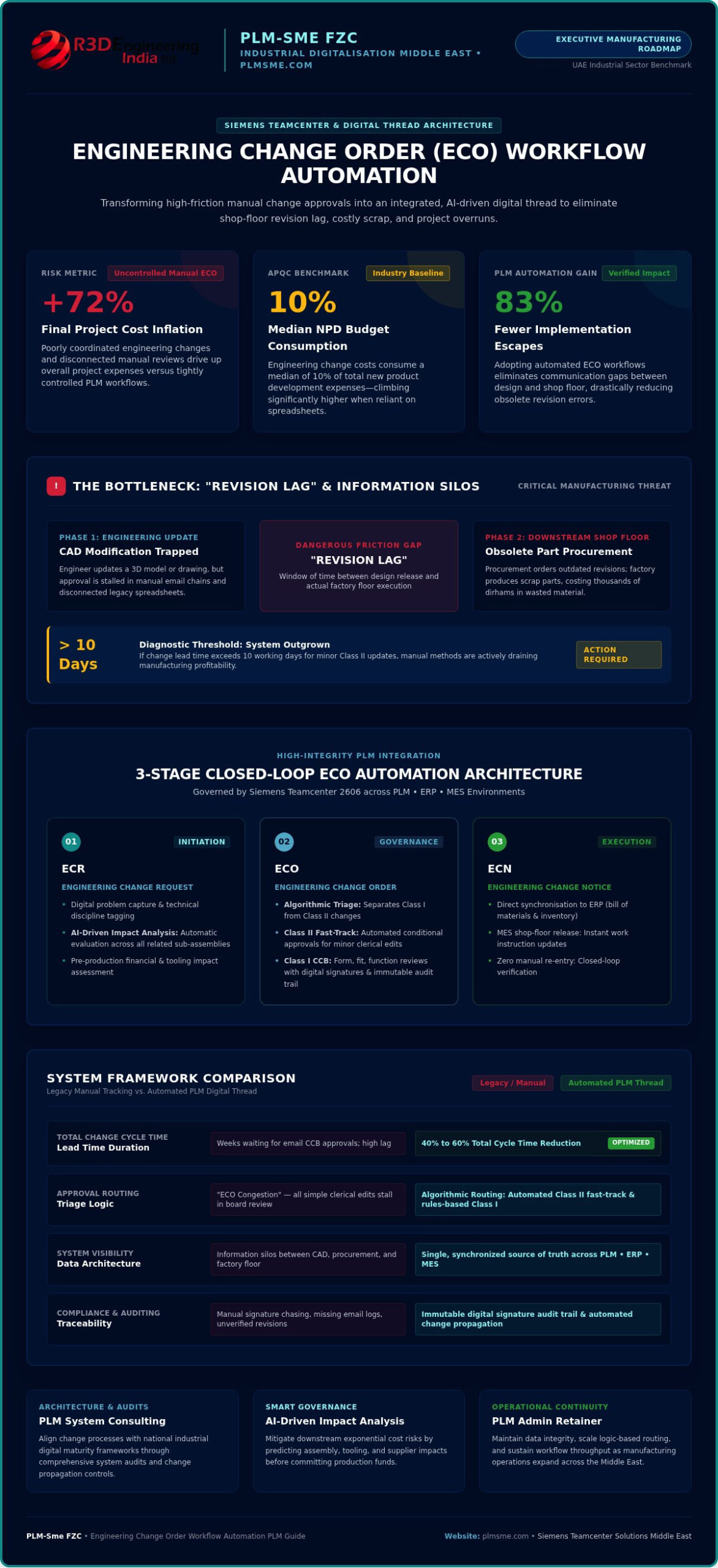
Did you know that poorly coordinated engineering changes can drive final project costs up by as much as 72% compared to tightly controlled workflows? For many industrial leaders in the UAE, the reality of manual ECO management involves weeks of waiting for email approvals while outdated revisions continue to circulate on the shop floor. Implementing engineering change order workflow automation PLM is no longer just a technical upgrade; it’s a necessary shift to protect your margins and production integrity. When manual processes fail to keep pace with modern manufacturing, the resulting scrap and rework can cost your organization thousands of dirhams in wasted material and lost time.
It’s frustrating when a simple part modification stalls because the data is trapped in a silo between engineering and the shop floor. We understand that the transition from legacy spreadsheets to a digital thread feels complex and demanding. This guide provides a strategic roadmap to master that transition. You’ll learn how to leverage Siemens Teamcenter 2606 and AI-driven impact analysis to reduce cycle times by up to 60%. We’ll preview the steps required to eliminate data silos and create a seamless, high-integrity integration between your PLM, ERP, and MES environments.
Key Takeaways
- Identify the hidden costs of manual change management and how “revision lag” impacts production quality within the UAE industrial sector.
- Architect a robust engineering change order workflow automation PLM environment that bridges the gap between engineering design and the shop floor.
- Master the configuration of Siemens Teamcenter to automate Class II fast-track approvals and complex Class I change boards.
- Align your automated ECO processes with a national industrial digitalization roadmap through expert architectural consulting and objective system audits.
- Establish a long-term support framework using a PLM administration retainer to maintain data integrity and workflow performance as your operations scale.
Identifying Inefficiencies in Manual Engineering Change Management
Manual management of engineering change orders (ECOs) often hides substantial operational costs that don’t appear on a standard balance sheet. In the UAE’s competitive industrial sector, these inefficiencies manifest as “revision lag.” This is the dangerous window of time between a design update and its actual implementation on the factory floor. According to APQC benchmarking, ECO costs typically consume a median of 10% of total new product development expenses. When these processes rely on paper trails or disconnected spreadsheets, that figure often climbs much higher due to uncoordinated data flow.
Recognizing the threshold for moving toward engineering change order workflow automation PLM is critical for maintaining national manufacturing quality. If your team spends more time chasing signatures than solving technical challenges, the system is broken. These bottlenecks are frequently highlighted in a digital maturity report manufacturing, which serves as a diagnostic tool to identify where manual interventions are causing the most friction. Moving to an automated environment ensures that change logic is baked into the system rather than residing in an individual’s inbox.
The High Cost of Information Silos
Manual systems inherently create data silos that lead to expensive scrap and rework. When an engineer updates a drawing but the procurement team continues to order components based on an obsolete revision, the financial impact is immediate. Human error is a constant threat in manual approval chains; a single missed email or a lost folder can stall a production line for days. These communication gaps between engineering and the shop floor lead to “implementation escapes.” Research shows that adopting engineering change order workflow automation PLM reduces these escapes by up to 83%, ensuring every stakeholder accesses a single, synchronized source of truth.
Setting Benchmarks for Change Cycle Times
To remain agile, manufacturers must define “Best-in-Class” durations for their change cycles. A typical manual process can take weeks to navigate the Change Control Board (CCB). In contrast, automated, AI-assisted workflows often achieve a 40% to 60% reduction in total cycle times. It’s essential to measure the lead time from the initial Engineering Change Request (ECR) to the final Engineering Change Notice (ECN). If your current lead time exceeds ten working days for minor Class II changes, it’s a clear signal that your organization has outgrown manual methods. Maturity assessments help pinpoint these specific friction points, allowing for a targeted transition to a high-integrity digital thread.
Architecting the Automated ECO Workflow Environment
Architecting a high-integrity environment for engineering change order workflow automation PLM requires moving beyond simple electronic form routing. It demands a systemic approach where data, not just documents, drives the process. This structural shift is where PLM system architecture consulting becomes indispensable. By treating the change process as a core architectural component, organizations ensure that every Engineering Change Request (ECR) flows logically into an Engineering Change Order (ECO) and finally into an Engineering Change Notice (ECN) without data loss or manual re-entry.
A robust architecture uses Siemens Teamcenter as the central repository, ensuring a single source of truth across the enterprise. This setup mitigates the risks identified in NIST research on engineering change management, which highlights how poorly managed change propagation leads to exponential cost increases downstream. Effective architecture ensures that when a design change occurs, its impact is automatically evaluated across all related assemblies and manufacturing processes before a single dirham is spent on production.
Logic-Based Approval Routing
Modern workflow design uses algorithmic triage to separate minor Class II clerical updates from major Class I modifications that affect form, fit, or function. By automating this categorization, you prevent “ECO congestion” where simple revisions get stuck in lengthy board reviews. Conditional logic within the PLM environment routes tasks based on cost thresholds or technical disciplines, utilizing digital signatures to maintain an immutable audit trail. This level of automation ensures that task escalations happen automatically, preventing projects from stagnating in an approver’s queue.
Cross-System Integration Architecture
The true value of engineering change order workflow automation PLM is realized when it extends beyond the engineering department. Integration with Enterprise Resource Planning (ERP) and Manufacturing Execution Systems (MES) is essential for national manufacturers aiming for operational excellence. When an ECO is approved, the system triggers real-time inventory updates in ERP to flag parts for scrap or rework. Simultaneously, the MES must be alerted to prevent the shop floor from starting work on obsolete revisions. Managing this Bill of Materials (BOM) transition ensures the “as-designed” state in PLM always matches the “as-produced” reality on the floor. If you’re unsure if your current infrastructure supports this level of synchronization, an independent architectural audit can provide the necessary clarity.
Evaluating Manual vs. Automated Engineering Change Frameworks
Choosing the right framework determines whether your engineering team leads or lags behind the competition. Manual change management relies heavily on tribal knowledge and physical sign-offs, creating a fragile environment where one person’s absence can halt an entire project. In contrast, engineering change order workflow automation PLM codifies these rules into a persistent digital system. This shift reduces administrative overhead by eliminating the need for manual status tracking and assembly “where-used” queries. It’s about moving from a reactive posture to a controlled, proactive methodology.
Traceability and Compliance Auditing
Maintaining an immutable audit trail is nearly impossible with paper or spreadsheet-based logs. Automated workflows capture every interaction, comment, and approval in real-time, providing a transparent history that’s vital for national regulatory compliance. Following ISO 10007 configuration management guidelines ensures that your change authorization and status accounting meet international benchmarks. While manual logs are susceptible to tampering or accidental deletion, PLM history tracking provides a tamper-proof record of why a change was made, who authorized it, and when it was implemented. This level of transparency is essential for high-stakes industries where safety and precision are non-negotiable.
Resource Allocation and Throughput
The impact on New Product Introduction (NPI) speed is one of the most significant ROI drivers for automation. Engineering teams often spend significant hours on administrative tasks related to change management. Automating task distribution frees these highly skilled professionals to focus on design innovation rather than logistics. These self-correcting workflows also reduce the burden on PLM administrators, as the system automatically enforces business rules and data validation. By streamlining these approvals, organizations can achieve first-pass approval ratings above 90%, drastically cutting down on the back-and-forth that typically plagues manual systems.
Evaluating these frameworks shows that scalability is the ultimate differentiator for national industrial operations. As projects grow in complexity, the volume of engineering changes increases exponentially. A manual framework eventually collapses under this weight, leading to production delays and high scrap rates. Implementing engineering change order workflow automation PLM ensures that cycle time reductions of 40% to 60% are sustained even as production volumes scale. This creates a resilient foundation for long-term growth, allowing companies to bring products to market faster while maintaining the highest data integrity standards across the entire product lifecycle.
Implementing Your Engineering Change Order Workflow Automation
Executing engineering change order workflow automation PLM is a structured transition that moves beyond simple software installation into the realm of business process engineering. It requires a meticulous approach to ensure that the digital thread remains unbroken from the initial design tweak to the final assembly on the shop floor. For national manufacturers, this implementation is the most critical phase of their digitalization journey, as it directly impacts the speed and accuracy of production cycles.
Step 1: Workflow Mapping and Rule Definition
The first priority is documenting your current “As-Is” process to identify hidden waste and redundant approval steps. Many organizations find that their manual workflows are cluttered with non-value-added activities that don’t contribute to quality. Defining a “To-Be” state involves setting clear, logic-based criteria for “Fast-Track” changes versus “Full-Review” changes. Fast-track paths are reserved for minor Class II clerical or drafting updates, while full-review paths handle major Class I modifications affecting form, fit, or function. This triage prevents your Change Control Board from becoming a bottleneck for simple revisions.
Step 2: Technical Configuration and Integration
Once rules are defined, the technical configuration of the Siemens Teamcenter change management module begins. This involves setting up specific status codes, transition rules, and required attributes that the system must validate before a change can progress. Engaging with Siemens Teamcenter consulting during this phase is essential for navigating complex system configurations and verifying CAD data management links. Ensuring that 3D models and drawings are automatically locked once an ECO is initiated prevents concurrent, conflicting edits that could compromise data integrity.
Step 3: Validation and Continuous Optimisation
Before a full-scale rollout, you must perform rigorous User Acceptance Testing (UAT) using complex, real-world change scenarios. This testing verifies that the integration layer for ERP and MES connectivity functions correctly, ensuring that an ECO approval in PLM triggers the necessary inventory flags in downstream systems. After the phased rollout with pilot teams, monitoring adoption metrics helps identify areas where users might need additional support. Utilizing a PLM administration retainer provides the ongoing expertise needed to refine these automated workflows as your operational requirements evolve.
If your organization is ready to move beyond manual processes and secure its digital future, our team offers specialized expertise to guide your implementation. Discover how our strategic Siemens Teamcenter consulting can transform your engineering change order workflow automation PLM into a competitive advantage.
Optimising the Digitalisation Journey with Expert Support
Integrating engineering change order workflow automation PLM into a comprehensive industrial digitalization roadmap UAE ensures that change management isn’t treated as a siloed IT project. It’s a strategic pillar of a broader national effort to modernize manufacturing. When automation is aligned with long-term business goals, it ceases to be a mere administrative tool and becomes a driver for operational excellence. This alignment requires a culture of data-driven decision making where every engineering modification is backed by real-time analytics and cross-departmental visibility.
The Role of an Independent PLM Partner
Vendor-neutral advice is critical for complex system integrations. While software providers focus on license sales, an independent consultant prioritizes the integrity of your solution architecture. This objective perspective ensures that your engineering change order workflow automation PLM remains agile enough to adapt to future market shifts without being locked into a proprietary ecosystem. Accessing specialized Teamcenter integration development expertise allows for bespoke connections between PLM and legacy ERP systems. This tailored approach ensures long-term scalability, allowing your digital thread to expand as your production capacity grows across the UAE.
Preparing for AI and Advanced Automation
Structured ECO data serves as the essential fuel for future AI-driven initiatives. By automating your current workflows, you’re building the foundation for advanced change impact simulations and predictive maintenance models. Future systems will utilize generative AI, such as the AI BOM Agent in Teamcenter 2606, to automatically flag scrap liability and inventory exposure across multi-level assemblies. This shift moves engineering teams from manual “where-used” queries to agentic impact analysis. Aligning your change management today with the national vision for industrial AI ensures your organization remains a “thinking partner” in the global supply chain, capable of executing complex design shifts with surgical precision.
Establishing this foundation requires more than just software; it demands a partner who understands the nuances of UAE industrial regulations and the technical depth of Siemens Teamcenter. By focusing on high-integrity data and robust architecture, manufacturers can transition from reactive troubleshooting to a proactive, automated state. This evolution reduces lead times and eliminates the costly data silos that historically hindered national industrial growth.
Securing Your Industrial Competitive Edge
Transitioning from manual, error-prone spreadsheets to a high-integrity digital environment is no longer optional for national manufacturers. By implementing engineering change order workflow automation PLM, organizations eliminate the “revision lag” that leads to expensive scrap and production delays. We’ve explored how a logic-based architecture and seamless ERP/MES integration create a single source of truth that scales with your operations. This strategic shift doesn’t just reduce cycle times; it builds the essential foundation for future AI-driven impact analysis and predictive manufacturing.
As a Siemens Digital Industries Alliance Partner, we specialize in end-to-end PLM implementation and complex Teamcenter integrations that bridge the gap between design and delivery. Our independent consultancy provides the objective architectural advice needed to future-proof your workflows, functioning as a dedicated thinking partner for your long-term vision. If you’re ready to identify your specific bottlenecks and accelerate your digitalization journey, take the first step today. Request a Digital Maturity Assessment for Your Engineering Workflows to ensure your change management processes are optimized for the next generation of industrial excellence.
Frequently Asked Questions
What is the difference between an ECR, ECO, and ECN in an automated workflow?
An Engineering Change Request (ECR) identifies the problem and justifies the need for modification. The Engineering Change Order (ECO) follows as the technical authorization, detailing Bill of Materials adjustments and resource allocation. Finally, the Engineering Change Notice (ECN) serves as the execution dispatch to procurement and the shop floor. In an automated environment, these stages are digitally interlocked to ensure no step is bypassed without valid authorization or proper data validation.
How does engineering change order workflow automation PLM reduce scrap rates?
Automation reduces scrap by ensuring the shop floor never works from obsolete revisions. By implementing engineering change order workflow automation PLM, organizations can achieve up to an 83% reduction in implementation escapes. This is accomplished through real-time synchronization between the PLM system and the MES or ERP. This immediate link flags or locks outdated work orders the moment a new revision is released, preventing the waste of materials and expensive rework.
Can I automate ECOs if my ERP and PLM systems are from different vendors?
Yes, you can automate workflows across different vendors by developing a robust integration layer. While Siemens Teamcenter is our primary platform, we specialize in integration development that connects PLM data to diverse ERP and MES environments. This ensures that a change approved in engineering is automatically reflected in your manufacturing and procurement systems. This approach maintains a consistent digital thread across the entire enterprise, regardless of the specific software brands used in different departments.
Is it possible to implement ECO automation without a full PLM system overhaul?
It’s entirely possible to automate change workflows by configuring specific modules within your existing infrastructure. You don’t always need a full system replacement. Instead, we recommend starting with a digital maturity assessment to identify high-friction points. This targeted approach allows for the deployment of automated ECR and ECO logic as a standalone improvement. It provides immediate ROI while fitting into a larger national industrial digitalization roadmap for long-term scalability and growth.
What are the most common challenges when automating engineering change workflows?
The most frequent challenge is “paving the cowpath,” which occurs when a company automates a broken or inefficient manual process without re-engineering it first. Other obstacles include fragmented data silos between departments and a lack of clear logic for fast-track versus full-track approvals. Success requires a thorough workflow audit and mapping session. This ensures the automated system actually streamlines the decision-making process rather than just speeding up a dysfunctional or bloated manual routine.
How does Siemens Teamcenter handle complex multi-site change management?
Siemens Teamcenter manages multi-site changes through synchronized “Change Action” objects that maintain data consistency across global locations. It uses a federated data model to ensure that an ECO initiated at one site is visible and actionable by relevant stakeholders at other national facilities. This ensures that all engineering and manufacturing sites stay aligned on the latest product configuration. It prevents the accidental use of mismatched revisions in complex, distributed supply chains.
How long does a typical ECO workflow automation project take to implement?
A typical project for engineering change order workflow automation PLM generally spans three to six months, depending on system complexity and integration requirements. This timeline includes the initial workflow mapping, technical configuration, and User Acceptance Testing (UAT). We recommend a phased rollout, starting with a pilot engineering team to validate the logic before expanding the automated environment to the broader organization. This ensures any integration with ERP or MES systems functions correctly before full adoption.
What security measures protect sensitive IP during an automated change process?
Security is maintained through robust role-based access controls (RBAC) and system-enforced digital signatures that comply with international standards. Every modification is tracked in an immutable audit trail. This ensures that only authorized personnel can view or approve sensitive IP. Automated workflows also include data encryption and secure transition rules. These measures prevent unauthorized data exports, protecting your competitive advantage and intellectual property throughout the entire engineering change and approval lifecycle.