
EBOM to MBOM Transformation Consulting: Bridging the Engineering-Manufacturing Divide
What if the primary bottleneck in your production cycle isn’t a physical machine, but a digital disconnect? Many technical leaders find that even the most sophisticated CAD models fail when they hit the factory floor because the Engineering Bill of Materials (EBOM) doesn’t translate to the Manufacturing Bill of Materials (MBOM). You’ve likely dealt with the frustration of manual data re-entry between PLM and ERP systems or faced production delays because of outdated design data. It’s a common challenge that risks your competitiveness as the UAE pushes toward its 2026 industrial targets.
By engaging in EBOM to MBOM transformation consulting, you can turn this friction into a strategic advantage. This article outlines how to master the transition from engineering design to production reality through expert-led process alignment. We’ll explore the architecture needed for a seamless digital thread, moving from CAD to MES while automating synchronization. You’ll discover how to reduce time-to-market and ensure your manufacturing readiness is visible long before the first part is machined. This guide provides the technical roadmap required to align your engineering intent with your shop floor execution.
Key Takeaways
- Understand why aligning engineering intent with manufacturing execution is critical to avoiding costly production errors and quality issues in the UAE industrial sector.
- Learn the technical differences between functional EBOMs and process-driven MBOMs, including how to manage phantom parts and assembly sequences effectively.
- Discover how EBOM to MBOM transformation consulting utilizes digital maturity assessments to identify and eliminate operational silos within your organization.
- Explore the system architecture required to create a seamless digital thread by integrating Teamcenter with ERP systems for synchronized costing and logistics.
- Position your manufacturing operations for long-term scalability and AI readiness by establishing a robust, independent PLM foundation.
The Strategic Necessity of EBOM to MBOM Alignment
The Engineering Bill of Materials (EBOM) represents a product as it was designed, focusing on functional geometry and CAD structures. However, the factory floor requires a different perspective. The Manufacturing Bill of Materials (MBOM) organizes these same components into assembly sequences, kits, and workstations. Bridging this gap is the essence of EBOM to MBOM transformation consulting. Without a structured transition, the digital thread breaks, leaving manufacturers to rely on manual data re-entry that inevitably introduces errors.
For businesses operating within the UAE’s industrial framework, this alignment isn’t just a technical preference; it’s a strategic requirement to meet national 2026 digitalization goals. Relying on manual spreadsheets to translate design data into production instructions leads to significant delays. When the Bill of Materials (BOM) is misaligned, the shop floor might receive outdated revisions, resulting in scrap rates that drain profitability and slow down time-to-market.
The Cost of Misalignment: Beyond Data Errors
The “over-the-wall” approach, where engineering finishes a design and throws it to manufacturing without collaboration, creates hidden financial drains. Procurement teams often struggle with accuracy when the EBOM doesn’t account for manufacturing-specific items like adhesives, packaging, or lubricants. This lack of visibility reduces supply chain agility, making it difficult to pivot when global logistics fluctuate. In the UAE’s highly regulated sectors, such as energy or aerospace, these discrepancies also pose a severe risk of non-compliance, as the physical build may not match the certified design record.
Digital Maturity as a Prerequisite
Successful transformation doesn’t begin with software configuration. It starts with a clear understanding of your current state. Utilizing a manufacturing digital maturity model is a vital first step. This assessment identifies where legacy PDM systems or fragmented workflows might hinder automated synchronization. EBOM to MBOM transformation consulting helps bridge these gaps by evaluating how data currently flows through your organization.
Assessing organizational readiness involves identifying data gaps, such as missing attributes or inconsistent naming conventions, that would otherwise cause an automated integration to fail. By establishing this foundation, manufacturers can move toward a state where updates to the EBOM flow seamlessly into the MBOM. This ensures that production always reflects the latest engineering intent, reducing the need for costly manual interventions and ensuring long-term scalability for Industry 4.0 initiatives.
Decoding the Transformation: From Engineering Intent to Production Reality
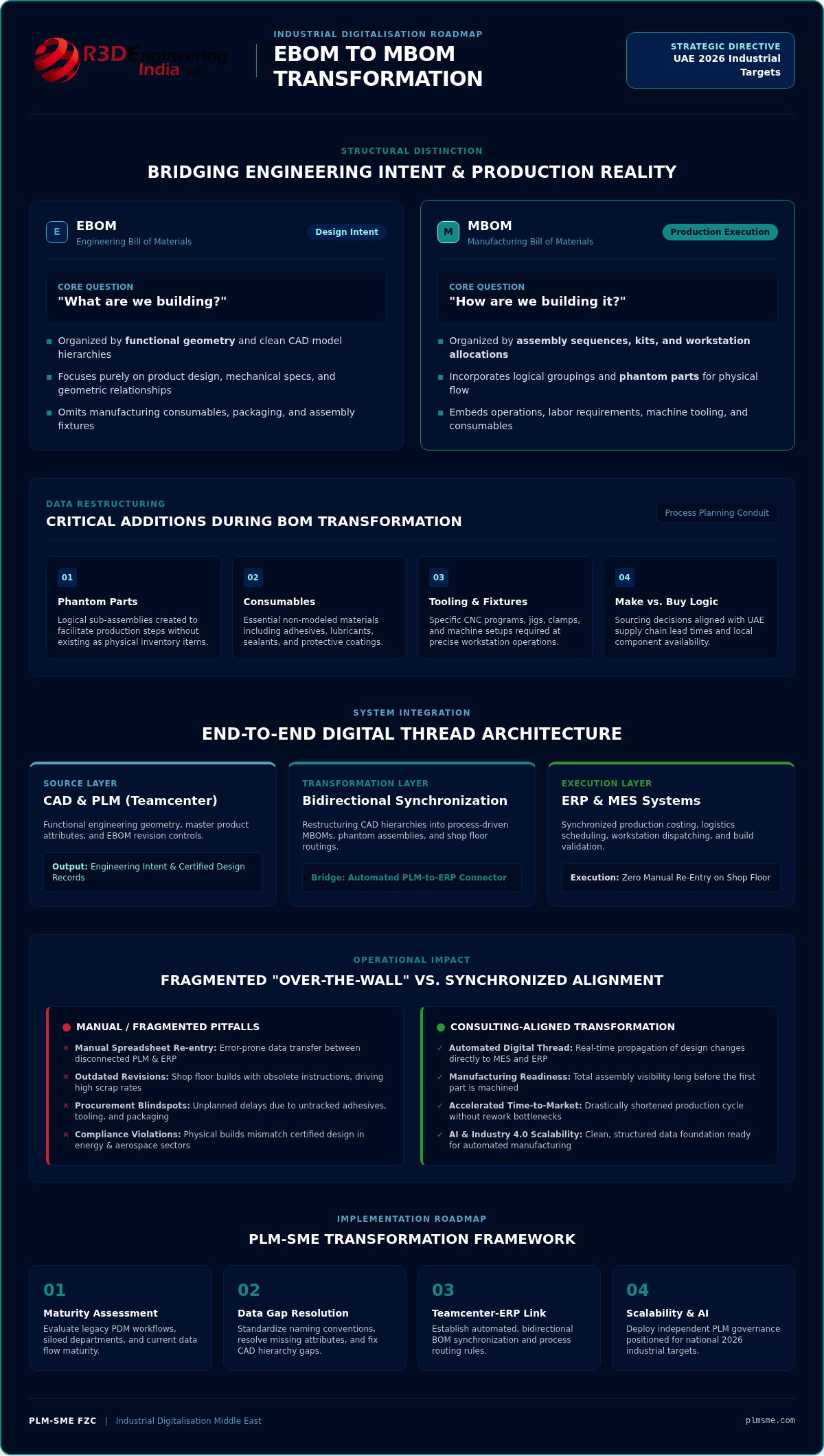
The Engineering Bill of Materials (EBOM) is a functional representation of a product, organized by design intent and geometric relationships. It answers the question: “What are we building?” In contrast, the Manufacturing Bill of Materials (MBOM) answers: “How are we building it?” This shift requires a fundamental restructuring of data that goes beyond a simple file transfer. Expert EBOM to MBOM transformation consulting ensures this transition accounts for the practical realities of the shop floor, such as assembly sequences and workstation constraints.
Manufacturing process planning acts as the conduit for this transformation. It’s the stage where engineers define the specific operations, labor requirements, and machine allocations needed to turn a design into a finished good. Without a bidirectional link between the EBOM and MBOM, any change in design intent can leave manufacturing teams working with obsolete instructions, leading to significant rework and material waste.
Restructuring the Engineering Bill of Materials
Manufacturing engineers must often dismantle the clean hierarchies found in CAD models to create a structure that mirrors the physical assembly process. This involves creating “phantom parts”-logical groupings that don’t exist as physical inventory but facilitate production steps. Decisions regarding “make vs. buy” are finalized here, often influenced by local UAE supply chain availability and lead times. Restructuring also involves adding items that engineering typically omits, such as:
- Consumables: Adhesives, lubricants, and protective coatings.
- Tooling and Fixtures: Specific jigs or CNC programs required for a particular station.
- Packaging: Shipping containers or internal transport kits.
Maintaining CAD data as the single source of truth during this process is vital. Any divergence without a synchronized link risks creating “dark data” that isn’t reflected in the final product record.
Synchronizing Change Management
One of the greatest risks to production stability is the Engineering Change Order (ECO). When design modifications occur late in the cycle, the impact on a live MBOM can be catastrophic if not managed through a digital thread. EBOM to MBOM transformation consulting focuses on implementing automated impact analysis. This allows manufacturing teams to see exactly how a design change affects current work-in-progress, existing inventory, and scheduled assembly steps.
Establishing a bidirectional link ensures that manufacturing feedback flows back to engineering efficiently. This closed-loop system is a core component of a Digitalisation Vision & Roadmap, ensuring every stakeholder works from the same synchronized data set. By automating these updates, firms can avoid the manual synchronization trap that often leads to production errors and wasted materials.
The PLM-Sme Framework for BOM Transformation Consulting
PLM-Sme FZC operates as a Siemens Teamcenter consulting partner, providing a structured methodology that moves beyond simple software installation. Our framework addresses the cultural and technical silos that often prevent a successful digital thread. Through specialized EBOM to MBOM transformation consulting, we guide manufacturers through a four-phase journey designed to ensure long-term scalability and operational precision in the UAE market.
This methodical approach ensures that the final system isn’t just a repository of parts, but a dynamic engine for production efficiency. By validating the logic in a pilot environment, we mitigate the risks of large-scale deployment. This ensures that the technical handshake between engineering intent and manufacturing reality is reliable before it affects full-scale operations.
Discovery and Gap Analysis
The first phase centers on a comprehensive audit of existing engineering workflows and shop floor requirements. We identify unstructured data currently trapped in isolated spreadsheets, personal emails, or paper-based notes. These information silos are the primary cause of version control failures and production delays. By defining clear KPIs for transformation, such as reduced manual re-entry time, we establish a baseline for success. This phase ensures the technical solution aligns with actual human processes on the factory floor rather than forcing a one-size-fits-all software model.
Solution Architecture and Roadmap Development
Moving from discovery to execution requires Building a Strategic Industrial Digitalisation Roadmap for UAE Manufacturing in 2026. We design a system architecture that connects Siemens Teamcenter with your ERP and MES layers. This involves selecting specific modules, such as the Manufacturing Process Planner, to manage the restructuring logic discussed earlier. Our architecture design prioritizes PLM-ERP-MES connectivity, ensuring that manufacturing-specific items and assembly sequences are synchronized across all platforms.
Our roadmap focuses on several critical workstreams:
- Data Migration: Establishing clear strategies to move data from legacy PDM systems without losing history.
- AI Readiness: Ensuring all BOM data is clean, structured, and accessible for future industrial automation.
- Validation: Executing pilot implementations to test the transformation logic against real-world production scenarios.
This phase results in a comprehensive plan that balances technical configuration with organizational readiness. It provides a clear path forward, allowing technical specialists to understand the “how” while executive decision-makers maintain oversight of the “why.” By the end of this phase, the digital thread is no longer a concept but a documented, executable strategy that supports EBOM to MBOM transformation consulting objectives.
Architecting the Digital Thread: Teamcenter and ERP Integration
Establishing a robust digital thread requires more than just connecting software; it demands a deep understanding of how data matures as it moves through different lifecycle stages. Professional PLM system architecture consulting is vital for maintaining BOM integrity during this journey. Without a clearly defined architecture, the technical handshake between Siemens Teamcenter and the Enterprise Resource Planning (ERP) system becomes a source of friction. The PLM system must own the manufacturing intent (the MBOM), while the ERP system manages the logistical execution, including costing, procurement, and inventory levels.
Closing the loop between these systems often involves a Manufacturing Operations Management (MOM) layer. This integration ensures that work instructions and assembly sequences defined in the MBOM are executed accurately on the factory floor. For companies dealing with complex, customer-specific orders, a Teamcenter CRM integration allows manufacturing requirements to be tailored directly to sales configurations. This end-to-end connectivity ensures that the final physical product remains perfectly synchronized with its digital twin.
The Teamcenter Advantage in BOM Transformation
Siemens Teamcenter provides specialized Multi-BOM capabilities that allow organizations to manage the EBOM, MBOM, and Service BOM (SBOM) within a single environment. A critical feature in this process is the “Accountability Check,” which ensures 100% data coverage between the engineering design and the manufacturing plan. This tool highlights any components present in the EBOM that haven’t yet been accounted for in the MBOM, preventing critical omissions before production begins. These capabilities allow engineers to visualize the entire manufacturing process and identify potential bottlenecks before the first physical prototype is ever built.
Integrating with ERP and MES Systems
Defining data ownership is a primary focus of EBOM to MBOM transformation consulting. A common architectural challenge is deciding which system “owns” the MBOM. In a high-maturity digital environment, the MBOM is typically authored and mastered in the PLM system before being released to the ERP for production scheduling. This flow ensures that complex routing information and work instructions remain linked to the original engineering data. To prevent the accumulation of technical debt and ensure these integrations remain stable, many UAE manufacturers utilize PLM system administration retainers to manage ongoing synchronization and system health.
By architecting these connections with precision, you eliminate the need for manual data re-entry and ensure that every update in engineering reflects automatically in manufacturing. If you’re ready to secure your digital thread, consider how professional system and solution architecture can stabilize your production pipeline.
Future-Proofing Production with Expert PLM Consultancy
Mastering the technical transition between engineering and manufacturing is a prerequisite for achieving the UAE’s ambitious industrial goals. EBOM to MBOM transformation consulting provides the structural foundation required to transition from legacy, manual processes to a fully integrated digital ecosystem. By establishing a clean link between design intent and shop floor execution, manufacturers position themselves to capitalize on emerging technologies. PLM-Sme FZC acts as a neutral partner, ensuring that your digitalization efforts prioritize long-term scalability over short-term software fixes.
Choosing a vendor-independent advisor ensures that the chosen system architecture serves your specific business logic rather than fitting into a pre-packaged software mold. This objectivity is essential for maximizing ROI across complex UAE production environments. As the region moves toward 2026 manufacturing targets, the ability to pivot and scale becomes a primary competitive differentiator. Working with a consultant who understands the nuances of the local industrial landscape allows for a more pragmatic implementation of the digital thread.
Preparing for Industrial AI and Automation
Artificial Intelligence in manufacturing relies on high-fidelity data. A synchronized EBOM-MBOM link provides the structured information AI models need to optimize production schedules and predict material shortages. This digital twin of the manufacturing process allows for predictive manufacturing, where potential failures are identified virtually before physical resources are committed. Integrating these links is a core step for firms seeking industrial automation solutions in the GCC. Scaling this transformation across multiple national production sites ensures that best practices in engineering and assembly are standardized, regardless of the physical location of the factory.
The ROI of Professional BOM Transformation
The financial impact of a successful transformation is measurable through several key performance indicators. Organizations often see a significant reduction in scrap and rework costs by ensuring that the shop floor always works from the most recent engineering revision. Additionally, automating the synchronization between EBOM and MBOM updates drastically shortens engineering change cycle times. This agility is vital for manufacturers handling custom or low-volume production runs where speed and precision are essential for profitability.
Achieving these results requires a clear starting point. To ensure your production infrastructure is ready for the next generation of industrial technology, it’s vital to evaluate your current processes objectively. Start with a comprehensive digital maturity assessment to identify existing silos. Contact PLM-Sme FZC to develop a tailored digitalization roadmap that finally bridges the divide between your engineering vision and manufacturing reality.
Securing Your Lead in UAE Industrial Excellence
Bridging the gap between design intent and factory execution is no longer a luxury for manufacturers aiming to remain competitive. By establishing a robust digital thread, you’ll eliminate manual re-entry errors and ensure your production floor always operates on the most current engineering data. This structural alignment reduces costly scrap and prepares your organization for the next wave of industrial automation. Engaging in specialized EBOM to MBOM transformation consulting provides the roadmap necessary to turn these technical challenges into operational advantages.
As a Siemens Digital Industries Alliance Partner specialized in complex Teamcenter architectures, PLM-Sme FZC supports the national vision for industrial digitalization. We focus on creating resilient system architectures that connect PLM, ERP, and MES layers seamlessly. Identifying your current bottlenecks is the first step toward a synchronized future. Request a Digital Maturity Assessment for Your Manufacturing Operation to define your path forward. Taking control of your data today ensures your operations are ready for the demands of tomorrow.
Frequently Asked Questions
What is the primary difference between an EBOM and an MBOM?
The Engineering Bill of Materials (EBOM) focuses on the product as designed, organized by functional systems and CAD hierarchy. The Manufacturing Bill of Materials (MBOM) represents the product as built, structured by assembly sequences, workstations, and production kits. While the EBOM lists design components, the MBOM includes manufacturing specific items like lubricants, packaging, and tooling. This distinction ensures that the factory floor receives actionable instructions rather than just a list of design parts.
Why do we need a consultant for EBOM to MBOM transformation if we already have PLM software?
Having PLM software provides the platform, but EBOM to MBOM transformation consulting provides the strategic framework and technical architecture needed to use it effectively. Software alone doesn’t define your make vs. buy logic or assembly sequences. Professional consultants align your engineering workflows with shop floor requirements, ensuring that the digital thread is robust. This objective guidance prevents common implementation pitfalls and ensures the system architecture supports long-term scalability across your national operations.
How long does a typical BOM transformation consulting project take?
Project timelines vary based on the complexity of your product structures and existing digital maturity. A typical transformation initiative often spans three to six months for the discovery, architecture design, and pilot validation phases. Highly complex environments with multiple production sites might require longer engagements to ensure full synchronization between PLM and ERP systems. PLM-Sme FZC focuses on a phased approach to deliver measurable improvements early while building toward a comprehensive digitalization roadmap.
Can Siemens Teamcenter automate the entire EBOM to MBOM transition?
Teamcenter provides powerful tools like Multi-BOM management and the Accountability Check to facilitate the transition, but it doesn’t automate the underlying manufacturing logic. Human expertise is required to define how parts are assembled and which consumables are needed at specific workstations. The software serves as the engine that maintains the bidirectional link between structures, ensuring that engineering changes flow into manufacturing instructions without manual data re-entry or loss of data integrity.
What are the most common challenges in integrating PLM with ERP for BOM management?
Common challenges include defining data ownership and managing the synchronization of Engineering Change Orders (ECOs) across platforms. Often, organizations struggle with unstructured data residing in legacy spreadsheets that must be cleaned before integration. Technical hurdles also involve mapping specific attributes between the PLM’s manufacturing view and the ERP’s logistical view. Professional system architecture design is required to ensure the handshake between these systems doesn’t create technical debt or production bottlenecks.
Is a digital maturity assessment mandatory before starting a BOM transformation?
While not strictly mandatory in a legal sense, PLM-Sme FZC considers a digital maturity assessment a critical prerequisite for a successful transformation. Starting without a clear understanding of your current data gaps often leads to expensive rework during the implementation phase. These reports identify where your processes are ready for automation and where manual silos still exist. Establishing this baseline ensures that your investment in new digitalization roadmaps delivers the highest possible return on investment.
How does the UAE National Strategy for Industry and Advanced Technology impact BOM management?
The UAE’s Operation 300bn strategy sets ambitious 2026 targets for industrial growth and digitalization. This national framework encourages manufacturers to adopt Industry 4.0 technologies like digital twins and integrated BOM management to increase local production efficiency. Aligning your EBOM and MBOM structures is a fundamental requirement for meeting these standards. It enables the agility needed to compete in a global market while supporting the UAE’s push toward a knowledge based, technologically advanced industrial sector.
What is the role of AI in future EBOM to MBOM transformation roadmaps?
AI is becoming a vital component in future roadmaps by automating the mapping between design intent and manufacturing execution. Predictive algorithms can analyze historical data to suggest assembly sequences or identify potential material shortages before they occur. A clean, synchronized link between your EBOM and MBOM is the essential fuel for these AI-driven production optimizations. As you move toward industrial automation, structured data becomes the foundation for smarter, self-optimizing factory floors.