
Industrial Digitalization Consulting in Dubai: Strategic UAE Roadmaps for 2026
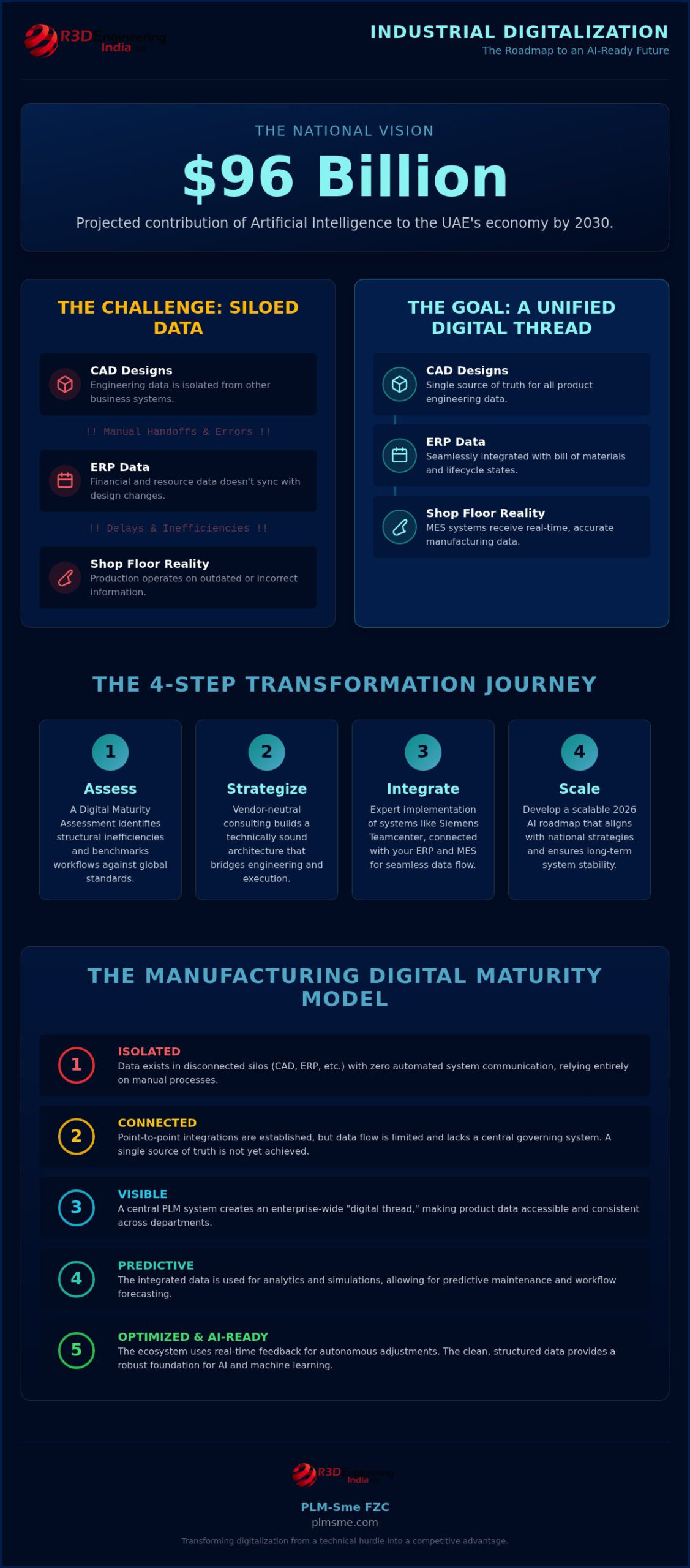
Artificial intelligence is projected to contribute $96 billion to the UAE’s economy by 2030, yet many manufacturers remain trapped by siloed data and legacy workflows. It’s a persistent challenge in the discrete industry where CAD designs, ERP data, and shop floor realities often fail to align. You likely recognize that local competitiveness now requires a unified digital thread rather than a collection of isolated tools. Partnering with specialized industrial digitalization consulting Dubai experts allows you to move beyond vendor-driven hype toward a neutral, technically sound architecture that bridges the gap between engineering and execution.
We understand the frustration of managing complex PLM implementations that result in technical debt instead of operational clarity. This article explains how to transition from fragmented systems to AI-ready, integrated ecosystems. You’ll discover how a structured digital maturity report provides the necessary roadmap for 2026 and beyond. We’ll examine the specific methodologies for integrating Siemens Teamcenter with ERP and MES systems, ensuring your data flows seamlessly across the product lifecycle. By the end, you’ll have a clear strategy for building a scalable AI roadmap that supports the national vision for industrial automation.
Key Takeaways
- Learn how a comprehensive digital maturity assessment identifies structural inefficiencies and benchmarks engineering workflows against global standards.
- Discover why specialized industrial digitalization consulting Dubai is critical for transitioning from legacy manufacturing processes to AI-ready environments.
- Understand the technical requirements for integrating Siemens Teamcenter with ERP and MES systems to create a seamless digital thread.
- Gain a clear framework for architecting a scalable 2026 roadmap that aligns with national UAE strategies for industrial automation.
- Identify the advantages of partnering with a boutique PLM specialist to ensure high-skill execution and long-term system stability.
Defining Industrial Digitalization Consulting in Dubai and the UAE
Industrial digitalization consulting Dubai acts as the strategic bridge connecting complex engineering data with overarching business objectives. Within the national manufacturing landscape, this discipline involves more than just implementing software; it’s about creating a cohesive framework where every design change and production metric is visible across the enterprise. As the nation pivots toward the Fourth Industrial Revolution, the need for a structured approach to data has never been higher. This transition requires a neutral system architect capable of aligning technical capabilities with long-term commercial growth.
Many national manufacturers discover that generic IT firms lack the domain-specific knowledge required for industrial environments. While an IT provider might excel at office networking or cloud storage, they often struggle with the intricacies of PLM data structures or real-time shop floor integration. Specialized consultants bring a deep understanding of discrete manufacturing, ensuring that digital tools support the physical reality of production. By serving as an independent guide, these experts help facilities move away from vendor-locked solutions toward an agile, integrated ecosystem.
The Role of a Thinking Partner in Digital Transformation
A true thinking partner does more than execute technical tasks; they engage deeply with a company’s long-term vision. This relationship differentiates independent strategic consultants from software vendors who are primarily focused on license sales. By maintaining a vendor-neutral stance, a consultant can objectively evaluate multi-system environments to find the most cost-effective path forward. This focus on long-term stability ensures that the digital thread remains intact as the business evolves, preventing the fragmentation that often plagues rapid technology adoption.
Strategic Goals for National Industrial Leaders
National industrial leaders are increasingly aligning their internal roadmaps with broader economic diversification strategies. These initiatives prioritize the development of a knowledge-based economy where high-tech production and AI-driven efficiency are the norm. Achieving these goals requires a relentless focus on reducing technical debt through professional system architecture. By establishing a robust digital foundation today through professional industrial digitalization consulting Dubai, manufacturers ensure they can scale their operations without being held back by legacy bottlenecks. It’s a methodical progression that transforms digitalization from a technical hurdle into a powerful competitive advantage.
Performing Digital Maturity Assessments to Identify Structural Inefficiencies
A digital maturity assessment serves as the diagnostic phase of any industrial transformation. It provides a baseline for comparing current engineering workflows against international benchmarks like Industry 4.0 frameworks. Without this step, manufacturers risk investing in high-end software that merely automates existing inefficiencies. Professional industrial digitalization consulting Dubai focuses on uncovering these structural gaps before any code is written or licenses are purchased. It’s about understanding the “as-is” state to build a realistic “to-be” vision.
Most inefficiencies stem from disconnected “data islands.” For example, when a design change occurs in a CAD environment, it often requires manual updates in the ERP system. These manual handoffs introduce errors and significant delays. Transitioning to automated data flows ensures that a single source of truth governs the entire product lifecycle. We identify these common data gaps to prevent the accumulation of technical debt during the implementation phase.
Analyzing the Manufacturing Digital Maturity Model
The journey toward excellence involves moving through distinct stages of digital sophistication. We categorize these levels to help stakeholders visualize their progress and set achievable milestones. The levels typically range from “Isolated,” where data exists in silos with zero system communication, to “Optimized,” where the environment uses real-time feedback for autonomous adjustments. Securing a comprehensive digital maturity report manufacturing is the most effective way to pinpoint where your facility sits on this spectrum and what specific steps are needed to reach the next tier.
Identifying AI Readiness in Industrial Environments
As the nation accelerates its UAE’s Digital Economy Strategy, the focus has shifted toward AI-driven production. However, machine learning algorithms are only as effective as the data they consume. If your shop floor data is locked in paper logs or unstructured spreadsheets, AI remains out of reach. We evaluate the accessibility and quality of your industrial data to determine if it’s ready for predictive analytics. Our industrial digitalization consulting Dubai services include a thorough evaluation of your CAD, CAM, and CAE data management systems to ensure they can support advanced AI models.
A typical readiness checklist for executive stakeholders includes verifying centralized data management, real-time shop floor connectivity, and standardized metadata structures across all departments. By addressing these foundational elements, you ensure that future automation projects deliver a measurable return on investment. If you’re ready to identify your specific roadblocks, our team can help you develop a strategic roadmap tailored to your facility’s unique requirements.
Architecting Siemens Teamcenter Solutions for National Industrial Leaders
Siemens Teamcenter stands as the industry-standard backbone for discrete manufacturing across the UAE. As of June 2026, the release of version 2606 has introduced significant advancements in AI integration and digital thread visibility, making it the central data authority for modern facilities. Implementing such a complex platform requires a methodical approach that extends far beyond simple software installation. Professional industrial digitalization consulting Dubai ensures that the system architecture supports the long-term lifecycle of high-value engineering assets while maintaining a neutral, vendor-independent perspective.
A successful end-to-end implementation begins with a robust architecture and concludes with meticulous data migration from legacy systems. This process ensures that historical engineering data remains accessible and accurate within the new environment. Engaging a specialized Siemens Teamcenter consulting partner is essential for navigating these technical complexities. It allows manufacturers to leverage deep domain expertise, ensuring that the software configuration aligns with specific operational workflows rather than forcing the business to adapt to the tool.
Maximizing ROI through System Integration
The true value of a PLM platform is realized only when it communicates effectively with other enterprise systems. Establishing a technical connection between Teamcenter and ERP platforms like SAP or Oracle eliminates manual Bill of Materials (BOM) entry. This synchronization reduces human error and accelerates time-to-market. Additionally, exploring Teamcenter CRM integration benefits helps align the sales-to-engineering pipeline. It ensures that customer requirements are accurately reflected in technical designs from the earliest stages.
Closing the loop requires integrating PLM with Manufacturing Operations Management (MOM) and MES systems. This integration provides engineering teams with real-time feedback from the shop floor, enabling faster design iterations. By creating a unified digital ecosystem, manufacturers achieve a higher return on investment and a more agile response to market changes. It’s about turning data into a strategic asset that drives continuous improvement.
Sustainable PLM System Administration
Maintaining the health of a complex PLM environment requires ongoing, proactive oversight. Relying on a retainer-based administration model ensures that the system remains optimized and secure without the overhead of a large in-house team. This approach reduces downtime through scheduled health checks and expert solution architecture. It also addresses the specific needs of CAD, CAM, and CAE extensions within the Teamcenter environment. These specialized tools must be managed carefully to ensure engineers perform at peak efficiency. A stable system architecture is the foundation upon which all future industrial digitalization efforts are built.
Building a Future-Proof AI Roadmap for Manufacturing Excellence
Industrial digitalization consulting Dubai provides the structural discipline required to transform raw factory data into actionable intelligence. While many organizations rush to deploy machine learning models, success depends on the underlying data architecture. Creating a comprehensive industrial digitalization roadmap UAE ensures that technology investments align with long-term commercial goals. This roadmap serves as a living document, evolving alongside your facility’s digital maturity while maintaining focus on high-impact use cases like predictive maintenance and automated quality control.
Integrating AI into a manufacturing environment isn’t a standalone project. It’s the culmination of a connected digital thread. AI algorithms require high-quality, contextualized data from PLM and automation systems to generate reliable predictions. Without this integration, AI remains a speculative tool rather than a core operational asset. Governance and risk management are also vital; you must ensure data sovereignty and cybersecurity protocols meet the evolving national standards for industrial data handling.
Phasing the Digital Transformation Journey
A methodical approach prevents the accumulation of technical debt and ensures each phase delivers measurable value. We recommend a three-step progression:
- Step 1: Foundation (PLM & Data Cleaning). Centralizing engineering data within a platform like Siemens Teamcenter ensures your “source of truth” is accurate and accessible.
- Step 2: Integration (ERP & MES Connectivity). Synchronizing design data with shop floor execution allows for real-time visibility across the entire production lifecycle.
- Step 3: Intelligence (AI & Machine Learning Implementation). Once the data pipeline is stable, you can deploy advanced analytics to optimize throughput and reduce waste.
Trends in Industrial Automation and AI Solutions
The regional market is seeing a rapid acceleration in industrial automation solutions GCC, particularly in the adoption of Digital Twins. These virtual replicas allow engineers to simulate production changes before they’re implemented on the physical floor, significantly reducing downtime. In 2026, AI is no longer just for predicting failures. It’s optimizing the entire Product Lifecycle, from generative design iterations to end-of-life recycling strategies. This holistic view ensures that your facility remains competitive in a knowledge-based economy.
As you move toward a more autonomous production environment, the complexity of your system architecture will grow. Maintaining control over these interconnected processes requires a partner that understands both high-level strategy and technical execution. If you’re ready to define your next steps, you can request a consultation for your AI roadmap to ensure your digital foundation is ready for the future of manufacturing.
Delivering Results-Oriented Digital Transformation with PLM-Sme FZC
Realizing a successful digital transformation requires a partner that prioritizes system integrity over software license quotas. By engaging in specialized PLM system architecture consulting, national manufacturers ensure that their digital thread remains robust and scalable. PLM-Sme FZC operates as a boutique entity, focusing on high-skill execution rather than mass-market solutions. This approach allows for a deeper engagement with a facility’s unique engineering challenges, ensuring that the resulting architecture is technically sound and aligned with long-term operational goals. Choosing industrial digitalization consulting Dubai specialists who understand the national industrial landscape is the most effective way to avoid the pitfalls of vendor-driven implementation. This partnership ensures that your system architecture isn’t just a software installation but a strategic asset that bridges the gap between the shop floor and executive decision-making.
System health isn’t a one-time achievement; it’s a continuous process of optimization. PLM-Sme FZC provides ongoing support through system administration retainers, allowing manufacturers to maintain peak performance without the need for a large in-house technical team. These retainers offer proactive solution architecture and integration development, ensuring that your Siemens Teamcenter environment evolves alongside your production needs. This model provides the stability required to manage complex CAD, CAM, and CAE extensions while reducing the risk of unexpected downtime. It ensures that the digital foundation remains agile enough to support the advanced AI roadmaps and digital twin simulations discussed earlier.
Why UAE Manufacturers Choose Specialized PLM Partners
The advantage of working with a localized specialist like PLM-Sme FZC lies in our regional market understanding and direct access to Siemens Digital Industries Alliance Partner resources. Unlike generic firms, we provide bespoke solutions designed to fit into existing multi-vendor environments. Since our founding in 2017, we’ve focused exclusively on the discrete industry, providing the wisdom needed to navigate complex digitalization projects without the overhead of larger, less agile firms. Our status as an independent consultant allows us to serve as a thinking partner, engaging deeply with your vision to create tailored quality that mass-market packages simply cannot offer.
Starting Your Digitalization Journey
A digital maturity assessment serves as the starting point for any successful transformation. During the first 90 days of an implementation project, we prioritize stabilizing the core data environment and establishing clear communication between engineering and business systems. This initial phase is critical for setting the pace of the entire roadmap and ensuring that early milestones are met with technical precision. If you’re ready to move toward an AI-ready facility and eliminate the data silos currently hindering your production, we invite you to begin with a comprehensive assessment to define your specific path forward.
Securing Your Competitive Edge in the UAE’s Digital Economy
Transitioning from fragmented legacy workflows to a unified digital thread is a strategic necessity for manufacturers aiming to stay competitive. You’ve seen how a structured maturity assessment identifies structural inefficiencies and how a robust Siemens Teamcenter architecture bridges the gap between engineering and the shop floor. By prioritizing deep system integration over isolated software tools, your facility can build a scalable foundation for the AI-driven production cycles of 2026. Professional industrial digitalization consulting Dubai ensures these transitions are managed with technical precision rather than vendor-driven hype.
As an independent Siemens Digital Industries Alliance Partner, PLM-Sme provides the technical objectivity required to navigate these complex transitions. Our boutique consultancy specializes in the seamless integration of Teamcenter with ERP and MES systems, ensuring your data remains accurate and actionable across the entire product lifecycle. Don’t let siloed information hinder your operational growth. You can Request Your Industrial Digital Maturity Assessment today to establish a clear, technical roadmap for your facility. We’re ready to partner with you in turning high-level strategic vision into grounded, practical execution.
Frequently Asked Questions
What is the role of an industrial digitalization consultant?
As a thinking partner, the consultant moves beyond software installation to engage with your long-term vision. They provide the objective system architecture needed to ensure technical decisions serve operational goals. This independent oversight is a hallmark of professional industrial digitalization consulting Dubai, helping manufacturers avoid vendor lock-in while building a sustainable digital thread that connects engineering and production departments.
How long does a typical Siemens Teamcenter implementation take in the UAE?
Most end-to-end Siemens Teamcenter implementations for national enterprises require between six and twelve months. This timeframe allows for thorough solution architecture, secure data migration from legacy systems, and essential user training. A phased approach ensures that core functionalities are stabilized before moving to complex integrations, allowing the business to maintain operational continuity while transitioning to a more sophisticated PLM environment.
Why is a digital maturity assessment necessary before buying PLM software?
The assessment acts as a technical audit that prevents you from automating existing inefficiencies. It produces a detailed digital maturity report that serves as a foundation for your 2026 roadmap. By identifying specific data gaps early, you can allocate resources more effectively and avoid the hidden costs of technical debt. This diagnostic step is critical for ensuring that any subsequent software investment delivers a measurable return.
Can PLM systems like Teamcenter integrate with my existing ERP and MES?
Yes, creating a seamless connection between PLM and your existing ERP or MES is a primary objective of our integration development services. We focus on synchronizing Bill of Materials (BOM) data and engineering changes across all platforms. This technical alignment ensures that your design office and shop floor always work from the same data, significantly reducing the errors typically caused by manual handoffs between disconnected systems.
What are the key benefits of an industrial AI roadmap for manufacturers?
A strategic AI roadmap prioritizes use cases that offer the highest impact, such as predictive maintenance and automated quality oversight. Beyond immediate efficiency gains, it establishes the governance and risk management protocols necessary for handling sensitive industrial data. This structured plan ensures your facility is ready to adopt emerging technologies like agentic AI as they become foundational to the national industrial strategy.
Is PLM-Sme FZC an independent consultant or a software vendor?
PLM-Sme FZC is an independent consultancy, not a software vendor. We don’t sell off-the-shelf licenses, which allows us to maintain total objectivity when designing your system architecture. Our status as a Siemens Digital Industries Alliance Partner confirms our technical expertise, but our primary loyalty is to the client’s long-term vision. We function as a collaborative guide throughout the entire digitalization journey with professional industrial digitalization consulting Dubai.
What industries do your digitalization services focus on?
PLM-Sme FZC focuses exclusively on the discrete manufacturing industry. Our expertise is tailored to sectors such as aerospace, automotive, industrial machinery, and high-tech electronics. We specialize in environments where complex engineering data and long product lifecycles require precise management. This niche focus allows us to provide more relevant, high-skill advice compared to generic firms that attempt to cover both discrete and process industries.
How does industrial digitalization reduce operational costs in the long term?
Long-term cost reduction is achieved by eliminating the systemic waste caused by siloed data and manual workflows. By establishing a unified digital thread, you reduce the time-to-market for new products and minimize the cost of engineering changes. Additionally, proactive system administration and a scalable architecture prevent the accumulation of technical debt, ensuring that your digital infrastructure remains cost-effective as your production volume and complexity increase.