
Selecting a PLM Implementation Partner in the GCC: A Strategic Guide
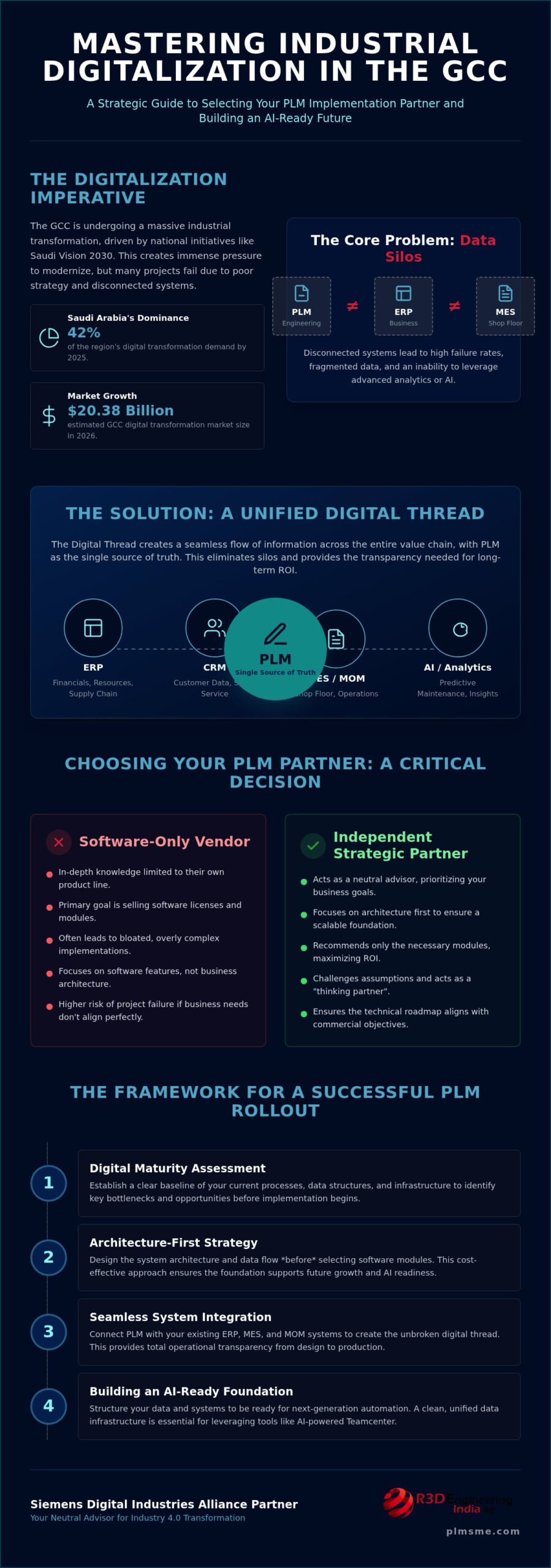
With Saudi Arabia alone accounting for 42% of the regional demand for digital transformation in 2025, the pressure to modernize industrial operations has never been higher. Yet, many organizations find that their complex software deployments result in high failure rates and persistent data silos between engineering and the shop floor. You know that a PLM system shouldn’t just be a digital filing cabinet; it must function as the backbone of your entire production lifecycle. Finding the right PLM implementation partner GCC is the difference between a stalled project and a seamless, AI-ready ecosystem.
This strategic guide provides a framework for evaluating partners based on technical expertise and their ability to integrate PLM, ERP, and MES environments effectively. You’ll discover how to secure your industrial digitalization roadmap while preparing your data infrastructure for the latest innovations, such as the AI-powered Teamcenter 2606. We’ll explore the essential criteria for selecting a neutral advisor who prioritizes your long-term ROI over software licensing quotas; ensuring your transition to Industry 4.0 is both structured and successful.
Key Takeaways
- Learn why selecting a specialized PLM implementation partner GCC is essential for navigating the region’s rapid industrial expansion and avoiding common deployment failures.
- Understand the strategic advantage of choosing a neutral Siemens Digital Industries Alliance Partner over software-only vendors to ensure unbiased, architecture-first decision-making.
- Discover how a comprehensive digital maturity assessment serves as the critical foundation for any successful Siemens Teamcenter rollout and long-term ROI.
- Explore technical strategies for integrating PLM with ERP, MES, and CRM systems to eliminate data silos and establish a seamless digital thread across your enterprise.
- Identify the necessary steps to build an AI-ready data infrastructure that secures your digitalization roadmap and prepares your operations for next-generation automation.
Navigating Industrial Digitalization in the GCC Landscape
The Gulf Cooperation Council (GCC) region is currently experiencing a profound industrial shift. With Saudi Arabia alone accounting for approximately 42% of the regional demand for digital transformation services in 2025, the scale of expansion is unprecedented. In this environment, Product Lifecycle Management (PLM) implementation has evolved from a back-office engineering requirement into a core strategic pillar. It’s the framework that allows manufacturers to scale rapidly while maintaining control over complex product data. However, many organizations face high failure rates because they treat PLM as a standalone software purchase rather than an architectural foundation. Selecting a specialized PLM implementation partner GCC is the most critical decision a manufacturer can make to ensure their digitalization roadmap doesn’t stall at the pilot phase.
The Evolving GCC Manufacturing Sector
National strategic initiatives, including Saudi Arabia’s Vision 2030 and the UAE’s Industrial Strategy 2031, have accelerated the push toward the “Industry 4.0” standard. Manufacturers are no longer just focused on output; they’re pivoting toward smart factories that prioritize sustainability and operational transparency. This transition requires more than just new machinery. It demands a sophisticated digital infrastructure that can handle the regional digital transformation market, which is estimated to reach USD 20.38 billion in 2026. Local expertise is vital during this phase. A partner who understands regional regulatory requirements and operational nuances can help you navigate the complexities of local supply chains while ensuring your systems meet international benchmarks for efficiency.
Defining the Digital Thread in Modern Industry
At the heart of any successful industrial digitalization effort is the digital thread. This concept describes the interconnected flow of information across the entire value chain. When you use Siemens Teamcenter as your backbone, PLM serves as the single source of truth for both engineering teams and the shop floor. It eliminates the data silos that typically exist between PLM, ERP, and MES systems. The digital thread is the seamless flow of data from concept to retirement. Without this continuity, your data remains fragmented, making it impossible to leverage advanced AI tools or predictive analytics. A competent PLM implementation partner GCC ensures that this thread remains unbroken, providing the transparency needed to justify digitalization investments and secure long-term ROI.
Evaluating Your PLM Implementation Partner: Independence vs. Vendor Bias
Choosing a PLM implementation partner GCC involves more than checking a list of technical skills. It requires distinguishing between partners who sell software licenses and those who architect business solutions. A software-only vendor is often incentivized by license quotas, which can lead to bloated implementations where you pay for modules you don’t need. Conversely, an independent partner acts as a neutral advisor. They focus on whether the system actually solves your engineering bottlenecks rather than simply meeting a sales target.
Success in industrial digitalization depends on having a “thinking partner” who engages with your long-term vision. This type of specialist doesn’t just execute a task list; they challenge assumptions and offer bespoke advice based on experience with complex industrial challenges. This collaborative spirit builds trust and ensures that the final architecture serves the business rather than the software provider. Selecting the right PLM implementation partner GCC ensures that your technical roadmap remains aligned with your commercial objectives.
The Value of Independent Strategic Consulting
Getting the architecture right before committing to specific software modules is the most cost-effective way to deploy PLM. An independent partner prioritizes your specific business goals, ensuring that the system scales as your production grows. This is where the role of PLM in system architecture consulting becomes vital. By focusing on the structural integrity of your data flow first, you avoid the common trap of high failure rates seen in vendor-led projects. It’s about building a foundation that supports future AI readiness without unnecessary overhead.
Technical Literacy and Professional Authority
Technical background is non-negotiable. A reliable partner should hold Siemens Teamcenter certifications and demonstrate a deep understanding of CAD, CAM, and CAE extensions. Many GCC manufacturers currently struggle with technical debt, which is often characterized by years of fragmented legacy data stored in disparate formats. Your partner must be capable of handling complex data migrations without compromising data integrity.
They should also possess the wisdom to navigate regional operational standards. This involves understanding how to bridge the gap between engineering and the shop floor using specialized integrations for ERP, CRM, and MES. If you’re unsure where your current infrastructure stands, starting with a digital maturity assessment can provide the clarity needed to proceed with confidence.
Executing End-to-End Siemens Teamcenter Implementation
Successful implementation of a Siemens Teamcenter environment requires a methodical progression that moves from high-level strategy to granular technical execution. A reliable PLM implementation partner GCC views the rollout as a strategic lifecycle rather than a one-time software installation. This process ensures that every configuration choice aligns with the manufacturer’s specific production goals. By following a structured roadmap, organizations avoid the common pitfalls of fragmented data and underutilized software modules.
Phase 1: Digital Maturity and AI Readiness
The strategic value of a digital maturity report in manufacturing is the foundation of any successful project. This assessment identifies gaps in current engineering workflows and highlights where manual processes create bottlenecks. With the release of Siemens Teamcenter 2606 in June 2026, AI-powered tools like the “Teamcenter Copilot” and AI BOM agents have become central to modern digitalization. Your partner must define an AI roadmap before technical execution begins; ensuring your data infrastructure is clean enough to leverage these automated agents. In the current regional climate, AI readiness has transitioned from a future goal to a standard requirement for industrial digitalization.
Phase 2: System Architecture and Data Migration
Designing a scalable system architecture is the next priority. The environment must be tailored to discrete industry needs, supporting complex Bill of Materials (BOM) management and deep CAD/CAM integration. Secure and accurate data migration from legacy systems is often the most technical hurdle in this phase. A professional PLM implementation partner GCC manages this transition by cleaning and mapping data to maintain integrity. This robust architecture ensures that the system can support future industrial automation solutions in the GCC, creating a foundation where engineering and the shop floor communicate without friction.
Once deployment is complete, the focus shifts to maintaining long-term system health. Utilizing a PLM system administration retainer provides the specialized oversight needed to manage updates, user permissions, and performance tuning. This ongoing support prevents the technical debt and performance degradation that often occur when systems are left unmanaged. It’s this commitment to the entire lifecycle that distinguishes a strategic partner from a simple software vendor.
Architecting System Integrations: Connecting PLM with ERP, MES, and MOM
Industrial digitalization fails when systems operate in isolation. A strategic PLM implementation partner GCC ensures that engineering data doesn’t stop at the CAD workstation; it must flow seamlessly into broader enterprise systems to create a unified data environment. Integrating Siemens Teamcenter with ERP platforms like SAP or Oracle allows for automated transfer of Bill of Materials (BOM) data, which synchronizes procurement and inventory management with actual engineering requirements. This connectivity prevents the manual data entry errors that frequently derail production schedules.
Beyond the back office, connecting engineering with customer-facing departments is becoming a competitive necessity. Unlocking Teamcenter CRM integration benefits ensures that sales and service teams have access to up-to-date product configurations. This visibility reduces the risk of selling unmanufacturable options and improves the accuracy of after-sales support. For GCC manufacturers, this level of system transparency is the only way to justify the significant digital transformation investments required by national industrial strategies.
Bridging the Gap Between Engineering and Production
Direct integration between PLM and Manufacturing Execution Systems (MES) is what truly transforms a factory into a smart facility. This link reduces time-to-market by ensuring that the shop floor always executes the most recent engineering revision. Manufacturing Operations Management (MOM) further enhances this by orchestrating production schedules in direct response to engineering changes. Real-time data flow from the shop floor validates engineering designs. This feedback loop allows engineers to refine products based on actual manufacturing performance, closing the loop of the digital thread.
Developing Custom Teamcenter Integration Modules
Off-the-shelf connectors often aren’t enough for the complex, bespoke environments found in the GCC’s discrete manufacturing sector. Specialized integration development is frequently required to handle unique business logic or legacy system requirements. A competent PLM implementation partner GCC focuses on maintaining data consistency across PLM, ERP, and CRM platforms to prevent the emergence of new data silos. Managing this multi-system architecture requires a partner who understands both the technical API layers and the practicalities of a national industrial context.
Building these bridges is essential for achieving a resilient and scalable digital backbone. If you’re ready to eliminate silos and unify your operations, consider our Teamcenter integration development expertise to secure your production future.
Establishing Your AI Roadmap with PLM-Sme FZC
PLM-Sme FZC operates as an independent Siemens Digital Industries Alliance Partner, focusing on technical excellence rather than software license quotas. We function as a boutique specialist, providing the agility and tailored quality that mass-market providers often lack. This independence allows us to act as a neutral advisor, ensuring that your system architecture serves your specific business goals. Selecting the right PLM implementation partner GCC means finding a team that prioritizes your long-term ROI and AI readiness over simple task execution.
Our role as a “thinking partner” involves engaging deeply with your organization’s vision to navigate the complexities of industrial digitalization. We provide end-to-end support, from initial solution architecture to ongoing maintenance through our PLM system administration retainers. This structured approach ensures that your Teamcenter environment remains optimized, secure, and capable of supporting the high-stakes projects typical of the GCC’s industrial sector. By managing the technical foundation, we allow your internal teams to focus on core manufacturing innovation.
A Collaborative Approach to Industrial Digitalization
A successful digital transformation requires a partner rooted in strategic Siemens Teamcenter consulting. Our methodology emphasizes transparency and objectivity, helping you avoid the bloated implementations that lead to high failure rates. We focus on grounded, practical execution, connecting your broad industry goals with specific technical methodologies. This collaborative spirit ensures that every integration between PLM, ERP, and MES is intentional and cost-effective, building a stable digital backbone that evolves with your production needs.
Next Steps for GCC Manufacturers
The transition toward Industry 4.0 starts with a clear understanding of your current technical state. Requesting a digital maturity report allows you to benchmark your operations against regional standards and identify the specific gaps in your engineering workflows. This data is the essential first step for industrial digitalization roadmap development, providing the clarity needed to justify future investments. It ensures that your organization doesn’t just adopt new software but builds a resilient infrastructure ready for industrial AI.
Preparing for the next wave of automation requires more than just technical skill; it demands a partner who understands the regional landscape. As your PLM implementation partner GCC, we provide the wisdom and technical literacy necessary to secure your digitalization roadmap. Contact us today to begin your comprehensive digital maturity assessment and take the first step toward a seamless, AI-ready industrial future.
Securing Your Industrial Digitalization Roadmap
Successful industrial transformation in the GCC demands more than just software procurement; it requires a robust architectural foundation that bridges the gap between engineering and the shop floor. By prioritizing an independent, architecture-first approach, you ensure your data remains a strategic asset rather than a siloed liability. Selecting the right PLM implementation partner GCC is the most critical step in establishing a seamless digital thread that supports both current operations and future AI-driven automation.
As a Siemens Digital Industries Alliance Partner, PLM-Sme FZC provides the technical literacy and neutral oversight needed to navigate these complex deployments. Our expertise in Siemens Teamcenter architecture ensures your systems are integrated, scalable, and ready for the next generation of industrial innovation. It’s time to move beyond fragmented systems and embrace a unified, data-driven production environment.
Request Your Strategic Digital Maturity Assessment today to benchmark your operations and secure your path toward a resilient, AI-ready future. Your journey to Industry 4.0 starts with a clear vision and a partner committed to your long-term success. We’re ready to help you build a roadmap that delivers measurable value and sustainable growth.
Frequently Asked Questions
What is the role of a PLM implementation partner in the GCC?
A PLM implementation partner GCC acts as a technical architect and strategic guide for modernizing industrial workflows. They don’t just install software; they design a system architecture that manages product data from concept to retirement. Their role includes data migration, system configuration, and ensuring the platform supports regional regulatory standards. By bridging the gap between engineering and production, they help manufacturers scale operations while maintaining a single source of truth for all product information.
How long does a typical Siemens Teamcenter implementation take?
Implementation timelines for Siemens Teamcenter vary significantly based on the project’s scope and the organization’s digital maturity. A standard deployment for a discrete manufacturer typically takes between six to twelve months to reach full operational status. This duration accounts for initial system architecture design, data migration from legacy formats, and user training. Complex environments requiring deep integrations with ERP or MES systems may extend this timeline to ensure data integrity and seamless cross-platform communication.
Why should we choose an independent PLM consultant over a software vendor?
Independent consultants prioritize your business objectives over software license quotas. Unlike vendors who focus on selling modules, an independent PLM implementation partner GCC offers objective advice on system architecture. This neutrality ensures you invest only in functionality that delivers ROI. As a Siemens Digital Industries Alliance Partner, we provide high-level strategic vision and grounded execution, acting as a “thinking partner” rather than a biased software reseller focused on volume-based licensing targets.
What are the benefits of integrating PLM with ERP and MES systems?
Integrating these systems creates a digital thread that eliminates data silos between the back office and the shop floor. When PLM connects with ERP, it automates the transfer of Bill of Materials (BOM) data, reducing procurement errors. Connecting with MES ensures that production teams always work with the latest engineering revisions. This real-time visibility reduces time-to-market and manufacturing errors, providing the transparency needed to justify digitalization investments in a competitive regional landscape.
How does a digital maturity assessment help in PLM planning?
A digital maturity assessment serves as the critical first step in identifying technical gaps and operational bottlenecks. It provides a benchmark of your current engineering workflows, allowing you to build a structured digitalization roadmap. Without this initial report, organizations often face high failure rates due to poorly defined goals or mismatched system architectures. This assessment ensures that your PLM strategy is grounded in reality, helping you prioritize high-impact improvements that align with your long-term industrial vision.
Does PLM-Sme FZC provide ongoing support after implementation?
Yes, we provide continuous oversight through a specialized PLM system administration retainer. This service ensures that your Siemens Teamcenter environment remains optimized and secure long after the initial rollout. Ongoing support includes managing system updates, performance tuning, and user permissions to prevent technical debt. Having a dedicated partner for system administration allows your internal teams to focus on core production tasks while we ensure the stability and scalability of your digital infrastructure.
What is an AI roadmap for manufacturing, and why do I need one?
An AI roadmap is a strategic plan that prepares your data infrastructure for advanced automation and machine learning tools. With the release of Teamcenter 2606 in June 2026, features like the AI BOM agent have become vital for simplifying workflows. You need this roadmap to ensure your data is clean and structured enough for AI to process effectively. It secures your future-readiness by identifying how next-generation technologies will enhance your specific manufacturing processes and operational efficiency.