
5 Critical Signs Your Manufacturing Operation Needs a PLM System in 2026
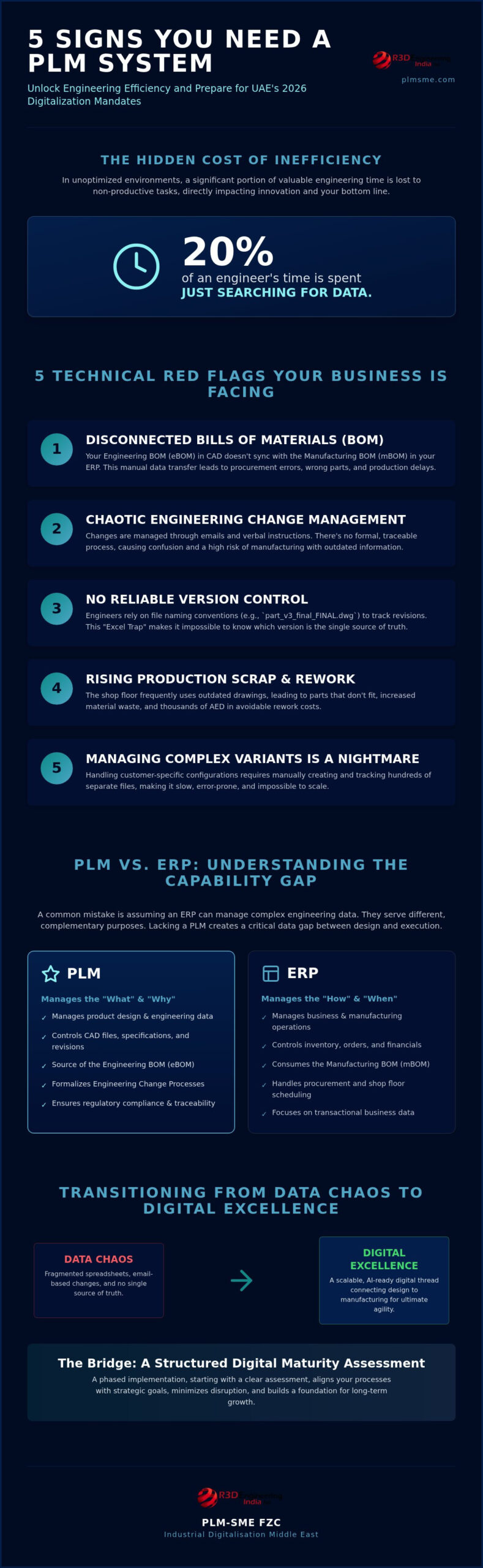
Did you know that engineers in unoptimized manufacturing environments spend over 20% of their time simply searching for data instead of designing products? It’s a staggering waste of technical talent that directly impacts your bottom line. If you’ve noticed that production scrap is rising because of inaccurate Bills of Materials, or if managing complex product variants has become a manual nightmare, you’re likely seeing the first signs you need a PLM system. These operational bottlenecks aren’t just minor inconveniences. They’re clear indicators that your legacy data management tools can no longer keep pace with the UAE’s accelerating industrial digitalization mandates for 2026.
We understand that justifying a major software investment requires more than just a feeling that things are inefficient. You need a structured way to prove value to your stakeholders. This article identifies the specific red flags that signal your engineering and production data requires a professional PLM framework. We’ll also clarify the critical differences between PLM and ERP capabilities, using solutions like Siemens Teamcenter as a benchmark for scalable digital maturity. This provides you with a clear roadmap to transition from fragmented spreadsheets to a scalable, AI-ready digital thread that supports your long-term vision.
Key Takeaways
- Identify the hidden financial impact of the “Excel Trap” by quantifying the time your engineering team loses to manual data retrieval and administrative tasks.
- Recognize the five technical signs you need a PLM system, specifically focusing on critical discrepancies between your engineering and manufacturing Bills of Materials.
- Understand the fundamental capability gap between ERP and PLM systems to prevent your complex design data from being lost during the transition to execution.
- Learn how a structured digital maturity assessment aligns your manufacturing processes with the UAE’s industrial digitalization mandates for 2026.
- Discover the strategic advantage of a phased implementation approach to minimize operational disruption while building a scalable digital thread.
Identifying the Hidden Costs of Manual Product Data Management
Manufacturing leaders often rely on spreadsheets to manage complex data because they’re familiar and require no upfront software investment. However, this “Excel Trap” creates a fragmented environment where no single source of truth exists. When engineering data is trapped in isolated files, version control becomes nearly impossible to maintain. This lack of transparency is one of the primary signs you need a PLM system. Without a centralized framework for Product Lifecycle Management, your organization accumulates “Dark Data”-information that’s collected but remains inaccessible for strategic decision-making. This visibility gap directly hinders your ability to comply with the UAE’s evolving industrial digitalization mandates for 2026, which demand higher levels of traceability and data integrity.
Manual workflows also create a significant barrier to manufacturing agility. When engineering changes are managed through email threads and physical folders, the time required to implement a modification increases exponentially. This delay prevents firms from responding quickly to market shifts or customer requests for complex variants. As the national industrial strategy pushes toward more advanced automation and AI integration, relying on manual data handling becomes a significant liability. A professional system architecture ensures that data flows seamlessly from design to execution, eliminating the bottlenecks that characterize legacy operations.
Escalating Cost of Production Scrap and Rework
Manual data management inevitably leads to the shop floor receiving outdated drawing versions. When a machinist works from Revision B while Engineering has already released Revision C, the result is immediate production scrap. These errors aren’t just isolated incidents; they create a ripple effect across the entire supply chain. Inaccurate Bills of Materials (BOM) lead to incorrect procurement, resulting in excess inventory or critical shortages. By synchronizing data access through a professional framework, manufacturers can mitigate these “hidden” financial drains that often cost thousands of AED in avoidable rework and material waste.
Erosion of Engineering Productivity
The ratio of searching to designing is a critical metric for operational health. Industry data suggests that engineers in manual environments spend more than 20% of their day hunting for the correct file or re-entering data into disconnected systems. This redundant administrative burden doesn’t just stall product development; it actively erodes team morale. In a competitive industrial landscape, talented engineers want to focus on innovation rather than data entry. High turnover rates among technical staff are often subtle signs you need a PLM system to provide the sophisticated, reliable tools your workforce expects to perform at a high level.
5 Technical Red Flags: Signs You Need a PLM System Now
Technical bottlenecks in a manufacturing environment often signal that your existing data management tools have reached their functional limit. While spreadsheets and local servers might suffice for simple components, they fail to support the multi-layered requirements of modern discrete manufacturing. Identifying these red flags early allows you to transition toward a structured digital framework before operational inefficiencies impact your market position. These signs you need a PLM system are often most visible at the intersection of engineering design and shop floor execution, where data silos create the most friction.
Red Flag 1: The Disconnected Bill of Materials
BOM fragmentation represents a critical technical failure. When your Engineering BOM (eBOM) exists in a CAD environment while the Manufacturing BOM (mBOM) lives in a separate ERP or spreadsheet, discrepancies are inevitable. Manual synchronization is a recipe for procurement disasters because it relies on human entry to match part numbers and quantities across disconnected silos. According to IBM on Product Lifecycle Management, integrating these data streams is essential to eliminate silos and ensure compliance. Unified BOM synchronization is a core PLM requirement that ensures every department works from the same structural definition.
Red Flag 2: Engineering Change Management (ECM) Failures
ECM failures often manifest as administrative bottlenecks. In many UAE firms, a single senior engineer or manager becomes the “bottleneck” persona, manually reviewing every change request via email or physical sign-offs. This lack of a structured workflow creates a high risk of unauthorized or unverified changes reaching the shop floor, leading to significant rework. A professional PLM framework automates the ECM process, providing total transparency and an immutable audit trail for every modification. This ensures that only validated designs proceed to production, protecting your operational integrity.
Collaboration breakdowns also result in significant delays for cross-functional approvals. When procurement, quality, and manufacturing teams cannot access real-time design data, the entire production cycle slows down. This difficulty in integrating CAD data with downstream ERP and MES systems creates a “wall” where information is lost in transition. If your team struggles to track variants and options without creating entirely new document sets, your current system has reached its limit. These persistent technical signs you need a PLM system suggest that your current infrastructure cannot support the high-speed requirements of modern manufacturing. If you are noticing these patterns, conducting a digital maturity assessment is a logical next step to identify specific architectural gaps.
PLM vs. ERP: Understanding the Capability Gap
Many manufacturers reach a point where their ERP system feels cluttered or insufficient for technical data. This frustration usually stems from a fundamental misunderstanding of software intent. ERP systems are designed for transactional efficiency; they manage stock levels, procurement, and financial records. They excel at answering “how many” and “when.” In contrast, PLM systems manage the relational complexity of a product, answering “what” and “how.” If your engineering team is constantly struggling to find the “why” behind a design change within your ERP interface, these are clear signs you need a PLM system.
Without a dedicated PLM layer, a “wall” forms between the design office and the shop floor. Data is often manually exported from CAD and imported into ERP as flat files. During this transition, rich metadata, assembly relationships, and simulation results are lost. This gap leads to production delays and quality issues because the execution team lacks the full context of the engineering intent. Recognizing these signs you need a PLM system allows you to stop treating your ERP as an engineering repository, which it was never intended to be.
Strategic Differences in Data Management
ERP systems prioritize the “Golden Triangle” of cost, quantity, and time. While these are vital for business operations, they lack the granularity required to manage 3D models or material certifications. Most ERP systems offer basic “Revision Control,” but this is often a static attribute that doesn’t capture the workflow or the approval history. Relational product data requires a system that understands how a change in one component affects the entire assembly. For firms looking to close the loop on product performance, exploring Teamcenter CRM integration benefits allows feedback from the field to flow directly back into the engineering phase, creating a more responsive design cycle.
Mapping the Integrated Architecture
Successful digitalization requires synergy rather than substitution. A robust PLM system integration ERP ensures that the engineering BOM is automatically transformed into an accurate manufacturing BOM for production. This seamless data loop extends to Manufacturing Execution Systems (MES), providing a single digital thread from concept to service. Because these connections are technically complex, engaging in PLM system architecture consulting is a critical step. This ensures that your software stack is designed to support the specific technical requirements of your manufacturing operation without creating new data silos or redundant workflows.
Conducting a Digital Maturity Assessment for PLM Readiness
The transition from recognizing the signs you need a PLM system to executing a deployment requires a methodical evaluation of your current state. Jumping into software selection without a clear understanding of your internal processes often leads to costly technical debt. A structured digital maturity assessment serves as the foundation for this transition. It begins with auditing existing data silos and manual touchpoints to identify where information flow breaks down. From there, leadership must evaluate organizational AI readiness and automation goals to ensure the future system supports advanced technologies. Identifying internal “Digital Champions” is equally vital; these stakeholders ensure the new framework is adopted across departments. Finally, you must define a clear industrial digitalization roadmap and select a partner for Siemens Teamcenter consulting to guide the technical implementation.
The Value of an Independent Digital Maturity Report
Internal teams often struggle to see the inefficiencies in their daily routines because they’ve become accustomed to manual workarounds. An outside perspective is critical for identifying workflow blind spots that have become ingrained in the corporate culture. By benchmarking your operations against global digital maturity report manufacturing standards, you gain an objective view of your competitive position. This independent report provides the quantified evidence needed for executive buy-in, transforming anecdotal complaints about data loss into a compelling business case for investment. It moves the conversation from a software purchase to a strategic operational upgrade that aligns with long-term profitability.
Building Your AI and Automation Roadmap
High-quality data is the non-negotiable prerequisite for successful Industrial AI implementation. Before introducing industrial automation solutions GCC manufacturers must ensure their product data is structured and accessible. PLM provides this structure, acting as the single source of truth that feeds AI algorithms with reliable information. Aligning your digitalization roadmap with the UAE’s “Operation 300bn” strategy ensures your firm contributes to the national goal of increasing the industrial sector’s GDP contribution. This alignment future-proofs your operation and positions you within the broader national vision for technological excellence. To begin your journey toward a more structured production environment, you can book a digital maturity assessment today to identify your specific architectural requirements.
Navigating the Transition: From Data Chaos to Digital Excellence
Transitioning from fragmented data silos to a unified digital framework is a complex undertaking that requires more than just a software installation. Once you’ve identified the persistent signs you need a PLM system, the focus must shift toward risk mitigation and operational continuity. An expert implementation partner plays a vital role here, functioning as a technical architect who understands the specific nuances of UAE discrete manufacturing. Rather than attempting a “big bang” deployment that risks overwhelming the organization, we recommend a phased approach. This methodical strategy allows for the stabilization of core modules, such as Bill of Materials (BOM) management and Engineering Change Management (ECM), before expanding into more advanced lifecycle phases.
Measuring the return on investment (ROI) within the first 12 months is essential for sustaining stakeholder support. Success is typically quantified through specific operational KPIs. You should track the reduction in production scrap caused by versioning errors and the decrease in the average time required to process engineering change orders. Additionally, monitoring the recovery of engineering hours previously lost to manual data retrieval provides a clear financial justification for the transition. These metrics transform the implementation from a technical cost into a measurable driver of industrial efficiency.
Choosing the Right Implementation Framework
While many platforms offer “out of the box” configurations, these generic setups often fail to address the unique architectural requirements of a bespoke manufacturing environment. Expert tailoring ensures the system supports your specific workflows rather than forcing your team to adapt to rigid software constraints. A critical part of this framework is data migration. It’s vital to clean and validate legacy data before the move; migrating “dirty” data only digitizes existing chaos. Finally, a robust change management strategy ensures high user adoption across departments, preventing the system from becoming another isolated tool that engineers avoid.
Securing Long-Term Performance
The deployment of a PLM system isn’t a one-time event but the start of a continuous improvement journey. Ongoing system administration is necessary to maintain performance and ensure the architecture remains aligned with evolving business goals. A managed service or retainer-based approach provides access to specialized expertise without the overhead of a full-time internal team. This support is crucial for future-proofing the system for upcoming industrial IoT and AI integrations, which are central to the UAE’s 2026 digitalization mandates. If your operation is showing the signs you need a PLM system, the most effective next step is to request a professional digital maturity assessment to define your specific transition requirements.
Securing Your Industrial Future through Digital Maturity
The transition from fragmented spreadsheets to a unified digital thread is a strategic necessity for UAE manufacturers facing the 2026 industrial mandates. Relying on manual data management creates hidden financial drains through production scrap and eroded engineering productivity. Recognizing the signs you need a PLM system, such as persistent BOM discrepancies or engineering change bottlenecks, allows you to address these inefficiencies before they impact your competitive standing. A professional framework ensures that your technical data remains relational and accessible, bridging the gap that transactional ERP systems cannot fill.
As a Siemens Digital Industries Alliance Partner, PLM-Sme FZC specializes in end-to-end Teamcenter implementation and providing independent, vendor-neutral digital maturity reports. Our expertise helps you navigate the complexities of system architecture and data migration with a phased, results-oriented approach. We invite you to book a Digital Maturity Assessment with PLM-Sme FZC to identify your specific operational red flags and build a scalable roadmap for excellence. Taking this proactive step today ensures your manufacturing operation is prepared for the high-speed requirements of the future industrial landscape.
Frequently Asked Questions
How do I know if my company is too small for a PLM system?
Decision-making should be based on data complexity and regulatory requirements rather than just headcount. If your team manages complex product variants or frequently encounters versioning errors, these are clear signs you need a PLM system. Even small manufacturers in the UAE must align with national industrial mandates for 2026. A digital maturity assessment can determine if the investment is justified by identifying specific operational bottlenecks and your current growth trajectory.
What is the typical ROI timeline for a Siemens Teamcenter implementation?
Most manufacturers begin to see a measurable return on investment within the first 12 to 18 months after deployment. This ROI is primarily driven by the reduction in production scrap caused by inaccurate Bills of Materials and the recovery of engineering hours lost to manual data searches. By establishing a clear digitalization roadmap, firms can prioritize high-impact modules that deliver immediate efficiency gains while building a scalable foundation for long-term technical excellence.
Can PLM replace our existing ERP system?
No, PLM and ERP serve distinct but complementary functions within a modern manufacturing operation. ERP systems manage transactional data like procurement and finance, while PLM handles the relational product data from design through manufacturing. The most effective digital architectures use PLM to feed accurate engineering data into the ERP. This integration ensures that the shop floor works with validated manufacturing BOMs, eliminating the manual data entry errors that occur when systems remain disconnected.
What are the main challenges during a PLM transition?
The primary challenges involve data migration and organizational change management. Moving legacy data from fragmented spreadsheets into a structured system requires a rigorous cleaning and validation process to ensure integrity. Additionally, user adoption can be a hurdle if the technical architecture isn’t tailored to existing workflows. Engaging an expert implementation partner helps mitigate these risks by providing a phased deployment strategy and comprehensive training for internal stakeholders and digital champions.
How does PLM support the UAE’s industrial digitalization goals?
PLM is a fundamental technology for achieving the objectives of the UAE’s “Operation 300bn” strategy. It provides the structured data environment necessary for advanced industrial automation and AI integration. By establishing a single source of truth, manufacturers can meet national mandates for 2026 regarding product traceability and sustainability. This digital maturity allows local firms to compete globally by reducing time to market and enhancing product quality through a synchronized, enterprise-wide digital thread.
Is it possible to implement PLM in phases?
Yes, a phased approach is often the most effective strategy to minimize operational disruption. Manufacturers typically start by stabilizing core functions like document management and Bill of Materials synchronization. Once these foundational elements are secure, the implementation can expand to include Engineering Change Management and integration with ERP or MES systems. This incremental method allows the organization to realize value at each step while managing the technical complexity of the transition without overwhelming technical staff.
What is the difference between PDM and PLM?
Product Data Management (PDM) focuses primarily on managing CAD files and engineering versions within the design department. Product Lifecycle Management (PLM) is an enterprise-wide strategy that extends this control across the entire product lifespan, from initial concept to service and recycling. While PDM is a subset of PLM, a full PLM framework connects engineering data with procurement, manufacturing, and quality teams, providing a comprehensive and relational view of the product’s entire digital history.
How does PLM improve collaboration between engineering and the shop floor?
PLM eliminates the “wall” between design and production by providing the shop floor with real-time access to validated drawings and manufacturing instructions. When a design change is approved, the updated information is instantly available to the production team, preventing errors caused by outdated revisions. This synchronization ensures that procurement and manufacturing teams are always aligned with the latest engineering intent, which addresses one of the most significant signs you need a PLM system.